Archives: Solution Manual
978-0134729329 Chapter 9 Lecture Note Part 4
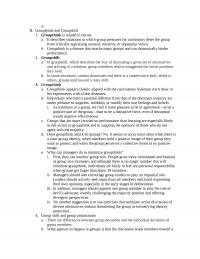
a. B. Groupthink and Groupshift 1. Groupthink is related to norms. performance. 2. Groupshift a. In groupshift, which describes the way of discussing a given set of alternatives and arriving at a solution, group members tend to exaggerate the initial […]
978-0134729329 Chapter 9 Lecture Note Part 3
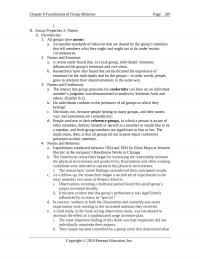
Chapter 9 Foundations of Group Behavior Page i. II. Group Properties 2: Norms A. Introduction 1. All groups have norms circumstances. 2. Norms and Emotions a. A recent study found that, in a task group, individuals’ emotions influenced the group’s […]
978-0134729329 Chapter 9 Lecture Note Part 2
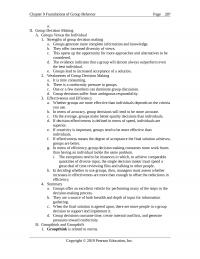
Chapter 9 Foundations of Group Behavior Page a. II. Group Decision Making A. Groups Versus the Individual 1. Strengths of group decision making considered. d. The evidence indicates that a group will almost always outperform even the best individual. e. […]
978-0134729329 Chapter 9 Lecture Note Part 1
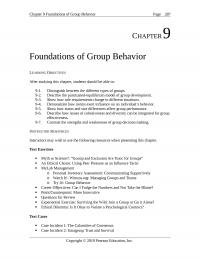
Chapter 9 Foundations of Group Behavior Page CHAPTER 9 Foundations of Group Behavior LEARNING OBJECTIVES After studying this chapter, students should be able to: 9-1. Distinguish between the different types of groups. 9-2. Describe the punctuated-equilibrium model of group development. […]
978-0134729329 Chapter 8 Solution Manual
Chapter 8 Motivation: From Concepts to Applications Page Questions For Review 8-1. How does the job characteristics model motivate employees? Answer: The job characteristics model is the Hackman and Oldham’s concept information on performance. The way elements in a job […]
978-0134729329 Chapter 8 Lecture Note Part 3
Chapter 8 Motivation: From Concepts to Applications Page i. II. Using Benefits to Motivate Employees A. Flexible Benefits: Developing a Benefits Package 1. Flexible benefits individualize rewards by allowing each employee to choose situation. 2. Flexible benefits can accommodate differences […]
978-0134729329 Chapter 8 Lecture Note Part 2
Chapter 8 Motivation: From Concepts to Applications Page a. II. Using Intrinsic Rewards to Motivate Employees A. Employee Recognition Programs 1. Organizations are increasingly recognizing that important work rewards can be both intrinsic and extrinsic. a. Rewards are intrinsic in […]
978-0134729329 Chapter 8 Lecture Note Part 1
Chapter 8 Motivation: From Concepts to Applications Page Chapter 8 Motivation: From Concepts to Applications LEARNING OBJECTIVES After studying this chapter, students should be able to: environment. 8-2. Compare the main ways jobs can be redesigned. 8-3. Explain how specific […]
978-0134729329 Chapter 7 Solution Manual
Chapter 7 Motivation Concepts Page 215 Questions for Review 7-1. What are the three key elements of motivation? Answer: Motivation is the processes that account for an individual’s intensity, Learning Objective: Describe the three key elements of motivation Learning Outcome: […]
978-0134729329 Chapter 7 Lecture Note Part 4
Chapter 7 Motivation Concepts Page 215 1. II. Job Engagement 1. Job engagement: the investment of an employee’s physical, cognitive, and emotional energies into job performance. or finding it interesting drives performance. 2. Many studies attempt to measure this deeper […]
978-0134729329 Chapter 7 Lecture Note Part 3
Chapter 7 Motivation Concepts Page 215 a) B. Goal-Setting Theory 2. Goals tell an employee what needs to be done and how much effort is needed. 3. Evidence strongly suggests that specific goals increase performance, that difficult goals, when accepted, […]
978-0134729329 Chapter 7 Lecture Note Part 2
Chapter 7 Motivation Concepts Page 215 i. V. Equity Theory/Organizational Justice inequities. (Exhibit 7-6) 1. If we perceive our ratio to be equal to that of the relevant others with whom we compare ourselves, a state of equity is said […]
978-0134729329 Chapter 7 Lecture Note Part 1
Chapter 7 Motivation Concepts Page 215 Chapter 7 Motivation Concepts LEARNING OBJECTIVES After studying this chapter, students should be able to: 7-1. Describe the three key elements of motivation. 7-2. Compare the early theories of motivation. 7-3. Contrast the elements […]
978-0134729329 Chapter 6 Solution Manual
Chapter 6 Perception and Individual Decision Making Page Questions for Review 6-1. What are the factors that influence our perception? AACSB: Reflective thinking 6-2. What is attribution theory? Answer: Attribution theory suggests that when we observe an individual’s behavior, we […]
978-0134729329 Chapter 6 Lecture Note Part 3
Chapter 6 Perception and Individual Decision Making Page a. 2. Cultural differences a. The rational model makes no acknowledgment of cultural differences, nor does the bulk of OB research literature on decision making. b. We need to recognize that the […]
978-0134729329 Chapter 6 Lecture Note Part 2
Chapter 6 Perception and Individual Decision Making Page a) II. What about Ethics in Decision Making? A. Introduction 1. Ethical considerations should be an important criterion in organizational decision making. B. Three Ethical Decision Criteria consequences. 2. Focus on rights—calls […]
978-0134729329 Chapter 6 Lecture Note Part 1
Chapter 6 Perception and Individual Decision Making Page CHAPTER 6 Perception and Individual Decision Making LEARNING OBJECTIVES After studying this chapter, your students should be able to: 6-1. Explain the factors that influence perception. 6-2. Describe attribution theory. 6-3. Explain […]
978-0134729329 Chapter 5 Solution Manual
Chapter 5 Personality and Values Page Questions for Review 5-1. What is personality? How do we typically measure it? What factors determine personality? AACSB: Reflective thinking 5-2. What are the strengths and weaknesses of the Myers-Briggs Type Indicator (MBTI) and […]
978-0134729329 Chapter 5 Lecture Note Part 3
Chapter 5 Personality and Values Page a. II. Cultural Values A. Hofstede’s Framework for Assessing Cultures 1. Five value dimensions of national culture: a. Power distance: the degree to which people in a country accept that power in institutions and […]
978-0134729329 Chapter 5 Lecture Note Part 2
Chapter 5 Personality and Values Page EXPANDED CHAPTER OUTLINE I. Personality A. What Is Personality? with others. 2. Measuring personality a. The most important reason managers need to know how to measure personality is that research has shown personality tests […]
978-0134729329 Chapter 5 Lecture Note Part 1
Chapter 5 Personality and Values Page CHAPTER 5 Personality and Values LEARNING OBJECTIVES After studying this chapter, students should be able to: 5-1. Describe personality, the way it is measured, and the factors that shape it. personality framework and the […]
978-0134729329 Chapter 4 Solution Manual
Chapter 4 Emotions and Moods Page Questions for Review 4-1. How are emotions different from moods? Answer: Emotions are intense feelings directed at someone or something. Moods are as joy and gratitude, and those with a negative affect, such as […]
978-0134729329 Chapter 4 Lecture Note Part 3
Chapter 4 Emotions and Moods Page Myth or Science? “Smile, and the Work World Smiles with You” This exercise contributes to: Learning Objective: Differentiate between emotions and moods of office politics. Research on the “boss effect” suggests that the amount […]
978-0134729329 Chapter 4 Lecture Note Part 2
Chapter 4 Emotions and Moods Page EXPANDED CHAPTER OUTLINE I. What Are Emotions and Moods? A. Introduction and encompasses both emotions and moods. 2. Emotions are intense, discrete, and short lived feeling experiences that are often caused by a specific […]
978-0134729329 Chapter 4 Lecture Note Part 1
Chapter 4 Emotions and Moods Page CHAPTER 4 Emotions and Moods LEARNING OBJECTIVES After studying this chapter, students should be able to: 4-1. Differentiate between emotions and moods. 4-2. Identify the sources of emotions and moods. 4-3. Show the impact […]
978-0134729329 Chapter 3 Solution Manual
Questions for Review 3-1. What are the three components of attitudes? related, particularly cognition and affect. As a manager, you need to understand how attitudes are formed and the relationship to actual job behavior. Learning Objective: Contrast the three components […]
978-0134729329 Chapter 3 Lecture Note Part 3
Chapter 3 Attitudes and Job Satisfaction Page An Ethical Choice Office Talk This exercise contributes to: components of human resource practices AACSB: Ethical understanding and reasoning You are peacefully at work in your cubicle when your coworker invades your space, […]
978-0134729329 Chapter 3 Lecture Note Part 2
Chapter 3 Attitudes and Job Satisfaction Page EXPANDED CHAPTER OUTLINE I. Attitudes A. Introduction concerning objects, people, or events. 2. They reflect how you feel about something. B. What Are the Main Components of Attitudes? 1. Three components of an […]
978-0134729329 Chapter 3 Lecture Note Part 1
Chapter 3 Attitudes and Job Satisfaction Page CHAPTER 3 Attitudes and Job Satisfaction LEARNING OBJECTIVES After studying this chapter, students should be able to: 3-1. Contrast the three components of an attitude. 3-2. Summarize the relationship between attitudes and behavior. […]
978-0134729329 Chapter 2 Solution Manual
Chapter 2 Diversity in Organizations Page 1 Questions for Review 2-1. What are the two major forms of workplace diversity? Answer: The two major forms of workplace diversity are surface level diversity and deep progressively more important for determining similarity […]
978-0134729329 Chapter 2 Lecture Note Part 3
Chapter 2 Diversity in Organizations Page 42 An Ethical Choice Affirmative Action for Unemployed Veterans This exercise contributes to: discrimination undermines organizational effectiveness Learning Outcomes: Describe the factors that influence the formation of individual attitudes and values; Apply the study […]
978-0134729329 Chapter 2 Lecture Note Part 2
Chapter 2 Diversity in Organizations Page 42 1. II. Biographical Characteristics A. Introduction 2. Start with factors that are readily available in an employee’s personnel file. There is a sizable amount of research on these factors. B. Age 1. Age […]
978-0134729329 Chapter 2 Lecture Note Part 1
Chapter 2 Diversity in Organizations Page 42 CHAPTER 2 Diversity in Organizations LEARNING OBJECTIVES After studying this chapter, students should be able to: 2-1. Describe the two major forms of workplace diversity. 2-2. Demonstrate how workplace discrimination undermines organizational effectiveness. […]
978-0134729329 Chapter 18 Solution Manual
Chapter 18 Organizational Change and Stress Management Page Questions for Review 18-1. What is the difference between the forces for change and planned change? Answer: Planned changes are the activities that are proactive and purposeful: an is accidental in nature. […]
978-0134729329 Chapter 18 Lecture Note Part 5
Chapter 18 Organizational Change and Stress Management Page a. B. Organizational Approaches demands—can be controlled by management. 2. Strategies to consider include improved employee selection and job placement, training, realistic goal-setting, redesign of jobs, increased employee involvement, improved organizational communication, […]
978-0134729329 Chapter 18 Lecture Note Part 4
Chapter 18 Organizational Change and Stress Management Page a. II. Stress at Work A. Introduction 1. Exhibit 18-7 shows work is, for most people, the most important source of stress in life. B. What Is Stress? 1. Stress is a […]
978-0134729329 Chapter 18 Lecture Note Part 3
Chapter 18 Organizational Change and Stress Management Page a. B. Overcoming Resistance to Change 1. Communication a. Resistance can be reduced on two levels through communicating to help employees see the logic of a change. 2. Participation participated. b. Prior […]
978-0134729329 Chapter 18 Lecture Note Part 2
Chapter 18 Organizational Change and Stress Management Page 1. B. Simulating a Culture of Innovation 1. Definition of innovation netbook computers, to radical breakthroughs, such as Nissan’s electric Leaf car. 2. Sources of innovation a. Structural variables are the most […]
978-0134729329 Chapter 18 Lecture Note Part 1
Chapter 18 Organizational Change and Stress Management Page Chapter 18 Organizational Change and Stress Management LEARNING OBJECTIVES After studying this chapter, students should be able to: 18-1. Contrast the forces for change and planned change. 18-2. Describe ways to overcome […]
978-0134729329 Chapter 17 Solution Manual
Questions for Review 17-1. What is the value of various recruitment methods? evaluate the roles they may be occupying. The most effective recruiters use a variety of online tools, including jobs boards and social media, to bring in applications. Learning […]
978-0134729329 Chapter 17 Lecture Note Part 4
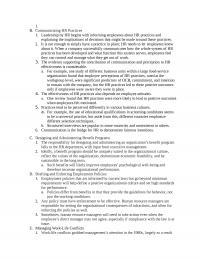
1. B. Communicating HR Practices 2. It is not enough to simply have a practice in place; HR needs to let employees know about it. When a company successfully communicates how the whole system of HR practices has been developed […]
978-0134729329 Chapter 17 Lecture Note Part 3
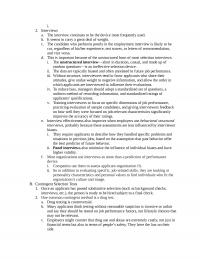
i. 2. Interviews a. The interview continues to be the device most frequently used. b. It seems to carry a great deal of weight. c. The candidate who performs poorly in the employment interview is likely to be cut, regardless […]
978-0134729329 Chapter 17 Lecture Note Part 2
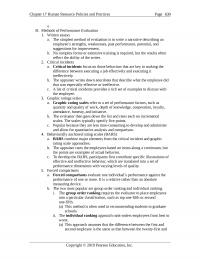
Chapter 17 Human Resource Policies and Practices Page a. B. Methods of Performance Evaluation 1. Written essays suggestions for improvement. b. No complex forms or extensive training is required, but the results often reflect the ability of the writer. 2. […]
978-0134729329 Chapter 17 Lecture Note Part 1
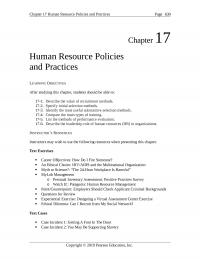
Chapter 17 Human Resource Policies and Practices Page Chapter 17 Human Resource Policies and Practices LEARNING OBJECTIVES After studying this chapter, students should be able to: 17-1. Describe the value of recruitment methods. 17-2. Specify initial selection methods. 17-3. Identify […]
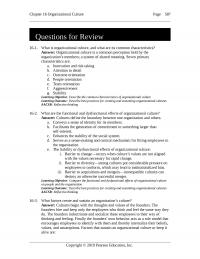
978-0134729329 Chapter 16 Solution Manual
Chapter 16 Organizational Culture Page 587 Questions for Review 16-1. What is organizational culture, and what are its common characteristics? AACSB: Reflective thinking 16-2. What are the functional and dysfunctional effects of organizational culture? Answer: Cultures define the boundary between […]
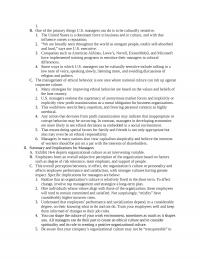
978-0134729329 Chapter 16 Lecture Note Part 4
1. B. One of the primary things U.S. managers can do is to be culturally sensitive. influence comes a reputation. 2. “We are broadly seen throughout the world as arrogant people, totally self-absorbed and loud,” says one U.S. executive. 3. […]
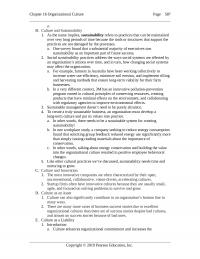
978-0134729329 Chapter 16 Lecture Note Part 3
Chapter 16 Organizational Culture Page 587 a. B. Culture and Sustainability 1. As the name implies, sustainability refers to practices that can be maintained sustainability as an important part of future success. 2. Social sustainability practices address the ways social […]
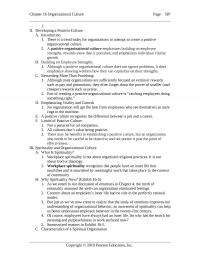
978-0134729329 Chapter 16 Lecture Note Part 2
Chapter 16 Organizational Culture Page 587 1. II. Developing a Positive Culture A. Introduction organizational culture. 2. A positive organizational culture emphasizes building on employee strengths, rewards more than it punishes, and emphasizes individual vitality growth. B. Building on Employee […]
978-0134729329 Chapter 16 Lecture Note Part 1
Chapter 16 Organizational Culture Page 587 Chapter 16 Organizational Culture LEARNING OBJECTIVES After studying this chapter, students should be able to: 16-1. Describe the common characteristics of organizational culture. people and the organization. 16-3. Identify the factors that create and […]
978-0134729329 Chapter 15 Solution Manual
Chapter 15 Foundations of Organization Structure Page 543 Questions for Review 15-1. What are seven key elements to define an organization’s structure? 15-2. What are the characteristics of the functional, divisional, and matrix structures? Answer: The functional structure groups employees […]