Archives: Solution Manual
978-1305645349 Chapter 1 Part 2
20 corresponding to units of study, or they can be written for term projects, which may take the place of a final examination. Projects can take many forms—research papers, interviews, dramatic productions, surveys, journals. There are two advantages to such […]

978-1305645349 Chapter 1 Part 1
Instructor’s Resource Manual to Accompany A d l e r a n d P r o c t o r ’ s LOOKING OUT/LOOKING IN F I F T E E N T H E D I T I O […]
978-1305580985 Chapter 3
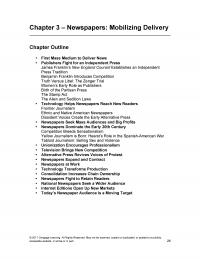
© 2017 Cengage Learning. All Rights Reserved. May not be scanned, copied or duplicated, or posted to a publicly accessible website, in whole or in part. 26 Chapter 3 – Newspapers: Mobilizing Delivery Chapter Outline • First Mass Medium to […]
978-1305403581 Part 11
CLOSING ACTIVITY: The Communication Web Page Storyboard Purpose/Objective: This exercise allows students to define salient issues and topics in communication by constructing a storyboard of a web page devoted exclusively to communication happenings, news, and features. To give students direction […]
978-1305403581 Part 10
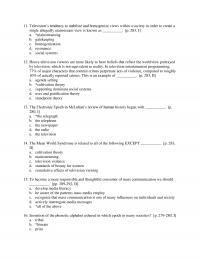
11. Television’s tendency to stabilize and homogenize views within a society in order to create a e. social systems 12. Heavy television viewers are more likely to have beliefs that reflect the worldview portrayed by television, which is not equivalent […]
978-1305403581 Part 9
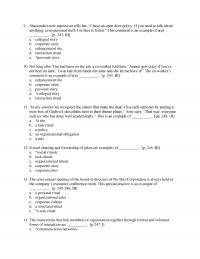
9. Shawanda’s new supervisor tells her, “I have an open door policy. If you need to talk about anything, even personal stuff, I’m here to listen.” This comment is an example of a(n) __________. [p. 243, III] a. collegial story […]
978-1305403581 Part 8
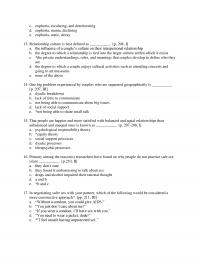
c. euphoria, escalating, and deteriorating d. euphoria, mania, declining e. euphoria, static, decay 13. Relationship culture is best defined as __________. [p. 204, I] a. the influence of a couple’s culture on their interpersonal relationship 14. One big problem experienced […]
978-1305403581 Part 7
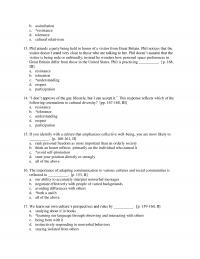
e. cultural relativism 13. Phil attends a party being held in honor of a visitor from Great Britain. Phil notices that the visitor doesn’t stand very close to those who are talking to her. Phil doesn’t assume that the visitor […]
978-1305403581 Part 6
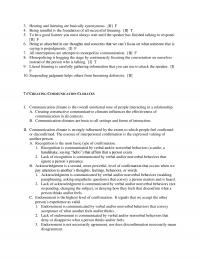
3. Hearing and listening are basically synonymous. [II] F 5. To be a good listener you must always wait until the speaker has finished talking to respond. [II] F 6. Being so absorbed in our thoughts and concerns that we […]
978-1305403581 Part 5
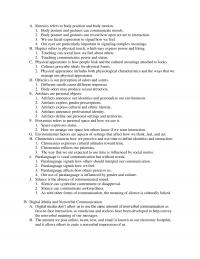
D. Olfactics is our perception of odors and scents. 1. Different smells cause different responses. 2. Body odors may produce sexual attraction. E. Artifacts are personal objects. 1. Artifacts announce our identities and personalize our environment. 2. Artifacts express gender […]
978-1305403581 Part 4
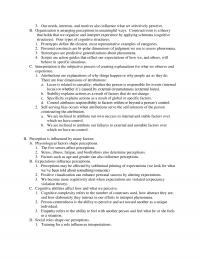
3. Our needs, interests, and motives also influence what we selectively perceive. B. Organization is arranging perceptions in meaningful ways. Constructivism is a theory that holds that we organize and interpret experience by applying schemata (cognitive structures). Four types of […]
978-1305403581 Part 3
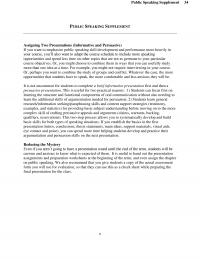
Public Speaking Supplement 34 PUBLIC SPEAKING SUPPLEMENT Assigning Two Presentations (Informative and Persuasive) If you want to emphasize public speaking skill development and performance more heavily in your course, you’ll also want to adapt the course schedule to include more […]

978-1305403581 Part 2
Sample Journal Entry Journal Entry for Chapter 6 Reprinted with permission of Jeremy Losee Mindfulness, as it is stated in the book occurs when we decide to focus on what is happening in the moment. Also when someone is mindful, […]
978-1305403581 Part 1
INSTRUCTOR’S RESOURCE MANUAL FOR JULIA T. WOOD’S COMMUNICATION MOSAICS: AN INTRODUCTION TO THE FIELD OF COMMUNICATION Eighth Edition Ronald J. Shope Grace University, Omaha, NE Julia T. Wood University of North Carolina-Chapel Hill [insert cities] [insert copyright page] iii Wadsworth/Cengage […]
978-1285445854 Chapter 18
108 Chapter 18 SPEAKING ON SPECIAL OCCASIONS A common form of public speaking includes a variety of short speeches that provide an integrative function in organizational settings. One way to give students practice in special occasion speaking is to require […]
978-1285445854 Chapter 17
104 Chapter 17 PERSUASIVE SPEAKING Chapter Goals At the end of this chapter, your students should be able to: • Find a subject for a persuasive speech • Decide on a claim of fact, value, or policy • Diagram and […]
978-1285445854 Chapter 16
98 Chapter 16 FOUNDATIONS OF PERSUASION In the 1950s the British writer, Dorothy Sayers, lamented that we were sending unprepared young people into a world in which they’d be bombarded with massive amounts of information. Imagine her concerns if she […]
978-1285445854 Chapter 15
92 Chapter 15 INFORMATIVE SPEAKING Most professors assign at least one informative speech, so the chapter begins with guidelines for analyzing and adapting to the level of understanding the audience brings to the speech. It describes how to give speeches […]
978-1285445854 Chapter 14
84 Chapter 14 DELIVERING YOUR SPEECH This chapter focuses on what many identify as their greatest public speaking worry—actually performing the speech. Good delivery requires the management of nonverbal behaviors, the display of skills such as eye contact, vocal variation, […]
978-1285445854 Chapter 13
78 Chapter 13 PRESENTATION AIDS In a media-saturated culture this chapter is essential. People generally learn and remember better when the ideas they hear are presented with visual, and sometimes audio, as well as verbal support. Because this chapter focuses […]
978-1285445854 Chapter 12
69 Chapter 12 CHOOSING EFFECTIVE LANGUAGE This chapter provides a blend of theory and application in a way that most students enjoy. I like socio-linguistics and was fascinated with Raymond Gozzi’s book New Words and a Changing American Culture; I […]
978-1285445854 Chapter 11
65 Chapter 11 OUTLINING YOUR SPEECH This is the final installment in the nuts-and-bolts series of skills chapters. Some students drag their feet when confronted with the task of crafting a written outline that represents their speech’s structure. However, students […]
978-1285445854 Chapter 10
61 Chapter 10 INTRODUCTIONS AND CONCLUSIONS This is another in the “how to” series of chapters that provide students with fundamental skills for speech construction. I like to think of the audience as being in a mental world that’s removed […]
978-1285445854 Appendix a
110 Appendix A SPEAKING IN SMALL GROUPS Some instructors definitely want material on small group presentations. Others simply have no time for this topic. This appendix includes information on the advantages and disadvantages of groups and then guides students through […]
978-1285445854 Chapter 9
56 Chapter 9 ORGANIZING YOUR MAIN POINTS If you’ve gone through the chapters in order, your students are now sitting at their desks, topics firmly in mind, various bits of evidence scattered in front of them. They’re about half way […]
978-1285445854 Chapter 8
51 Chapter 8 CHOOSING SUPPORTING MATERIALS This chapter is so closely linked to the previous one that it’s hard to separate them. In fact, when I initially outlined the first edition, I considered and reconsidered whether to rearrange the order […]
978-1285445854 Chapter 7
45 Chapter 7 RESEARCHING YOUR SPEECH IN THE DIGITAL AGE In the years since the first edition came out, we’ve witnessed an explosion of information available electronically. (The first manuscript went to the editor in December of 1993; this means […]
978-1285445854 Chapter 6
38 Chapter 6 AUDIENCE ANALYSIS To maintain the dialogical theme of the text, this chapter emphasizes the speaker’s view of the audience and the audience’s view of the speaker. Effective speakers understand what motivates audiences and adapt their messages accordingly. […]
978-1285445854 Chapter 5
33 Chapter 5 SELECTING YOUR TOPIC AND PURPOSE This chapter is devoted to the skills of identifying an appropriate topic and deciding on a specific purpose and central idea. Additional materials in Chapter 17 provide more guidance on topic selection—one […]
978-1285445854 Chapter 4
25 Chapter 4 EFFECTIVE LISTENING To participate in dialogical communication, students must be savvy, yet responsible listeners as well as speakers. Let’s face it; we spend infinitely more time listening than we do giving speeches. The chapter opens with a […]
978-1285445854 Chapter 3
18 Chapter 3 ETHICS IN A DIVERSE SOCIETY Diversity often divides people whose core beliefs, values, attitudes, and cherished behaviors vary significantly; individuals and groups deal with diversity in both unproductive and productive ways. Fortunately, leading communication scholars offer several […]
978-1285445854 Chapter 2
10 Chapter 2 GIVING YOUR FIRST SPEECH: DEVELOPING CONFIDENCE This chapter provides an overview of the speechmaking process. Because public speaking is almost always a humanities or liberal arts course, I introduce classical terminology relating to the canons of rhetoric. […]
978-1285445854 Chapter 1
1 Public Speaking: Concepts and Skills for a Diverse Society 8TH Edition INSTRUCTOR’S MANUAL Boost your students’ confidence in speaking publicly and their performance with the new MindTap V2.0 for Public Speaking: Concepts and Skills for a Diverse Society, 8th […]
978-1319102852 Chapter 16 Part 5
470 The First Amendment (1998, 20 minutes). The history and text of the First Amendment, with a series of experts discussing and interpreting the amendment’s freedoms and boundaries. Distributed by Films for the Humanities and Sciences, 800-322-8755; http://films.com. The Theories […]
978-1319102852 Chapter 16 Part 4
451 that publication via the Internet could mean instant global distribution and perpetual existence. (See the cases of former U.S. representatives Anthony Weiner and Chris Lee about how embarrassing photos of oneself can be globally distributed and endure forever.) Twitter […]
978-1319102852 Chapter 16 Part 3
431 In the description phase, you will need to not only draw on your own experiences with social media but also research others’ experiences systematically. For example, you might do me. 1. I fear others have more rewarding experiences than […]
978-1319102852 Chapter 16 Part 2
411 This Film Is Not Yet Rated (2005, 97 minutes). Academy Award-nominated director Kirby Dick takes an incisive look at the Motion Picture Association of America, finds out who is on the secretive rating board, and documents the movie-rating process. […]
978-1319102852 Chapter 16 Part 1
391 Chapter 16 Legal Controls and Freedom of Expression In this chapter, we will: • Examine free-expression issues, focusing on the implications of the First Amendment for a 1. The Pentagon Papers Case 2. The Progressive Magazine Case variety of […]
978-1319102852 Chapter 15
371 Chapter 15 Media Effects and Cultural Approaches to Research In this chapter, we will: • Examine the evolution of media research over time • Focus on the two major strains of media research, investigating the strengths and limitations of […]
978-1319102852 Chapter 14 Part 2
353 • Bloggers are significantly affecting journalism by demanding more transparency from journalists and media outlets. Leading this conversation are bloggers such as Jeff Jarvis (http://buzzmachine.com; director of the Tow-Knight Center for Entrepreneurial Journalism at the City University of New […]
978-1319102852 Chapter 14 Part 1
334 Chapter 14 The Culture of Journalism: Values, Ethics, and Democracy In this chapter, we examine the changing news landscape and definitions of journalism. We will: • Explore the values underlying news and ethical problems confronting journalists • Investigate the […]
978-1319059491 Chapter 17
© 2018 Bedford/St. Martin’s. All rights reserved. Chapter 17 Persuasive Speaking CHAPTER OUTCOMES • Define the goals of persuasive speaking • Develop a persuasive topic and thesis • Build persuasive arguments specifically tailored for your intended audience • Explain three […]
978-1319059491 Chapter 16
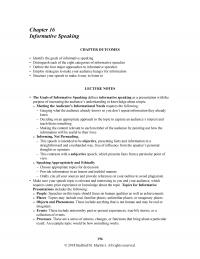
196 Chapter 16 Informative Speaking CHAPTER OUTCOMES • Identify the goals of informative speaking • Distinguish each of the eight categories of informative speeches • Outline the four major approaches to informative speeches • Employ strategies to make your audience […]
978-1319059491 Chapter 15
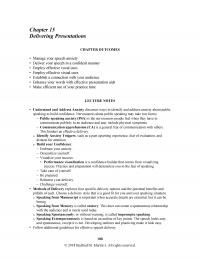
© 2018 Bedford/St. Martin’s. All rights reserved. Chapter 15 Delivering Presentations CHAPTER OUTCOMES • Manage your speech anxiety • Deliver your speech in a confident manner • Employ effective vocal cues • Employ effective visual cues • Establish a connection […]
978-1319059491 Chapter 14
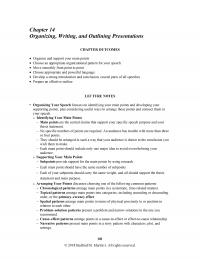
181 Chapter 14 Organizing, Writing, and Outlining Presentations CHAPTER OUTCOMES • Organize and support your main points • Choose an appropriate organizational pattern for your speech • Move smoothly from point to point • Choose appropriate and powerful language • […]
978-1319059491 Chapter 13
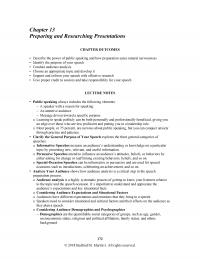
172 Chapter 13 Preparing and Researching Presentations CHAPTER OUTCOMES • Describe the power of public speaking and how preparation eases natural nervousness • Identify the purpose of your speech • Conduct audience analysis • Choose an appropriate topic and develop […]
978-1319059491 Chapter 12
© 2018 Bedford/St. Martin’s. All rights reserved. Chapter 12 Communicating in Organizations CHAPTER OUTCOMES • Describe and compare approaches to managing an organization • Describe ways in which organizational culture is communicated • Contrast relational contexts in organizations • Identify […]
978-1319059491 Chapter 11
© 2018 Bedford/St. Martin’s. All rights reserved. Chapter 11 Leadership and Decision Making in Groups CHAPTER OUTCOMES • Explain how a leader’s power, style, and personal qualities impact effectiveness • Identify how culture affects appropriate leadership behavior • List the […]
978-1319059491 Chapter 10
© 2018 Bedford/St. Martin’s. All rights reserved. Chapter 10 Communicating in Groups CHAPTER OUTCOMES • List the characteristics and types of groups and explain how groups develop • Describe ways in which group size, social relationships, and communication networks affects […]
978-1319059491 Appendix B
© 2018 Bedford/St. Martin’s. All rights reserved. Appendix B Mass and Mediated Communication CHAPTER OUTCOMES • Distinguish different types of communication • Explain how the business of media and the principle of free speech shape the kinds of media messages […]