Archives: Solution Manual
978-0393639032 Chapter 24
85 b. increased interest in choral singing D. Messiah 1. composed in 24 days, premiered in Dublin 2. performed continuously since its premiere 3. libretto: biblical verses, Old and New Testaments a. Christmas section: prophecy of the coming of Christ […]
978-0393639032 Chapter 23
82 Musical Sermons: Bach and the Lutheran Cantata CHAPTERfi23 7. output: prolific in secular and sacred works, suites, concertos, sonatas, keyboard music, cantatas a. St.fiJohn and St.fiMatthew Passions, The Well- Tempered Clavier, The Art of Fugue, Bran– denburg Concertos B. […]
978-0393639032 Chapter 22
79 CHAPTERfi22 Performing Grief: Purcell and Early Opera 2. from palace to public, widespread entertainment 3. first public opera house, Venice 4. accompanying orchestra ensemble became standard 5. Italian- style opera spread throughout Eu rope 6. turn of 18th century, […]
978-0393639032 Chapter 21
4. refrains bring back lines of text/music a. “My soul glorifies the Lord” b. “He has done great things for me” c. highly expressive, rich in word- painting 5. closes with doxology II. Barbara Strozzi and the Baroque Aria A. […]
978-0393639032 Chapter 20
59 a. collection of popu lar dance types b. ronde: originated as a country dance, circle or line dance 3. LG 9: Susato, Three Dances from Danserye (published 1551) a. three rondes, each in binary form (A- A- B- B) […]
978-0393639032 Chapter 19
56 c. incorporation of popu lar songs in Masses d. secular spirit in sacred music e. irreverent attitude of church musicians f. complex polyphony obscured the text 4. Council’s general recommendations: a. favored pure vocal style b. re spect integrity […]
978-0393639032 Chapter 18
53 B. Josquin des Prez (c. 1450–1521) 1. power ful influence on following generations 2. varied career: northern Eu rope, Italy, France a. courts in Milan, Ferrara b. papal choir in Rome c. returned to France, provost at Condé 3. […]
978-0393639032 Chapter 17
50 1. plea sure to amateur performers 2. grew in complexity 3. expanded to five or six voices C. Later madrigal (1580–1620) 1. extends into Baroque era 2. Claudio Monteverdi: influential, Renaissance- to- Baroque transitional composer III. Monteverdi and Vocal […]
978-0393639032 Chapter 16
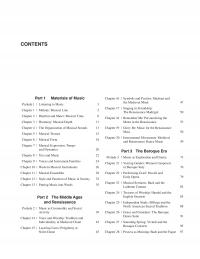
Chapter16 | Symbols and Puzzles: Machaut and the Medieval Mind 47 Chapter17 | Singing in Friendship: The Re nais sance Madrigal 50 Chapter18 | Remember Me: Personalizing the Motet in the Re nais sance 53 Chapter19 | Glory Be: Music […]
978-0393639032 Chapter 15
45 b. enhanced impor tant feast days c. became mark of distinction D. Gaude Maria virgo (Rejoice, Virgin Mary) 1. prayer in praise of the Virgin Mary a. in the style of Pérotin, possibly by him b. three– part polyphony […]
978-0393639032 Chapter 14
42 b. 3 phrases, each sung 3 times c. conjunct, wavelike d. neumatic, then melismatic III. Life and Music in the Medieval Monastery A. Monasteries, other religious communities 1. religious seclusion, available to men and women 2. devoted to prayer, […]
978-0393639032 Chapter 13
35 OVERVIEW Chapter13 introduces a variety of issues specific to writing about music, with a focus on the ways in which students can learn to support a discussion of their reaction to a piece with ele ments of musical analy […]
978-0393639032 Chapter 12
CHAPTERfi12 Style and Function of Music in Society OUTLINE I. Music Serves Dif fer ent Functions in Dif fer ent Socie ties A. Genres: categories of repertoire 1. sacred music: religious purposes 2. secular music: outside religious context, entertainment B. […]
978-0393639032 Chapter 11
29 3. jazz bands: instrumentation varies a. reed section: saxophones, clarinet b. brass section: trumpets and trombones c. rhythm section: percussion, piano, double bass, and electric guitar 4. rock bands: amplified guitars, percussion, and synthesizers V. The Role of the […]
978-0393639032 Chapter 10
26 3. oboe and bassoon families: double reed a. oboe, En glish horn, bassoon, contrabassoon 4. clarinet and saxophone families: single reed a. clarinet, bass clarinet, saxophone (metal) III. Brass Instruments (Aerophones) A. Cup– shaped mouthpiece attached to metal tubing, […]
978-0393639032 Prelude 7
261 II. Music in a Postmodern World A. Postmodern: definition is elusive 1. breaking away from modernist stance that mass media is incompatible with art a. technology: recordings available, hi- fi’s, tele- vi sions purchased, FM radio, MTV, YouTube 2. […]
978-0393639032 Prelude 6
a. Tin Pan Alley, street in Manhattan b. popu lar music writers/publishers set up business c. Irving Berlin: most successful Tin Pan Alley composer D. Between Two Wars: Music in the Great Depression 1. Roaring 20s: growth of radio, film […]
978-0393639032 Prelude 5
3. short- lived optimism, doubt, disenchantment D. Romantic mood 1. eternal longing 2. regret for lost happiness of childhood 3. discontent, pessimism E. Romantic themes 1. conflict between individual and society 2. glamorization of the past 3. strangeness and won […]
978-0393639032 Prelude 4
111 1. elegant, lyrical melodies a. symmetrical four– bar phrases, clear– cut cadences b. clarity: repetition, sequence; balanced structure 2. diatonic harmonies; homophonic texture 3. basic meters, steady tempos 4. frequent use of folk and popu lar ele ments 5. […]
978-0393639032 Prelude 3
2. religion in New World a. Protestant refugees settle on East Coast of North Amer i ca b. Catholic Spanish and French colonies 3. Martin Luther, call for religious reform 4. Counter– Reformation: Catholic response F. Artists in society 1. […]
978-0393639032 Prelude 2
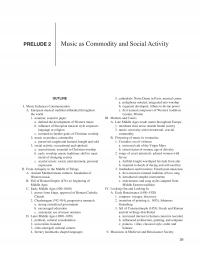
5. cathedrals: Notre Dame in Paris, musical center a. polyphony notated, integrated into worship b. organum developed, tribute to divine power c. first named composers of Western tradition: Léonin, Pérotin III. Markets and Courts A. Late Middle Ages: trade routes […]
978-0393639032 Prelude 1
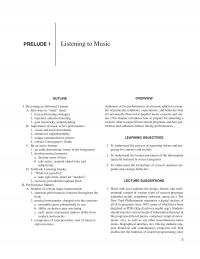
OVERVIEW Audiences at live per for mances of art music adhere to a num– ber of par tic u lar traditions, expectations, and be hav iors that are not usually observed at popu lar music concerts and ven- ues. This […]
978-0393639032 Chapter 9
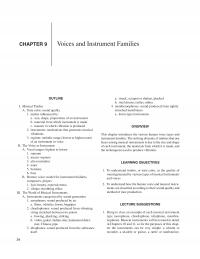
24 a. struck, scraped or shaken, plucked b. steel drums, rattles, mbira 4. membranophones: sound produced from tightly stretched membranes a. drum- type instruments OVERVIEW This chapter introduces the vari ous human voice types and instrument families. The striking diversity […]
978-0393639032 Chapter 8
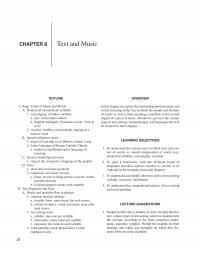
22 OVERVIEW In this chapter we explore the relationship between music and words, focusing on the way in which the sounds and rhythms of words as well as their meanings contribute to the overall impact of a piece of music. […]
978-0393639032 Chapter 7
20 2. directions to change dynamics a. crescendo: growing louder b. decrescendo or diminuendo: growing softer c. sforzando (sf): accent III. Tempo and Dynamics as Ele ments of Expression A. Tempo and dynamic markings 1. shape expressive content 2. indications […]
978-0393639032 Chapter 6
18 a. in early Western church music b. African, Native American, and African American cultures 2. ostinato: short repeated musical pattern a. unifying technique b. blues, jazz, rock, and rap D. Movement: term for a complete, in de pen dent […]
978-0393639032 Chapter 5
15 B. Strict imitation 1. canon: each voice enters in succession with the same melody 2. round: perpetual canon (e.g., Row, Row, Row Your Boat) OVERVIEW The intermingling of melody and harmony provides the basis of musical texture. More specifically, […]
978-0393639032 Chapter 4
13 1. pentatonic: five- note scale a. African, Asian, Native American musics 2. tritonic: three– note pattern a. music of some African cultures 3. microtones: intervals smaller than half step a. inection: brief microtonal dip from original pitch V. The […]
978-0393639032 Chapter 3
11 1. resolution: relaxation, fulfillment C. Year 900: approximate date harmony introduced in Western music 1. perception of dissonance changes over time D. Asian cultures, Eu ro pean folk music: relatively simple harmonies 1. drone: single sustained tone OVERVIEW Harmony— […]
978-0393639032 Chapter 2
8 B. Polyrhythm: simultaneous conicting rhythmic patterns 1. drum ensembles from Ghana, Uganda 2. gamelan music of Indonesia C. Additive rhythms: grouping of irregular numbers of beats 1. beats add up to larger pattern, e.g. 2 + 3 + 3 […]
978-0393639032 Chapter 1
5 a. can be inconclusive or conclusive (analogous to comma and period, respectively) 3. rhyme scheme: ending of text lines coincide with musical phrase structure 4. climax: high point in melodic line a. peak in intensity, range 5. countermelody: secondary […]
978-0393617467 MLA Guide Part 3
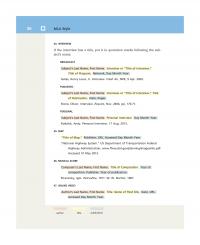
MLA Style 36 44. INTERVIEW If the interview has a title, put it in quotation marks following the sub- ject’s name. BROADCAST Subject’s Last Name, First Name. Interview or “Title of Interview.” Title of Program, Network, Day Month Year. Stone, […]
978-0393617467 MLA Guide Part 2
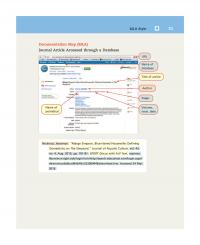
MLA Style 21 Documentation Map (MLA) Pages Volume, issue, date Author Name of periodical Neuhaus, Jessamyn. “Marge Simpson, Blue-Haired Housewife: Defi ning Domesticity on The Simpsons.” Journal of Popular Culture, vol. 43, no. 4, Aug. 2010, pp. 761-81. SPORT Discus […]
978-0393617467 MLA Guide Part 1
1 MLA style calls for (1) brief in-text documentation and (2) complete bib- liographic information in a list of works cited at the end of your text. The models and examples in this chapter draw on the eighth edition of […]
978-0393617467 Lecture Note Part 19
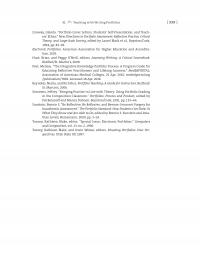
31 % Teaching with Writing Portfolios [ 339 ] Conway, Glenda. “Portfolio Cover Letters, Students’ Self– Presentation, and Teach- ers’ Ethics.” New Directions in Portfolio Assessment: Refl ective Practice, Critical Theory, and Large- Scale Scoring, edited by Laurel Black et […]
978-0393617467 Lecture Note Part 18
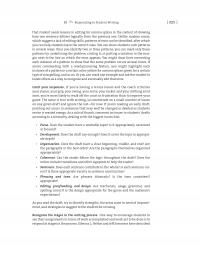
30 % Responding to Student Writing [ 325 ] that student needs lessons in editing for comma splices in the context of showing how one sentence follows logically from the previous one. Unlike random errors, which suggest a lack of […]
978-0393617467 Lecture Note Part 17
28 % Teaching for Inclusion and Diversity [ 305 ] to successfully complete the tasks and assignments. Here are three instructional interventions that consistently help students with learning disabilities (and other students as well) to improve their writing abilities, and […]
978-0393617467 Lecture Note Part 16
24 % Teaching Writing Online [ 285 ] Provide students with adequate and detailed information about policies and procedures for using the online tools. Step- by- step written instructions for turn- ing in assignments, completing tests and quizzes, participating in […]
978-0393617467 Lecture Note Part 15
[ 265 ] WRITING IS A FORM OF LEARNING. As we write, we generate thoughts we wouldn’t have had if we hadn’t put pen to paper or fi n gers to keyboard. In our own writing as well as our […]
978-0393617467 Lecture Note Part 14
[ 245 ] YOU MAY REMEMBER most vividly your upper– division courses, which were prob ably a mix of lecture and discussion. As a new teacher of writing, however, you’re faced with a dif fer ent situation, a course in […]
978-0393617467 Lecture Note Part 13
[ 225 ] 14 % Teaching with the Tumblr 2. The humor of Wilkinson’s cartoon lies mostly in what the man says, but another critical ele ment involves his companion— what she is doing and how she responds to his […]
978-0393617467 Lecture Note Part 12
13 % Teaching the Readings [ 205 ] MARK DAWIDZIAK Walking Dead Opens in Lively Fashion 1. The major criteria for Dawidziak’s review appear in the third paragraph, where Dawidziak refers to “nerve- jangling suspense, grand gross outs, intriguing char– […]
978-0393617467 Lecture Note Part 11
12 % Part VII: Design and Delivery [ 185 ] We suggest discussing this chapter on or near the last day of class. Talk about ending the term on a high note and making connections between students’ self- sponsored writing […]
978-0393617467 Lecture Note Part 10
10 % Part V: Research [ 165 ] to be made between types of sources: primary or secondary? scholarly or popu lar? older/historical or current? Because our students have had some diffi culty with both fi nding and discerning acceptable […]
978-0393617467 Lecture Note Part 9
8 % Part III: Genres of Writing [ 145 ] Reviewers— whether ordinary people deciding whether they like a product or critics deciding whether they like a cultural production— are in the business of making judgments. Making judgments is always […]
978-0393617467 Lecture Note Part 8
8 % Part III: Genres of Writing [ 125 ] learn to look closely and critically at something (the rhe toric of verbal or visual text, a data set, a pro cess, etc.) to identify its component parts and determine […]
978-0393617467 Lecture Note Part 7
7 % Part II: Writing Pro cesses [ 105 ] early and to avoid the busiest times around assignment deadlines. You will want to consult the director of the writing center fi rst, and then ask your students to sign […]
978-0393617467 Lecture Note Part 6
[ 85 ] When students feel confi dent that they can express themselves well, their curiosity is unleashed and encouraged to grow and develop. Part VI, Style, and Part VII, Design and Delivery, encourage students to communicate with confi dence. […]
978-0393617467 Lecture Note Part 5
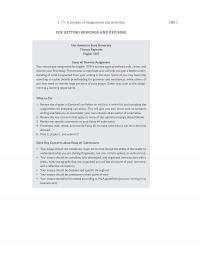
[ 65 ] FOR GETTING RESPONSE AND REVISING Northwestern State University Thomas Reynolds En glish 1010 Essay #1 Rewrite Assignment Your next major assignment for En glish 1010 is to once again proofread, edit, revise, and rewrite your rst […]
978-0393617467 Lecture Note Part 4
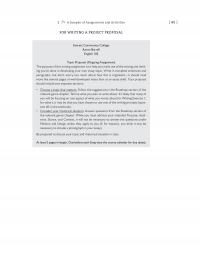
[ 45 ] FOR WRITING A PROJ ECT PROPOSAL Everett Community College Aaron Barrell En glish 102 Topic Proposal (Ongoing Assignment) The purpose of this writing assignment is to help you make use of the writing and think- ing you’ve […]