
13 % Teaching the Readings [ 205 ]
MARK DAWIDZIAK
Walking Dead Opens in Lively Fashion
1. The major criteria for Dawidziak’s review appear in the third paragraph, where
Dawidziak refers to “nerve- jangling suspense, grand gross outs, intriguing char–
acter study, razor– sharp dialogue, heart– thumping action, psychologically rivet–
ing moral dilemmas, state- of– the- art monster makeup and scream– inducing
special effects.” Dawidziak does not emphasize all criteria equally. His review
own stylistic preferences. Pos si ble responses include that the use of ellipses
creates a colloquial tone, that it marks a pause in the sentence, or that it creates
suspense leading up to a punch line.
3. Dawidziak anticipates criticism of (or indifference to) The Walking Dead in
several ways. He raises this possibility in the second paragraph. This recog-
nition appears again in ¶8 when Dawidziak mentions a diffi cult situation
that the characters face, saying that “it sure doesn’t look like there’s any way
disagree.
4. Dawidziak makes his review relatable for readers who may not be familiar
with the show by providing summaries and essential information that would
be helpful to such readers. His discussion of the criteria for evaluating this
5. Essay
JUNOT DÍAZ
The Money
1. Responses will vary. Students may respond that Díaz’s narrative talks about
the importance of maintaining family ties, the fi ckleness of justice, the
p. 908
p. 912

[ TEACHING THE READINGS ]
[ 206 ]
ethical challenges presented by poverty, or that the story opens a win dow
into the unique hardships of the immigrant experience.
and setting, and a narrative persona. Had he stuck to standard En glish, Díaz
might have been able to describe his community, but the experience would
not seem as au then tic and immersive.
3. Díaz’s use of the second– person pronoun “you” helps the story achieve a
4. This is a potentially diffi cult question since it asks readers to look beneath
the surface of the short story. As readers of the story, we know two things. One
is that for the mother, sending money home to her parents was desperately
impor tant. Díaz says in the fi rst paragraph that his mother’s “remittances,
beyond material support, were a way, I suspect, for Mami to negotiate the
5. Essay
BARBARA EHRENREICH
Serving in Florida
1. A preferred response is that the voices combine very effectively. In her wait–
ress voice, Ehrenreich puts the readers right into the situation, so that it is nearly
2. Responses will vary; the greatest likelihood is that Ehrenreich’s experience
will be considered typical of, or even somewhat better than, current condi-
tions in similar workplaces.
p. 917

13 % Teaching the Readings [ 207 ]
4. The main point is that the minimum wage is not suffi cient for even a meager
subsistence, and that workers who must rely on minimum- wage work are not
very likely to ever be able to improve their lot, even with discipline and hard
work. This point is most clearly stated in ¶22 and ¶24. Responses to the ques-
5. Essay
DAVID FREEDMAN
How Junk Food Can End Obesity
1. Freedman’s basic argument is that the solutions favored by advocates like Bitt–
man work well for high- middle and upper– class persons, but not for the work–
ing or unemployed poor. His proposal focuses on what is pos si ble and most
2. Responses to the question will vary. Some students may have resisted Freed-
man’s manner of describing poor people and obese people as they read; others
may not have recognized this as an issue until they read this question. Either
way, it seems clear that, whether consciously or unconsciously, Freedman is not
including poor people and obese people as members of the audience for this
essay. His attitude toward these groups might be characterized as well– meaning
but somewhat patronizing. Instead, the essay is directed toward middle- and
3. Responses to this question will vary in terms of how persuasive each student
fi nds Freedman’s article to be. Freedman’s article is lengthy, and it includes a
variety of reasons and evidence. Some of the most notable are: the signifi cant
p. 931

[ TEACHING THE READINGS ]
[ 208 ]
that Americans face today; his citation of research that suggests that simply
persuading people to eat unpro cessed food will not solve the obesity prob lem;
and his analy sis of efforts that are already occurring within the fast– food
distort these authors’ views. They might also cite on- the- ground initiatives—
such as urban community gardens, SNAP- funded support of purchases at farm–
ers markets, and other urban gardening and cooking initiatives— that, while
hardly effecting large- scale change, are making a difference.
4. Responses will vary. Many students will be drawn to a fairly simplistic answer:
I do or do not pay attention to calorie count information on menus. Try inviting
them to think beyond this simple binary to consider more complex questions. If
5. Essay
LARRY GORDON
Wikipedia Pops Up in Biblio graphies and Even College Assignments
1. Responses will vary. Depending on what students have been told about Wiki-
pedia in the past, what their own experiences with it have been, and even
how you as an instructor have advised them to use it or not, they might fi nd
Gordon’s argument easier or harder to accept. Those who are persuaded by Gor–
practices; and from trends he observes in college classrooms across the country.
He pres ents other viewpoints near the end of his article in ¶26–28, stating that
“some skepticism remains.”
3. Responses will vary. Many will agree that Gordon remains objective, but
others might fi nd his report unbalanced in that it pres ents many more positive
p. 952

13 % Teaching the Readings [ 209 ]
4. Responses to this question will vary, but most students will agree in general
with the idea that they need to prepare for a future of digital information.
Their understanding of the specifi cs related to this future may be limited, so
your class discussion might helpfully draw this out, especially in relation to stu-
GERALD GRAFF
Hidden Intellectualism
1. Responses will vary on the question of how well evidence is presented. Graff’s
pre sen ta tion of both supporting and opposing views is generalized and abstract;
no specifi c author or source is cited other than Elvis Presley and Ned Laff, quoted
2. Responses will vary greatly. Students are likely to mention that they have
never been encouraged to take the themes of everyday life very seriously.
3. The likeliest (and preferred) response to the question of the identity of “we” is
that it refers to Graff and his fellow academics/professors; other possibilities
may be argued. Evidence includes the information in the headnote, the title of
the book from which this excerpt is taken, and the fact that Graff is talking con–
4. Responses will vary; valid arguments can be made with either choice. A likely
affi rmative response may conjecture that a student who learns to take an aca-
demic approach to anything will want to apply that approach to every thing (or
nearly every thing) and hence he or she might be drawn to seek out traditional
p. 957

[ TEACHING THE READINGS ]
[ 210 ]
ANDY HINDS
I’m Considering Becoming a Sports Fan— How Do I Pick a Team?
1. The three reasons Hinds lists are: family tradition, identifi cation with their com–
munity or region, and some ineffable attraction to the ethos or aesthetics of a
par tic u lar team. In discussing this question, you might invite students to list as
many additional reasons as they can why they follow a par tic u lar sports team.
2. Hinds pres ents evidence from his poll of friends on social media, stories his
friends tell of their own fandom, articles written on the topic, and his own per–
sonal experiences. Responses will vary as to whether Hinds has provided
enough or strong enough evidence for his claims.
3. Responses will vary, but most students will understand that Hinds’ use of
meta phors usually associated with romantic relationships is appropriate given
his goals and the journalistic nature of his essay. These meta phors call atten–
tion to the emotional/affective nature of many fans’ relationship with the
should choose a team. As his article is more of a general exploration (and a
somewhat humorous one at that) of sports fandom than an argument about
which team he should embrace, it is not essential that he conclude by fi nding
a team for himself, and failing to do so should not damage his point.
5. Essay
BELL HOOKS
Touching the Earth
1. Hooks is exhorting her readers, particularly her black readers, to renew their
relation to the earth in order to heal and recover themselves. Among the con-
crete steps she mentions is growing plants, especially for food, which can be
p. 963
p. 968

13 % Teaching the Readings [ 211 ]
3. Although the quotation from Berry is not explicit, “profi table diseases and
dependencies” (¶11) could refer to such conditions as hypertension, which has
a very high incidence among African Americans and is conventionally con–
trolled with drugs that must be taken daily for the rest of a person’s life. Hence,
such conditions are “profi table” for phar ma ceu ti cal companies, pharmacies,
4. Responses will vary, but a preferred response is that yes, the path described
by hooks could be a healing one for any group, especially one that is concen–
trated in an urbanized environment.
5. Essay
RYAN KOHLS
Clean Sweep
1. Most students will recognize that Kohls’ purpose in this profi le is to provide a
fi rsthand account of an experience that most of those attending sports events
in large stadiums typically don’t think about: the army of (poorly paid, often
makes sense for Kohls to focus on the experiences of those who are likely to
continue as stadium cleaners. Mentioning his own experience adds to his
ethos and credibility, but further discussion of his experience might weaken it.
3. Kohls’ attitude toward his former colleagues is, most would agree, respect–
ful. He focuses a good deal on Rosario Coutinho, who has risen from the
ranks to serve as the resident man ag er of the stadium. Early in her time at the
Rogers Centre, Coutinho returned a briefcase containing $10,000 in cash, and
Kohls praises her for doing so. But he also has empathy for other employees
4. Responses to this question might vary. Some students might argue that Kohls’
approach to this topic when addressing an audience of sports fans might not
vary. It would still make sense to encourage these fans to have empathy for the
workers who make their experience at stadiums like the Rogers Centre pos si ble.
p. 976

[ TEACHING THE READINGS ]
[ 212 ]
But for an audience of sports fans, Kohls could also have approached his topic
with more vivid contrasts of the stadium as they see it during sports games and
after hours when the cleaners work. He might also add in more particulars of the
TIM KREIDER
The “Busy Trap”
1. Responses will vary.
2. This question is more complicated than it fi rst appears. How students respond
to this question may depend upon their own situations. A student who is a
single parent, working twenty- fi ve hours a week, and taking a full load of
classes may fi nd Kreider’s tone snarky or in other ways unappealing. A stu-
dent who is from an upper– class family where busyness as Kreider describes
it is a fact of life for both parents and children may feel other wise. In respond-
ing to this question, it may be helpful to remind students about issues of
3. Admissions to his own laziness help Kreider maintain a humorous, self–
deprecating tone. To some, this might support his ethos and make him more
credible; to others, it might sound hypocritical and detract from his authority.
Responses will vary, but generally readers who pick up on his strand of humor
will not fi nd his admissions to detract from his credibility.
4. Responses to this question will vary.
5. Essay
JOHN MAEDA
On Meaningful Observation
1. The prob lem, as Maeda defi nes it, is the “disconnect between the words ‘innova-
tion’ and ‘art.’ ” That is, the “humanizing” touch that creative activity provides
p. 982
p. 987

13 % Teaching the Readings [ 213 ]
is required in order for the innovation to be truly worthwhile. Responses will
vary about how well he defi nes the prob lem; a preferred response might note
that he presumes a great deal of background knowledge about the cutting of
2. Maeda compares art to “true science” in order to highlight a common way of
thinking that involves curiosity, open- mindedness, creativity, and risk
taking— all of which underlie the very idea of innovation. The comparison is
3. Maeda does an excellent job of establishing his authority. In the second para-
graph, for instance, he identifi es himself as “a lifelong STEM student myself, with
degrees in electrical engineering and computer science from MIT.” In that same
paragraph he describes himself as a “geek.” In ¶3 his knowledge of the “technol-
4. Most students will easily understand why Maeda focuses on the arts’ contri–
bution to economic prosperity. Maeda recognizes, correctly, that at our cur–
rent cultural moment college students are worried (rightly) about their
ability to fi nd meaningful employment and to support themselves after
5. Essay
EMILY MARTIN
The Egg and the Sperm
1. Martin’s argument is that the traditional descriptions of egg and sperm echo
traditional gender ste reo types of women as passive and weak and of men as
active, strong, and dynamic. While acknowledging that a more “cybernetic”
approach is not without its own pitfalls, Martin proposes “substituting more
p. 991

[ TEACHING THE READINGS ]
[ 214 ]
2. As Martin states in footnote 2, “The textbooks I consulted are the main ones
used in classes for undergraduate premedical students or medical students (or
those held on reserve in the library for these classes) during the past few years
3. Martin describes how, in the nineteenth century, Malthus’s ideas about soci-
ety and Darwin’s about nature were tidy counterpoints to one another, allow–
ing Darwin’s ideas about natu ral se lection and survival of the fi ttest to be
4. Responses will vary as to how well Martin’s summary of traditional teaching
on the topic matches what students remember learning. As for whether stu-
dents had ever questioned this teaching or now think it should be questioned,
5. Martin was writing for an academic audience of scholars and students in
anthropology, gender studies, and cultural studies. For a general adult audi-
ence, she would not have needed to be so meticulous and precise about each
6. Essay
TRESSIE MCMILLAN COTTOM
The Logic of Stupid Poor People
1. Most students will recognize that this is a provocative title, but you may have
to help them understand the larger context that provokes a title like this— that
is, the common equating of poverty with laziness and a lack of intelligence, and
recent efforts to constrain and demean those who are the recipients of social
2. Most students will have no trou ble recognizing the investment meta phor at
work. Responses will vary as to how well the meta phor works, with the
p. 1011

13 % Teaching the Readings [ 215 ]
preferred response being that overall it is effective. One of the most striking
examples occurs when the author’s mother dresses in her fi nest clothes and
helps her neighbor accomplish in one after noon what she has spent a year try–
ing to achieve: getting benefi ts to care for the grand daughter she is raising.
Other examples include “the investment yield” that the author has experi–
3. Responses will vary. Students who want to resist McMillan Cottom’s argu–
ment may indeed argue that she needed to include more objective empirical
evidence. Others will fi nd that her use of personal experience gives power
4. The author distinguishes between “presentable” and “acceptable” in ¶7 and 8
of her blog entry. In ¶7 she defi nes presentable as being “the bare minimum of
social civility.” In contrast, “acceptable” is about gaining access to a limited set
of rewards granted upon group membership. Because our culture often views
JUDITH NEWMAN
To Siri, with Love
1. Newman specifi es a number of ways that her son’s interactions with Siri
have changed him. It has taught him to be more polite. It has encouraged him
to take greater care enunciating his words. It has given him the opportunity
to explore his intellectual passions. It has helped him to be more attentive to
social cues.
2. Newman uses humor to lighten what might other wise be a diffi cult and pain-
ful subject and to give insight into her son’s experience of autism. Her son’s
statement that he takes his iPhone with him to the Apple store so “it can visit
its friends” is humorous— but it also tells us something impor tant about how
p. 1017

[ TEACHING THE READINGS ]
[ 216 ]
responds, “Well, of course, I don’t know for certain. . . . But when you think
about it, you’ve just described half of Silicon Valley.” The humor in Newman’s
piece entertains, but it also paints a real and endearing picture of autism and
Siri’s quirky persona.
4. Newman draws on multiple sources of evidence including personal anecdote
and fi rsthand observation to humanize the topic, writings and experiences of
others who have experience with autism or personal assistants to broaden the
picture, and interviews with developers working on virtual assistant technol–
5. Essay
THE ONION
Nation Shudders at Large Block of Uninterrupted Text
1. Responses will vary, but the preferred response is that the information is
presented in a very journalistic manner and seems reliable. Sources are
3. Journalistic features include a spare and straightforward style with quota-
tions from named interviewees (“Boston resident Charlyne Thomson,” ¶4) and
precise details that lend credibility (“3:16 pm,” ¶5; “450 percent rise,” ¶6).
p. 1025

13 % Teaching the Readings [ 217 ]
STEVEN PINKER
Mind over Mass Media
1. Responses will vary. Those who claim he is not fair may point to his glib tone
(“cognitive neuroscientists roll their eyes,” ¶4) or suggest that he is setting up
straw man arguments (“conjugating Latin does not make you more logical,” ¶7).
3. The preferred response is that yes, Pinker was writing for an audience already
inclined to agree with him. The touches of humor have a “knowing wink” qual-
ity to them. His references to historical events and trends are written with a
inspired it is in ¶9: “The solution is not to bemoan technology but to develop
strategies of self– control, as we do with every other temptation in life.” In any
case, the title reinforces Pinker’s point that the workings of our brains are not
determined by the par tic u lar kinds of media that inform them.
5. Essay
MIKE ROSE
Blue- Collar Brilliance
3. Rose might have wanted to establish his familiarity with and re spect for blue-
collar work right from the beginning. The preferred response to the questions
about effectiveness is that this rhetorical strategy is effective because narra-
p. 1029
p. 1033

[ TEACHING THE READINGS ]
[ 218 ]
JAMES SANBORN
Weight Loss at Any Cost
1. Responses to this question will vary. Some students may feel that since San–
born devotes the bulk of his essay to prob lems with the body composition and
military appearance standards, his own position is critical of these standards.
They could argue that his shift to the standards’ supporters at the end is pri-
mation from the commandant’s offi ce, an explanation of the BCP and MAP
standards, interviews with several plastic surgeons and the developer of a
workout program called P90X, conversations with ser vice members, and items
from the news media. These sources seem appropriate for his purpose.
3. Sanborn uses military abbreviations such as BCP and MAP, but he always
explains these abbreviations the fi rst time he uses them. There are several other
terms that Sanborn does not explain. One is gunny, which is an informal term
4. Responses to this question will vary. Instructors might want to extend the
conversation by asking students if they are aware of ways in which college
students take drastic, possibly dangerous mea sures not to protect their careers
ERIC SCHLOSSER
Why McDonald’s Fries Taste So Good
1. Responses will vary; the preferred response is that the evidence does all tie in
to the subject of McDonald’s fries and that the analy sis is cohesive. All of the
evidence combines to demonstrate how our sense of taste is both trained
p. 1043
p. 1051

13 % Teaching the Readings [ 219 ]
2. Schlosser’s purpose in this excerpt is to increase readers’ consciousness
about the ingredients of fast foods and other pro cessed food items. There is no
explicit advocacy in the article of any par tic u lar stance or course of action; for
3. Responses will vary; likely responses are that appetite for fast foods has been
affected but that buying and eating habits will not be much affected because
article. Schlosser provides abundant evidence showing how complicated the
issues involved in food chemicals are and that there are no simple ways to eval-
uate them.
5. Essay
BRENT STAPLES
Why Colleges Shower Their Students with A’s
1. Responses will vary; plausible arguments can be made for both affi rmative
and negative responses, although the preferred response is affi rmative. Staples
touches on the motivations of all stakeholders— administrators, faculty, stu–
dents, and their families.
2. Responses will vary.
3. A preferred response is that Staples’ intended audience may have been adminis-
trators and faculty who potentially have the voice and the power to address
what he identifi es as a systemic prob lem in US higher education. Although
proposal to remedy the situation, which might be interpreted as implying his
endorsement of that proposal.
5. Essay
p. 1065

[ TEACHING THE READINGS ]
[ 220 ]
NEIL DEGRASSE TYSON
Cosmic Perspective
1. Most generally, Tyson argues that the cosmic perspective helps humans look
at their own lives and situations in an appropriate context. Doing so reminds
them “that uncounted people walk this Earth without food and shelter,” that
“ every day . . . people kill and get killed in the name of someone else’s con-
2. Responses will vary. Those familiar with Tyson will answer these questions
with a resounding yes. Others may feel differently. Instructors might want
to prepare a brief overview of Tyson’s life and career to help orient students. In
3. Repetition adds to the philosophical weight and authority of the essay— and
JOSE ANTONIO VARGAS
My Life as an Undocumented Immigrant
1. Other personal examples that highlight issues about US immigration policy
include Vargas’s naive attempt to get a driver’s license in high school, the dif–
fi culty he experienced applying to and paying for college, and his having to
2. The inclusion of the Tagalog references and language reminds readers that
however acclimated Vargas becomes to life in the United States, he is con-
stantly negotiating two languages and two worlds.
p. 1069
p. 1078

13 % Teaching the Readings [ 221 ]
4. The reference to Disneyland at the end of Vargas’s essay is ironic. Most people
ALICE WALKER
Oppressed Hair Puts a Ceiling on the Brain
1. Responses will vary, but several major points should emerge in a discussion
of this question. Given Walker’s audience— young black women who have
almost certainly dealt with issues about their hair— Walker is encouraging
them to liberate themselves from socially and culturally sanctioned notions
2. Students may or may not be aware that Spelman is a women’s college as well
as a historically black college, so you may want to share this information
with them before they read Walker’s essay. Walker establishes a tone of inti–
macy by beginning her talk with references to her own time as a student at
Spelman and by using a casual, conversational tone, as she does when she
refers to “our friend hair.” (Note the signifi cance of the pronoun.) Given her
3. Walker continues to anthropomorphize hair when she notes, for instance,
that her hair had its own “true self” and had a “willfulness” of its own. She
plant.” She returns to this meta phor later in the essay when she fi rst recognizes
that her personal and spiritual growth could not continue if she remained
“chained to thoughts about my hair,” characterizing that understanding as
allowing her to break “through the seed skin” and continue “on my way
p. 1088
[ TEACHING THE READINGS ]
[ 222 ]
upward through the earth.” She continues this meta phor in the conclusion to
her essay, where she declares that thanks to her change in attitude toward her
hair, “the plant was above the ground!” She thus weaves the evolution of her
thinking about her hair with the meta phor of the seed. Most students will

Introducing the Tumblr page for Every one’s an Author
Everyone’s an Author on Tumblr (everyonesanauthor . tumblr . com) is an exciting
and impor tant extension of our text. Every week, we post links to new readings,
each one accompanied by discussion questions and a writing prompt. Did we say
text. What’s more, all posts are searchable by genre (position, narrative, report, analy–
sis, review, proposal), theme (Home, Work, Identity and Self, Education, Food, Lan–
guage), and medium (text, audio, video, image), making it easy to fi nd an appropriate
post for any purpose. And the page is open access—no password or user key required.
A suggested class session using the Tumblr
Now, we know what follows would never really happen to you! But we offer it as
an example of our Tumblr’s fl exibility and usefulness. Let’s say life has gotten a
little hectic, your class meets tomorrow, and you have nothing prepared. Why not
select one of the ads or editorial cartoon posts on the Tumblr to work with? (Find
them by fi ltering for “image.”) Because the se lection doesn’t involve much reading
nation as necessary to make sure that every one has an equal understanding and
interpretation. The suggestions that follow employ both full– class discussion/activ-
ities as well as pair or small– group work to guide students through a thorough exam-
ination of the cartoon, its message, and rhetorical strategies, centered around the
fourteen
Teaching with the Tumblr
[ TEACHING THE READINGS ]
[ 224 ]
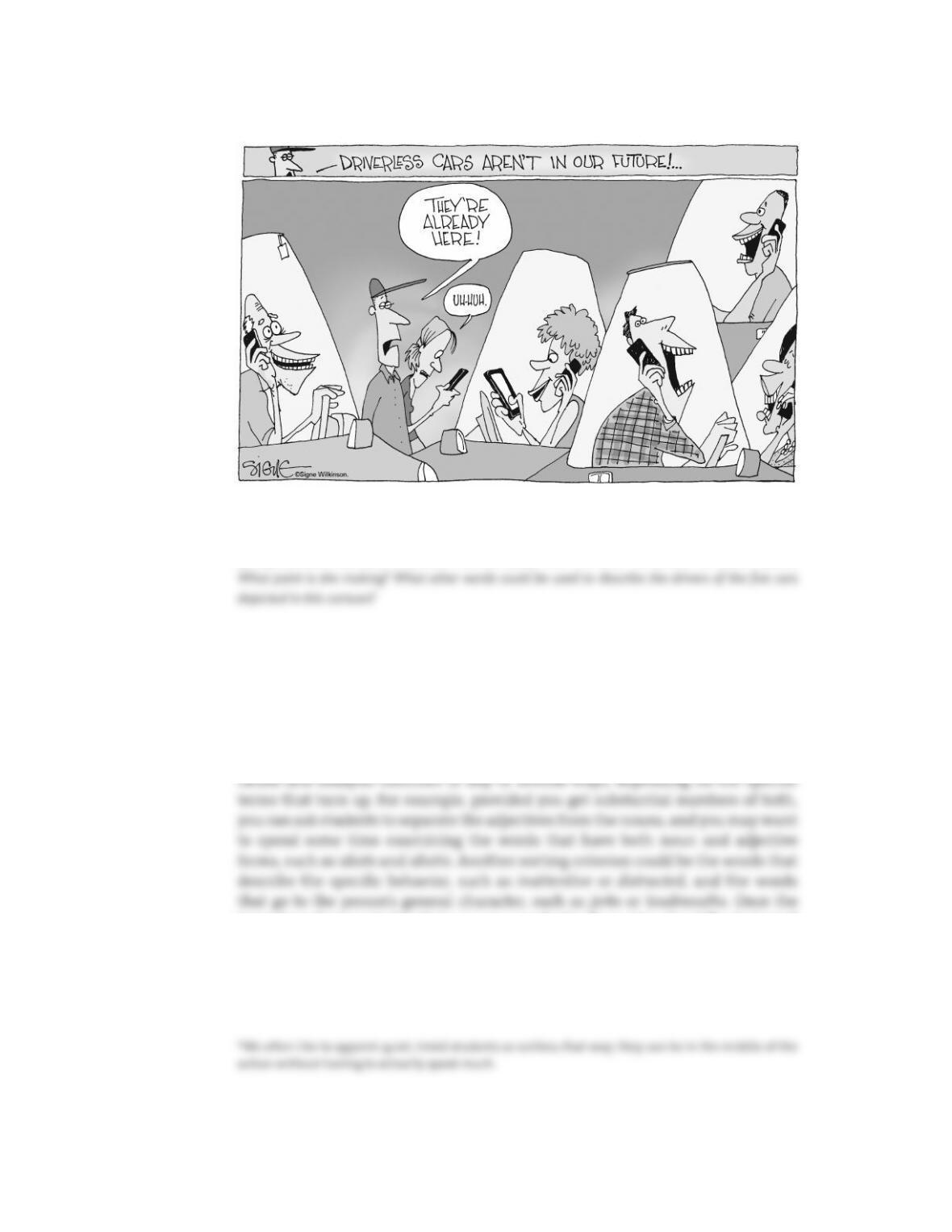
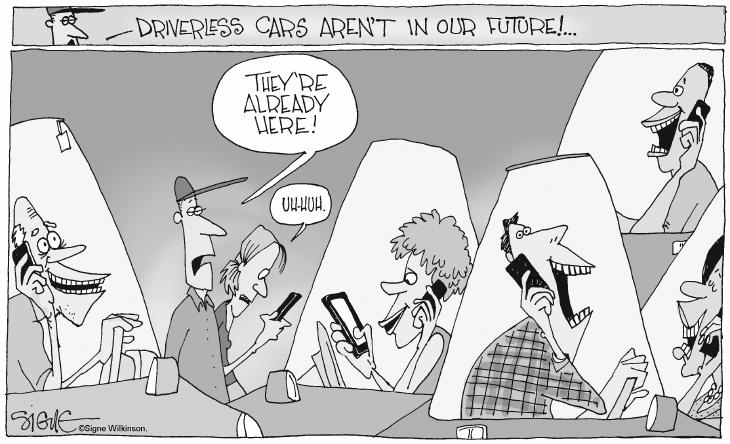
1. The driverless cars that Google and other companies are developing are driven not by humans but
by sophisticated software; Wilkinson’s cartoon plays with the term “driverless” to make a point.
The fi rst question does two things: fi rst, it elicits confi rmation of comprehen–
sion of the cartoon. That’s always a good place to start. Second, it asks for terms to
describe the drivers depicted in the drawing. With the whole group, come up with
terms and list them (or have a student scribe them†) on the blackboard. There are
numerous possibilities, of course; among the most likely are distracted, inattentive,
oblivious, careless, negligent, multitasking, loudmouthed, dangerous, talkative, idi-
otic, jerks, and a**holes. Once you have a good long list in view, you can do classifi –
terms have been sorted in that way, you can lead a discussion about the rhetorical
strategies, advantages, and disadvantages of each type of term. Another fruitful
use of the list may be an exploration of the connotations of each term. All of these
simple exercises serve to develop consciousness about grammar, word choice, and
style. There are many possibilities, and that’s just the fi rst question!