1
MLA style calls for (1) brief in-text documentation and (2) complete bib-
liographic information in a list of works cited at the end of your text. The
models and examples in this chapter draw on the eighth edition of the
A DIRECTORY TO MLA STYLE
In-Text Documentation 4
2. Author named in parentheses 5
4. Authors with the same last name 5
6. Organization or government as author 6
8. Literary works 7
10. Encyclopedia or dictionary 8
12. Sacred text 8
14. Two or more works cited together 9
16. Work without page numbers 9
17. An entire work or a one-page article 10
MLA Style
2. Two authors 14
4. Two or more works by the same author 15
6. No author or editor 15
8. Article in a journal 16
10. Article in a newspaper 20
12. Entry in a reference work 22
14. Letter to the editor 23
16. Comment on an online article 24
BOOKS AND PARTS OF BOOKS 24
18. Anthology 25
20. Multivolume work 27
22. Graphic narrative 28
MLA Style 3
24. Edition other than the first 28
26. Foreword, introduction, preface, or afterword 29
28. Paper at a conference 29
30. Entire website 30
32. Blog entry 32
34. Personal letter 32
36. Text message 33
38. Post to Twitter, Facebook, or other social media 33
AUDIO, VISUAL, AND OTHER SOURCES 34
40. Art 34
42. Supreme Court case 35
44. Interview 36
46. Musical score 36
48. Oral presentation 37
50. Radio program 37
52. TV show 38
53. Video game 38
Formatting a Research Paper 39
Sample Research Paper 40
Throughout this chapter, you’ll nd models and examples that are color
coded to help you see how writers include source information in their texts
IN-TEXT DOCUMENTATION
Brief documentation in your text makes clear to your reader what you
took from a source and where in the source you found the information.
In your text, you have three options for citing a source: quoting, para-
phrasing, and summarizing. As you cite each source, you will need to
decide whether or not to name the author in a signal phrase — “as Toni
1. AUTHOR NAMED IN A SIGNAL PHRASE
If you mention the author in a signal phrase, put only the page number(s)
in parentheses. Do not write page or p.
2. AUTHOR NAMED IN PARENTHESES
If you do not mention the author in a signal phrase, put his or her last
name in parentheses along with the page number(s). Do not use punctua-
tion between the name and the page number(s).
Whether you use a signal phrase and parentheses or parentheses only, try
to put the parenthetical documentation at the end of the sentence or as
close as possible to the material you’ve cited — without awkwardly inter–
3. TWO OR MORE WORKS BY THE SAME AUTHOR
If you cite multiple works by one author, include the title of the work you
are citing either in the signal phrase or in parentheses. Give the full title
if it’s brief; otherwise, give a short version.
Put a comma between author and title if both are in the parentheses.
Understanding power in the Near East requires “Western leaders who
4. AUTHORS WITH THE SAME LAST NAME
Give the author’s rst and last names in any signal phrase, or add the
author’s rst initial in the parenthetical reference.
MLA Style
6
5. TWO OR MORE AUTHORS
For a work with two authors, name both, either in a signal phrase or in
parentheses.
For a work by three or more authors, name the rst author followed by et al.
6. ORGANIZATION OR GOVERNMENT AS AUTHOR
Acknowledge the organization either in a signal phrase or in parentheses.
It’s acceptable to shorten long names.
The US government can be direct when it wants to be. For example, it
7. AUTHOR UNKNOWN
If you don’t know the author, use the work’s title or a shortened version
of the title in the parenthetical reference.
8. LITERARY WORKS
When referring to literary works that are available in many different edi-
tions, give the page numbers from the edition you are using, followed by
information that will let readers of any edition locate the text you are citing.
NOVELS. Give the page and chapter number, separated by a semicolon.
POEMS. Give the part and the line numbers (separated by periods). If a poem
has only line numbers, use the word line(s) only in the first reference.
Whitman sets up not only opposing adjectives but also opposing nouns
Whitman
10. ENCYCLOPEDIA OR DICTIONARY
Acknowledge an entry in an encyclopedia or dictionary by giving the
author’s name, if available. For an entry without an author, give the entry’s
title in parentheses. If entries are arranged alphabetically, no page number
is needed.
11. LEGAL AND HISTORICAL DOCUMENTS
For legal cases and acts of law, name the case or act in a signal phrase or
in parentheses. Italicize the name of a legal case.
In 2005, the Supreme Court confirmed in MGM Studios, Inc. v. Grokster,
Ltd. that peer-to-peer file sharing is copyright infringement.
The president is also granted the right to make recess appointments
(US Const., art. 2, sec. 2).
12. SACRED TEXT
When citing a sacred text such as the Bible or the Qur’an for the rst time,
give the title of the edition, and in parentheses give the book, chapter, and
M
GM Stu
d
ios, Inc. v. Gro
k
ster,
Ltd
.
art. 2, sec. 2
).
(
US Const.,
MLA Style 9
13. MULTIVOLUME WORK
If you cite more than one volume of a multivolume work, each time you
cite one of the volumes, give the volume and the page number(s) in paren-
theses, separated by a colon and a space.
MLA Style
10
Studies show that music training helps children to be better at multitask-
ing later in life (”Hearing the Music”).
For an audio or a video recording, give the hours, minutes, and seconds
(separated by colons) as shown on the player: (00:05-08:30).
17. AN ENTIRE WORK OR A ONE-PAGE ARTICLE
NOTES
Sometimes you may need to give information that doesn’t t into the text
itself — to thank people who helped you, to provide additional details, to
refer readers to other sources, or to add comments about sources. Such
information can be given in a footnote (at the bottom of the page) or an
TEXT
This essay will argue that small liberal arts colleges should not recruit
athletes and, more specifically, that giving student athletes preferential
treatment undermines the larger educational goals.1
publication
title
author
MLA Style 11
NOTE
1. I want to thank all those who have contributed to my thinking
on this topic, especially my classmates and my teacher Marian Johnson.
LIST OF WORKS CITED
Core Elements
The new MLA style provides a list of “core elements” for documenting
sources, advising writers to list as many of them as possible in the order
that MLA speci es. We’ve used these general principles to provide tem-
AUTHORS AND OTHER CONTRIBUTORS
• If there is one author, list the name last name rst: Morrison, Toni.
• If there are two authors, list the rst author last name rst and the
whose work you wish to highlight before the title, and list any others
you want to mention after the title. For contributors named before
the title, put the label after the name: Fincher, David, director. For
MLA Style
12
those named after the title, specify their role rst: directed by David
Fincher.
TITLES
• Include any subtitles and capitalize all the words in titles and subtitles
except for articles (a, an, the), prepositions (to, at, from, and so on), and
PUBLICATION INFORMATION
• Write publishers’ names in full, but omit words like Company or Inc.
DATES
• Whether to give just the year or to include the month and day depends
on the source. Give the full date that you nd there.
• For books, give the year of publication: 1948. If a book lists more than
one date, use the most recent one.
publication
title
author
MLA Style 13
• If an online source includes the time when it was posted or modi ed,
include the time along with the date: 18 Oct. 2005, 9:20 a.m.
LOCATION
• For online sources, give the URL, omitting http:// or https://. If a source
has a permalink, give that.
• For sources found in a database, give the DOI for any that have one.
Otherwise, give the URL.
PUNCTUATION
• Use a period after the author name(s) that start an entry (Morrison,
Toni.) and the title of the source you’re documenting (Beloved.)
• Use a comma between the author’s last and rst names: Morrison, Toni.
• Sometimes you’ll need to provide information about more than one
work for a single source — for instance, when you cite an article from
MLA Style
14
The guidelines below should help you document kinds of sources
you’re likely to use. The rst section shows how to acknowledge authors
and other contributors and applies to all kinds of sources — print, online,
Authors and Other Contributors
When you name authors and other contributors in your citations, you are
crediting them for their work and letting readers know who’s in on the con-
versation. The following guidelines for citing authors and other contribu-
tors apply to all sources you cite: in print, online, or in some other media.
1. ONE AUTHOR
2. TWO AUTHORS
1st Author’s Last Name, First Name, and 2nd Author’s First and Last
Names. Title. Publisher, Date.
3. THREE OR MORE AUTHORS
1st Author’s Last Name, First Name, et al. Title. Publisher, Date.
publication
title
author
4. TWO OR MORE WORKS BY THE SAME AUTHOR
Give the author’s name in the rst entry, and then use three hyphens in
the author slot for each of the subsequent works, listing them alphabeti-
cally by the rst important word of each title.
5. AUTHOR AND EDITOR OR TRANSLATOR
Author’s Last Name, First Name. Title. Role by First and Last Names,
Publisher, Date.
Austen, Jane. Emma. Edited by Stephen M. Parrish, W. W. Norton, 2000.
6. NO AUTHOR OR EDITOR
When there’s no known author or editor, start with the title.
The Turner Collection in the Clore Gallery. Tate Publications, 1987.
7. ORGANIZATION OR GOVERNMENT AS AUTHOR
Organization Name. Title. Publisher, Date.
Diagram Group. The Macmillan Visual Desk Reference. Macmillan, 1993.
For a government publication, give the name of the government rst, fol-
lowed by the names of any department and agency.
Stylebook on Religion 2000: A Reference Guide and Usage Manual.
Catholic News Service, 2002.
Articles and Other Short Works
Articles, essays, reviews, and other shorts works are found in journals,
magazines, newspapers, other periodicals, and books — all of which you
8. ARTICLE IN A JOURNAL
PRINT
Author’s Last Name, First Name. “Title of Article.” Name of Journal,
Volume, Issue, Date, Pages.
publication
title
author
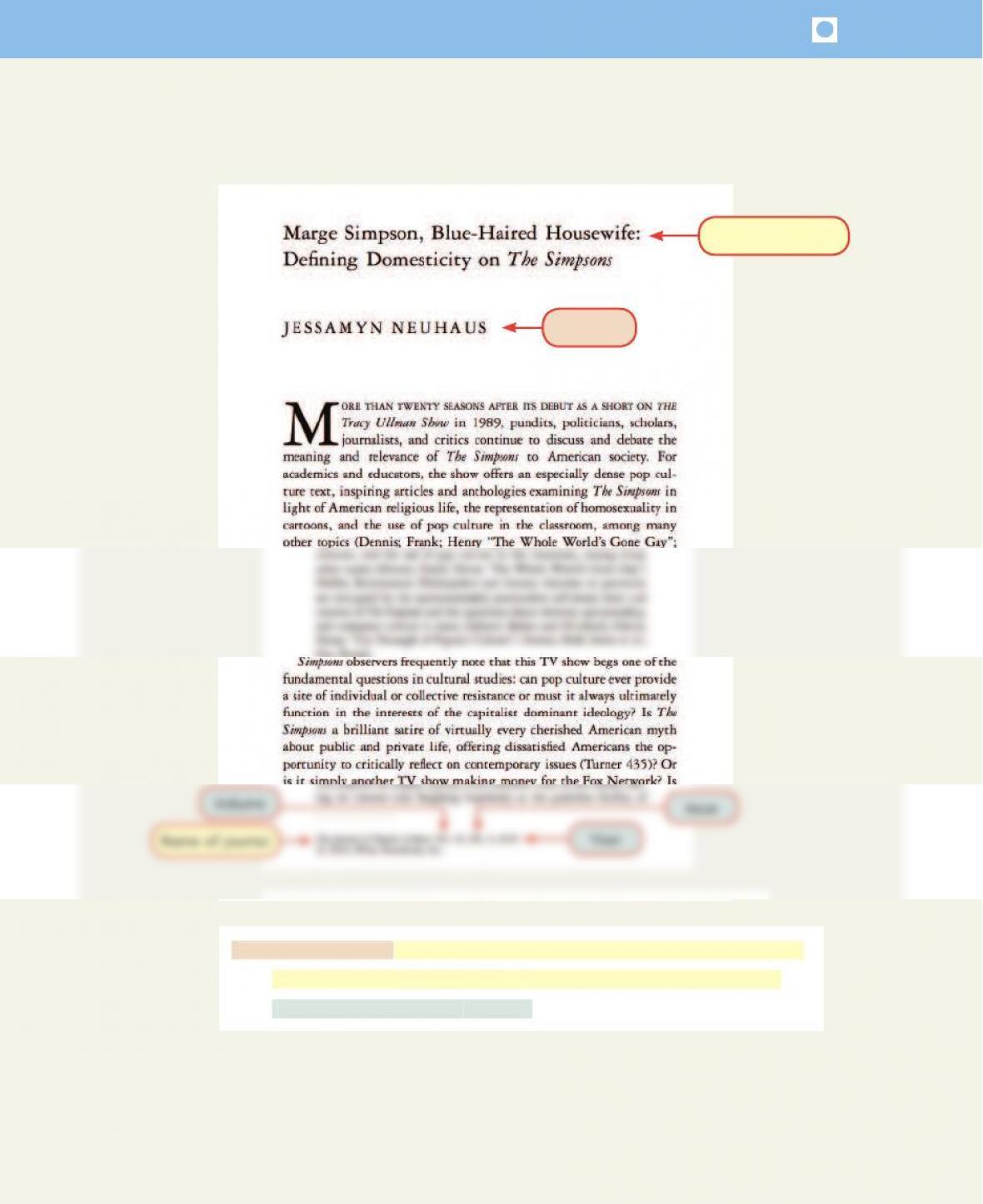
MLA Style 17
Documentation Map (MLA)
Article in a Print Journal
Title of article
Author
Volume Issue
Neuhaus, Jessamyn. “Marge Simpson, Blue-Haired Housewife: Defining
Domesticity on The Simpsons.” The Journal of Popular Culture,
vol. 43, no. 4, 2010, pp. 761-81.
Neuhaus, Jessam
y
n. “Mar
g
e Simpson, Blue-Haired Housewife: Definin
g
Domesticit
y
on
Th
e Sim
p
son
s
.”
The Journal o
f
Po
p
ular Culture,
vo
l
. 43, no. 4, 2010,
pp.
7
6
1-
8
1
.
MLA Style
18
Cooney, Brian C. “Considering Robinson Crusoe’s ‘Liberty of Conscience’
in an Age of Terror.” College English, vol. 69, no. 3, Jan. 2007,
pp. 197-215.
ONLINE
in Hamlet.” Early Modern Literary Studies, vol. 11, no. 3, Jan. 2006,
purl.oclc.org/emls/11-3/glechaml.htm. Accessed 31 Mar. 2015.
9. ARTICLE IN A MAGAZINE
PRINT
Author’s Last Name, First Name. “Title of Article.” Name of Magazine,
Date, Pages.
ONLINE
Author’s Last Name, First Name. “Title of Article.” Name of Magazine,
Date on web, Pages (if any), URL. Accessed Day Month Year.
publication
title
author
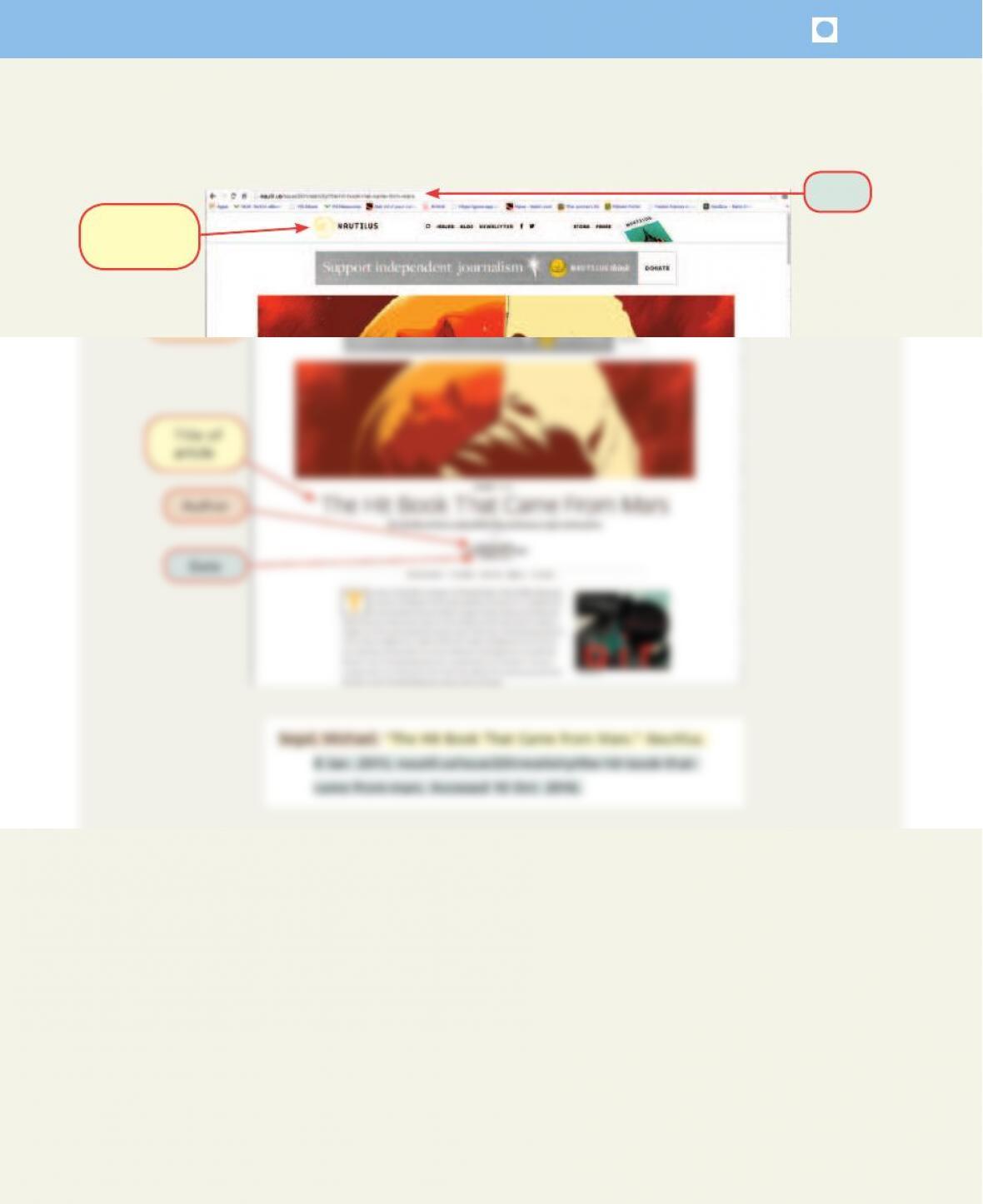
MLA Style 19
Documentation Map (MLA)
Article in an Online Magazine
Name of
magazine
Author
Date
Title of
article
URL
10. ARTICLE IN A NEWSPAPER
PRINT
Author’s Last Name, First Name. “Title of Article.” Name of Newspaper,
Date, Pages.
Saulny, Susan, and Jacques Steinberg. “On College Forms, a Question of
Race Can Perplex.” The New York Times, 14 June 2011, p. A1.
ONLINE
Author’s Last Name, First Name. “Title of Article.” Name of Newspaper,
Date on web, URL. Accessed Day Month Year.
Banerjee, Neela. “Proposed Religion-Based Program for Federal Inmates
Is Canceled.” The New York Times, 28 Oct. 2006, www.nytimes.
com/2006/10/28/us/28prison.html?_r=0. Accessed 4 Apr. 2015.
publication
title
author