MLA Style
36
44. INTERVIEW
If the interview has a title, put it in quotation marks following the sub-
ject’s name.
BROADCAST
Subject’s Last Name, First Name. Interview or “Title of Interview.”
Title of Program, Network, Day Month Year.
Stone, Oliver. Interview. Esquire, Nov. 2004, pp. 170-71.
PERSONAL
Subject’s Last Name, First Name. Personal interview. Day Month Year.
Roddick, Andy. Personal interview. 17 Aug. 2013.
45. MAP
“Title of Map.” Publisher, URL. Accessed Day Month Year.
46. MUSICAL SCORE
Composer’s Last Name, First Name. Title of Composition. Year of
47. ONLINE VIDEO
Author’s Last Name, First Name. Title. Name of Host Site, Date, URL.
Accessed Day Month Year.
publication
title
author
MLA Style 37
48. ORAL PRESENTATION
Presenter’s Last Name, First Name. “Title of Presentation.” Sponsoring
Institution, Date, Location.
49. PODCAST
If you accessed a podcast online, give the URL and date of access; if you
accessed it through a service such as iTunes or Spotify, indicate that instead.
Last Name, First Name, role. “Title of Episode.” Title of Program,
season, episode, Sponsor, Date, URL. Accessed Day Month Year.
50. RADIO PROGRAM
Last Name, First Name, role. “Title of Episode.” Title of Program, Station,
51. SOUND RECORDING
ONLINE
Last Name, First Name. “Title of Work.” Title of Album, Distributor, Date.
Name of Audio Service.
MLA Style
38
Simone, Nina. “To Be Young, Gifted and Black.” Black Gold, RCA Records,
1969. Spotify.
CD
52. TV SHOW
ORIGINAL BROADCAST
“Title of Episode.” Title of Show, role by First and Last Names,
season, episode, Network, Day Month Year.
DVD
“The Pants Tent.” 2003. Curb Your Enthusiasm: Season One, performance
by Larry David, season 1, episode 1, HBO Video, 2006, disc 1.
ONLINE
“Shadows in the Glass.” Marvel’s Daredevil, season 1, episode 8, Netflix,
53. VIDEO GAME
Last Name, First Name, role. Title of Game. Distributor, Date of release.
Gaming System or Platform.
publication
title
author
MLA Style 39
Metzen, Chris, and James Waugh, writers. StarCraft II: Legacy of the
Void. Blizzard Entertainment, 2015. OS X.
FORMATTING A RESEARCH PAPER
Page numbers. In the upper right-hand corner of each page, one-half
inch below the top of the page, include your last name and the page num-
ber. Number pages consecutively throughout your paper.
Font, spacing, margins, and indents. Choose a font that is easy to read
(such as Times New Roman) and that provides a clear contrast between regu-
lar and italic text. Double-space the entire paper, including your works
Long quotations. When quoting more than three lines of poetry, more
than four lines of prose, or dialogue between characters in a drama, set
In Eastward to Tartary , Kaplan captures ancient and contemporary
Antioch for us:
At the height of its glory in the Roman-Byzantine age, when it
had an amphitheater, public baths, aqueducts, and sewage pipes,
half a million people lived in Antioch. Today the population is
MLA Style
40
In the first stanza of Arnold’s “Dover Beach,” the exclamations make clear
that the speaker is addressing someone who is also present in the scene:
Come to the window, sweet is the night air!
Only, from the long line of spray
Be careful to maintain the poet’s line breaks. If a line does not t on one
line of your paper, put the extra words on the next line. Indent that line
an additional quarter inch (or two spaces).
Illustrations. Insert illustrations close to the text that discusses them.
For tables, provide a number (Table 1) and a title on separate lines above
the table. Below the table, provide a caption and information about the
source. For graphs, photos, and other figures, provide a figure number
(Fig. 1), caption, and source information below the figure. If you give only
SAMPLE RESEARCH PAPER
The following report was written by Dylan Borchers for a rst-year writing
course. It’s formatted according to the guidelines of the MLA (style.mla.org).
MLA Style 41
Against the Odds:
Harry S. Truman and the Election of 1948
Just over a week before Election Day in 1948, a New York
electoral votes and 21,991,291 popular votes (Donaldson 204-07).
In fact, many historians and political analysts argue that Truman
1
•
•
Title centered.
Double-spaced
1”
•
MLA Style
42
would have won by an even greater margin had third-party
Progressive candidate Henry A. Wallace not split the Democratic
vote in New York State and Dixiecrat Strom Thurmond not won four
states in the South (McCullough 711). Although Truman’s defeat
Borchers 2
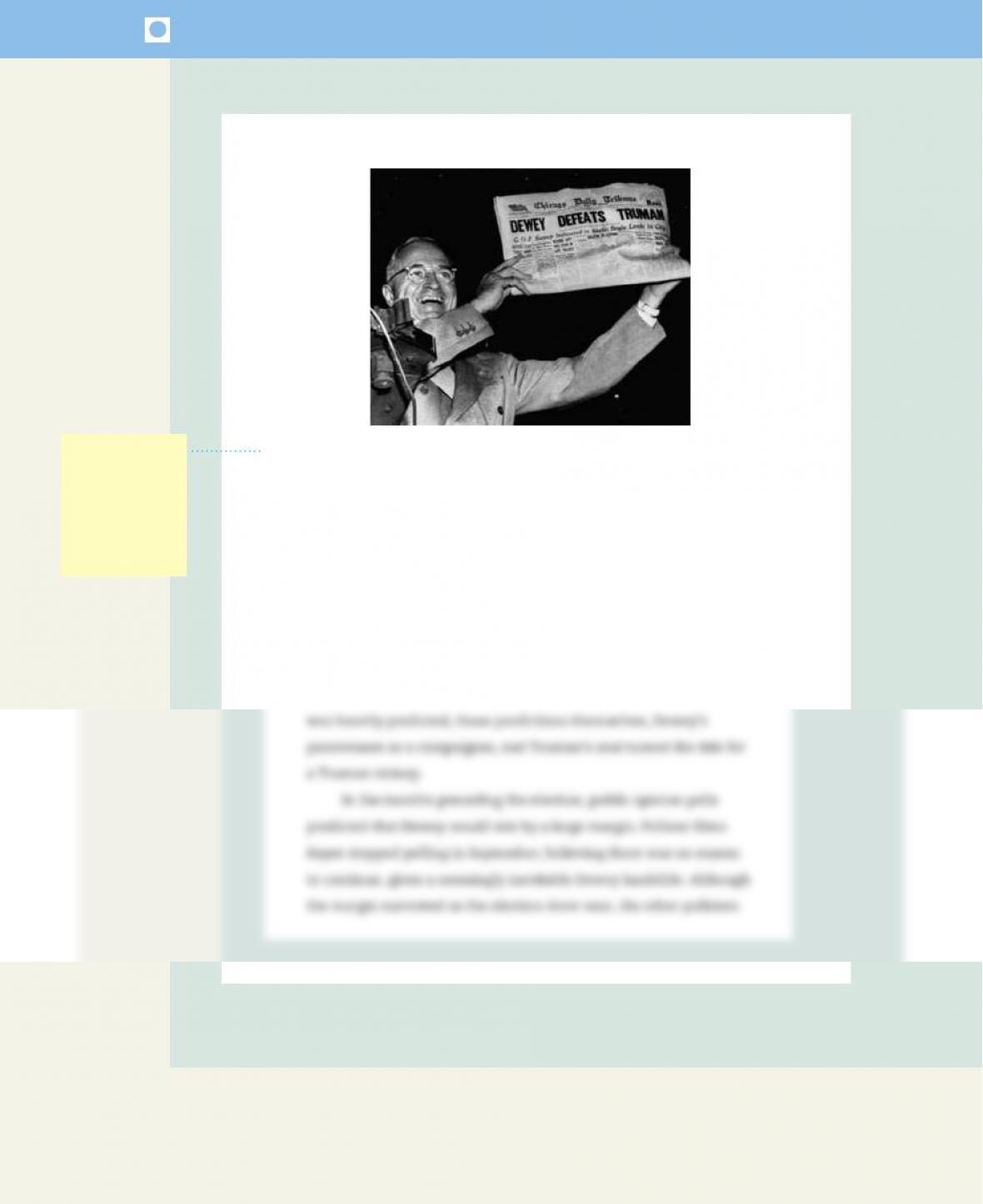
•Fig. 1. President Harry S. Truman holds up an edition of the Chicago
Daily Tribune that mistakenly announced “Dewey Defeats Truman”
(Rollins).
Illustration is
positioned close
to the text to
which it relates,
with figure
number, caption,
and parenthetical
documentation.
Borchers 3
predicted a Dewey win by at least 5 percent (Donaldson 209). Many
historians believe that these predictions aided the president in
the long run. First, surveys showing Dewey in the lead may have
prompted some of Dewey’s supporters to feel overconfident about
According to political analyst Samuel Lubell, those Democrats may
have saved Dewey from an even greater defeat (Hamby, Man 465).
Whatever the impact on the voters, the polling numbers had a
decided effect on Dewey.
no foolish mistakes. Dewey himself said, “When you’re leading,
don’t talk” (Smith 30). Each of Dewey’s speeches was well crafted
and well rehearsed. As the leader in the race, he kept his remarks
faultlessly positive, with the result that he failed to deliver a solid
message or even mention Truman or any of Truman’s policies.
Eventually, Dewey began to be perceived as aloof and stuffy. One
•
•
No signal phrase;
author and
page number in
parentheses.
MLA Style
44
Dewey insisted that his campaign not alter its course. Even Time
magazine, though it endorsed and praised him, conceded that
his speeches were dull (McCullough 696). According to historian
Zachary Karabell, they were “notable only for taking place, not for
any specific message” (244). Dewey’s numbers in the polls slipped
in the weeks before the election, but he still held a comfortable
Borchers 4
MLA Style 45
Borchers 5
the autumn of 1948, he wrote to his sister, “It will be the greatest
campaign any President ever made. Win, lose, or draw, people will
know where I stand” (91). For thirty-three days, Truman traveled
the nation, giving hundreds of speeches from the back of the
Ferdinand Magellan railroad car. In the same letter, he described the
campaign:
No President in history had ever gone so far in quest of
support from the people, or with less cause for the effort,
to judge by informed opinion. ... As a test of his skills and
judgment as a professional politician, not to say his stamina
and disposition at age sixty-four, it would be like no other
experience in his long, often difficult career, as he himself
He developed an energetic style, usually speaking from notes rather
than from a prepared speech, and often mingled with the crowds
that met his train. These crowds grew larger as the campaign
•
Quotations of
more than 4 lines
indented
}
1
2
}
inch
(5 spaces) and
double-spaced.
MLA Style
46
progressed. In Chicago, over half a million people lined the streets
as he passed, and in St. Paul the crowd numbered over 25,000.
When Dewey entered St. Paul two days later, he was greeted by
only 7,000 supporters (“1948 Truman-Dewey Election”). Reporters
brushed off the large crowds as mere curiosity seekers wanting to
The legacy and lessons of Truman’s whistle-stop campaign
continue to be studied by political analysts, and politicians today
often mimic his campaign methods by scheduling multiple visits
to key states, as Truman did. He visited California, Illinois, and
Ohio 48 times, compared with 6 visits to those states by Dewey.
magazine’s editors concluded that pollsters as well as reporters and
commentators were too convinced of a Dewey victory to analyze
the polls seriously, especially the opinions of undecided voters
(Karabell 256). Pollsters assumed that undecided voters would vote
in the same proportion as decided voters — and that turned out
Borchers 6
MLA Style 47
to be a false assumption (Karabell 257). In fact, the lopsidedness
of the polls might have led voters who supported Truman to
call themselves undecided out of an unwillingness to associate
After the election, many political analysts, journalists, and
historians concluded that the Truman upset was in fact a victory
for the American people, who, the New Republic noted, “couldn’t
be ticketed by the polls, knew its own mind and had picked the
rather unlikely but courageous figure of Truman to carry its banner”
(T.R.B. 3). How “unlikely” is unclear, however; Truman biographer
Dewey campaign, with its “packaged candidate who ran so as not to
lose, who steered clear of controversy, and who made a good show
of appearing presidential” (Karabell 266). The election of 1948 shows
that voters are not necessarily swayed by polls, but it may have
presaged the packaging of candidates by public relations experts, to
the detriment of public debate on the issues in future presidential
elections.
Borchers 7
et al.
MLA Style
48
Works Cited
campaigns-and-elections. Accessed 17 Mar. 2012.
– – -. Man of the People: A Life of Harry S. Truman. Oxford UP, 1995.
Holbrook, Thomas M. “Did the Whistle-Stop Campaign Matter?” PS:
Political Science and Politics, vol. 35, no. 1, Mar. 2002, pp. 59-66.
Karabell, Zachary. The Last Campaign: How Harry Truman Won the
1948 Election. Alfred A. Knopf, 2000.
McCullough, David. Truman. Simon and Schuster, 1992.
McDonald, Daniel G., et al. “The Spiral of Silence in the 1948
Borchers 8
•
•
1”
•
Heading
centered.
Multiple works
by a single
author listed
alphabetically by
title. For second
and subsequent
works, replace
author’s name
with three
hyphens.
MLA Style 49
Rollins, Byron. “President Truman with Chicago Daily Tribune
Headline of ‘Dewey Defeats Truman.’ ” Associated Press, 4 Nov.
1948. Harry S. Truman Library & Museum, www.trumanlibrary.
org/photographs/view.php?id=25248. Accessed 20 Apr. 2012.
Roper, Elmo. “Roper Eats Crow; Seeks Reason for Vote Upset.”
Evening Independent, 6 Nov. 1948, p. 10. Google News, news.
google.com/newspapers?nid=PZE8UkGerEcC&dat=19481106&
printsec=frontpage&hl=en. Accessed 13 Apr. 2012.
Borchers 9