30 % Responding to Student Writing [ 325 ]
that student needs lessons in editing for comma splices in the context of showing
how one sentence follows logically from the previous one. Unlike random errors,
which suggest a lack of editing skills, patterns of error can be identifi ed, after which
you can help students learn the correct rules. You can show students such patterns
in several ways. Once you identify two or three patterns, you can mark only those
patterns by underlining the prob lem, circling it, or putting a notation in the mar–
gin next to the line on which the error appears. You might draw lines connecting
Limit your responses. If you’re having a tennis lesson and the coach criticizes
your stance, your grip, your swing, your serve, your racket, and your clothing all at
once, you’re more likely to walk off the court in frustration than to improve your
game. The same is true with writing, so concentrate on a small number of issues
• Focus. Does the student have a workable topic? Is it appropriately narrowed
or focused?
• Development. Does the draft say enough? Does it cover the topic in appropri-
ate depth?
• Phrasing and tone. Are phrases idiomatic? Is the tone consistent?
appropriate?
• Editing, proofreading, and design. Are mechanics, usage, grammar, and
spelling correct? Is the design appropriate for the genre and the audience’s
expectations?
Recognize the stages in the writing pro cess. One way to encourage students to
[ RESPONDING TO WRITING ]
[ 326 ]
a useful method: E- M- L, or early, middle, and late. A draft marked early is early in
the pro cess: it may lack a clear thesis; it may be unfocused and underdeveloped. A
middle draft likely has a clear direction but needs signifi cant work on develop–
ment and clarifi cation. A late draft may be almost fi nished, needing only editing
and proofreading.
Use minimal marking. Students, like the rest of us, often know more than their
writing shows; they make mistakes that they know are mistakes but simply don’t
see as they put together a draft. To place the responsibility for fi nding and fi xing
errors on the students, consider this method, fi rst described by Richard Haswell:
note errors in grammar, spelling, mechanics, and usage by a check mark in the mar–
gin next to the line on which the error appears. Students then must check that line
Respond to errors in context. Many of us are good at seeing errors; in fact, mark–
ing formal errors is the easiest part of responding to writing. Although there’s no
question that errors in a piece of writing can seriously undermine its effectiveness
and its writer’s credibility, a resolute focus on error leads student writers to the
conclusion that what they have to say doesn’t matter as long as they write error–
To respond to error productively, remember that correctness is one of a con–
stellation of goals. Here are some questions to help you think about errors:
• Which errors are most serious? Prob lems involving sentence structure and
bound aries, such as sentence fragments, comma splices, and run–on sen–
tences, are usually seen as more serious than misspellings or nonstandard
verb forms.
30 % Responding to Student Writing [ 327 ]
Making Specific Comments
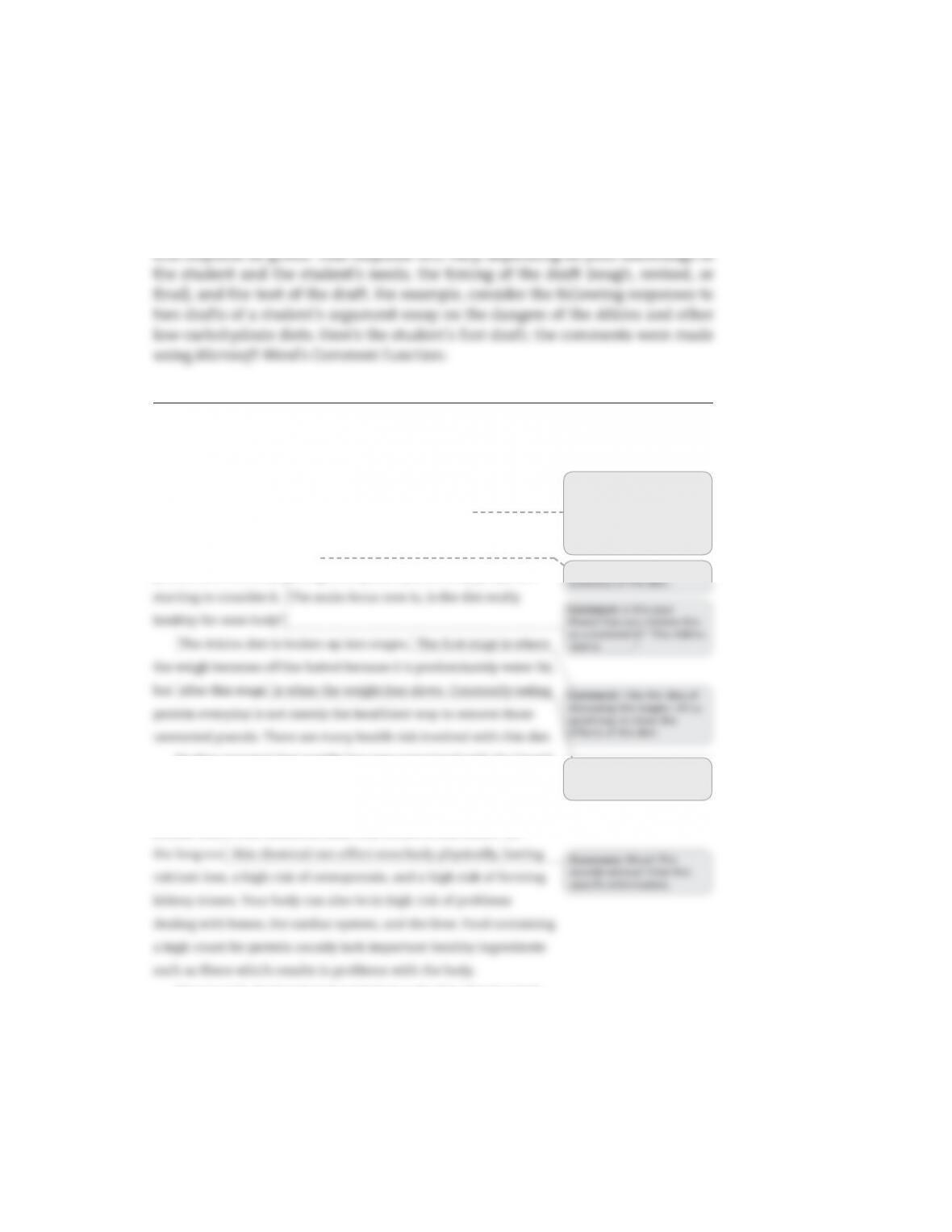
When you respond to students’ drafts, you should consider these questions: What
response will help the writer at this stage of the writing? What does the writer need
to know— and what does the writer not need to know— right now? How should
Atkins Diet, Good or Bad?
fi rst draft
[With the general population in the United States being obese
and constantly more and more people becoming obese,] many
consider the Atkins diet. This diet is simply [low to no carbohydrates
and a great intake of protein.] This diet has been around for many
years, but is currently getting more publicity and many people are
Studies reported that weight loss was associated with the length
of time being on the diet and not the reduced intake of carbohydrates
(PCRM pg7). Low carbohydrate diets induce a chemical known as
ketosis which is an abnormal state that occurs in starvation. [In
Many people don’t look at the risk factors for this diet, but their
focus is primarily on, Am I going to lose weight, how fast, and is it
easy? The Atkins diet ts these three questions and that’s why many
people decide to go on it. This diet is said to burn your fat for energy.
Comment: It’s good to
explain the context for your
topic, as you do here. In
fact, I’d like to know more
about why Americans are
diet-crazy!
Comment: Good, brief
Comment: I’d like to know
more about these stages.
Are there more than 2?
[ RESPONDING TO WRITING ]
[ 328 ]
This draft has several prob lems, ranging from its lack of a clear thesis to prob lems
with sentence structure and wording. Since it’s a rough draft, however, your goal
in responding should be to give advice to help the student revise it. You may have
a checklist or rubric for the assignment that moves from more global issues (focus,
development, and or ga ni za tion) to more local (coherence, sentence structure,
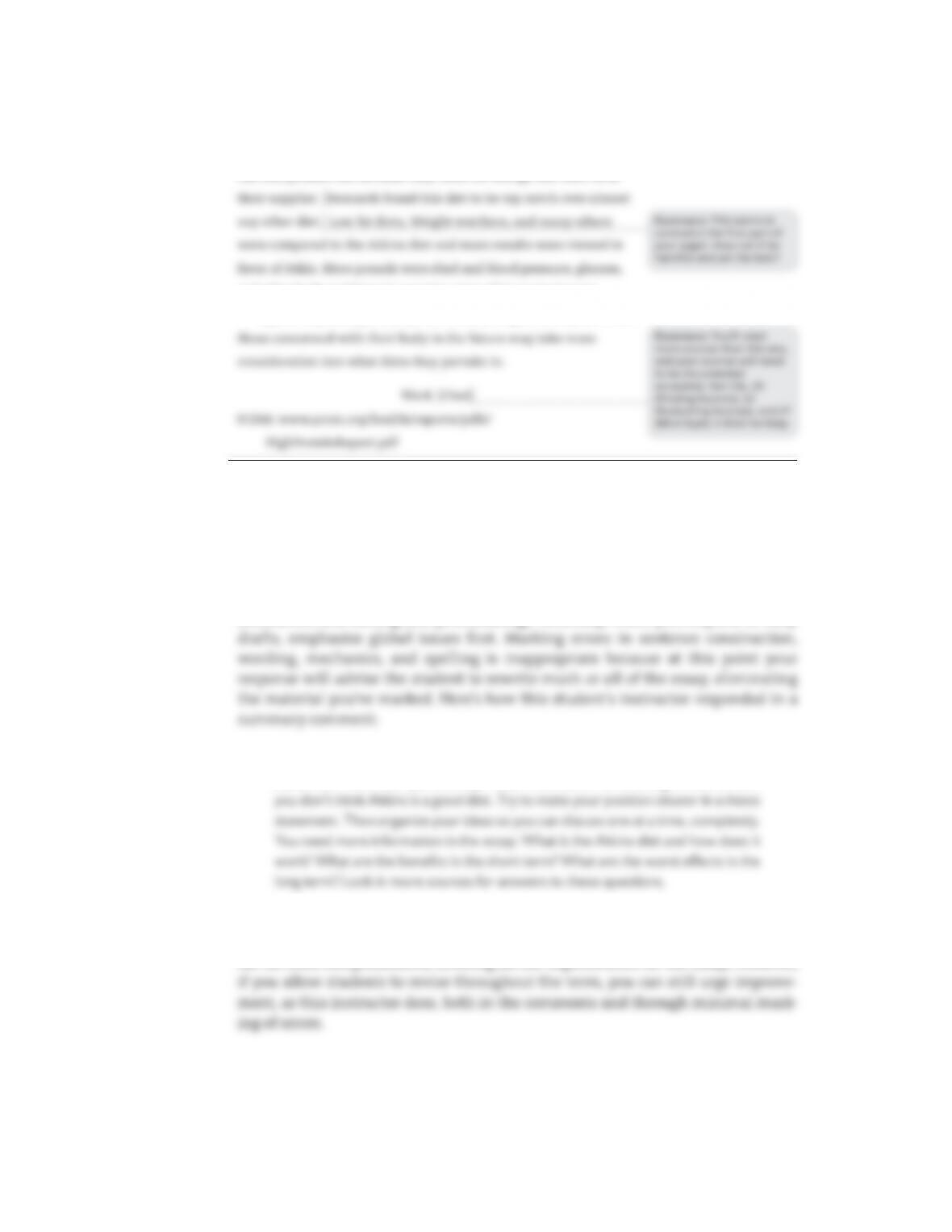
mechanics, and editing and proofreading). Generally, when you respond to early
I think this topic is really in ter est ing; I tried the Atkins diet once and couldn’t
stand how I felt after just one day! Your information is troubling; it sounds as if
The student then revised the draft twice, eventually submitting the following
fi nal version in her midterm portfolio for a grade. In this situation, your response
can be more comprehensive, covering all the requirements for the essay; however,
This attracts the so called “busy” people fast. Those always on the go
can lose pounds fast because they need the energy and their fat is
and other body problems in question were all in normal range.
I guess depending on the person Atkins might be for you, but for
HighProteinReport.pdf
30 % Responding to Student Writing [ 329 ]
Atkins Diet, Good or Bad?
With the general population in the United States being obese and
constantly more and more people becoming obese, many consider the
Atkins diet. This diet consist of little to no carbohydrates and a high
intake of protein. This diet has been around for many years, but is
currently getting more publicity and many people are starting to
consider it. The main focus now is, whether or not the diet is really
slows. What makes the fat come off so fast the rst stage of this diet
is because eating fewer grams of carbohydrate results in fewer spikes
in blood sugar, resulting in less insulin output. Insulin makes the body
retain sodium, which makes your body retain water. When you are
not producing as much insulin, the cycle slows and the effect is like
taking a diuretic which is a drug that increases the output of urine.
After a few days, that’s when you will also begin to lose body fat.
[Young men and people who have a lot of weight to lose are more likely
Supposedly many health bene ts are to come out of this diet.
your ideal weight, prevent you from getting caught up in those foods
✓
✓
✓
✓
[ RESPONDING TO WRITING ]
[ 330 ]
that cause severe weight gain, help you to make healthy food
choices, reduce risk factors for various disorders including diabetes,
and give you a sense of accomplishment.] However, these health
bene ts are not clearly what you are going to get out of this diet in
the long run. Constantly consuming protein for several weeks is not
nearly the healthiest way to remove those unwanted pounds. There
are many health risk involved with this diet. Studies reported that
This diet doesn’t even t the guidelines for the American Heart
Association. These guidelines include: eating fruits, grains, drinking
milk, limiting food high in saturated fats, eating less than 6 grams of
salt, exercise, and drinking no more than one alcoholic drink a day
for a woman and two for a man (“Diet and Lifestyle”). In the long
runthis ketosis can effect ones body physically leading to having
calcium loss, a high risk of osteoporosis, and a high risk of forming
ofcholesterol. Many people don’t look at the risk factors for this
diet, but their focus is primarily on, Am I going to lose weight, how
fast, and is it easy? The Atkins diet ts these three questions and
that’s why many people decide to go on it. This diet is said to burn
your fat for energy. This attracts the so called ‘busy’ people fast, those
always on the go can lose pounds quicker because they need the
energy and their fat is their supplier. Research found this diet to be
Comment: A long
sentence—break into at
least 2: one on weight
benefi ts, one on health
benefi ts.
✓
✓
✓
30 % Responding to Student Writing [ 331 ]
pressure, glucose, and other body problems in question were all in
normal range.] Unfortunately it is still putting your body in a higher
risk of health problems in the future (“The Science Behind Atkins”).
Many studies done came to the conclusion that the Atkins diet is
good for a short period of time, but not a lifelong thing. I feel short
or long, you will still be in a higher risk for health problems either
weight is regained (diets nutrition). Though this diet may work in
ones favor for a few months it still has its share of serious disadvan-
tages. I guess depending on the person Atkins might be for you, but
[for those concerned with their body in the future may take more
Works Cited
“Diet and Lifestyle Recommendations.” American Heart Association,
American Heart Association, 29 June 2012, www . heart . org
/ HE ARTORG / HealthyL iv ing / Diet – and – Lifestyle -Recommen
dations _ UCM _ 305855 _ Article . jsp# . V6JDjPkrIdU. Accessed 23
Sept. 2012.
Comment: Who did this
comparison? Can we trust
them? Seems to contradict
the rest of your argument.
Maybe it belongs with the
earlier section on “Many
health benefi ts.”
✓
✓
✓
This draft shows many improvements over the fi rst draft, but it still has prob lems
with or ga ni za tion, wording, editing and proofreading, and accurate documenta-
tion of sources. The instructor said as much in the summary comment:
[ RESPONDING TO WRITING ]
[ 332 ]
still needs work on or ga ni za tion, however: you discuss three di er ent topics in
two di er ent places in the essay, so the essay seems to repeat itself. For example,
discuss the bene ts of Atkins all at once, and discuss the aspects of each stage
Marking Student Writing
Respond in pencil. If you’re responding to printed drafts, pencil is less intimidat–
ing to students than ink, red or other wise. Also, if you make a comment that you
want to reconsider, comments in pencil can be erased without making a mess of
the student’s draft.
Respond on a separate sheet. Marginal comments offer the benefi t of being visu-
ally tied to the text to which they are responding, and patterns can be marked
easily. If you need to say more than a few words or a phrase, however, the margins
can become crowded and your comments hard to read. For that reason, consider
making up response sheets that you can attach to each draft. On the sheet, you can
print any rubric or checklist you’re using, or you can simply provide space for com-
Use correction symbols or abbreviations sparingly. Handbooks traditionally pro–
vide a list of correction or revision symbols that instructors may use to save time.
Unfortunately, students seldom know what those symbols mean, and too often
they are too vague to be helpful. (AWK, for example, usually means “ There’s some-
30 % Responding to Student Writing [ 333 ]
only a limited number and explain to students what they mean. The slight
increase in time spent identifying the prob lem in plain En glish benefi ts students’
understanding.
Useful Readings
Blumner, Jakob S., and Francis Fritz. “Students Using Evaluation in Their Writing
Pro cess.” Alternatives to Grading Student Writing, edited by Stephen
Lunsford, Andrea A., and Karen J. Lunsford. “ ‘ Mistakes Are a Fact of Life’: A National
Comparative Study.” College Composition and Communication, vol. 59, no. 4,
June 2008, pp. 781–806.
Sommers, Nancy. Beyond the Red Ink. Bedford/St. Martin’s, 2012.
Straub, Richard. A Sourcebook for Responding to Student Writing. Hampton Press,
1999.
[ 334 ]
TAKE A GOOD LOOK at the snapshot on your driver’s license. How well does
it capture your looks? When you read a draft of a student’s writing, you see
a snapshot of their writing at a par tic u lar time, in response to a par tic u lar prompt
or assignment. And like any snapshot, it’s not clear how well that draft represents
the student’s overall writing ability. For that reason, many writing teachers ask
students to create and submit portfolios of their work during a course. Portfolios
allow instructors to examine several samples of students’ writing for patterns,
Self– Assessing Writing Portfolios
Many writing teachers who require portfolios see the students’ written assess-
ment of the contents as the most impor tant ele ment—it moves students toward
in de pen dence through the ability to assess their work themselves, instead of
relying on teachers. This refl ective self– assessment may be written in the form of
an informal letter or a formal essay asking students to use the materials in the
portfolio as the evidence on which they base thoughtful examination of their
writing and their work in the class. Ch. 36 of Every one’s an Author offers guidelines
If you ask students to include all drafts and revisions as well as in- class work
and research materials, you can evaluate how diligently they worked; usually
that diligence will result in good fi nal products. Some students will use their
thirty– one
Teaching with Writing Portfolios
31 % Teaching with Writing Portfolios [ 335 ]
self– assessments to argue that their grade should be based on their effort, rather
than on the writing they produce. Also, some students will use the self– assessment
Assigning Writing Portfolios
What should go into a portfolio of writing? In its barest form, a portfolio is simply
a paper or online folder in which students keep their writing. If you assign, collect,
and grade individual assignments and then ask students to submit them again in
such a portfolio, they can write an assessment of the contents before submitting it
at term’s end. More often, however, instructors ask for a portfolio of students’ work
Polished, fi nal drafts of assigned essays. You may ask for every assigned essay or
offer students a choice among their assignments, since every writer drafts some
texts that don’t work out. Or, you might require some and make others optional.
For example, if students work on a narrative, a text analy sis, and an evaluation,
they must include in their portfolio the analy sis plus either the narrative or the
All drafts of assigned essays. Drafts are useful for seeing the pro gress students
make from fi rst to fi nished draft and for jogging your memory if you’ve seen an
earlier draft. Ask that students label and date each draft and, in print portfolios,
place them in order from fi nished on top to fi rst on the bottom.
require electronic portfolios, having labeled and annotated copies of sources used
will save you time as you evaluate students’ research and use of source material.
Student assessment of the contents. Some instructors ask for an informal letter
that discusses the strengths of the contents and the writer’s plans for improvement
in the future. Others assign a lengthy self– assessment essay that includes quota-
[ RESPONDING TO WRITING ]
[ 336 ]
Other materials. Other course- related writing, such as collaborative work or in-
class writing and tests, may be included. Also, some instructors allow students to
include other writing— essays from other courses, fi ction or poetry, work– related
writing— that shows aspects of their writing ability.
Organ izing Electronic Portfolios
If you ask students to submit their work in electronic portfolios, you need to create
ways for students to or ga nize their essays and fi les. Learning management systems
such as Desire2Learn allow you to create specifi c assignments to which students
post their drafts, so you may set up portfolio assignments like “Position essay port–
folio draft,” “Evaluation portfolio draft,” and “Self– assessment.” If you’re relying on
Reading Portfolios
The guidelines presented in Ch. 30 of this Guide, “Responding to Student Writing,”
apply to portfolios of writing, too. A signifi cant difference is that instead of or in
addition to evaluating individual pieces of writing, you may evaluate students’
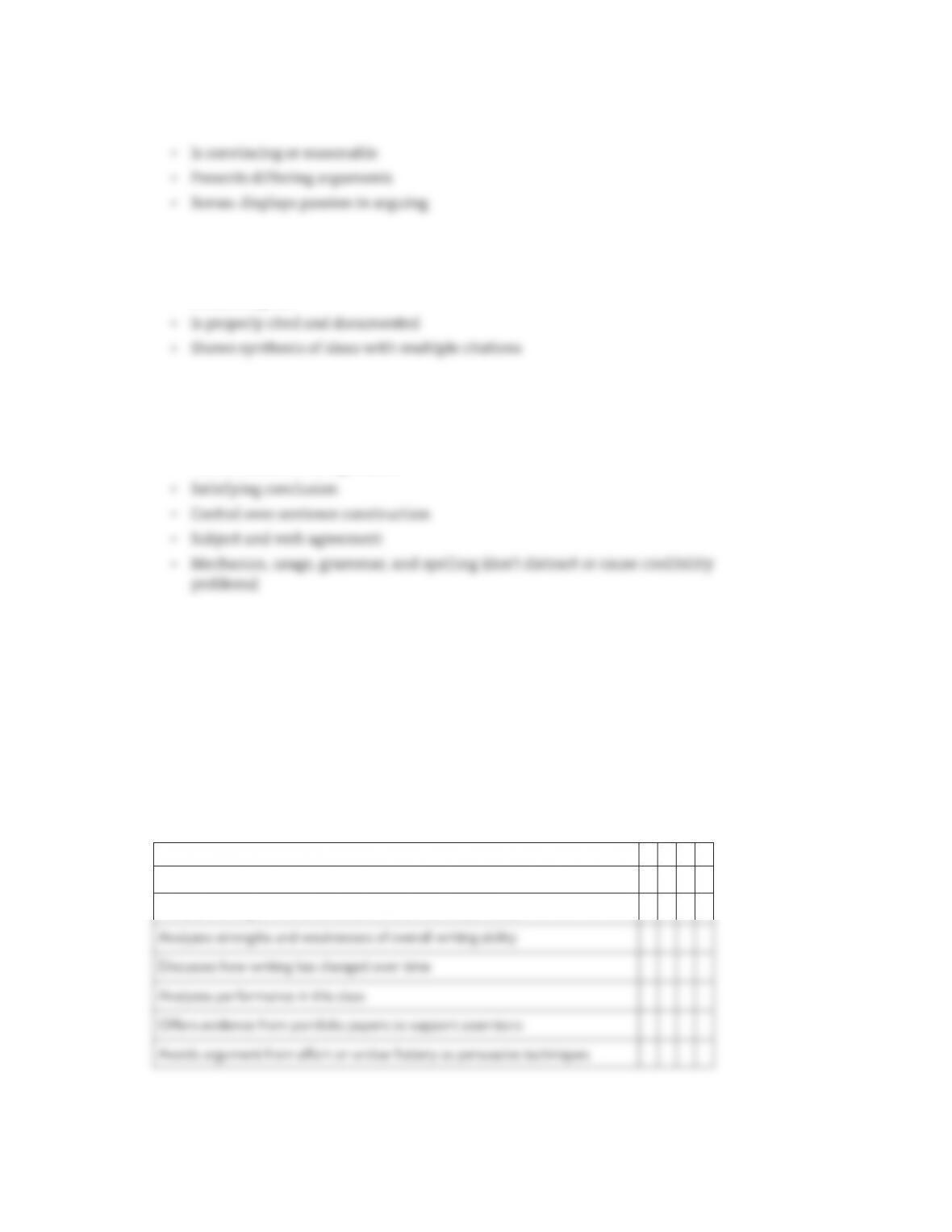
Content
• Defi nes the issue and its context
• Enters a debate (engages the issue, not just a lit er a ture review or detached
analy sis of the argument: “One might argue . . .”)
• Shows awareness of the audience and needs of that audience
31 % Teaching with Writing Portfolios [ 337 ]
Evidence
• Is pres ent
• Relates to point
Form
• Coherence and cohesion (at the essay and sentence level: transitions, signal
phrases, repeated words, and integrated quotations)
• Thesis statement or equivalent
Assessment
• Critical assessment of own work, supported by evidence from portfolio
You might combine criteria common to each individual essay’s rubric to develop
a single rubric for the portfolio as a whole, separating out those criteria that apply
only to a single assignment. You might also combine the rubrics for each individ-
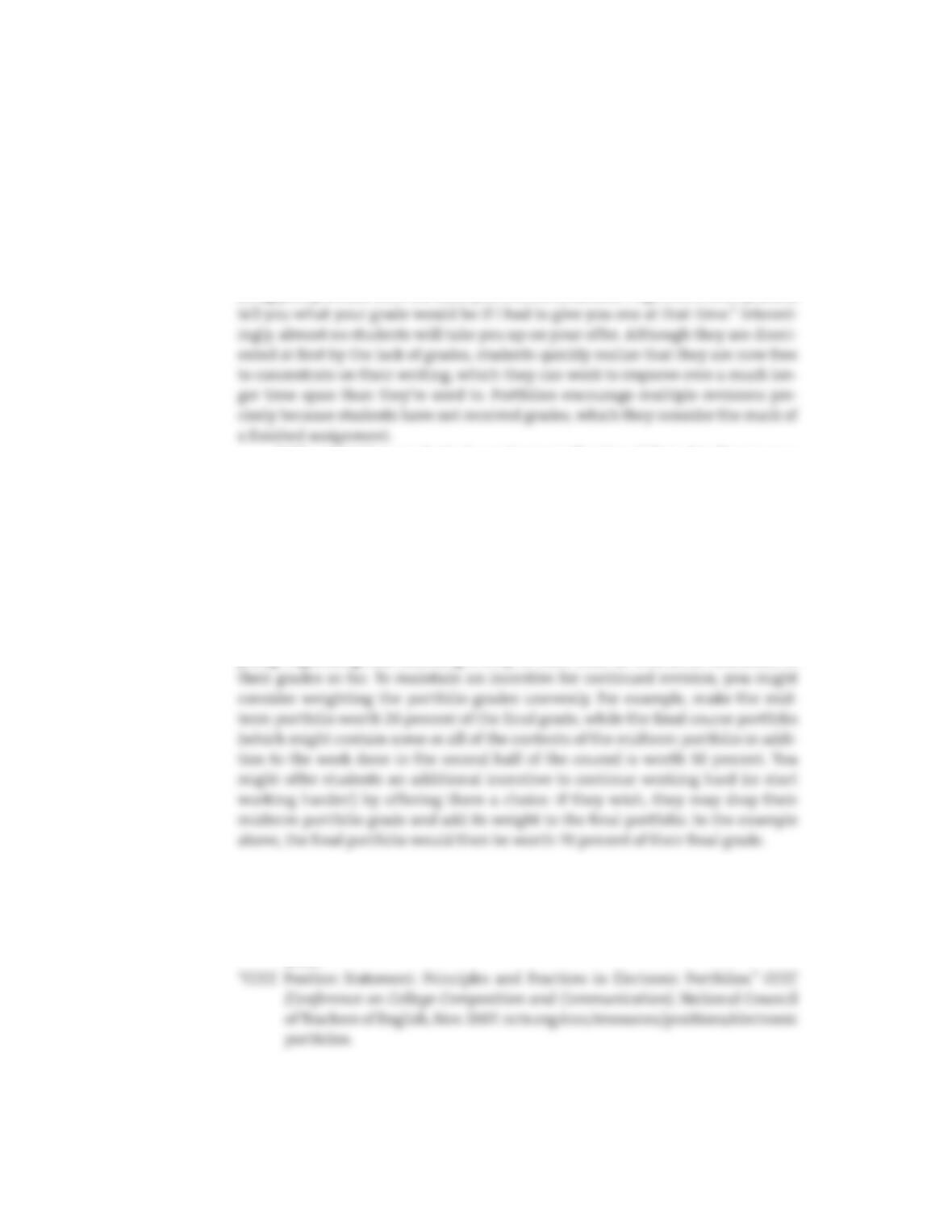
ual essay with a rubric for the self– assessment or refl ection, such as the one
below.
Self- Assessment Rubric
Selection 3210
Analyzes work habits from invention to polished work
Analyzes strengths and weaknesses of each item in portfolio
[ RESPONDING TO WRITING ]
[ 338 ]
Delaying Grades
If you design your course to include portfolios, you may assign grades much less
often than if you grade each assigned essay separately. As a result, some students
will express anxiety over not receiving frequent grades, as they did in high school
or other classes. To allay their fears, make this offer: “Anytime you want to know
your grade as it stands at this point in the course, schedule a conference with me.
Bring your portfolio with the work you’ve done so far, and I’ll go over it with you and
At the same time, students do need some indication of their standing in your
course before the very end, and some may need a grade in order to understand
your grading standards. To give students an indication of how you’ll be grading
their work, consider putting a grade on a draft early in the course. Give it a low value,
and grade it using the rubric you’ll use when assessing their work at the end of the
term— the grades will likely be far lower than your students expect, and you can
then explain the advantages of multiple revisions and delayed grading.
Later in the term, you can give students a pro gress report by asking them to
submit a midterm portfolio that contains the work done through the fi rst half of
the term, along with their self– assessment of that work. They’ll get practice in com-
piling, or ga niz ing, and assessing a body of their work as well as an indication of
Useful Readings
Belanoff, Pat, and Marcia Dickson. Portfolios: Pro cess and Product. Heinemann,
1991.