31 % Teaching with Writing Portfolios [ 339 ]
Conway, Glenda. “Portfolio Cover Letters, Students’ Self– Presentation, and Teach-
ers’ Ethics.” New Directions in Portfolio Assessment: Refl ective Practice, Critical
Theory, and Large- Scale Scoring, edited by Laurel Black et al., Boynton/Cook,
1994, pp. 83–92.
Electronic Portfolios. American Association for Higher Education and Accredita-
tion, 2005.
Reynolds, Nedra, and Rich Rice. Portfolio Teaching: A Guide for Instructors. Bedford/
St. Martin’s, 2006.
Sommers, Jeffrey. “Bringing Practice in Line with Theory: Using Portfolio Grading
in the Composition Classroom.” Portfolios: Pro cess and Product, edited by
Pat Belanoff and Marcia Dickson, Boynton/Cook, 1991, pp. 153–64.
Sunstein, Bonnie S. “Be Refl ective, Be Refl exive, and Beware: Innocent Forgery for
Inauthentic Assessment.” The Portfolio Standard: How Students Can Show Us
What They Know and Are Able to Do, edited by Bonnie S. Sunstein and Jona-
[ 340 ]
CONSIDER THE SITUATION described by Chris Massey, a TA: “My students
are constantly writing, and that means I am constantly reading what
they are writing. Even though I am not marking every piece of writing they submit
to me, I am reading each piece and responding to their writing in some fashion. My
students are writing and writing well; the only downside is that I am spending a
great deal of my time reading.” The prob lem Chris describes, responding adequately
Don’t read every thing. Just because you assign it doesn’t require you to read it, let
alone respond to it. Some things you read carefully (drafts); some things you skim
Read all the drafts fi rst. We evaluate things by comparing them with others, and
student drafts are no dif fer ent. To get an overall sense of how your students did on
an assignment, read quickly through all the drafts you collect, perhaps sorting
them as you read into three groups: strong, middling, and weak. This pro cess helps
Set a schedule. As a new instructor, you’re likely to spend thirty minutes reading
and responding to each draft of an essay; in a class of twenty- fi ve students, that
totals twelve and a half hours. Establish a schedule for responding and keep to it. If
you collect drafts late in the week and keep them over the weekend, spread out
thirty– two
Managing the Paper Load
32 % Managing the Paper Load [ 341 ]
one course at a time, consider establishing a regular, daily schedule: every after–
noon from 3 to 5 p.m., you read student writing.
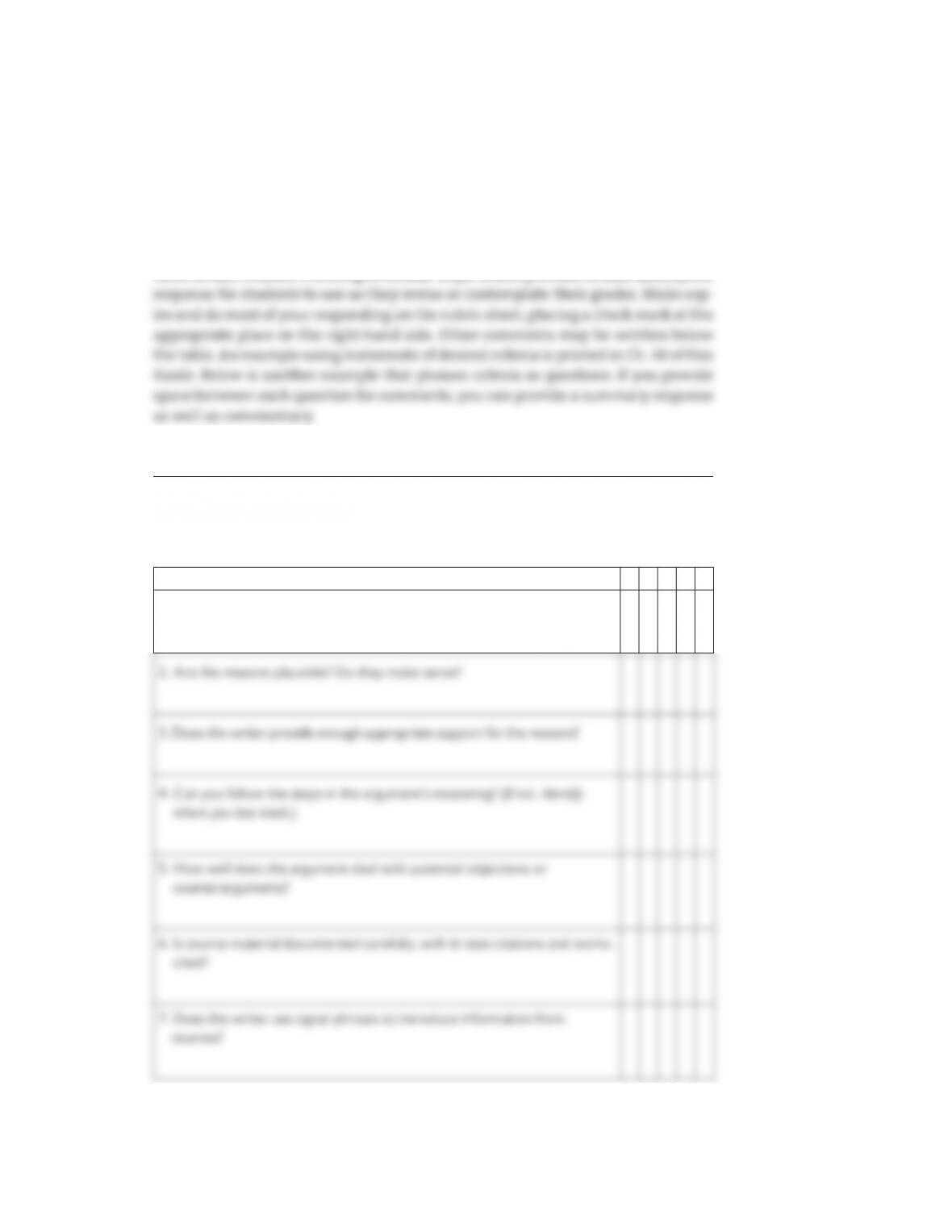
Use rubrics. If you clearly articulate the requirements of an assignment, you can
create a chart– style rubric that lists them in the form of a table. The rubric helps
you maintain discipline over your reading, forcing you to pay attention to the fea-
tures of each student’s writing in similar ways. It also provides a clear, descriptive
Argument Draft Assessment
Author: __________________________ Assessor: __________________________
Circle one: First draft Rewritten draft Further revision
Answer each question on a scale of 1– 5 (5 = very well, yes indeed; 1 = no, not at all)
Comment below the question.
Question 54321
1. Is the thesis clear and appropriately quali ed?
[ RESPONDING TO WRITING ]
[ 342 ]
Have students evaluate their drafts. Before students give you their drafts, have
them write a self– assessment, pointing out strong ele ments, parts that need to be
Avoid overresponding. If you identify a few strengths, prob lems, and patterns
and use minimal marking, you’ll avoid the trap of making too many marginal and
in- text comments that take time and energy (and overwhelm many students).
Don’t worry about originality. Several students’ drafts will have similar prob lems,
so responding with the same comment can save you time— and they’re unlikely
to compare their comments’ prose style.
Stagger due dates. If you’re teaching more than one section of a course or more
Keep good rec ords. Be sure to keep rec ords of your students’ work as you read so
you don’t have to go through the stack one more time to rec ord grades or other
marks. Many instructors use a “received— date” stamp to show that assignments,
Useful Readings
Golub, Jeffrey N., editor. More Ways to Handle the Paper Load: On Paper and Online.
NCTE, 2005.
Ketter, Jean S. “Using Rubrics and Holistic Scoring of Writing.” Alternatives to Grad-
ing Student Writing, edited by Stephen Tchudi, NCTE, 1997, pp. 291–95.

[ 343 ]
IF YOU’VE DEVELOPED GOOD ASSIGNMENTS and responded to drafts of stu-
dents’ writing, grading will be less onerous. If you clarify expectations up
Developing a Method
Preview your students’ work. Avoid the temptation to jump in and start reading
with an eye to grade. First, reread your assignment to remind yourself what you
asked for, and then read quickly through the whole stack (if you’re new to teaching)
Use rubrics. Rubrics help you maintain your focus on the criteria for evaluating
students’ work. Even if the rubrics are fairly general, they also provide a vocabu-
lary to help students understand why they earned the grades they did. See Ch. 30,
Write a fi nal comment. Whether or not you use a rubric, it’s helpful for students
when you sum up the strengths and prob lems in an essay or portfolio as a guide for
their future writing and as an explanation for the grade. A good fi nal comment
thirty– three
Grading Student Writing
[ RESPONDING TO WRITING ]
[ 344 ]
Use the full range of grades. After working with a group of students for ten or fi f-
teen weeks and getting to know them and their work, we all have diffi culty
assessing that work fairly. Most often, we give higher grades than an objective
grader who doesn’t know the students. You should resist the temptation to give
most students grades of B and a few grades of A or C, reserving the D or F for stu-
dents who didn’t do the work or dis appeared but didn’t drop the course. Why?
Because your credibility and your writing program’s credibility in the university
At the same time, don’t expect the grades in your classes to form a bell curve.
Writing classes are relatively small, so the group of students you have in any one
class may consist of many strong writers, many weak ones, or a mix, depending on
how courses are scheduled, whether or not students register by major, or even time
of day. You may well have a class in which more than half the students earn Bs
Ask for second opinions. All writing teachers encounter student work that they
have trou ble grading. No matter what the reason, ask another instructor what
grade they would give to a troublesome portfolio or essay. Your conversation about
the merits of the work and the reasons for your grades will both help you grade
Don’t grade every revision. Once expectations have been established, offer the
option to revise for a higher grade, but don’t fall into the trap of regrading every
draft a student submits. Some students will change exactly what you point out,
with the expectation that if they follow your instructions, they will earn a
higher grade. A few will resubmit several times, assuming that enough incre–
33 % Grading Student Writing [ 345 ]
Don’t assume that grades motivate. As you teach, you’ll fi nd that some students
are motivated only by a grade and will ask, “What do I have to do to get an A in this
course?” Many of us who pursue advanced degrees and teach in college were
motivated as undergraduates by the desire to excel, not just by earning high
grades but also by working hard to learn. This isn’t always the case for students. As
Keeping Rec ords
It’s impor tant to keep students’ grades or ga nized so that you can calculate their
fi nal grades without diffi culty. One way to lose credibility as a teacher is to lose
Note cards. Many instructors ask students to list information on index cards on the
fi rst day of class. Those same cards can then be used to jot notes about the students’
work: goals framed in conferences, ongoing pro gress in drafts, and vari ous other
assessments that might not lend themselves to a letter grade or number of points.
Three- ring binders. If you ask students to sign an attendance sheet, using three-
hole- punched paper that you can slip into a three- ring binder simplifi es maintain–
ing attendance rec ords. In fact, you can or ga nize your entire course— syllabus,
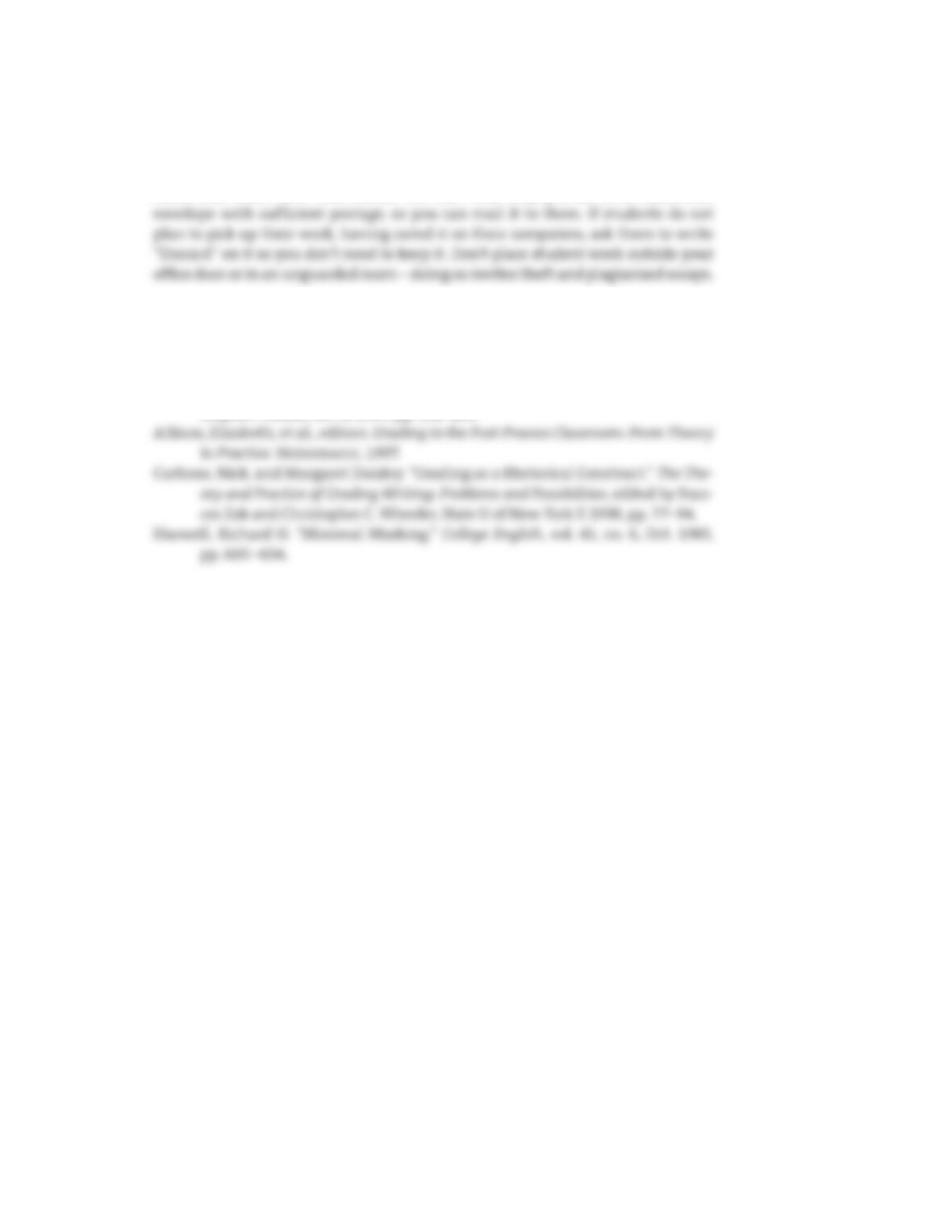
Gradebooks, online gradebooks, and spreadsheet programs. To keep track of stu–
dents’ grades and attendance, you should have a means of identifying each assign-
ment and noting students’ performance— a system that won’t take too much time.
The traditional gradebook offers a grid, but its spaces tend to be very small and
uniform, forcing you to abbreviate assignment titles and, at the same time, pro–
viding far more spaces for grades than you’re likely to need. Online gradebooks
[ RESPONDING TO WRITING ]
[ 346 ]
Returning Students’ Work
The fi nal step in responding to and grading students’ work is returning it to them.
Here are a few hints on doing that effectively:
During the term. Strive to return students’ work as quickly as you can; within a
At the end of the course. Most writing instructors schedule the due date of fi nal
portfolios or essays during fi nal exam week. As a result, students often cannot
pick them up until the following term or until the next fall term. If your school has
1
22/7 2/14 2/19 2/21 2/26 2/28 3/4 3/6 3/11 3/13
3
4
5
ENG 101-18,Winter 20XX
Attendance
D—, Dominic
D—, Mary
G—, Michael
ABCDEFGHIJK
absentpresent
33 % Grading Student Writing [ 347 ]
your offi ce during your offi ce hours in the fi rst fi ve weeks of the following term.
Place them in a box in your offi ce and give them to students as they show up. Stu–
dents who want their work before the next term may provide a self– addressed
Useful Readings
Adkison, Stephen, and Stephen Tchudi. “Grading on Merit and Achievement: Where
Quality Meets Quantity.” Alternatives to Grading Student Writing, edited by
Stephen Tchudi, NCTE, 1997, pp. 192–209.