Archives: Quiz
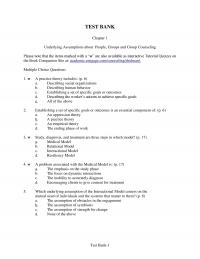
978-0495501954 Chapter 1
TEST BANK Chapter 1 Underlying Assumptions about People, Groups and Group Counseling Please note that the items marked with a “w” are also available as interactive Tutorial Quizzes on the Book Companion Site at: academic.cengage.com/counseling/shulman/. Multiple Choice Questions 1. w […]
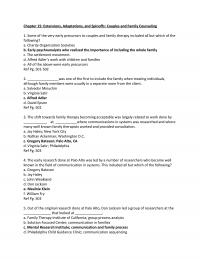
978-0495008842 Chapter 15
Chapter 15: Extensions, Adaptations, and Spinoffs: Couples and Family Counseling 1. Some of the very early precursors to couples and family therapy included all but which of the following? 2. ________________was one of the first to include the family when […]
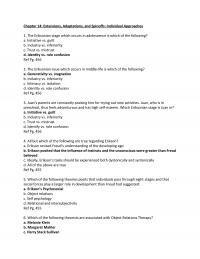
978-0495008842 Chapter 14
Chapter 14: Extensions, Adaptations, and Spinoffs: Individual Approaches 1. The Eriksonian stage which occurs in adolescence is which of the following? 2. The Eriksonian issue which occurs in middle-life is which of the following? a. Generativity vs. stagnation b. Industry […]
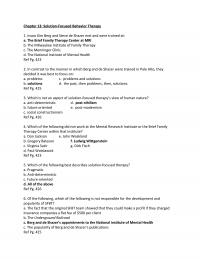
978-0495008842 Chapter 13
Chapter 13: Solution-Focused Behavior Therapy 1. Insoo Kim Berg and Steve de Shazer met and were trained at: 2. In contrast to the manner in which Berg and de Shazer were trained in Palo Alto, they decided it was best […]
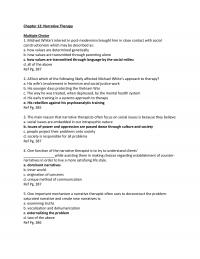
978-0495008842 Chapter 12
Chapter 12: Narrative Therapy Multiple Choice 1. Michael White’s interest in post-modernism brought him in close contact with social constructionism which may be described as: 2. All but which of the following likely affected Michael White’s approach to therapy? a. […]
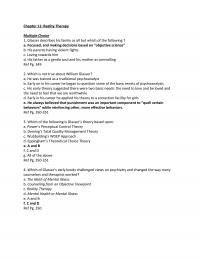
978-0495008842 Chapter 11
Chapter 11: Reality Therapy Multiple Choice 1. Glasser describes his family as all but which of the following ? 2. Which is not true about William Glasser? a. He was trained as a traditional psychoanalyst b. Early on in his […]
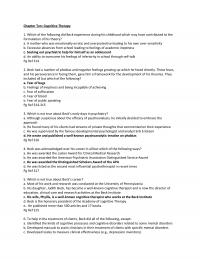
978-0495008842 Chapter 10
Chapter Ten: Cognitive Therapy 1. Which of the following did Beck experience during his childhood which may have contributed to the formulation of his theory? 2. Beck had a number of phobias and negative feelings growing up which he faced […]
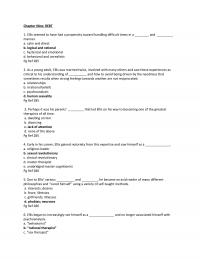
978-0495008842 Chapter 9
Chapter Nine: REBT 1. Ellis seemed to have had a propensity toward handling difficult times in a ________ and _________ manner. 2. As a young adult, Ellis was married twice, involved with many others and saw these experiences as critical […]
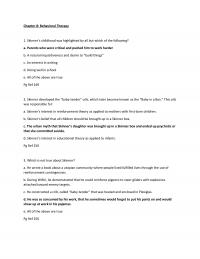
978-0495008842 Chapter 8
Chapter 8: Behavioral Therapy 1. Skinner’s childhood was highlighted by all but which of the following? 2. Skinner developed the “baby–tender” crib, which later become known as the “Baby in a Box.” This crib was responsible for: a. Skinner’s interest […]
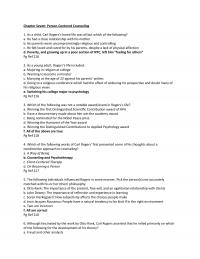
978-0495008842 Chapter 7
Chapter Seven: Person-Centered Counseling 1. As a child, Carl Rogers’s home life was all but which of the following? 2. As a young adult, Rogers’s life included: a. Majoring in religion at college b. Wanting to become a minister c. […]
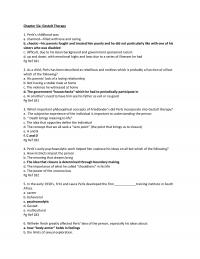
978-0495008842 Chapter 6
Chapter Six: Gestalt Therapy 1. Perls’s childhood was: 2. As a child, Perls has been described as rebellious and reckless which is probably a function of all but which of the following? a. His parents’ lack of a loving relationship […]
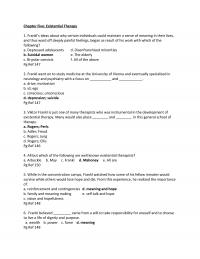
978-0495008842 Chapter 5
Chapter Five: Existential Therapy 1. Frankl’s ideas about why certain individuals could maintain a sense of meaning in their lives, and thus ward off deeply painful feelings, began as result of his work with which of the following? 2. Frankl […]
978-0495008842 Chapter 4
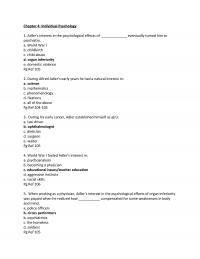
Chapter 4: Individual Psychology 1. Adler’s interest in the psychological effects of _____________ eventually turned him to psychiatry. 2. During Alfred Adler’s early years he had a natural interest in: a. science b. mathematics c. phenomenology d. fixations e. all […]
978-0495008842 Chapter 3
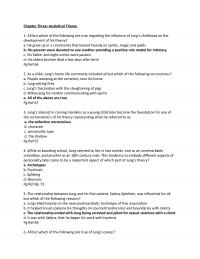
Chapter Three: Analytical Theory 1. All but which of the following are true regarding the influence of Jung’s childhood on the 2. As a child, Jung’s home life commonly included all but which of the following occurrences? a. People weeping […]
978-0495008842 Chapter 2
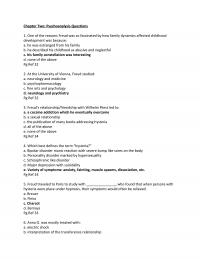
Chapter Two: Psychoanalysis Questions 1. One of the reasons Freud was so fascinated by how family dynamics affected childhood development was because: 2. At the University of Vienna, Freud studied: a. neurology and medicine b. psychopharmacology c. fine arts and […]
978-0495008842 Chapter 1
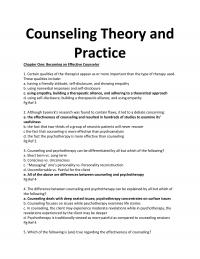
Counseling Theory and Practice Chapter One: Becoming an Effective Counselor 1. Certain qualities of the therapist appear as or more important than the type of therapy used. These qualities include: 2. Although Eysenck’s research was found to contain flaws, it […]

978-0393668971 Chapter 32
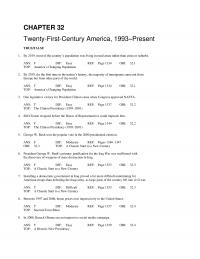
CHAPTER 32 Twenty-First-Century America, 1993–Present TRUE/FALSE 1. By 2019, most of the country’s population was living in rural areas rather than cities or suburbs. 2. By 2019, for the first time in the nation’s history, the majority of immigrants came […]
978-0393668971 Chapter 31
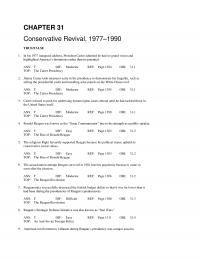
CHAPTER 31 Conservative Revival, 1977–1990 TRUE/FALSE 1. In his 1977 inaugural address, President Carter admitted he had no grand vision and highlighted America’s limitations rather than its potential. 2. Jimmy Carter took measures early in his presidency to demonstrate his […]
978-0393668971 Chapter 27
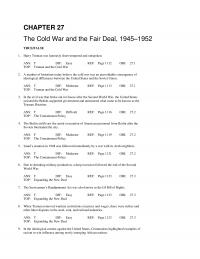
CHAPTER 27 The Cold War and the Fair Deal, 1945–1952 TRUE/FALSE 1. Harry Truman was famously short-tempered and outspoken. 2. A number of historians today believe the cold war was an unavoidable consequence of ideological differences between the United States […]

978-0393668971 Chapter 23
CHAPTER 23 TRUE/FALSE 1. The 1920s pitted a cosmopolitan urban America against the values of an insular rural America. 2. In the 1920s, the progressive wings of the Republican and Democratic parties grew stronger and more influential. ANS: F DIF: […]
978-0393668971 Chapter 22
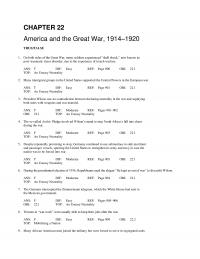
CHAPTER 22 America and the Great War, 1914–1920 TRUE/FALSE 1. On both sides of the Great War, many soldiers experienced “shell shock,” now known as post–traumatic stress disorder, due to the experience of trench warfare. 2. Many immigrant groups in […]
978-0393668964 Chapter 32
CHAPTER 32 Twenty-First-Century America, 1993–Present TRUE/FALSE 1. By 2019, most of the country’s population was living in rural areas rather than cities or suburbs. 2. By 2019, for the first time in the nation’s history, the majority of immigrants came […]

978-0393668964 Chapter 31
CHAPTER 31 Conservative Revival, 1977–1990 TRUE/FALSE 1. In his 1977 inaugural address, President Carter admitted he had no grand vision and highlighted America’s limitations rather than its potential. 2. Jimmy Carter took measures early in his presidency to demonstrate his […]
978-0393668964 Chapter 30
CHAPTER 30 Rebellion and Reaction, 1960s and 1970s TRUE/FALSE 1. The term “the New Left” was adopted to emphasize the strong alignment between the grassroots democracy of the 1960s and the orthodox Marxism of the 1930s. 2. Consistently friendly exchanges […]
978-0393668964 Chapter 29
CHAPTER 29 A New Frontier and a Great Society, 1960–1968 TRUE/FALSE 1. By the time of the 1960 presidential race, John F. Kennedy had far more experience in national politics than did Richard Nixon. 2. Kennedy’s father played a major […]
978-0393668964 Chapter 28
CHAPTER 28 America in the Fifties TRUE/FALSE 1. During Dwight D. Eisenhower’s presidency, moderate republicanism involved the promise of restoring the authority of state and local governments. 2. Dwight D. Eisenhower tried to reduce Social Security and other entitlement programs. […]
978-0393668964 Chapter 27
CHAPTER 27 The Cold War and the Fair Deal, 1945–1952 TRUE/FALSE 1. Harry Truman was famously short-tempered and outspoken. 2. A number of historians today believe the cold war was an unavoidable consequence of ideological differences between the United States […]

978-0393668964 Chapter 26
CHAPTER 26 The Second World War, 1933–1945 TRUE/FALSE 1. Hitler portrayed himself as Germany’s savior from the humiliation of having lost the Great War. 2. An incident at the Marco Polo Bridge in 1937 triggered a full-scale war between Japan […]

978-0393668964 Chapter 25
CHAPTER 25 The New Deal, 1933–1939 TRUE/FALSE 1. The federal government expanded its regulatory power over Wall Street as part of the First New Deal. 2. Early in his presidency, Roosevelt ended Prohibition, in part to regain federal tax revenues […]
978-0393668964 Chapter 24
CHAPTER 24 The Reactionary Twenties TRUE/FALSE 1. The second Ku Klux Klan of the 1920s was mainly a southern rural organization. 2. Fundamentalists argued that the Bible ought to be taken literally rather than interpreted. ANS: T DIF: Moderate REF: […]

978-0393668964 Chapter 23
CHAPTER 23 A Clash of Cultures, 1920–1929 TRUE/FALSE 1. The 1920s pitted a cosmopolitan urban America against the values of an insular rural America. 2. In the 1920s, the progressive wings of the Republican and Democratic parties grew stronger and […]

978-0393668964 Chapter 22
CHAPTER 22 America and the Great War, 1914–1920 TRUE/FALSE 1. On both sides of the Great War, many soldiers experienced “shell shock,” now known as post–traumatic stress disorder, due to the experience of trench warfare. 2. Many immigrant groups in […]

978-0393668964 Chapter 21
CHAPTER 21 The Progressive Era, 1890–1920 TRUE/FALSE 1. Among the varied sources of progressivism were populism and the Mugwumps. 2. Muckrakers were journalists who worked first and foremost for politicians—an arrangement that often perpetuated political and corporate corruption. ANS: F […]

978-0393668964 Chapter 20
CHAPTER 20 Seizing an American Empire, 1865–1913 TRUE/FALSE 1. The United States practiced global imperialism well before the European powers. 2. Social Darwinist ideas were used to justify policies of imperial expansion. ANS: T DIF: Easy REF: Page 821 OBJ: […]
978-0393668964 Chapter 19
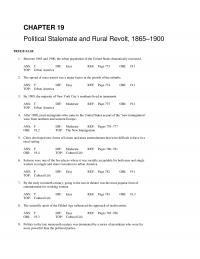
CHAPTER 19 Political Stalemate and Rural Revolt, 1865–1900 TRUE/FALSE 1. Between 1865 and 1900, the urban population of the United States dramatically increased. 2. The spread of mass transit was a major factor in the growth of the suburbs. ANS: […]

978-0393668964 Chapter 18
CHAPTER 18 The New South and the New West, 1865–1900 TRUE/FALSE 1. The number of cotton mills in the South more than doubled between 1880 and 1900. 2. Despite the growth of industry in the postwar South, in 1900 it […]
978-0393668964 Chapter 17
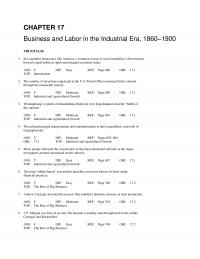
CHAPTER 17 Business and Labor in the Industrial Era, 1860–1900 TRUE/FALSE 1. In a capitalist democracy like America, a common source of social instability is the tensions between equal political rights and unequal economic status. 2. The number of inventions […]
978-0393668964 Chapter 16
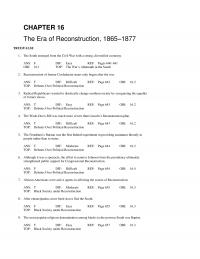
CHAPTER 16 The Era of Reconstruction, 1865–1877 TRUE/FALSE 1. The South emerged from the Civil War with a strong, diversified economy. 2. Reconstruction of former Confederate states only began after the war. ANS: F DIF: Difficult REF: Page 642 OBJ: […]
978-0393668964 Chapter 11
CHAPTER 11 The South, Slavery, and King Cotton, 1800–1860 TRUE/FALSE 1. The Old South was socially, culturally, and economically the most unified region of the United States. 2. Cotton had always been a major cash crop of the United States, […]

978-0393668940 Chapter 32
CHAPTER 32 Twenty-First-Century America, 1993–Present TRUE/FALSE 1. By 2019, most of the country’s population was living in rural areas rather than cities or suburbs. 2. By 2019, for the first time in the nation’s history, the majority of immigrants came […]

978-0393668940 Chapter 31
CHAPTER 31 Conservative Revival, 1977–1990 TRUE/FALSE 1. In his 1977 inaugural address, President Carter admitted he had no grand vision and highlighted America’s limitations rather than its potential. 2. Jimmy Carter took measures early in his presidency to demonstrate his […]
978-0393668940 Chapter 30
CHAPTER 30 Rebellion and Reaction, 1960s and 1970s TRUE/FALSE 1. The term “the New Left” was adopted to emphasize the strong alignment between the grassroots democracy of the 1960s and the orthodox Marxism of the 1930s. 2. Consistently friendly exchanges […]

978-0393668940 Chapter 29
CHAPTER 29 A New Frontier and a Great Society, 1960–1968 TRUE/FALSE 1. By the time of the 1960 presidential race, John F. Kennedy had far more experience in national politics than did Richard Nixon. 2. Kennedy’s father played a major […]

978-0393668940 Chapter 28
CHAPTER 28 Cold War America, 1950–1959 TRUE/FALSE 1. During Dwight D. Eisenhower’s presidency, moderate republicanism involved the promise of restoring the authority of state and local governments. 2. Dwight D. Eisenhower tried to reduce Social Security and other entitlement programs. […]
978-0393668940 Chapter 27
CHAPTER 27 The Cold War and the Fair Deal, 1945–1952 TRUE/FALSE 1. Harry Truman was famously short-tempered and outspoken. 2. A number of historians today believe the cold war was an unavoidable consequence of ideological differences between the United States […]

978-0393668940 Chapter 26
CHAPTER 26 The Second World War, 1933–1945 TRUE/FALSE 1. Hitler portrayed himself as Germany’s savior from the humiliation of having lost the Great War. 2. An incident at the Marco Polo Bridge in 1937 triggered a full-scale war between Japan […]

978-0393668940 Chapter 25
CHAPTER 25 The New Deal, 1933–1939 TRUE/FALSE 1. The federal government expanded its regulatory power over Wall Street as part of the First New Deal. 2. Early in his presidency, Roosevelt ended Prohibition, in part to regain federal tax revenues […]
978-0393668940 Chapter 24
CHAPTER 24 The Reactionary Twenties TRUE/FALSE 1. The second Ku Klux Klan of the 1920s was mainly a southern rural organization. 2. Fundamentalists argued that the Bible ought to be taken literally rather than interpreted. ANS: T DIF: Moderate REF: […]

978-0393668940 Chapter 23
CHAPTER 23 A Clash of Cultures, 1920–1929 TRUE/FALSE 1. The 1920s pitted a cosmopolitan urban America against the values of an insular rural America. 2. In the 1920s, the progressive wings of the Republican and Democratic parties grew stronger and […]

978-0393668940 Chapter 22
CHAPTER 22 America and the Great War, 1914–1920 TRUE/FALSE 1. On both sides of the Great War, many soldiers experienced “shell shock,” now known as post–traumatic stress disorder, due to the experience of trench warfare. 2. Many immigrant groups in […]