Archives: Quiz
MicroEconomic 167 Homework
1) Economic studies of lottery winners and people who have inherited large amounts of money show that a.the income effect of winning the lottery or inheriting large amounts of money likely outweighs the substitution effect for most people. b.the substitution […]
MicroEconomic 768
1) A disadvantage associated with in-kind transfers to reduce poverty is that they a.alter peoples’ incentives, whereas a negative income tax does not alter peoples’ incentives. b.do not allow poor families to make purchases based on their preferences. c.can only […]
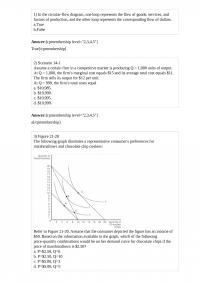
ECON E 478 Quiz 3
1) In the circular-flow diagram, one loop represents the flow of goods, services, and factors of production, and the other loop represents the corresponding flow of dollars. a.True b.False 2) Scenario 14-1 Assume a certain firm in a competitive market […]
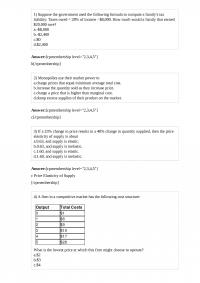
ECON E 487
1) Suppose the government used the following formula to compute a family’s tax liability: Taxes owed = 28% of income – $8,000. How much would a family that earned $20,000 owe? a.-$8,000 b.-$2,400 c.$0 d.$2,400 2) Monopolies use their market […]
ECB 435
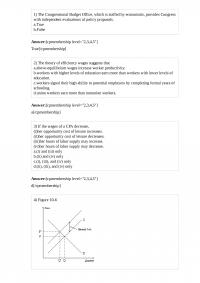
1) The Congressional Budget Office, which is staffed by economists, provides Congress with independent evaluations of policy proposals. a.True b.False 2) The theory of efficiency wages suggests that a.above-equilibrium wages increase worker productivity. b.workers with higher levels of education earn […]
BUS 204 Midterm 1
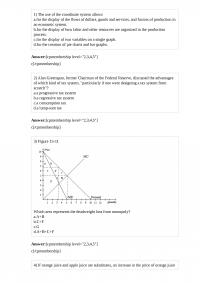
1) The use of the coordinate system allows a.for the display of the flows of dollars, goods and services, and factors of production in an economic system. b.for the display of how labor and other resources are organized in the […]
BUS 797 Quiz 3
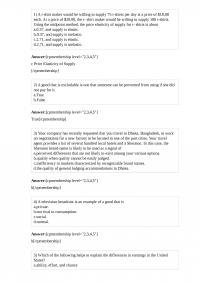
1) A t-shirt maker would be willing to supply 75 t-shirts per day at a price of $18.00 each. At a price of $20.00, the t- shirt maker would be willing to supply 100 t-shirts. Using the midpoint method, the […]
ECON E 360 Homework
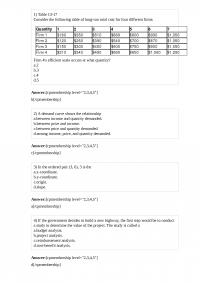
1) Table 13-17 Consider the following table of long-run total cost for four different firms: Firm 4’s efficient scale occurs at what quantity? a.2 b.3 c.4 d.5 2) A demand curve shows the relationship a.between income and quantity demanded. b.between […]
MicroEconomic 669
1) If a country allows trade and, for a certain good, the domestic price without trade is higher than the world price, a.the country will be an exporter of the good. b.the country will be an importer of the good. […]
ECB 843 Quiz 3
1) A decrease in population can be expected to a.increase the marginal product of land. b.decrease the supply of land. c.decrease the rents on land. d.increase the demand for land. 2) When a firm experiences economies of scale, long-run average […]
ECON 162 Final
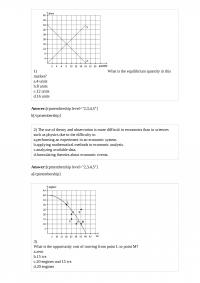
1) What is the equilibrium quantity in this market? a.4 units b.8 units c.12 units d.16 units 2) The use of theory and observation is more difficult in economics than in sciences such as physics due to the difficulty in […]
ECON E 723 Quiz 1
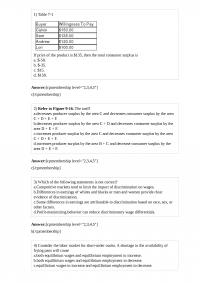
1) Table 7-1 If price of the product is $135, then the total consumer surplus is a. $-50. b. $-35. c. $15. d. $150. 2) Refer to Figure 9-16. The tariff a.decreases producer surplus by the area C and decreases […]
BUS 476 Test 2
1) In the market for apples in a certain country, consumer surplus increases and total surplus increases when that country a.abandons a no-trade policy, adopts a free-trade policy, and becomes an importer of apples. b.abandons a no-trade policy, adopts a […]
ECON 216 Quiz 1
1) A firm maximizes its profit by producing output up to the point where marginal revenue equals marginal cost a.only when the market is a monopoly. b.only when the market is a monopoly or monopolistically competitive. c.only when the market […]
ECON E 199 Quiz 1
1) Assume that your roommate is very messy. Suppose she gets a $25 benefit from being messy but imposes a $50 cost on you. The Coase theorem would suggest that an efficient solution would be for you to a.pay your […]
ECON A 677 Quiz 3
1) Which of the following examples illustrates an oligopoly market? a.a farmers’ market with many individuals selling sweet corn and tomatoes b.a city whose electrical service is provided by one electric co-operative c.a city with two firms who are licensed […]
ECB 384 Test
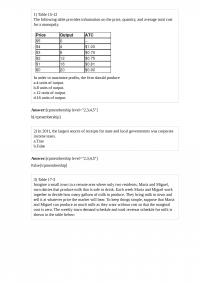
1) Table 15-12 The following table provides information on the price, quantity, and average total cost for a monopoly. In order to maximize profits, the firm should produce a.4 units of output. b.8 units of output. c.12 units of output. […]
ECB 767 Final
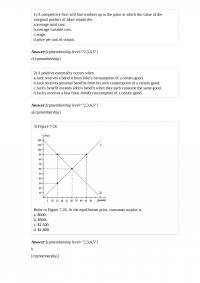
1) A competitive firm will hire workers up to the point at which the value of the marginal product of labor equals the a.average total cost. b.average variable cost. c.wage. d.price per unit of output. 2) A positive externality occurs […]
BUS 499
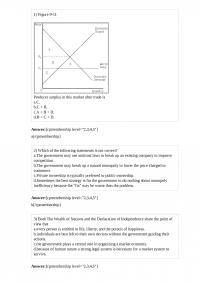
1) Figure 9-11 Producer surplus in this market after trade is a.C. b.C + B. c.A + B + D. d.B + C + D. 2) Which of the following statements is not correct? a.The government may use antitrust laws […]
ECON A 337 Test 2
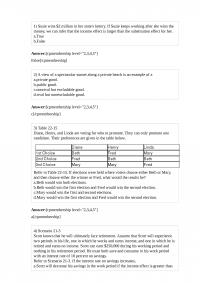
1) Susie wins $2 million in her state’s lottery. If Susie keeps working after she wins the money, we can infer that the income effect is larger than the substitution effect for her. a.True b.False 2) A view of a […]
ECON 526 Quiz
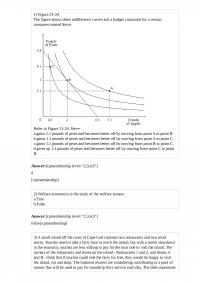
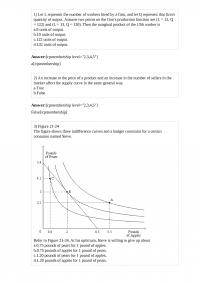
1) Figure 21-24 The figure shows three indifference curves and a budget constraint for a certain consumer named Steve. Refer to Figure 21-24. Steve a.gains 1.1 pounds of pears and becomes better off by moving from point A to point […]
ECON A 383 Quiz 2
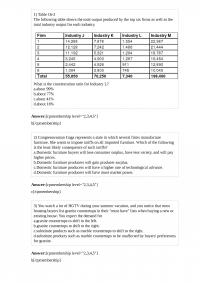
1) Table 16-2 The following table shows the total output produced by the top six firms as well as the total industry output for each industry. What is the concentration ratio for Industry L? a.about 99% b.about 77% c.about 41% […]
Economics 433 Midterm 1
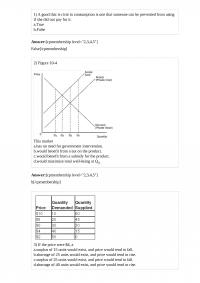
1) A good that is rival in consumption is one that someone can be prevented from using if she did not pay for it. a.True b.False 2) Figure 10-4 This market a.has no need for government intervention. b.would benefit from […]
Economics 484 Test 2
1) Positive statements are not a.descriptive. b.prescriptive. c.claims about how the world is. d.made by economists speaking as scientists. 2) If a government simplified its tax system the likeliest result would be a decrease in a.consumer surplus. b.producer surplus. c.in […]
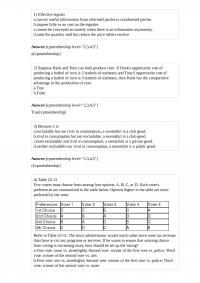
ECON A 288 Test
1) Effective signals a.convey useful information from informed parties to uninformed parties. b.impose little or no cost on the signaler. c.cannot be conveyed accurately when there is an information asymmetry. d.raise the quantity sold but reduce the price sellers receive. […]
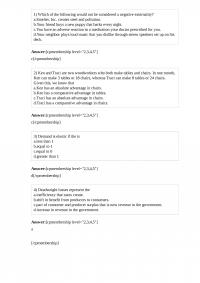
ECON A 389 Homework
1) Which of the following would not be considered a negative externality? a.Smelter, Inc. creates steel and pollution. b.Your friend buys a new puppy that barks every night. c.You have an adverse reaction to a medication your doctor prescribed for […]
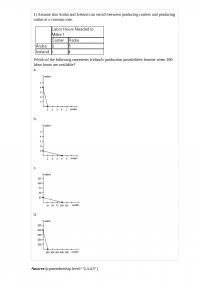
BUS 469 Test 2
1) Assume that Aruba and Iceland can switch between producing coolers and producing radios at a constant rate. Which of the following represents Iceland’s production possibilities frontier when 100 labor hours are available? a. b. c. d. Answer: 2) If […]
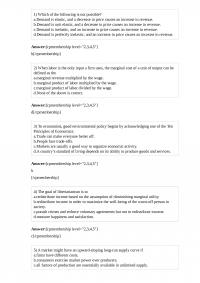
ECB 364 Homework
1) Which of the following is not possible? a.Demand is elastic, and a decrease in price causes an increase in revenue. b.Demand is unit elastic, and a decrease in price causes an increase in revenue. c.Demand is inelastic, and an […]
ECON A 256 Quiz 1
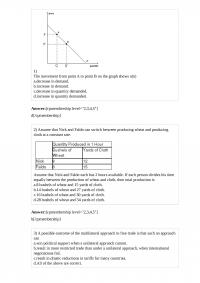
1) The movement from point A to point B on the graph shows a(n) a.decrease in demand. b.increase in demand. c.decrease in quantity demanded. d.increase in quantity demanded. 2) Assume that Nick and Faldo can switch between producing wheat and […]
ECON E 261 Midterm 1
1) Let L represent the number of workers hired by a firm, and let Q represent that firm’s quantity of output. Assume two points on the firm’s production function are (L = 12, Q = 122) and (L = 13, […]
MicroEconomic 833
1) Accounting profit is equal to a.marginal revenue minus marginal cost. b.total revenue minus the explicit cost of producing goods and services. c.total revenue minus the opportunity cost of producing goods and services. d.average revenue minus the average cost of […]
ECON A 388 Quiz 3
1) Music compact discs are normal goods. What will happen to the equilibrium price and quantity of music compact discs if musicians accept lower royalties, compact disc players become cheaper, more firms start producing music compact discs, and music lovers […]
ECB 213 Final
1) Capital owners are compensated according to the value of the marginal product of that capital. a.True b.False 2) You know an economist has crossed the line from policy adviser to scientist when he or she a.claims that the problem […]
ECB 221 Test 1
1) Which of the following does not affect an individual’s demand curve? a.expectations b.income c.prices of related goods d.the number of buyers 2) As an alternative to pairwise majority voting, each voter could be asked to rank the possible outcomes, […]
ECB 689 Homework
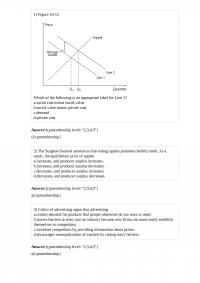
1) Figure 10-12 Which of the following is an appropriate label for Line 1? a.social cost minus social value b.social value minus private cost c.demand d.private cost 2) The Surgeon General announces that eating apples promotes healthy teeth. As a […]
ECON A 165 Test 1
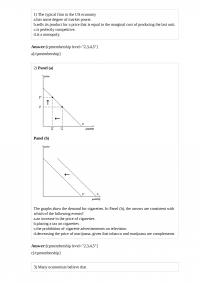
1) The typical firm in the US economy a.has some degree of market power. b.sells its product for a price that is equal to the marginal cost of producing the last unit. c.is perfectly competitive. d.is a monopoly. 2) Panel […]
ECB 439 Quiz
1) The less freedom young mothers have to work outside the home, the a.more elastic the supply of labor will be. b.less elastic the supply of labor will be. c.more horizontal the labor supply curve will be. d.larger is the […]
ECON A 888 Midterm
1) Which of the following is not an example of a compensating differential? a.paying workers who do dull, boring work higher wages than workers who do fun, interesting work, all else equal b.paying workers who work on the night shift […]
ECB 299 Quiz
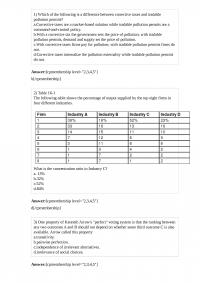
1) Which of the following is a difference between corrective taxes and tradable pollution permits? a.Corrective taxes are a market-based solution while tradable pollution permits are a command-and-control policy. b.With a corrective tax the government sets the price of pollution; […]
ECON A 713 Test 1
1) Willingness to pay a.measures the value that a buyer places on a good. b.is the amount a seller actually receives for a good minus the minimum amount the seller is willing to accept. c.is the maximum amount a buyer […]
ECB 675 Test
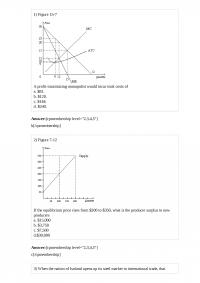
1) Figure 15-7 A profit-maximizing monopolist would incur total costs of a. $81. b. $120. c. $144. d. $240. 2) Figure 7-12 If the equilibrium price rises from $200 to $350, what is the producer surplus to new producers a. […]
BUS 389 Test 1
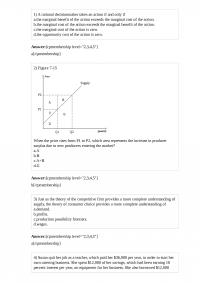
1) A rational decisionmaker takes an action if and only if a.the marginal benefit of the action exceeds the marginal cost of the action. b.the marginal cost of the action exceeds the marginal benefit of the action. c.the marginal cost […]
Economics 377 Test 1
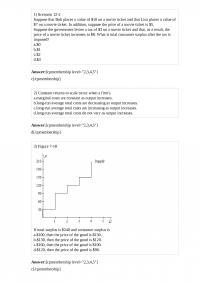
1) Scenario 12-2 Suppose that Bob places a value of $10 on a movie ticket and that Lisa places a value of $7 on a movie ticket. In addition, suppose the price of a movie ticket is $5. Suppose the […]
ECON A 881 Midterm 1
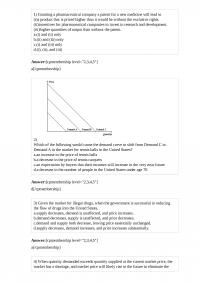
1) Granting a pharmaceutical company a patent for a new medicine will lead to (i)a product that is priced higher than it would be without the exclusive rights. (ii)incentives for pharmaceutical companies to invest in research and development. (iii)higher quantities […]
ECON 731 Midterm
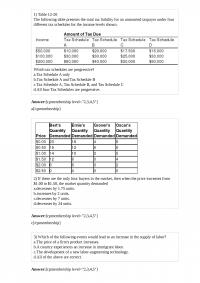
1) Table 12-20 The following table presents the total tax liability for an unmarried taxpayer under four different tax schedules for the income levels shown. Which tax schedules are progressive? a.Tax Schedule A only b.Tax Schedule A and Tax Schedule […]
MicroEconomic 709 Quiz
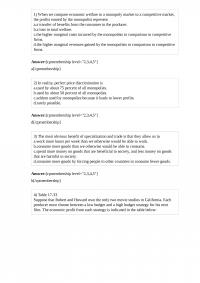
1) When we compare economic welfare in a monopoly market to a competitive market, the profits earned by the monopolist represent a.a transfer of benefits from the consumer to the producer. b.a loss in total welfare. c.the higher marginal costs […]
ECB 508 Midterm 2
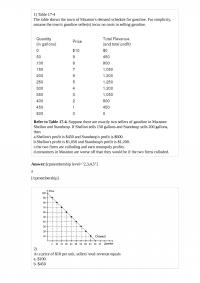
1) Table 17-4 The table shows the town of Mauston’s demand schedule for gasoline. For simplicity, assume the town’s gasoline seller(s) incur no costs in selling gasoline. Refer to Table 17-4. Suppose there are exactly two sellers of gasoline in […]
ECON 294
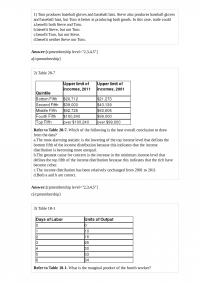
1) Tom produces baseball gloves and baseball bats. Steve also produces baseball gloves and baseball bats, but Tom is better at producing both goods. In this case, trade could a.benefit both Steve and Tom. b.benefit Steve, but not Tom. c.benefit […]
Economics 268 Quiz 2
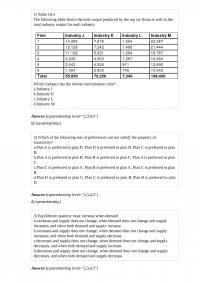
1) Table 16-2 The following table shows the total output produced by the top six firms as well as the total industry output for each industry. Which industry has the lowest concentration ratio? a.Industry J b.Industry K c.Industry L d.Industry […]
BUS 701 Test 2
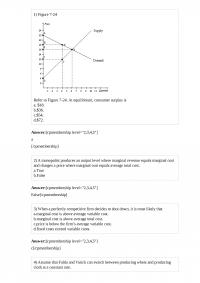
1) Figure 7-24 Refer to Figure 7-24. At equilibrium, consumer surplus is a. $18. b.$36. c.$54. d.$72. 2) A monopolist produces an output level where marginal revenue equals marginal cost and charges a price where marginal cost equals average total […]