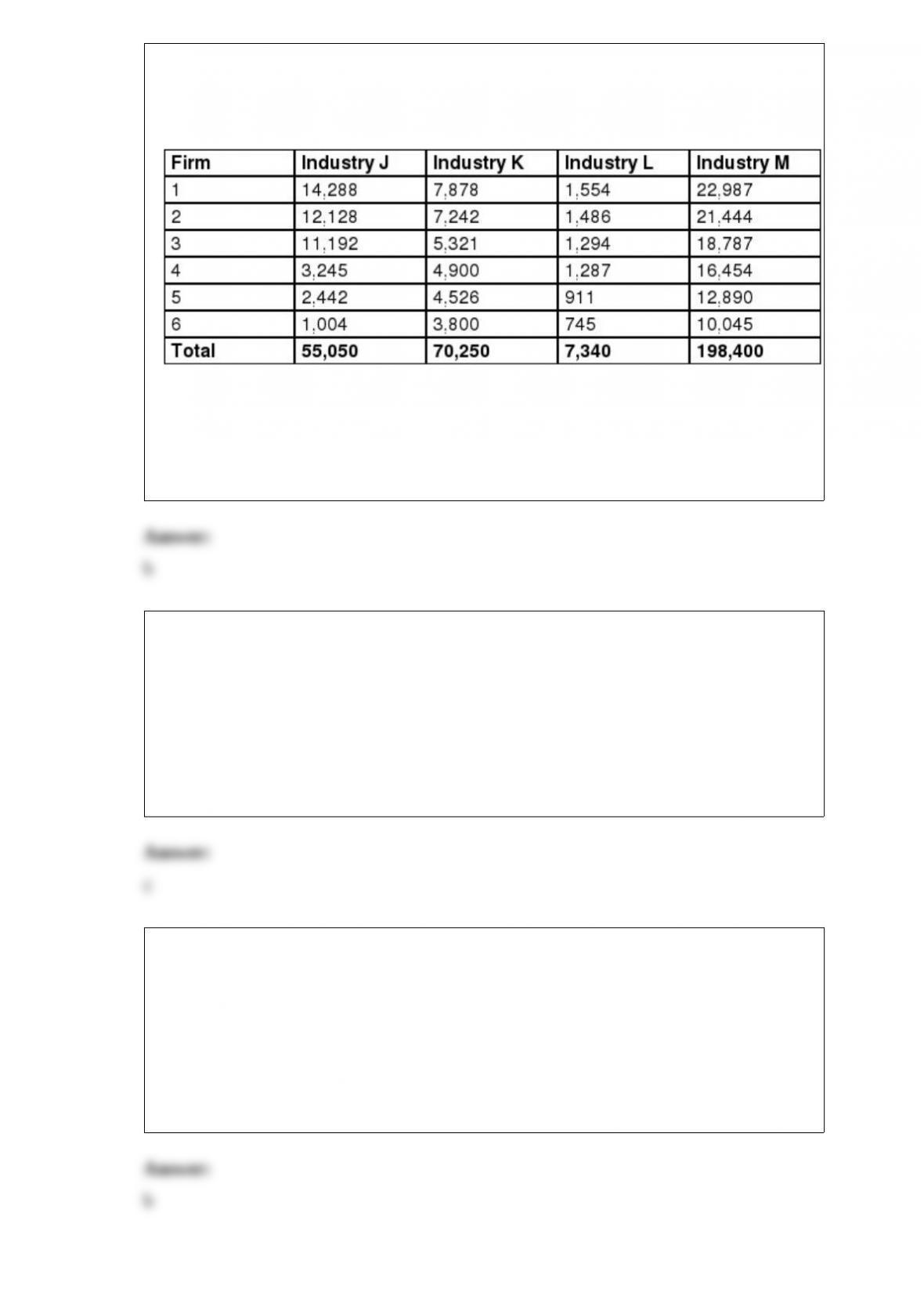
1) Table 16-2
The following table shows the total output produced by the top six firms as well as the
total industry output for each industry.
What is the concentration ratio for Industry L?
a.about 99%
b.about 77%
c.about 41%
d.about 16%
2) Congresswoman Gaga represents a state in which several firms manufacture
furniture. She wants to impose tariffs on all imported furniture. Which of the following
is the least likely consequence of such tariffs?
a.Domestic furniture buyers will lose consumer surplus, have less variety, and will pay
higher prices.
b.Domestic furniture producers will gain producer surplus.
c.Domestic furniture producers will have a higher rate of technological advance.
d.Domestic furniture producers will have more market power.
3) You watch a lot of HGTV during your summer vacation, and you notice that most
housing buyers list granite countertops in their “must have” lists when buying a new or
existing house. You expect the demand for
a.granite countertops to shift to the left.
b.granite countertops to shift to the right.
c.substitute products such as marble countertops to shift to the right.
d.substitute products such as marble countertops to be unaffected by buyers’ preferences
for granite.
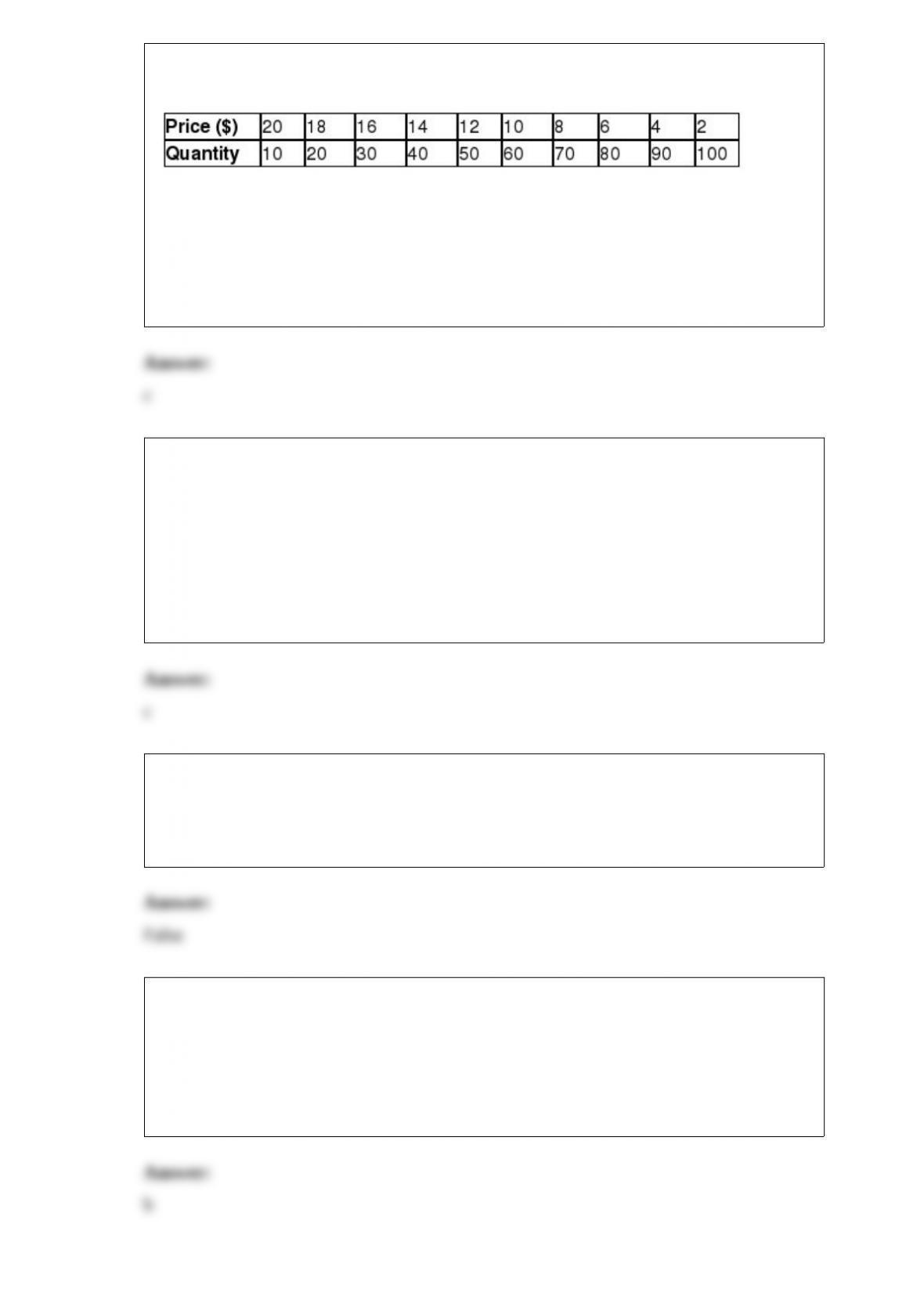
4) A monopolistically competitive firm faces the following demand curve for its
product:
The firm has total fixed costs of $120 and a constant marginal cost of $12 per unit. We
can conclude that
a.firms will exit this market.
b.firms will enter this market.
c.this market is in long-run equilibrium.
d.this firm is operating at its efficient scale.
5) Which of the following statements is true of wages, educational attainment, and
gender?
a.Male workers are compensated for attending college, while female workers generally
are not.
b.Female workers are compensated for attending college, while male workers generally
are not.
c.Both genders receive a higher wage for attending college.
d.Neither gender receives a higher wage for attending college.
6) In order to calculate the value of the marginal product of labor, a manager must know
the marginal product of labor and the wage rate of the worker.
a.True
b.False
7) Suppose that in 2020 the average citizen’s federal tax bill is $14,888 per person, and
total federal spending is $13,997 per person. In 2020, the federal government will have
a.a per person budget surplus of $891.
b.a per person budget deficit of $891.
c.horizontal equity.
d.vertical equity.
8) Conventional economic theory assumes that people
a.care a great deal about fairness.
b.are inconsistent over time in their decisionmaking.
c.are rational.
d.are satisficers.
9) If the government imposes a $3 tax in a market, the equilibrium price will rise by $3.
a.True
b.False
10) State and local governments
a.use a mix of taxes and fees to generate revenue.
b.are required by federal mandate to levy income taxes.
c.are required to tax property at a standard rate set by the federal government.
d.must tax wages more heavily than interest and dividend income.
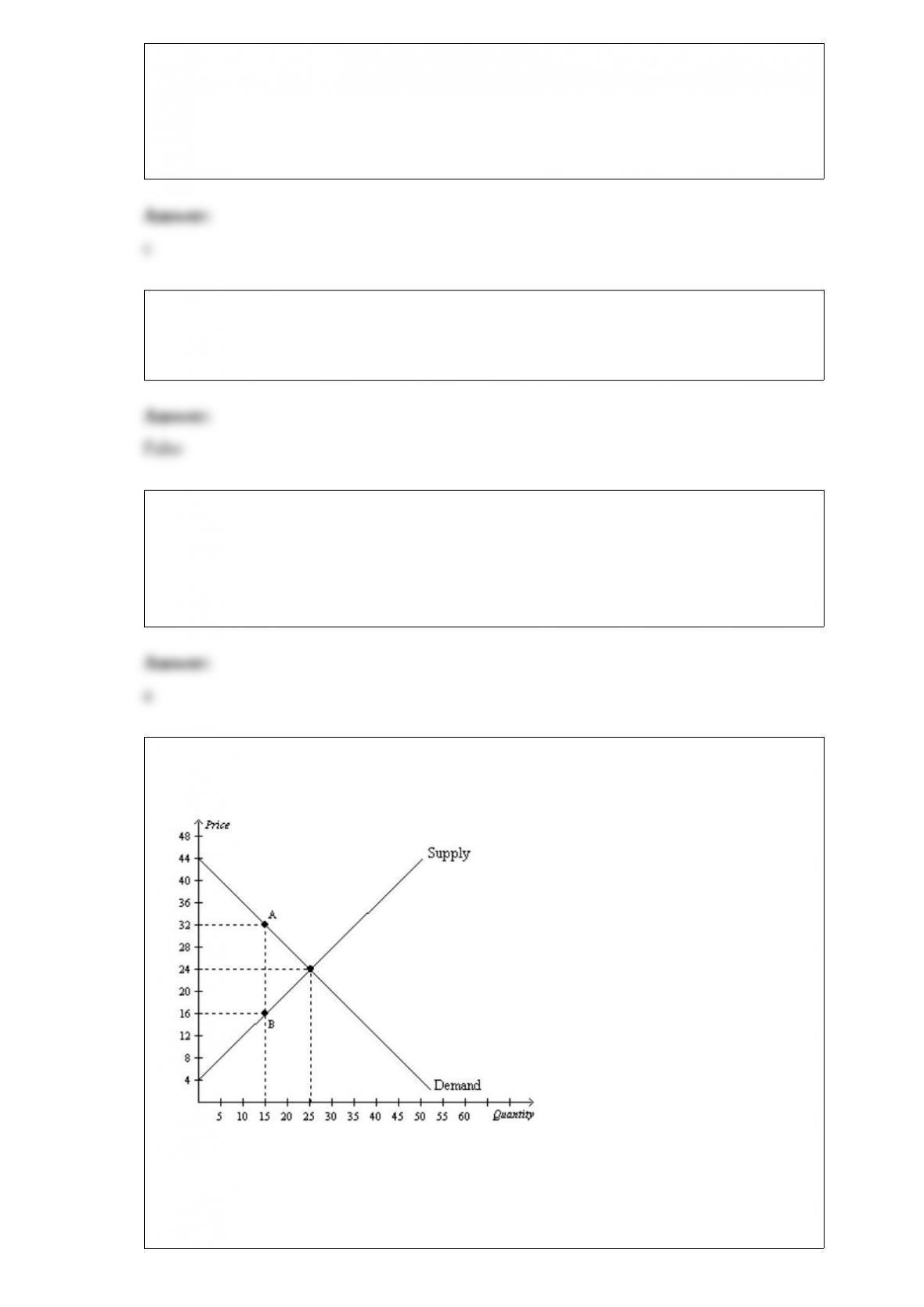
11) Figure 8-7
The vertical distance between points A and B represents a tax in the market.
The deadweight loss associated with this tax amounts to
a.$80, and this figure represents the amount by which tax revenue to the government
exceeds the combined loss of producer and consumer surpluses.
b.$80, and this figure represents the surplus that is lost because the tax discourages

mutually advantageous trades between buyers and sellers.
c.$60, and this figure represents the amount by which tax revenue to the government
exceeds the combined loss of producer and consumer surpluses.
d.$60, and this figure represents the surplus that is lost because the tax discourages
mutually advantageous trades between buyers and sellers.
12) Assume that a college student purchases only Ramen noodles and textbooks. If
Ramen noodles are an inferior good and textbooks are a normal good, then the income
effect associated with a decrease in the price of a textbook will result in
a.a decrease in the consumption of textbooks and a decrease in the consumption of
Ramen noodles.
b.a decrease in the consumption of textbooks and an increase in the consumption of
Ramen noodles.
c.an increase in the consumption of textbooks and an increase in the consumption of
Ramen noodles.
d.an increase in the consumption of textbooks and a decrease in the consumption of
Ramen noodles.
13) Welfare economics explains which of the following in the market for televisions?
a.The government sets the price of televisions; firms respond to the price by producing
a specific level of output.
b.The government sets the quantity of televisions; firms respond to the quantity by
charging a specific price.
c.The market equilibrium price for televisions maximizes the total welfare of television
buyers and sellers.
d.The market equilibrium price for televisions maximizes consumer welfare and
minimizes producer profit.
14) Figure 10-10
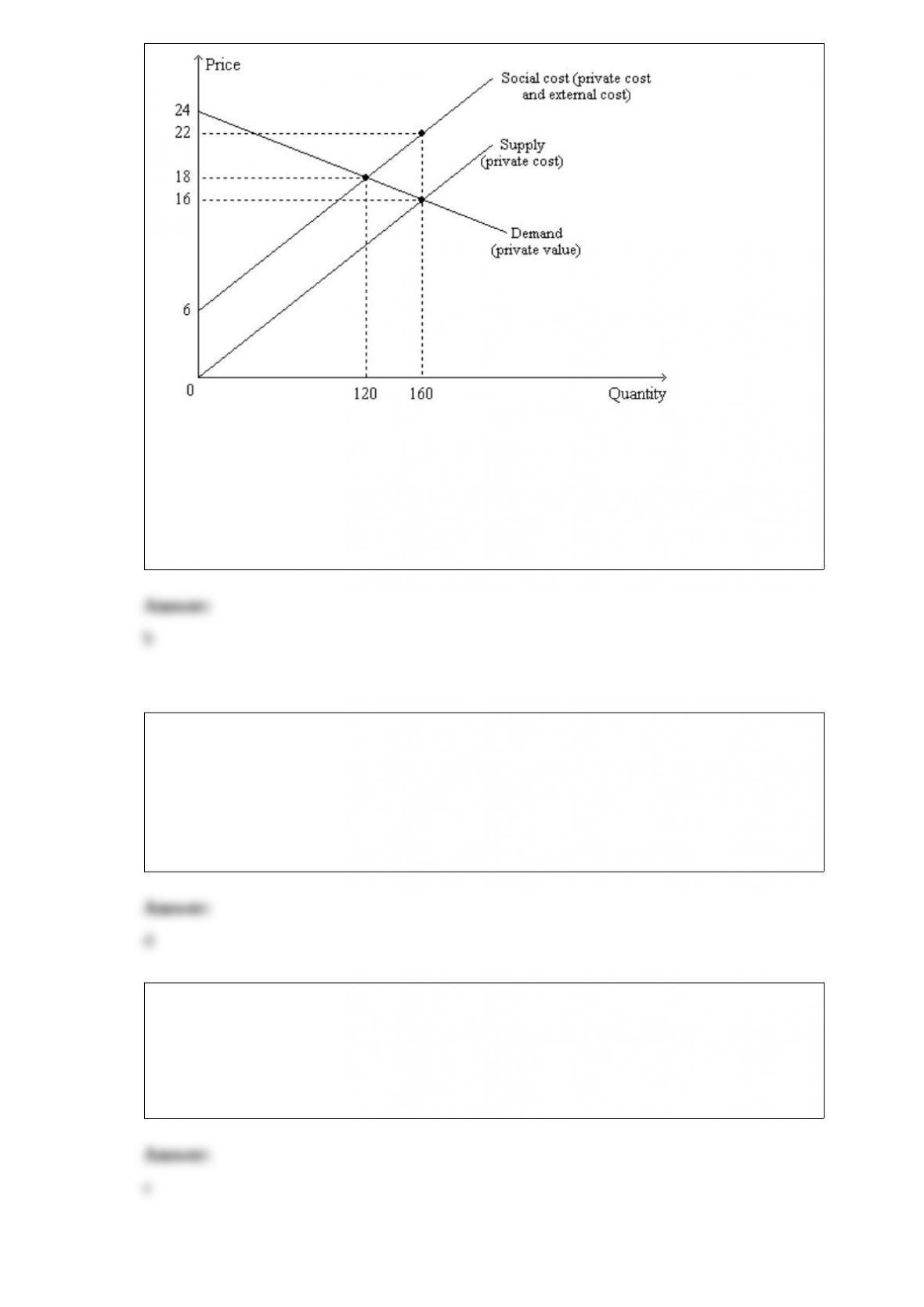
“The social cost of the last unit produced exceeds the value to buyers of the last unit
produced by $3.” This statement is correct at which quantity of output?
a.120 units
b.140 units
c.160 units
d.The statement is true at all quantities of output.
15) A monopolistically competitive market is like a monopoly in that
a.both market structures feature easy entry by new firms in the long run.
b.the main objective of firms in both market structures is something other than profit
maximization.
c.firms in both market structures produce the welfare-maximizing level of output.
d.firms in both market structures set price above marginal cost.
16) In economics, the cost of something is
a.the dollar amount of obtaining it.
b.always measured in units of time given up to get it.
c.what you give up to get it.
d.often impossible to quantify, even in principle.

17) Suppose a labor-augmenting technology were developed for a product that
increased the marginal product of labor for all workers. Which of the following would
happen in the labor market for this product?
a.Demand would decrease.
b.Demand would increase.
c.Supply would decrease.
d.Supply would increase.
18) The Condorcet voting paradox applies to situations in which voters
a.decide between exactly two possible outcomes.
b.decide among more than two possible outcomes.
c.as a group have transitive preferences.
d.choose the inferior candidate even though the majority preferred the better candidate.