Archives: Quiz
ECON A 436 Quiz 1
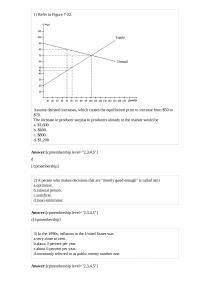
1) Refer to Figure 7-22. Assume demand increases, which causes the equilibrium price to increase from $50 to $70. The increase in producer surplus to producers already in the market would be a. $1,600. b. $600. c. $800. d. $1,200. […]
Economics 305
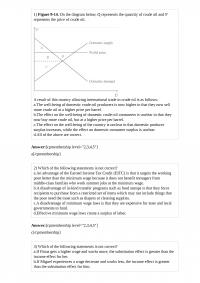
1) Figure 9-14. On the diagram below, Q represents the quantity of crude oil and P represents the price of crude oil. A result of this country allowing international trade in crude oil is as follows: a.The well-being of domestic […]
MicroEconomic 327 Test 1
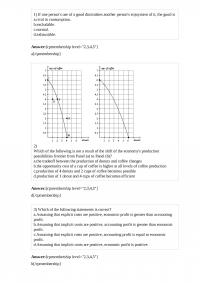
1) If one person’s use of a good diminishes another person’s enjoyment of it, the good is a.rival in consumption. b.excludable. c.normal. d.exhaustible. 2) Which of the following is not a result of the shift of the economy’s production possibilities […]
ECB 710 Test 1
1) The Laffer curve illustrates how taxes in markets with greater elasticities of demand compare to taxes in markets with smaller elasticities of supply. a.True b.False 2) For an economist, the idea of making assumptions is regarded generally as a […]
ECB 302 Quiz 3
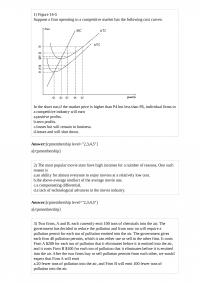
1) Figure 14-5 Suppose a firm operating in a competitive market has the following cost curves: In the short run,if the market price is higher than P4 but less than P6, individual firms in a competitive industry will earn a.positive […]
ECB 153 Homework
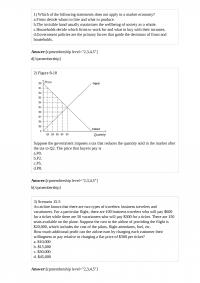
1) Which of the following statements does not apply to a market economy? a.Firms decide whom to hire and what to produce. b.The invisible hand usually maximizes the wellbeing of society as a whole. c.Households decide which firms to work […]
ECON A 382 Quiz 2
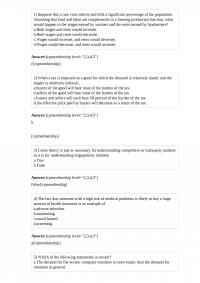
1) Suppose that a rare virus infects and kills a significant percentage of the population. Assuming that land and labor are complements in a farming production function, what would happen to the wages earned by workers and the rents earned […]
MicroEconomic 564 1 Individual
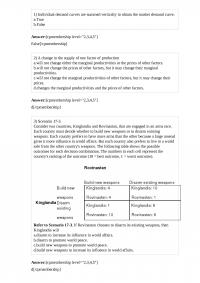
1) Individual demand curves are summed vertically to obtain the market demand curve. a.True b.False 2) A change in the supply of one factor of production a.will not change either the marginal productivities or the prices of other factors. b.will […]
ECON E 638 Midterm 1
1) In the long run the primary effect of increasing the quantity of money is higher prices. a.True b.False 2) Studies indicate that the for beer is about 0.9. A government policy aimed at reducing beer consumption changed the price […]
BUS 269
1) For a country that is considering the adoption of either a tariff or an import quota on a particular good, an important difference is that a.an import quota has no effect on consumer surplus, while a tariff decreases consumer […]
MicroEconomic 229 Quiz 1
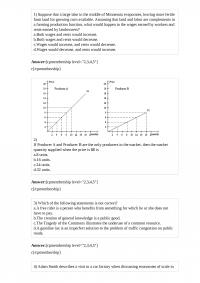
1) Suppose that a large lake in the middle of Minnesota evaporates, leaving more fertile farm land for growing corn available. Assuming that land and labor are complements in a farming production function, what would happen to the wages earned […]
Economics 560
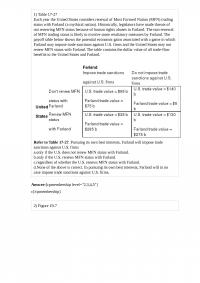
1) Table 17-27 Each year the United States considers renewal of Most Favored Nation (MFN) trading status with Farland (a mythical nation). Historically, legislators have made threats of not renewing MFN status because of human rights abuses in Farland. The […]
ECON A 804
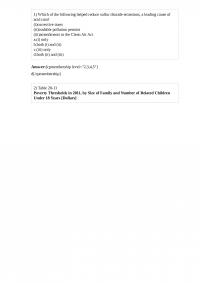
1) Which of the following helped reduce sulfur dioxide emissions, a leading cause of acid rain? (i)corrective taxes (ii)tradable pollution permits (iii)amendments to the Clean Air Act a.(i) only b.both (i) and (ii) c.(iii) only d.both (ii) and (iii) 2) […]
ECON E 232 Quiz 1
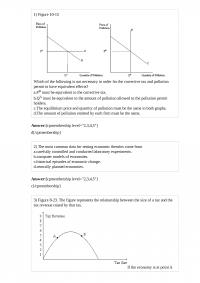
1) Figure 10-15 Which of the following is not necessary in order for the corrective tax and pollution permit to have equivalent effects? a.PB must be equivalent to the corrective tax. b.QA must be equivalent to the amount of pollution […]
ECON A 649 Final
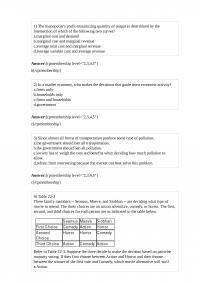
1) The monopolist’s profit-maximizing quantity of output is determined by the intersection of which of the following two curves? a.marginal cost and demand b.marginal cost and marginal revenue c.average total cost and marginal revenue d.average variable cost and average revenue […]
ECB 663
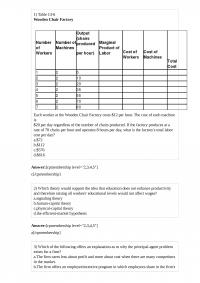
1) Table 13-6 Wooden Chair Factory Each worker at the Wooden Chair Factory costs $12 per hour. The cost of each machine is $20 per day regardless of the number of chairs produced. If the factory produces at a rate […]
ECON E 605
1) Economists argue that we can calculate the value of a human life by observing voluntary risks that people take every day. a.True b.False 2) Assume Leo buys coffee beans in a competitive market. It follows that a.Leo has a […]
Economics 304 Midterm 2
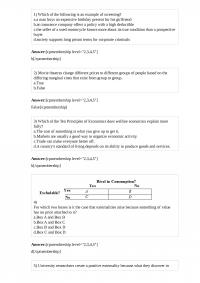
1) Which of the following is an example of screening? a.a man buys an expensive birthday present for his girlfriend b.an insurance company offers a policy with a high deductible c.the seller of a used motorcycle knows more about its […]
ECB 751
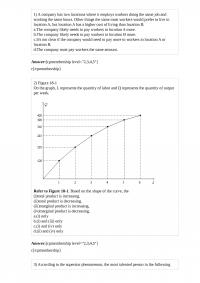
1) A company has two locations where it employs workers doing the same job and working the same hours. Other things the same most workers would prefer to live in location A, but location A has a higher cost of […]
ECON 506 Quiz 1 1 The Condorcet
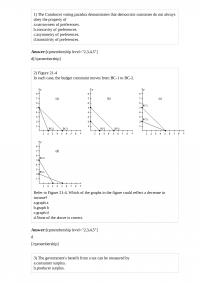
1) The Condorcet voting paradox demonstrates that democratic outcomes do not always obey the property of a.narrowness of preferences. b.concavity of preferences. c.asymmetry of preferences. d.transitivity of preferences. 2) Figure 21-4 In each case, the budget constraint moves from BC-1 […]
ECON 315
1) Total surplus is always equal to the sum of consumer surplus and producer surplus. a.True b.False 2) Which of the following is an example of labor-market discrimination? You may assume that worker A and worker B have identical characteristics […]
MicroEconomic 772 Quiz
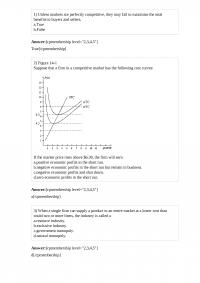
1) Unless markets are perfectly competitive, they may fail to maximize the total benefits to buyers and sellers. a.True b.False 2) Figure 14-1 Suppose that a firm in a competitive market has the following cost curves: If the market price […]
ECB 188 Quiz 3
1) Since measurable factors such as years of experience and years of education explain less than half of the variation in wages, ability, effort, and chance must play a significant role in determining wages. a.True b.False 2) The study by […]
ECON 765 Quiz 1
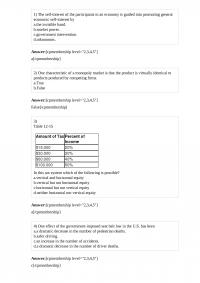
1) The self-interest of the participants in an economy is guided into promoting general economic self-interest by a.the invisible hand. b.market power. c.government intervention. d.oikonomos. 2) One characteristic of a monopoly market is that the product is virtually identical to […]
ECON 662
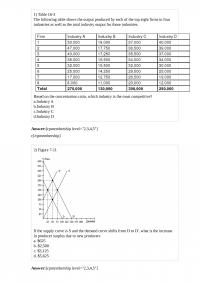
1) Table 16-3 The following table shows the output produced by each of the top eight firms in four industries as well as the total industry output for those industries. Based on the concentration ratio, which industry is the most […]
ECON E 717 Midterm 2
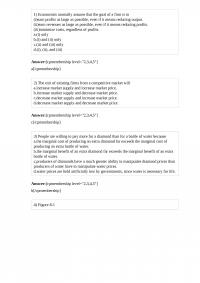
1) Economists normally assume that the goal of a firm is to (i)earn profits as large as possible, even if it means reducing output. (ii)earn revenues as large as possible, even if it means reducing profits. (iii)minimize costs, regardless of […]
MicroEconomic 501 Quiz
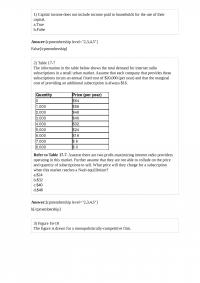
1) Capital income does not include income paid to households for the use of their capital. a.True b.False 2) Table 17-7 The information in the table below shows the total demand for internet radio subscriptions in a small urban market. […]
BUS 898 Final
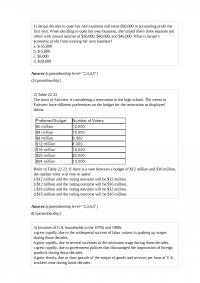
1) Jacqui decides to open her own business and earns $50,000 in accounting profit the first year. When deciding to open her own business, she turned down three separate job offers with annual salaries of $30,000, $40,000, and $45,000. What […]
ECON 610 Test 2
1) Which of the following statements is (are) true of a monopoly? (i)A monopoly has the ability to set the price of its product at whatever level it desires. (ii)A monopoly’s total revenue will always increase when it increases the […]
ECB 685 Midterm 1
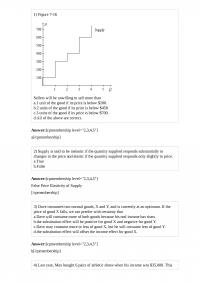
1) Figure 7-16 Sellers will be unwilling to sell more than a.1 unit of the good if its price is below $200. b.2 units of the good if its price is below $450. c.3 units of the good if its […]
ECON A 518 Midterm
1) The task of economic regulation is to a.protect monopoly profits. b.approximate the results of the competitive market. c.replace competition with government ownership. d.increase competition within the market. 2) One drawback to industrial policy is that a.technology spillovers are too […]
BUS 391 Final
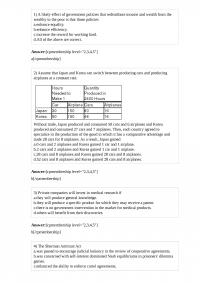
1) A likely effect of government policies that redistribute income and wealth from the wealthy to the poor is that those policies a.enhance equality. b.enhance efficiency. c.increase the reward for working hard. d.All of the above are correct. 2) Assume […]
ECON A 792 Midterm 1
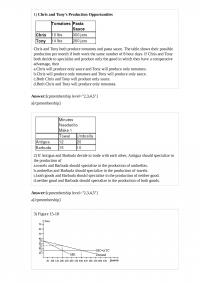
1) Chris and Tony’s Production Opportunities Chris and Tony both produce tomatoes and pasta sauce. The table shows their possible production per month if both work the same number of 8 hour days. If Chris and Tony both decide to […]
ECB 183 Test 1
1) Goods that do not have close substitutes have downward-sloping demand curves. a.True b.False 2) When a certain monopoly sets its price at $8 it sells 64 units. When the monopoly sets its price at $10 it sells 62 units. […]
ECON A 301 Midterm 2
1) A positive externality a.causes the product to be overproduced. b.provides an additional benefit to market participants. c.benefits consumers because it results in a lower equilibrium price. d.is a benefit to a market bystander. 2) A signaling theory of education […]
MicroEconomic 767 Test 2
1) Which of the following statements is correct? a.A disadvantage of a minimum-wage law is that it may benefit unskilled workers who are not low-income workers. b.A disadvantage of a negative income tax program is that a poor person who […]
ECON A 453
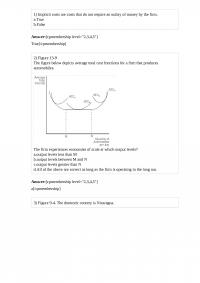
1) Implicit costs are costs that do not require an outlay of money by the firm. a.True b.False 2) Figure 13-9 The figure below depicts average total cost functions for a firm that produces automobiles. The firm experiences economies of […]
MicroEconomic 629 1 If
1) If preferences exhibit the property of transitivity, then a.the preferences are irrational. b.individuals prefer more government involvement in private markets than do people whose preferences are not transitive. c.preferences change over time more quickly than when preferences are not […]
ECON A 395 Final
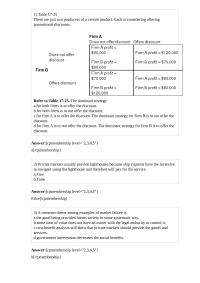
1) Table 17-25 There are just two producers of a certain product. Each is considering offering promotional discounts. Refer to Table 17-25. The dominant strategy a.for both firms is to offer the discount. b.for both firms is to not offer […]
ECON A 880 Midterm
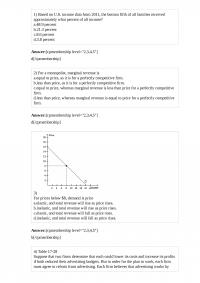
1) Based on U.S. income data from 2011, the bottom fifth of all families received approximately what percent of all income? a.48.9 percent b.21.3 percent c.8.6 percent d.3.8 percent 2) For a monopolist, marginal revenue is a.equal to price, as […]
ECON 342 Quiz 1
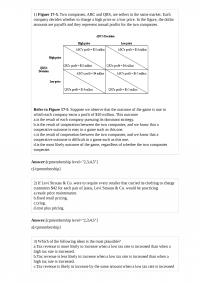
1) Figure 17-5. Two companies, ABC and QRS, are sellers in the same market. Each company decides whether to charge a high price or a low price. In the figure, the dollar amounts are payoffs and they represent annual profits […]
ECON E 419 Quiz
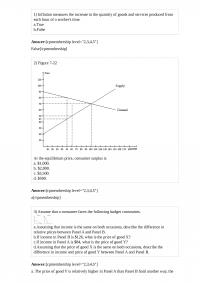
1) Inflation measures the increase in the quantity of goods and services produced from each hour of a worker’s time. a.True b.False 2) Figure 7-22 At the equilibrium price, consumer surplus is a. $1,000. b. $2,000. c. $3,500. d. $500. […]
Economics 104
1) At price of $1.25, a paper manufacturer is willing to supply 150 spiral notebooks per day. At a price of $1.50, the paper manufacturer is willing to supply 175 spiral notebooks per day. Using the midpoint method, the price […]
BUS 508 Homework
1) When two goods are perfect complements, the indifference curves are right angles. a.True b.False 2) Critics of the minimum wage argue that a.labor demand is inelastic so firms can adjust production. b.too many older employees benefit at the expense […]
Economics 752 Homework
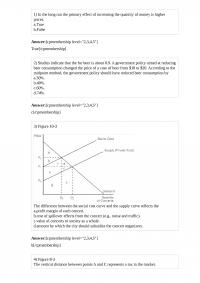
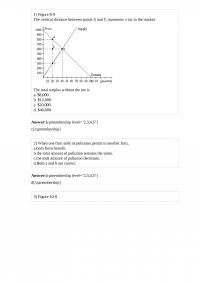
1) Figure 8-9 The vertical distance between points A and C represents a tax in the market. The total surplus without the tax is a. $8,000. b. $12,000. c. $20,000. d. $40,000. 2) When one firm sells its pollution permit […]
MicroEconomic 170
1) Corporate profits are a.included in payroll taxes. b.exempt from taxes. c.taxed twice, once as profit and once as dividends. d.taxed to pay for Medicare. 2) The two taxes that together provide the U.S. federal government with almost 80 percent […]
ECB 205 Test 2
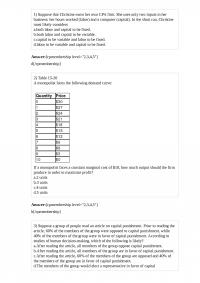
1) Suppose that Christine owns her own CPA firm. She uses only two inputs in her business: her hours worked (labor) and a computer (capital). In the short run, Christine most likely considers a.both labor and capital to be fixed. […]
Economics 113 Quiz 3
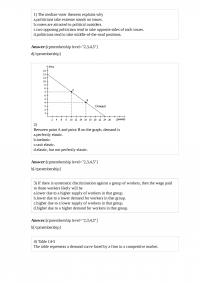
1) The median-voter theorem explains why a.politicians take extreme stands on issues. b.voters are attracted to political outsiders. c.two opposing politicians tend to take opposite sides of each issues. d.politicians tend to take middle-of-the-road positions. 2) Between point A and […]
MicroEconomic 165
1) If government officials break up a natural monopoly into four smaller firms, then a.each firm will be unable to maximize profits due to increased competition. b.competition will force firms to produce surplus output, which drives up price. c.the average […]
ECON A 830
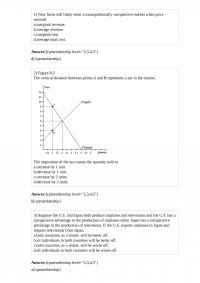
1) New firms will likely enter a monopolistically competitive market when price exceeds a.marginal revenue. b.average revenue. c.marginal cost. d.average total cost. 2) Figure 8-2 The vertical distance between points A and B represents a tax in the market. The […]