1) Capital income does not include income paid to households for the use of their
capital.
a.True
b.False
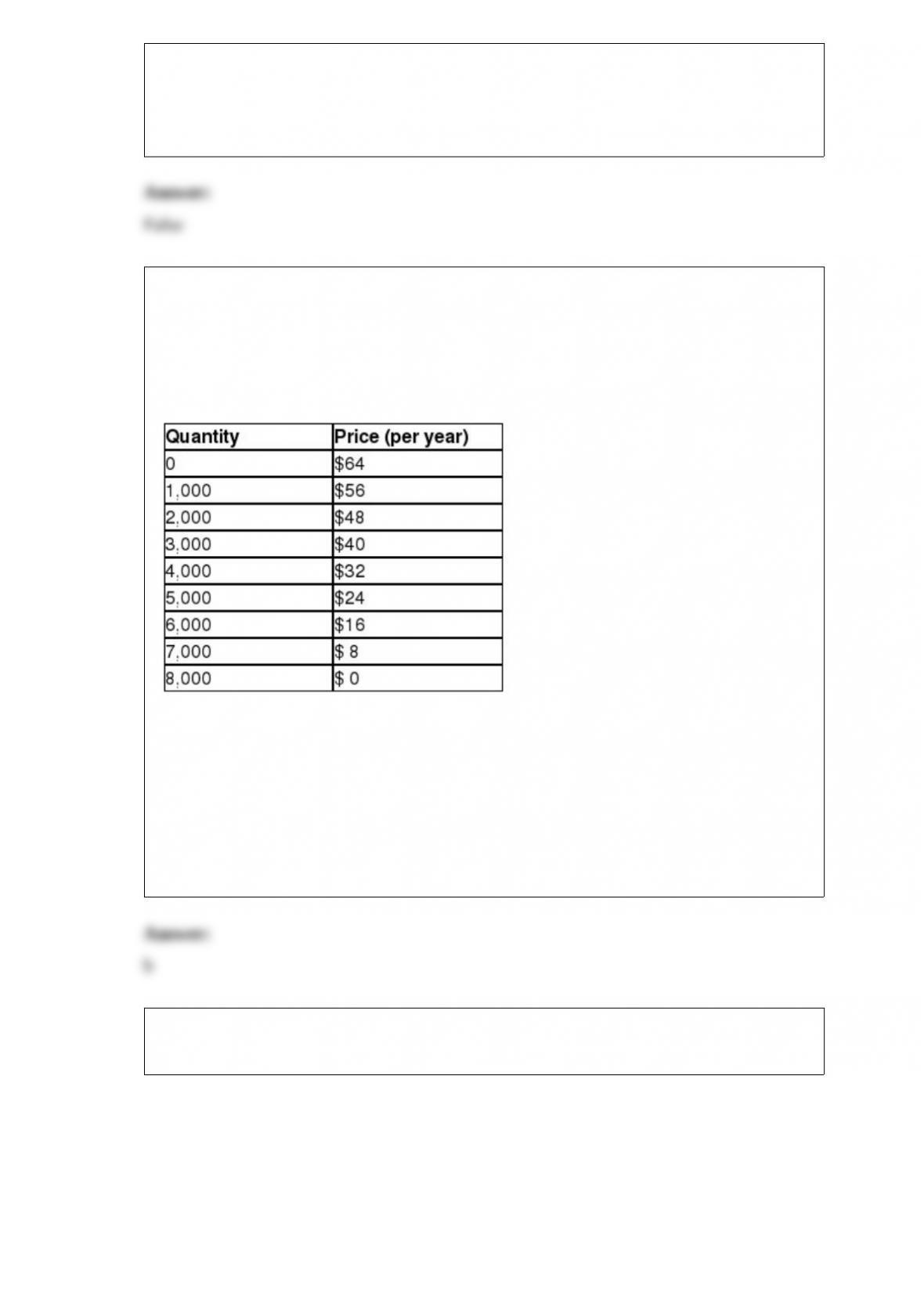
2) Table 17-7
The information in the table below shows the total demand for internet radio
subscriptions in a small urban market. Assume that each company that provides these
subscriptions incurs an annual fixed cost of $20,000 (per year) and that the marginal
cost of providing an additional subscription is always $16.
Refer to Table 17-7. Assume there are two profit-maximizing internet radio providers
operating in this market. Further assume that they are not able to collude on the price
and quantity of subscriptions to sell. What price will they charge for a subscription
when this market reaches a Nash equilibrium?
a.$24
b.$32
c.$40
d.$48
3) Figure 16-10
The figure is drawn for a monopolistically-competitive firm.
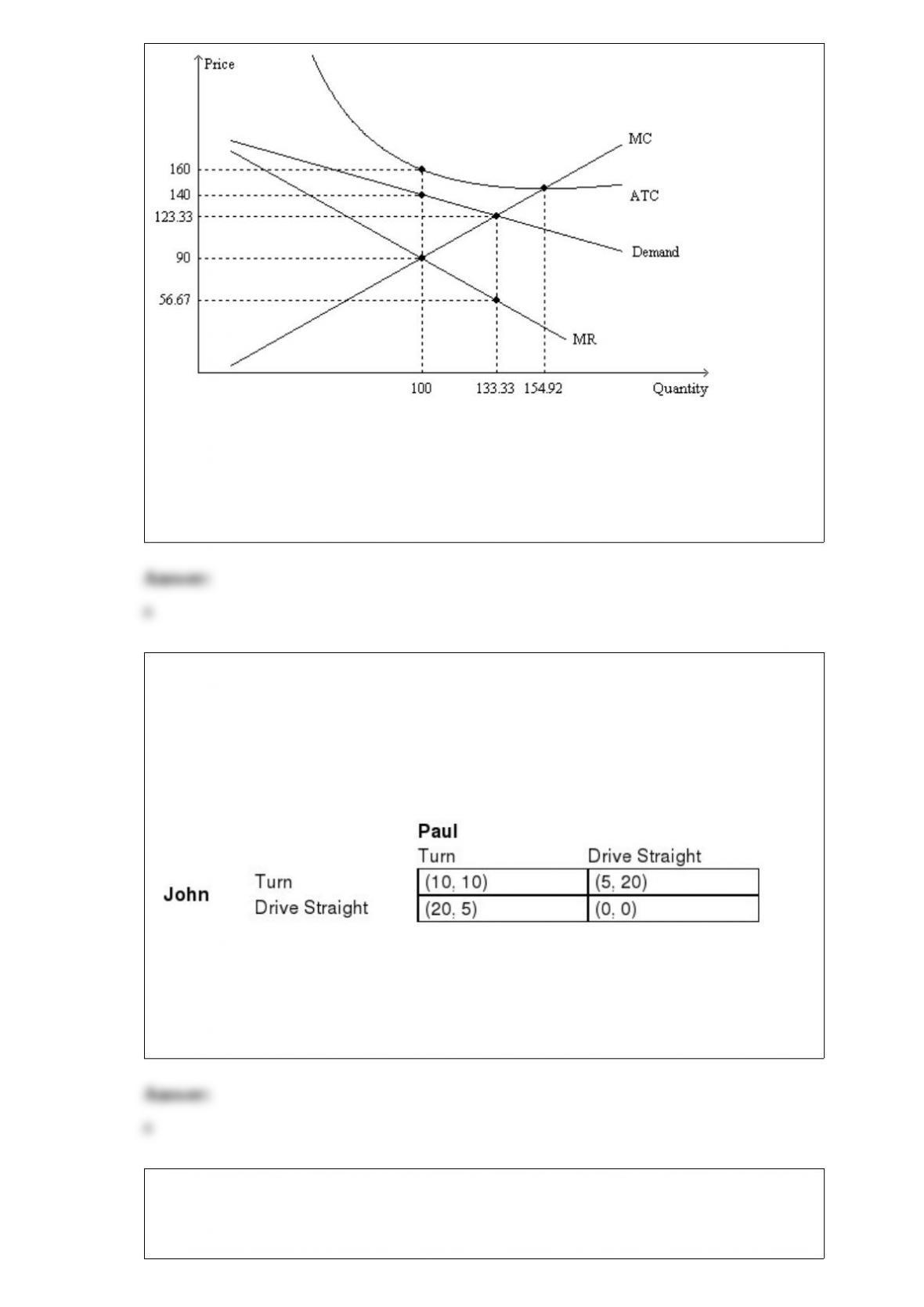
In order to maximize its profit, the firm will choose to produce
a.100 units of output.
b.between 100 and 133.33 units of output.
c.133.33 units of output.
d.154.92 units of output.
4) Table 17-21
The Chicken Game is named for a contest in which drivers test their courage by driving
straight at each other. John and Paul have a common interest to avoid crashing into each
other, but they also have a personal, competing interest to not turn first to demonstrate
their courage to those observing the contest. The payoff table for this situation is
provided below. The payoffs are shown as (John, Paul).
Refer to Table 17-21. What is John’s dominant strategy?
a.John has no dominant strategy.
b.John should always choose Turn.
c.John should always choose Drive Straight.
d.John has two dominant strategies.
5) Figure 14-9
In the figure below, panel (a) depicts the linear marginal cost of a firm in a competitive
market, and panel (b) depicts the linear market supply curve for a market with a fixed
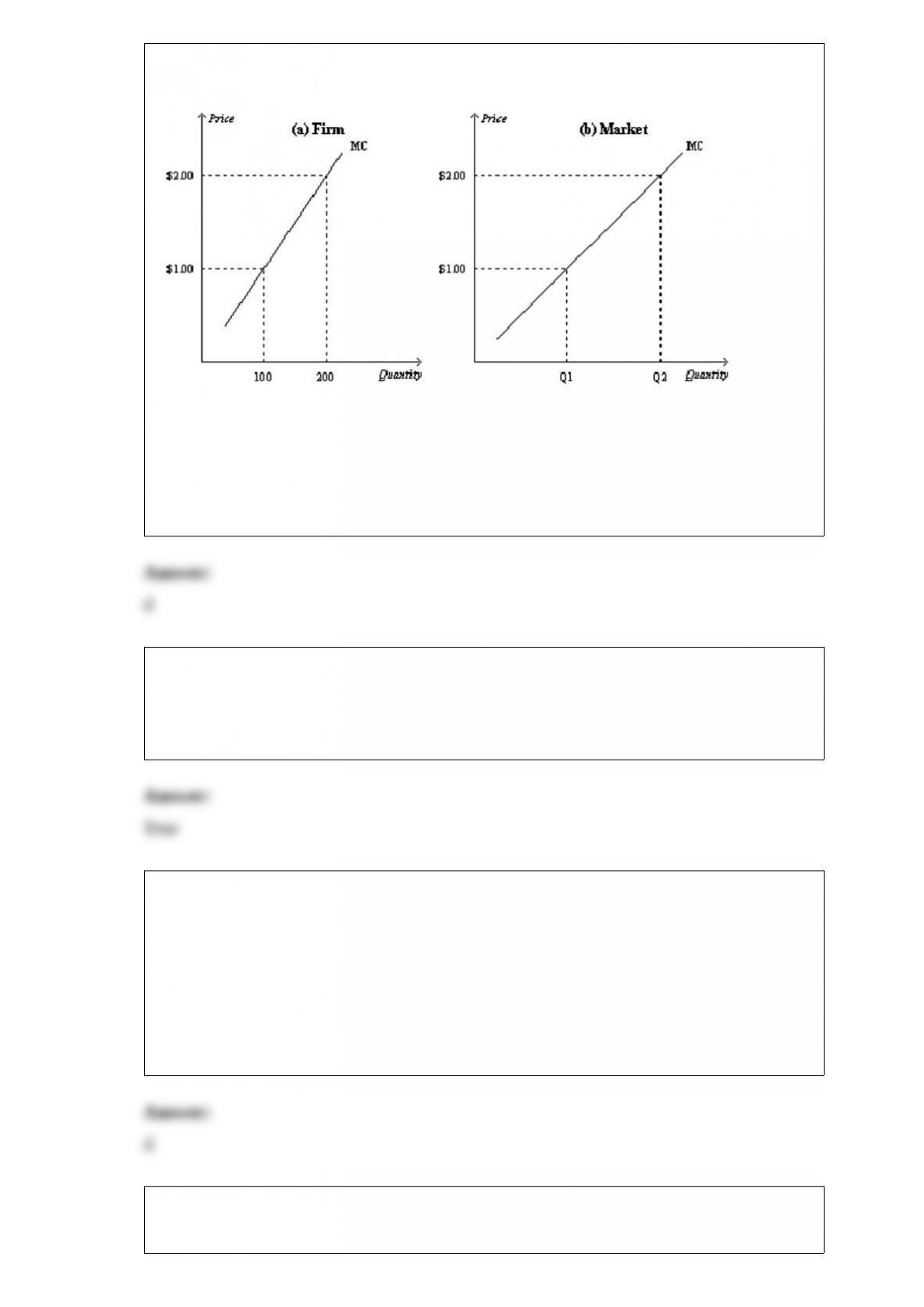
number of identical firms.
If at a market price of $1.75, 52,500 units of output are supplied to this market, how
many identical firms are participating in this market?
a.75
b.100
c.250
d.300
6) A second or third worker may have a higher marginal product than the first worker in
certain circumstances.
a.True
b.False
7) Which of the following relationships involves asymmetric information?
a.A potential employee knows more about his skills and motivations than potential
employers.
b.The seller of a used car knows of mechanical problems that aren’t easy for the average
buyer to observe.
c.A real estate agent knows the lowest price a seller is willing to sell her house for, but
does not reveal it to people he shows the house.
d.All of the above are correct.
8) Resale price maintenance involves a firm
a.colluding with another firm to restrict output and raise prices.

b.selling two individual products together for a single price rather than selling each
product individually at separate prices.
c.temporarily cutting the price of its product to drive a competitor out of the market.
d.requiring that the firm reselling its product do so at a specified price.
9) Due to the nature of the patent laws on pharmaceuticals, the market for such drugs
a.always remains a competitive market.
b.always remains a monopolistic market.
c.switches from competitive to monopolistic once the firm’s patent runs out.
d.switches from monopolistic to competitive once the firm’s patent runs out.
10) Which of the following markets impose deadweight losses on society?
(i)perfect competition
(ii)monopolistic competition
(iii)monopoly
a.(i) and (ii) only
b.(ii) and (iii) only
c.(i) and (iii) only
d.(i) only
11) A rational decisionmaker
a.ignores marginal changes and focuses instead on the big picture.
b.ignores the likely effects of government policies when he or she makes choices.
c.takes an action only if the marginal benefit of that action exceeds the marginal cost of
that action.
d.takes an action only if the combined benefits of that action and previous actions
exceed the combined costs of that action and previous actions.
12) When quantity moves proportionately the same amount as price, demand is
a.elastic, and the is 1
b.perfectly elastic, and the is infinitely large.
c.perfectly inelastic, and the is 0
d.unit elastic, and the is 1
13) Under a progressive tax system, the marginal tax rate could be equal to the average
tax rate only when a taxpayer
a.has a very high income.
b.has a very low income.
c.is self-employed.
d.invests in a retirement plan.
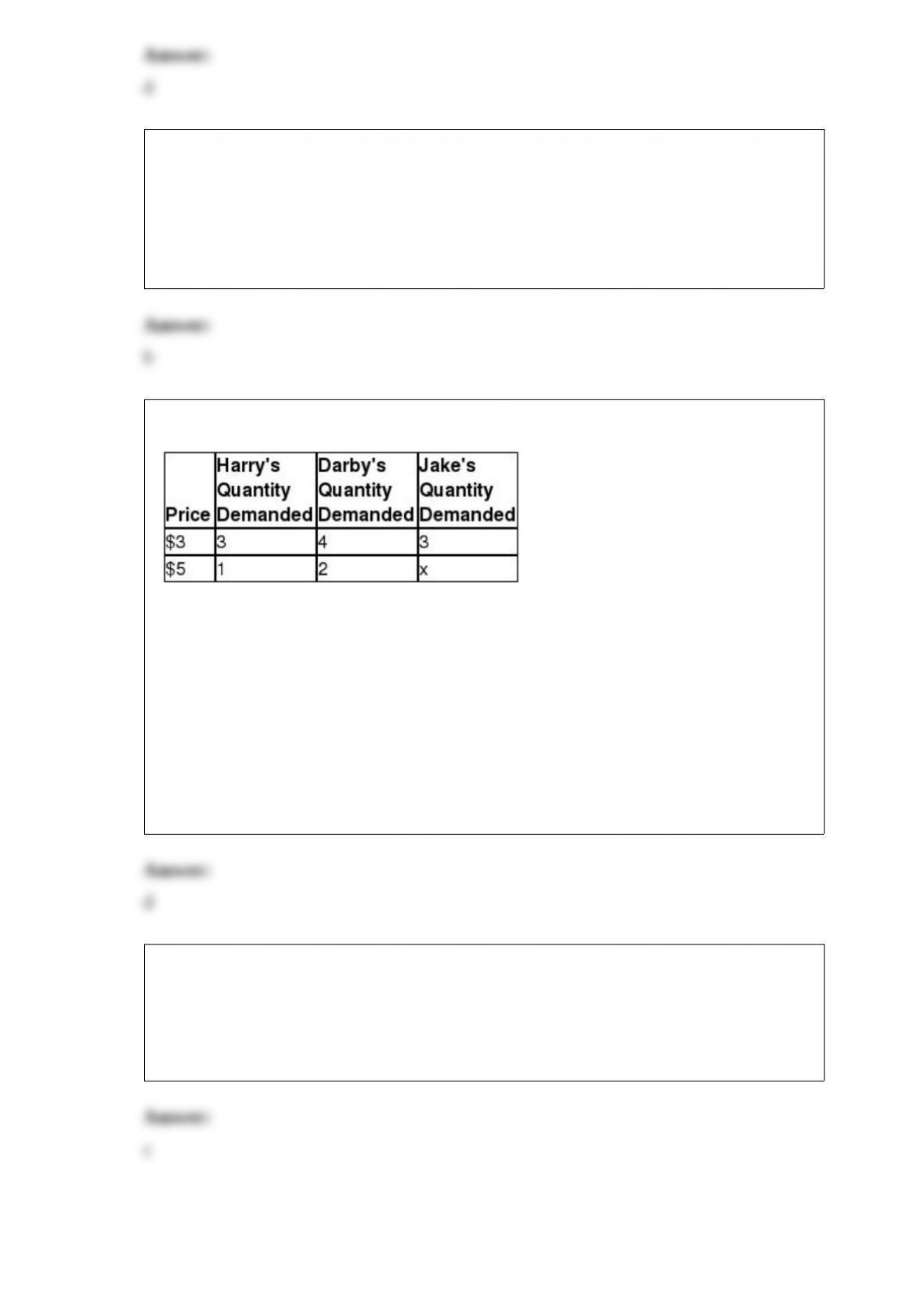
14) The demand schedule below pertains to sandwiches demanded per week.
Suppose Harry, Darby, and Jake are the only demanders of sandwiches. Also suppose x
= 2. Then
a.the slope of Jake’s demand curve is 1/2, and the slope of the market demand curve is –
5/2.
b.the slope of Jake’s demand curve is 1/2, and the slope of the market demand curve is –
2/5.
c.the slope of Jake’s demand curve is 2, and the slope of the market demand curve is –
5/2.
d.the slope of Jake’s demand curve is 2, and the slope of the market demand curve is –
2/5.
15) The Tragedy of the Commons
a.occurs most often with public goods.
b.is only applicable to shared grazing rights among sheep herders.
c.is eliminated when property rights are assigned to individuals.
d.occurs when social incentives are in line with private incentives.
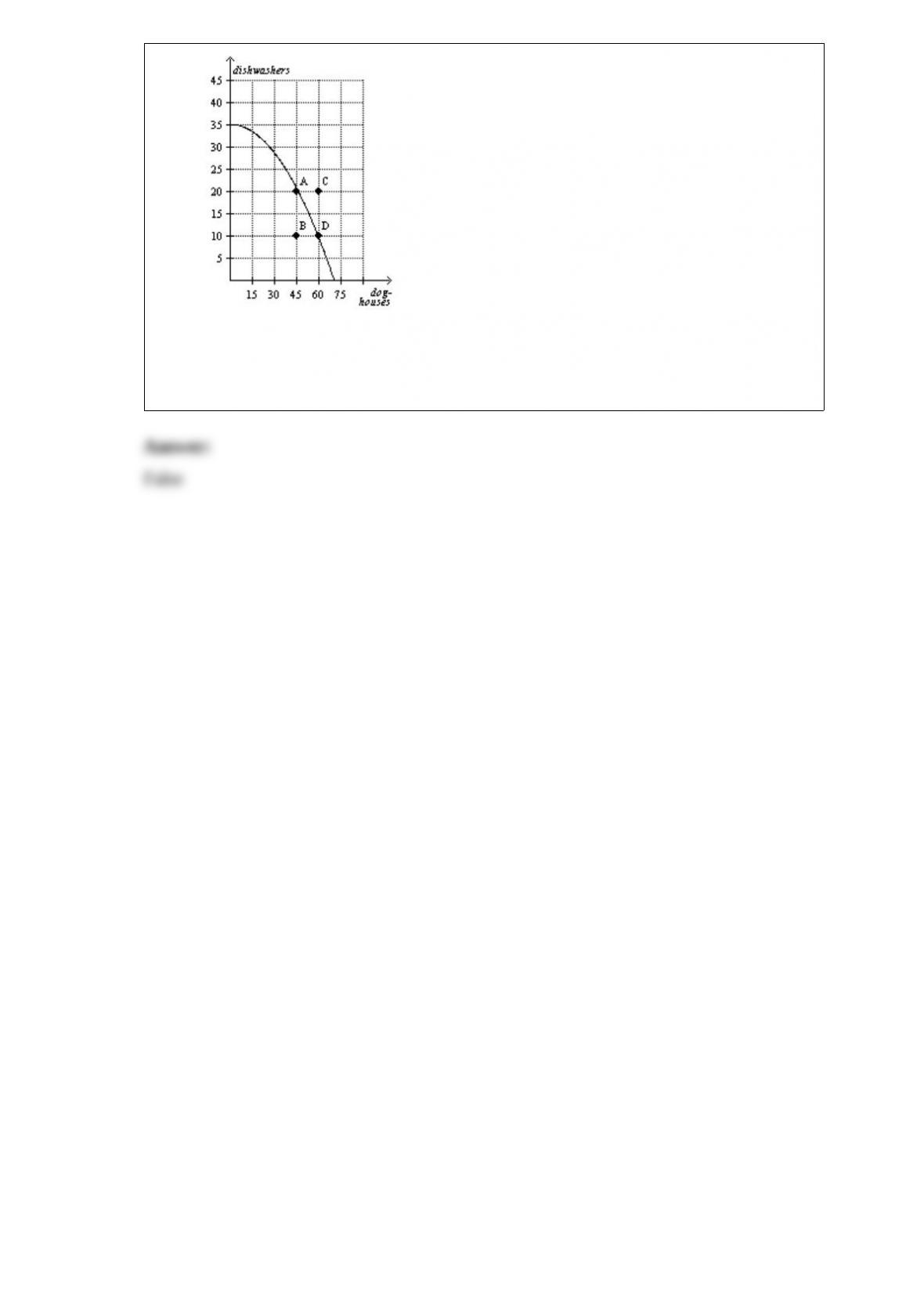
16) It is possible for this economy to produce 75
doghouses.
a.True
b.False