1) Which of the following is an example of screening?
a.a man buys an expensive birthday present for his girlfriend
b.an insurance company offers a policy with a high deductible
c.the seller of a used motorcycle knows more about its true condition than a prospective
buyer
d.society supports long prison terms for corporate criminals
2) Movie theatres charge different prices to different groups of people based on the
differing marginal costs that exist from group to group.
a.True
b.False
3) Which of the Ten Principles of Economics does welfare economics explain more
fully?
a.The cost of something is what you give up to get it.
b.Markets are usually a good way to organize economic activity.
c.Trade can make everyone better off.
d.A country’s standard of living depends on its ability to produce goods and services.
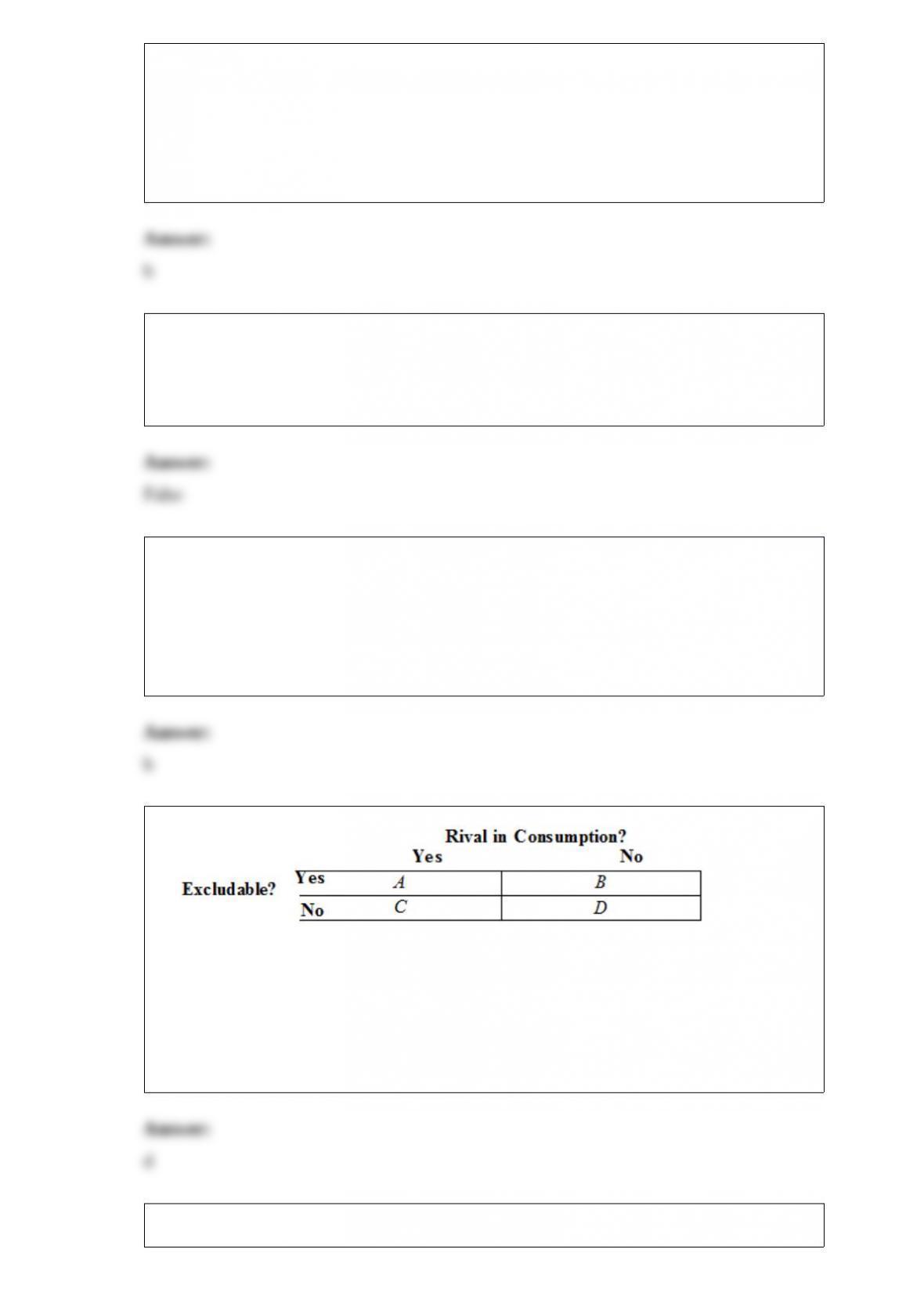
4)
For which two boxes is it the case that externalities arise because something of value
has no price attached to it?
a.Box A and Box B
b.Box A and Box C
c.Box B and Box D
d.Box C and Box D
5) University researchers create a positive externality because what they discover in
their research labs can easily be learned by others who haven’t contributed to the
research costs. Suppose that the federal government gives grants to these researchers
equal to the their per-unit production externality. What is the relationship between the
equilibrium quantity of university research and the socially optimal quantity of
university research produced?
a.The equilibrium quantity is greater than the socially optimal quantity.
b.They are equal.
c.The equilibrium quantity is less than the socially optimal quantity.
d.There is not enough information to answer the question.
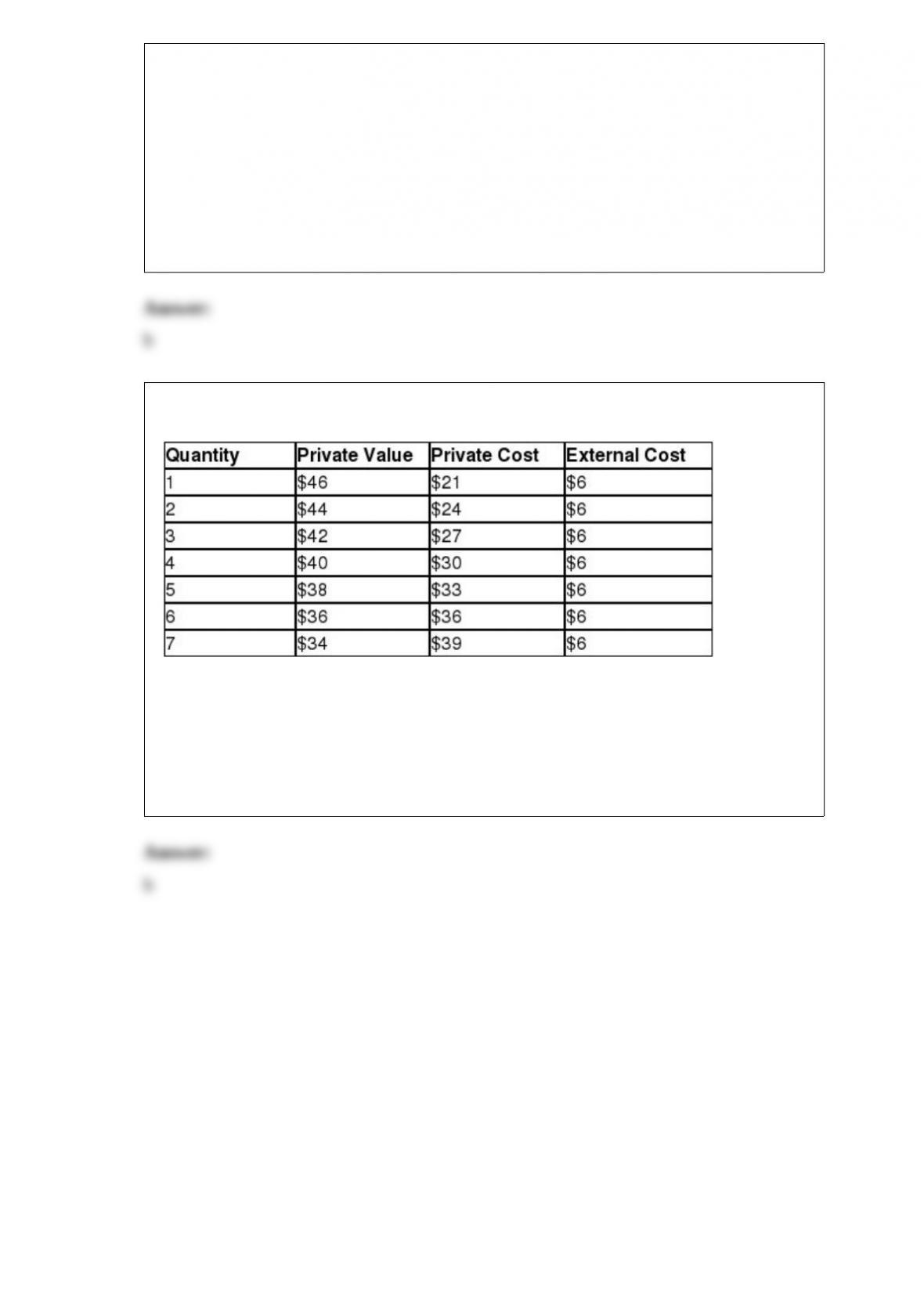
6) Table 10-4
Taking into account private and external costs, total surplus in the market equilibrium
amounts to
a.$28.
b.$39.
c.$45.
d.$51.
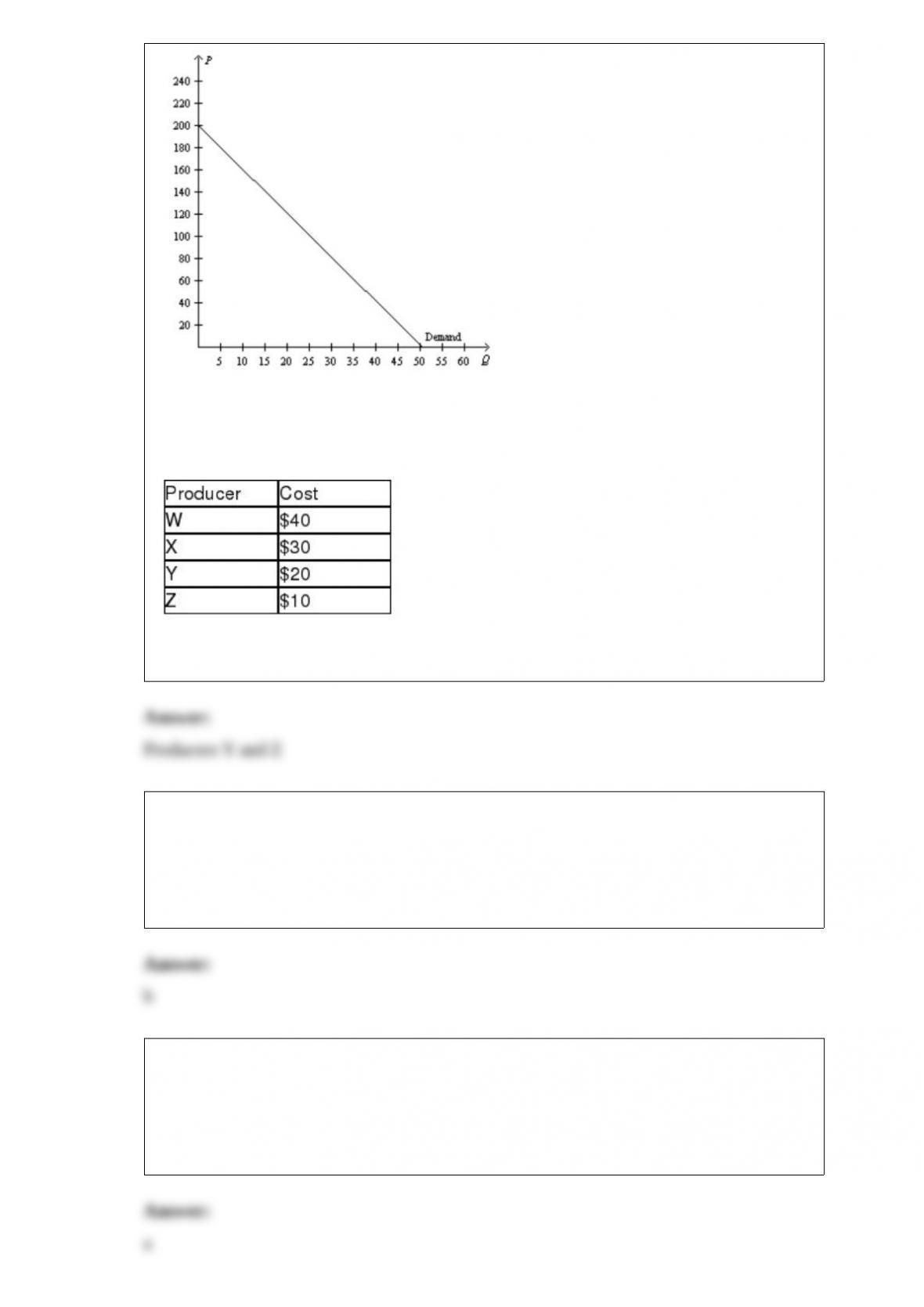
7) Table 7-19
The following table shows the cost of producing a good for the only four producers in a
market.
Refer to Table 7-19. If the market price is $28, which producers will supply units in the
market?
8) A leftward shift of a supply curve is called a(n)
a.increase in supply.
b.decrease in supply.
c.decrease in quantity supplied.
d.increase in quantity supplied.
9) The Black Death in fourteenth-century Europe resulted in
a.a lower marginal product of land.
b.a lower marginal product of labor of surviving workers.
c.economic hardship for surviving peasants.
d.economic prosperity for surviving landowners.
10) Consider Mandy’s decision to go to college. If she goes to college, she will spend
$20,000 on tuition, $10,000 on room and board, and $2,000 on books. If she does not
go to college, she will earn $18,000 working in a store and spend $8,000 on room and
board. Mandy’s cost of going to college is
a.$32,000.
b.$42,000.
c.$50,000.
d.$58,000.
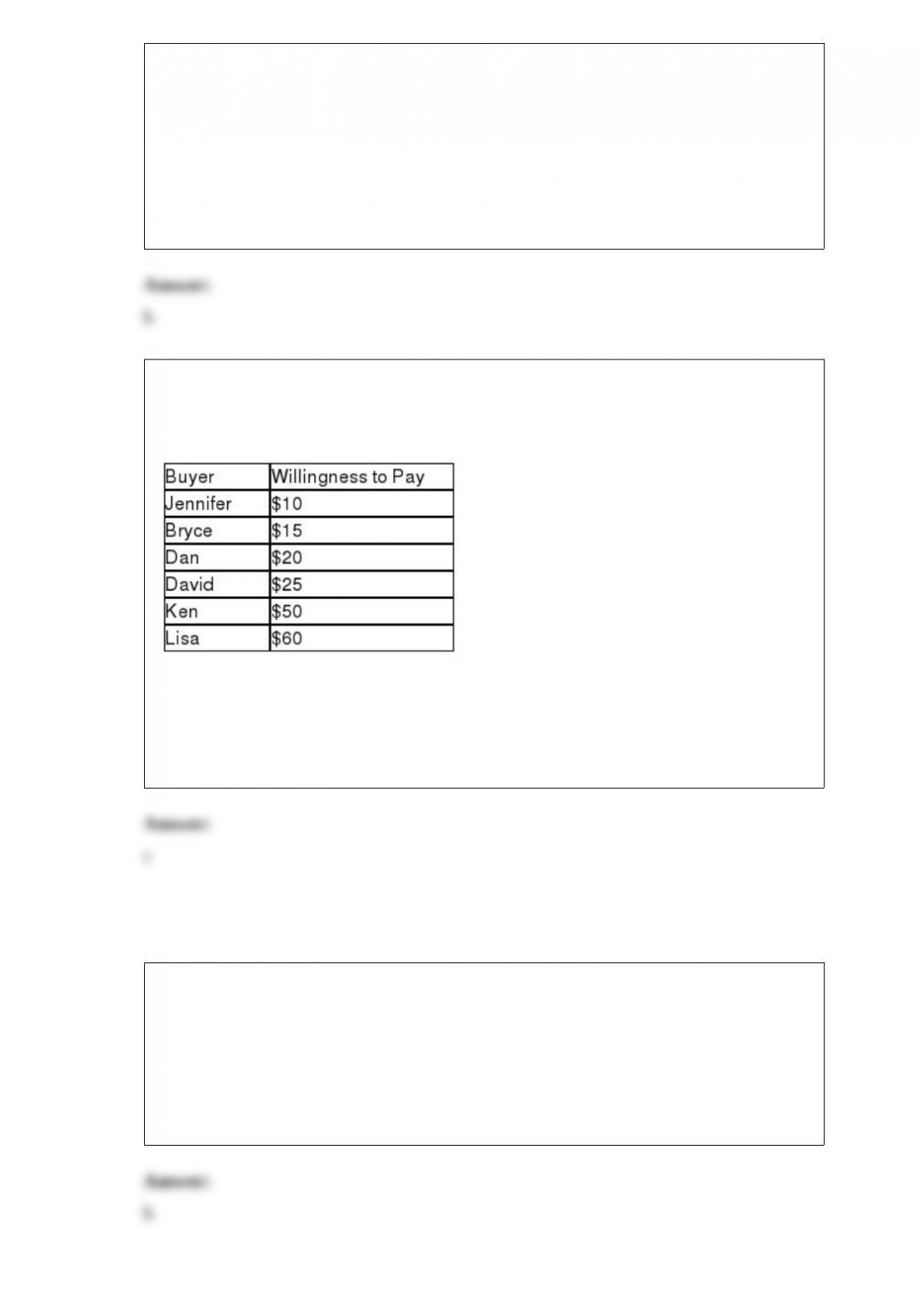
11) Table 7-4
The numbers in Table 7-1 reveal the maximum willingness to pay for a ticket to a
Chicago Cubs vs. St. Louis Cardinal’s baseball game at Wrigley Field.
If tickets sell for $25 each, then what is the total consumer surplus in the market?
a. $25
b. $35
c. $60
d. $110
12) Which of the following is not an example of a barrier to entry?
a.Mighty Mitch’s Mining Company owns a unique plot of land in Tanzania, under
which lies the only large deposit of Tanzanite in the world.
b.A college student starts a part-time tutoring business.
c.A novelist obtains a copyright for her new book.
d.A taxi cab driver in New York City obtains a license to legally provide transportation
in New York City.
13) Lori and Maya are competitors in a local market. Each is trying to decide if it is
better to advertise on TV, on radio, or not at all. If they both advertise on TV, each will
earn a profit of $10,000. If they both advertise on radio, each will earn a profit of
$14,000. If neither advertises at all, each will earn a profit of $20,000. If one advertises
on TV and other advertises on radio, then the one advertising on TV will earn $16,000
and the other will earn $6,000. If one advertises on TV and the other does not advertise,
then the one advertising on TV will earn $30,000 and the other will earn $4,000. If one
advertises on radio and the other does not advertise, then the one advertising on radio
will earn $24,000 and the other will earn $8,000. If both follow their dominant strategy,
then Lori will
a.advertise on TV and earn $10,000.
b.advertise on radio and earn $14,000.
c.not advertise at all and earn $20,000.
d.None of the above is correct. Lori and Maya do not have dominant strategies.
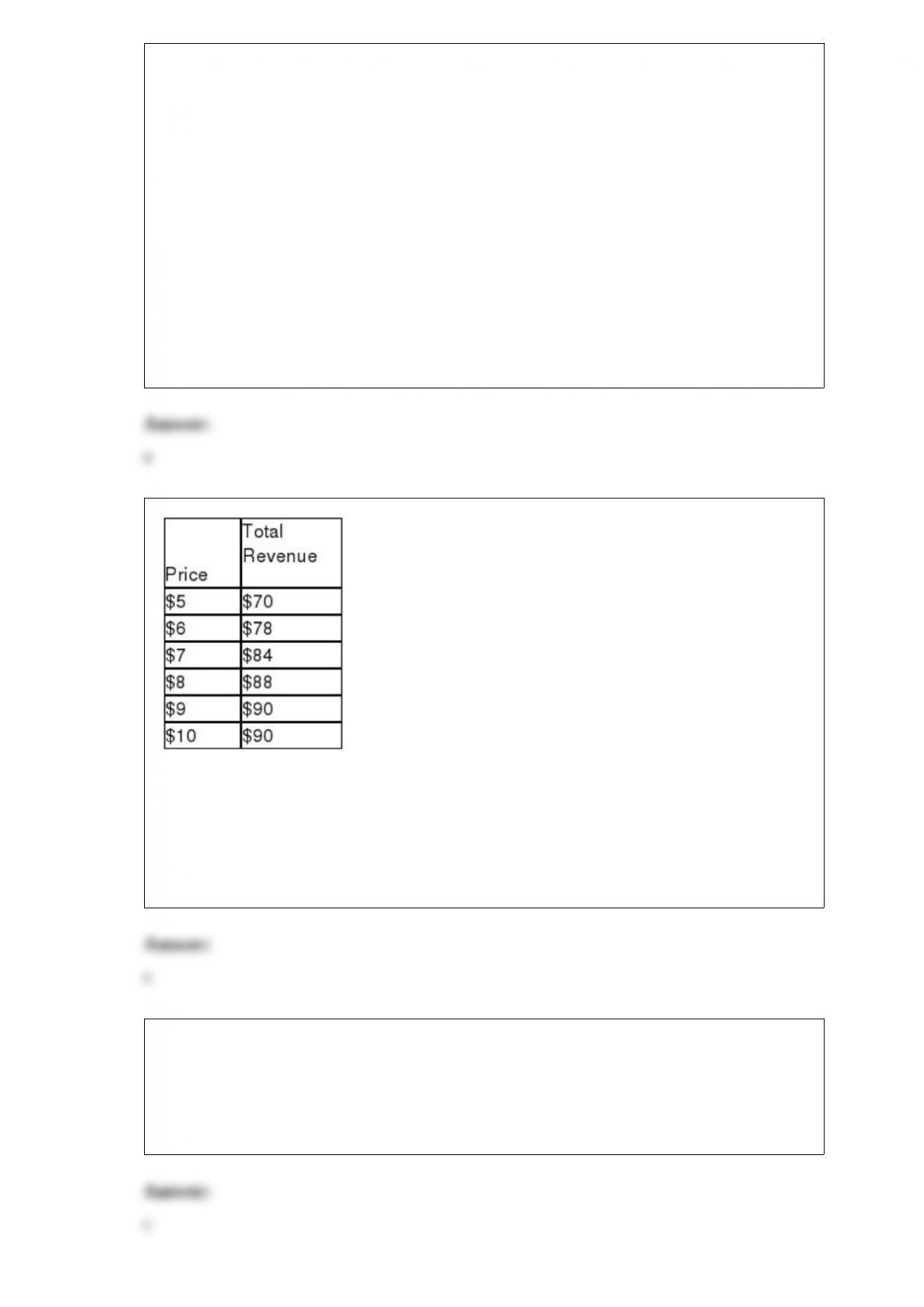
14) When price is between $5 and $9, demand is
a.elastic.
b.unit elastic.
c.inelastic.
d.There is not enough information given to determine whether demand is elastic, unit
elastic, or inelastic.
15) Economists view positive statements as
a.affirmative, justifying existing economic policy.
b.optimistic, putting the best possible interpretation on things.
c.descriptive, making a claim about how the world is.
d.prescriptive, making a claim about how the world ought to be.