1) Suppose that a large lake in the middle of Minnesota evaporates, leaving more fertile
farm land for growing corn available. Assuming that land and labor are complements in
a farming production function, what would happen to the wages earned by workers and
rents earned by landowners?
a.Both wages and rents would increase.
b.Both wages and rents would decrease.
c.Wages would increase, and rents would decrease.
d.Wages would decrease, and rents would increase.
2)
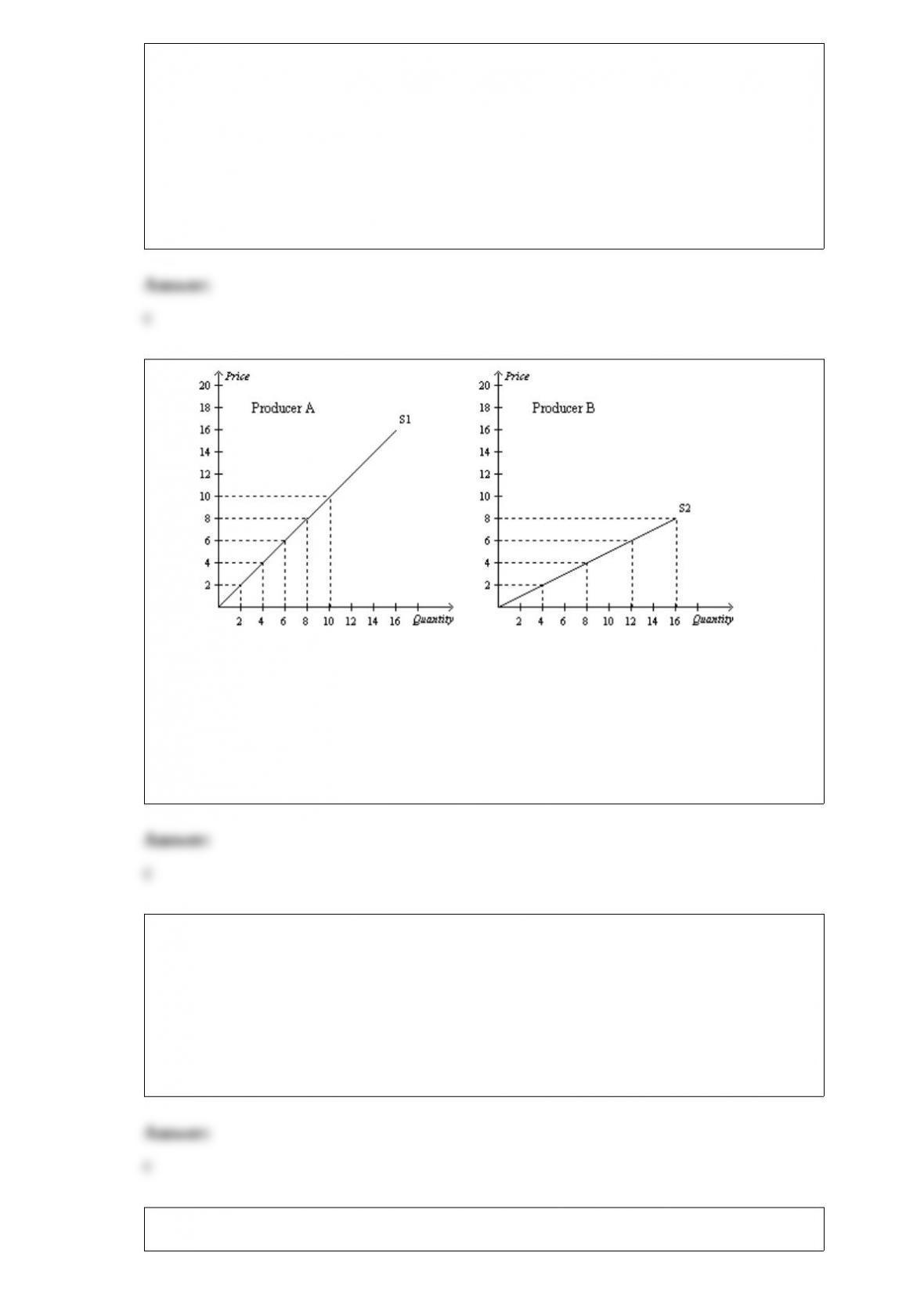
If Producer A and Producer B are the only producers in the market, then the market
quantity supplied when the price is $8 is
a.8 units.
b.16 units.
c.24 units.
d.32 units.
3) Which of the following statements is not correct?
a.A free rider is a person who benefits from something for which he or she does not
have to pay.
b.The creation of general knowledge is a public good.
c.The Tragedy of the Commons illustrates the underuse of a common resource.
d.A gasoline tax is an imperfect solution to the problem of traffic congestion on public
roads.
4) Adam Smith describes a visit to a car factory when discussing economies of scale in
his book An Inquiry into the Nature and Causes of the Wealth of Nations.
a.True
b.False
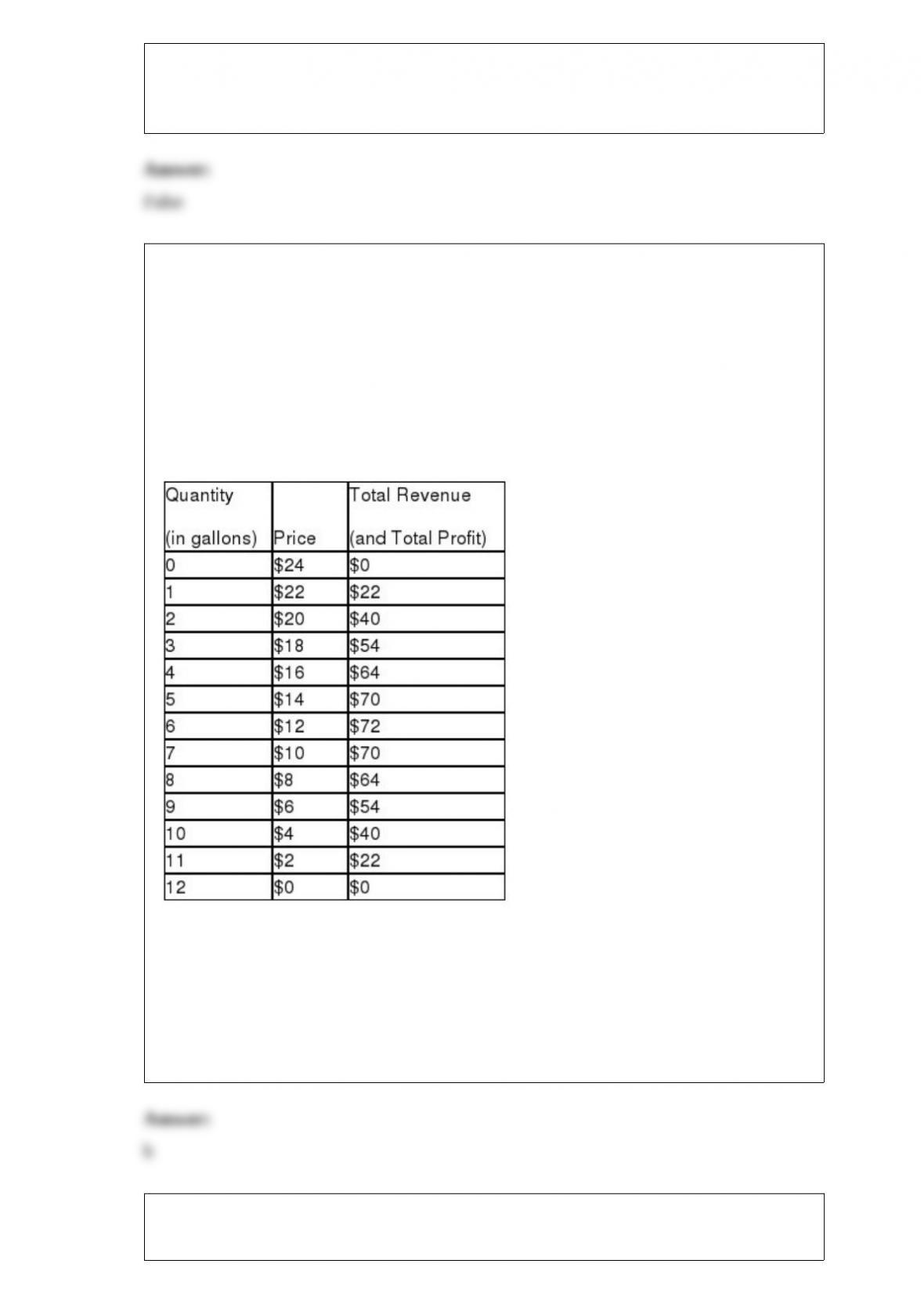
5) Table 17-3
Imagine a small town in a remote area where only two residents, Maria and Miguel,
own dairies that produce milk that is safe to drink. Each week Maria and Miguel work
together to decide how many gallons of milk to produce. They bring milk to town and
sell it at whatever price the market will bear. To keep things simple, suppose that Maria
and Miguel can produce as much milk as they want without cost so that the marginal
cost is zero. The weekly town demand schedule and total revenue schedule for milk is
shown in the table below:
Refer to Table 17-3. Suppose that Maria and Miguel work together in order to operate
as a profit-maximizing monopolist. How many gallons of milk will be produced and
sold?
a.5 gallons
b.6 gallons
c.7 gallons
d.8 gallons
6) President Ronald Reagan once joked that a Trivial Pursuit game designed for
economists would

a.have no questions but hundreds of answers.
b.have 100 questions and 3,000 answers.
c.have 1,000 questions but no answers.
d.never produce a winner.
7) If the is equal to 1, then demand is unit elastic.
a.True
b.False
8) When a country allows trade and becomes an importer of coal,
a.the losses of the domestic producers of coal exceed the gains of the domestic
consumers of coal.
b.the losses of the domestic consumers of coal exceed the gains of the domestic
producers of coal.
c.the gains of the domestic producers of coal exceed the losses of the domestic
consumers of coal.
d.the gains of the domestic consumers of coal exceed the losses of the domestic
producers of coal.
9) Hot dog vendors on the beach fail to cooperate with one another on the quantity of
hot dogs they should sell to earn monopoly profits. A consequence of their failure is
that, relative to the outcome the vendors would like,
(i)the quantity of hot dogs supplied is closer to the socially optimal level.
(ii)the price of hot dogs is closer to marginal cost.
(iii)the hot dog market at the beach is less competitive.
a.(i) and (ii)
b.(ii) and (iii)
c.(i) and (iii)
d.(iii) only
10) The old lyric “the best things in life are free”
a.is not true for any goods.
b.is even true for some goods that have a price.
c.refers to goods provided by nature or the government.
d.refers to goods provided by the market.
11) The labor supply curve reflects how
a.workers’ decisions about the labor-leisure tradeoff respond to a change in the wage.
b.workers’ decisions about the opportunity cost of labor respond to a change in the
quantity of labor supplied.
c.firms’ decisions about the labor-leisure tradeoff respond to the quantity of labor
demanded.
d.firms’ decisions about how the quantity of labor they hire respond to changes in their
opportunities to earn profits.
12) Buyers of a product will bear the larger part of the tax burden, and sellers will bear
a smaller part of the tax burden, when the
a.tax is placed on the sellers of the product.
b.tax is placed on the buyers of the product.
c.supply of the product is more elastic than the demand for the product.
d.demand for the product is more elastic than the supply of the product.
13) The demand curve is the upward-sloping line relating price and quantity demanded.
a.True
b.False
14) Because the demand for wheat tends to be inelastic, the development of a new,
more productive hybrid wheat would tend to
a.increase the total revenue of wheat farmers.
b.decrease the total revenue of wheat farmers.
c.decrease the demand for wheat.
d.decrease the supply of wheat.
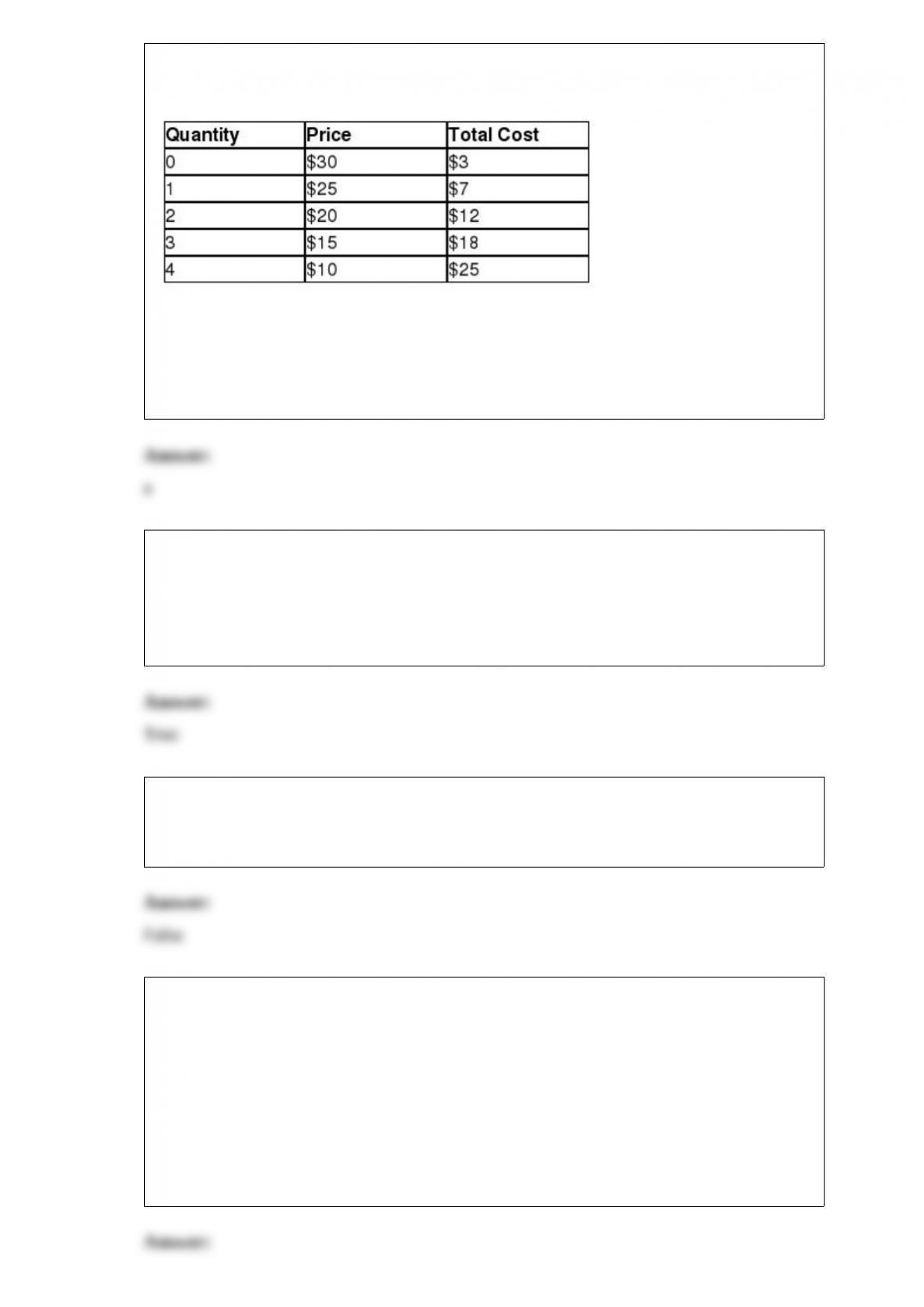
15) Table 15-3
Consider the following demand and cost information for a monopoly.
The marginal cost of the 4th unit is
a. $7.
b.$12.
c.$25.
d.$60.
16) A firm operating in a perfectly competitive market earns zero economic profit in the
long run but remains in business because the firm‘s revenues cover the business owners‘
opportunity costs.
a.True
b.False
17) All else equal, a decrease in demand will cause an increase in producer surplus.
a.True
b.False
18) Piper consumes Ragu spaghetti sauce exclusively. She claims that there is a clear
taste difference and that competing brands of spaghetti sauce leave an unsavory taste in
her mouth. However, in a blind taste test, Piper is found to prefer generic store-brand
spaghetti sauce to Ragu spaghetti sauce eight out of ten times. The results of Piper’s
taste test would reinforce claims by critics of brand names that
a.consumers are always willing to pay more for brand names.
b.brand names cause consumers to perceive differences that do not really exist.
c.brand names are always preferred to generics.
d.consumers are only willing to buy generics if they are less expensive.