1) Individual demand curves are summed vertically to obtain the market demand curve.
a.True
b.False
2) A change in the supply of one factor of production
a.will not change either the marginal productivities or the prices of other factors.
b.will not change the prices of other factors, but it may change their marginal
productivities.
c.will not change the marginal productivities of other factors, but it may change their
prices.
d.changes the marginal productivities and the prices of other factors.
3) Scenario 17-3.
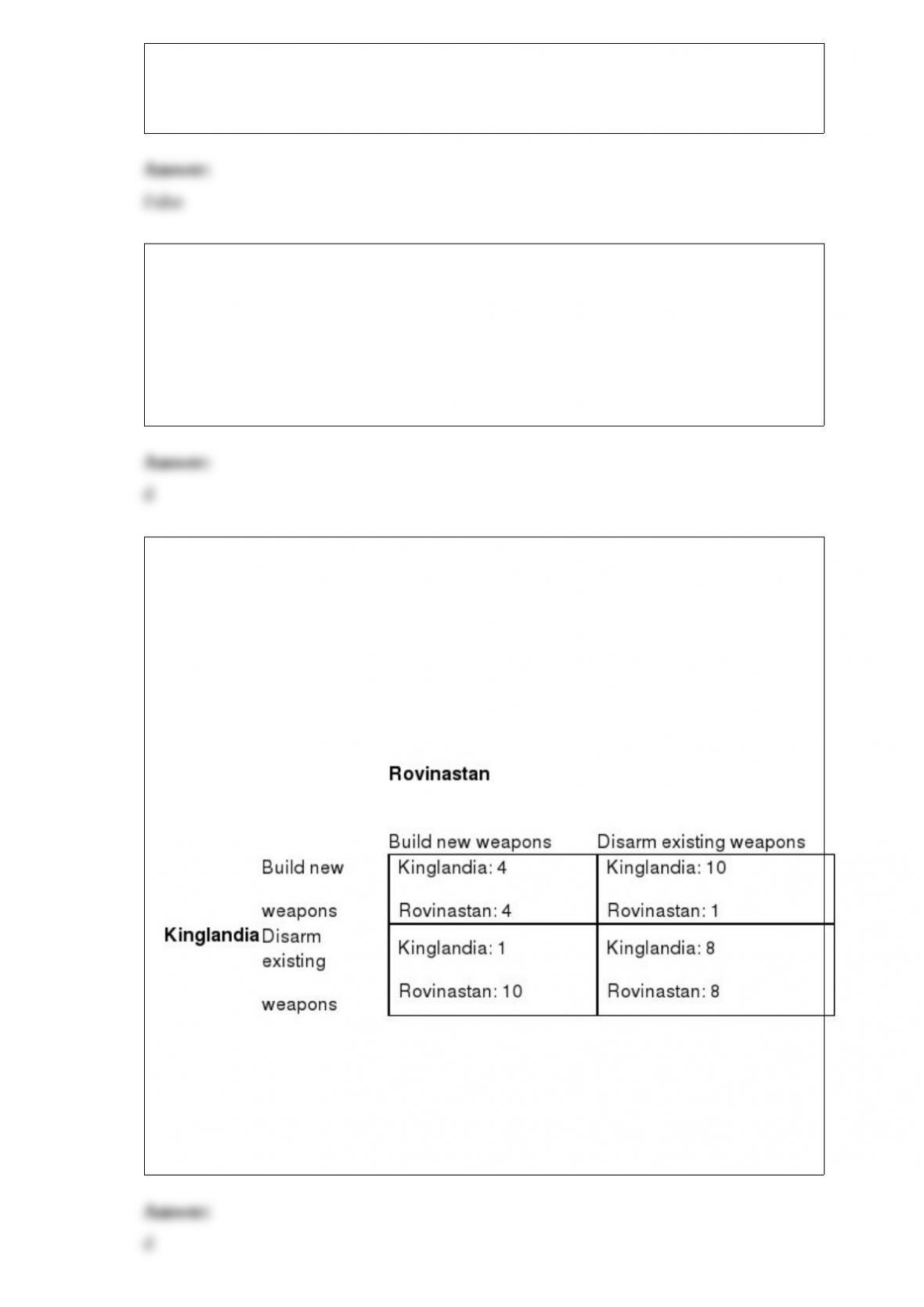
Consider two countries, Kinglandia and Rovinastan, that are engaged in an arms race.
Each country must decide whether to build new weapons or to disarm existing
weapons. Each country prefers to have more arms than the other because a large arsenal
gives it more influence in world affairs. But each country also prefers to live in a world
safe from the other country’s weapons. The following table shows the possible
outcomes for each decision combination. The numbers in each cell represent the
country’s ranking of the outcome (10 = best outcome, 1 = worst outcome).
Refer to Scenario 17-3. If Rovinastan chooses to disarm its existing weapons, then
Kinglandia will
a.disarm to increase its influence in world affairs.
b.disarm to promote world peace.
c.build new weapons to promote world peace.
d.build new weapons to increase its influence in world affairs.

4) If the use of a common resource is not regulated,
a.no one can enjoy it.
b.it will tend to be underused.
c.property rights will be clearly defined.
d.it will be overused.
5) For a worker, the opportunity cost of an hour of leisure
a.rises by $8 when his wage rises by $8 per hour.
b.falls by $8 when his wage rises by $8 per hour.
c.is the same for a celebrity talk-show host as it is for a teacher.
d.is determined by factors that are unrelated to his hourly wage.
6) In a competitive market, the price of a product
a.is determined by buyers, and the quantity of the product produced is determined by
sellers.
b.is determined by sellers, and the quantity of the product produced is determined by
buyers.
c.and the quantity of the product produced are both determined by sellers.
d.None of the above is correct.
7) The criminal actions of the top managers of corporations such as Enron, Tyco,
WorldCom, and Adelphia are an example of moral hazard.
a.True
b.False
8) By comparing marginal revenue and marginal cost, a firm in a competitive market is
able to adjust production to the level that achieves its objective, which we assume to be
a.maximizing total revenue.
b.maximizing profit.
c.minimizing variable cost.
d.minimizing average total cost.
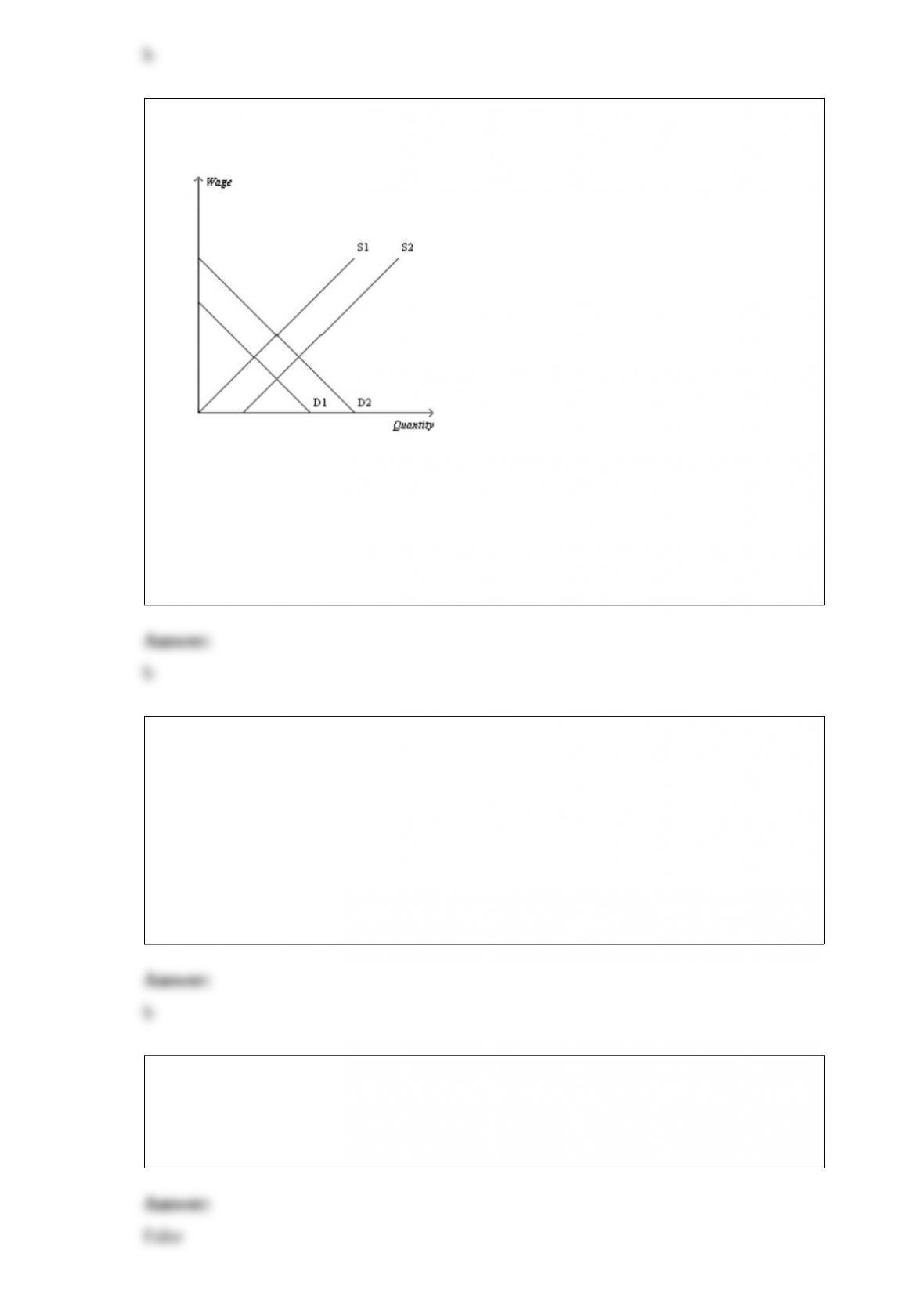
9) Figure 18-4
The graph below illustrates the market for nurses who work in doctors’ offices.
Refer to Figure 18-4. If doctors’ offices adopt new laborsaving technologies, what
happens in the market for nurses?
a.Demand increases from D1 to D2.
b.Demand decreases from D2 to D1.
c.Supply increases from S1 to S2.
d.Supply decreases from S2 to S1.
10) Which of the following quantities decrease in response to a tax on a good?
a.the equilibrium quantity in the market for the good, the effective price of the good
paid by buyers, and consumer surplus
b.the equilibrium quantity in the market for the good, producer surplus, and the
well-being of buyers of the good
c.the effective price received by sellers of the good, the wedge between the effective
price paid by buyers and the effective price received by sellers, and consumer surplus
d.None of the above is necessarily correct unless we know whether the tax is levied on
buyers or on sellers.
11) A decrease in the price of a complement will shift the demand curve for a good to
the left.
a.True
b.False

12) Individual Retirement Accounts and 401(k) plans make the current U.S. tax system
a.less like European tax systems than it otherwise would be.
b.more like a payroll tax than it otherwise would be.
c.more like an income tax than it otherwise would be.
d.more like a consumption tax than it otherwise would be.
13) Riva crafts and sells hard cider as a part-time job. She can bottle and sell four cases
in a week. She is considering hiring her friend Atul to help her. Together, Riva and Atul
can bottle and sell seven cases per week. What is Atul’s marginal product?
a.2 cases
b.3 cases
c.5 cases
d.7 cases