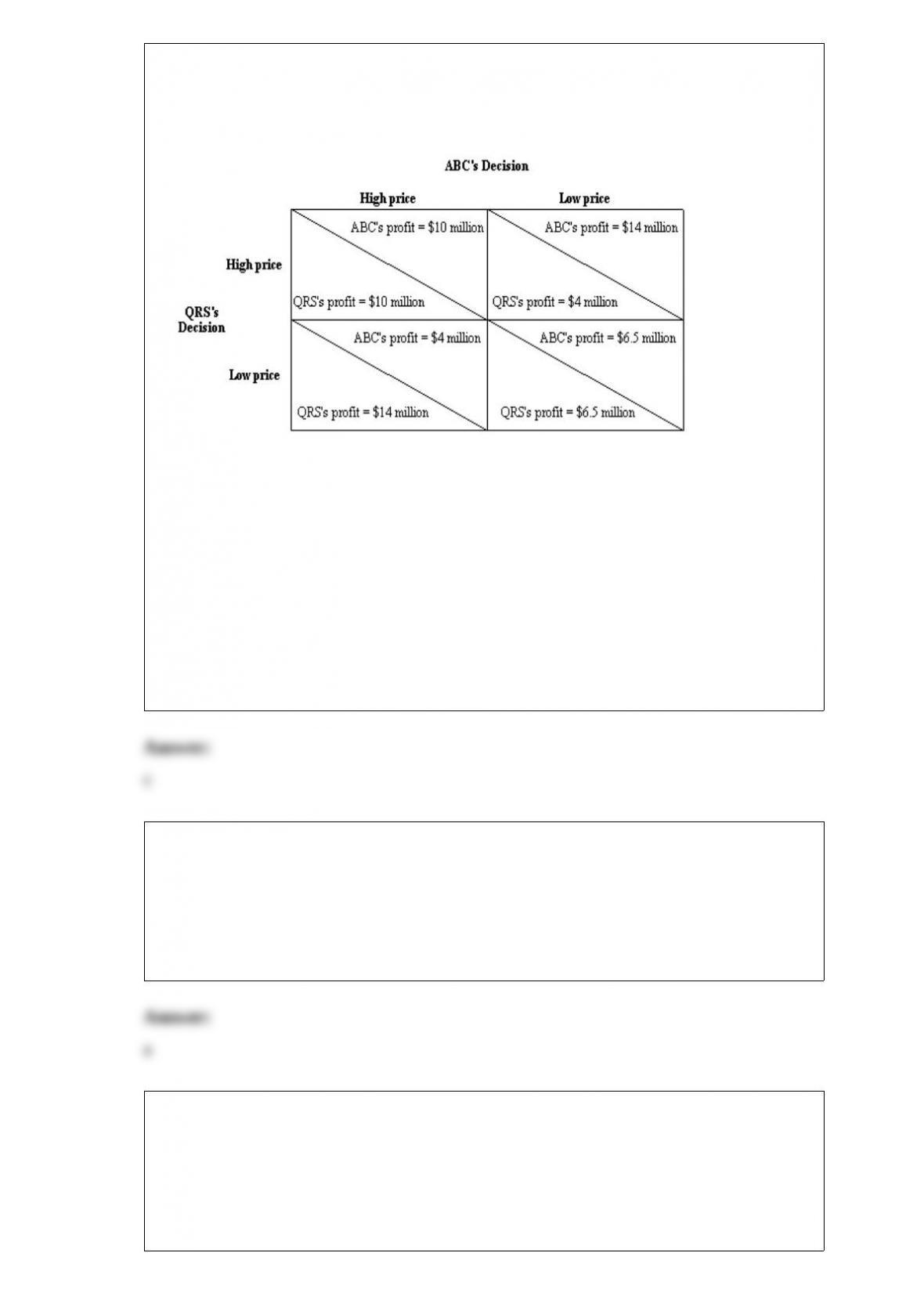
1) Figure 17-5. Two companies, ABC and QRS, are sellers in the same market. Each
company decides whether to charge a high price or a low price. In the figure, the dollar
amounts are payoffs and they represent annual profits for the two companies.
Refer to Figure 17-5. Suppose we observe that the outcome of the game is one in
which each company earns a profit of $10 million. This outcome
a.is the result of each company pursuing its dominant strategy.
b.is the result of cooperation between the two companies, and we know that a
cooperative outcome is easy in a game such as this one.
c.is the result of cooperation between the two companies, and we know that a
cooperative outcome is difficult in a game such as this one.
d.is the most likely outcome of the game, regardless of whether the two companies
cooperate.
2) If Levi Strauss & Co. were to require every retailer that carried its clothing to charge
customers $42 for each pair of jeans, Levi Strauss & Co. would be practicing
a.resale price maintenance.
b.fixed retail pricing.
c.tying.
d.cost plus pricing.
3) Which of the following ideas is the most plausible?
a.Tax revenue is more likely to increase when a low tax rate is increased than when a
high tax rate is increased.
b.Tax revenue is less likely to increase when a low tax rate is increased than when a
high tax rate is increased.
c.Tax revenue is likely to increase by the same amount when a low tax rate is increased
and when a high tax rate is increased.
d.Decreasing a tax rate can never increase tax revenue.
4) Under which of the following market structures would the highest output of a
particular good be produced?
a.perfect competition
b.monopolistic competition
c.oligopoly
d.monopoly
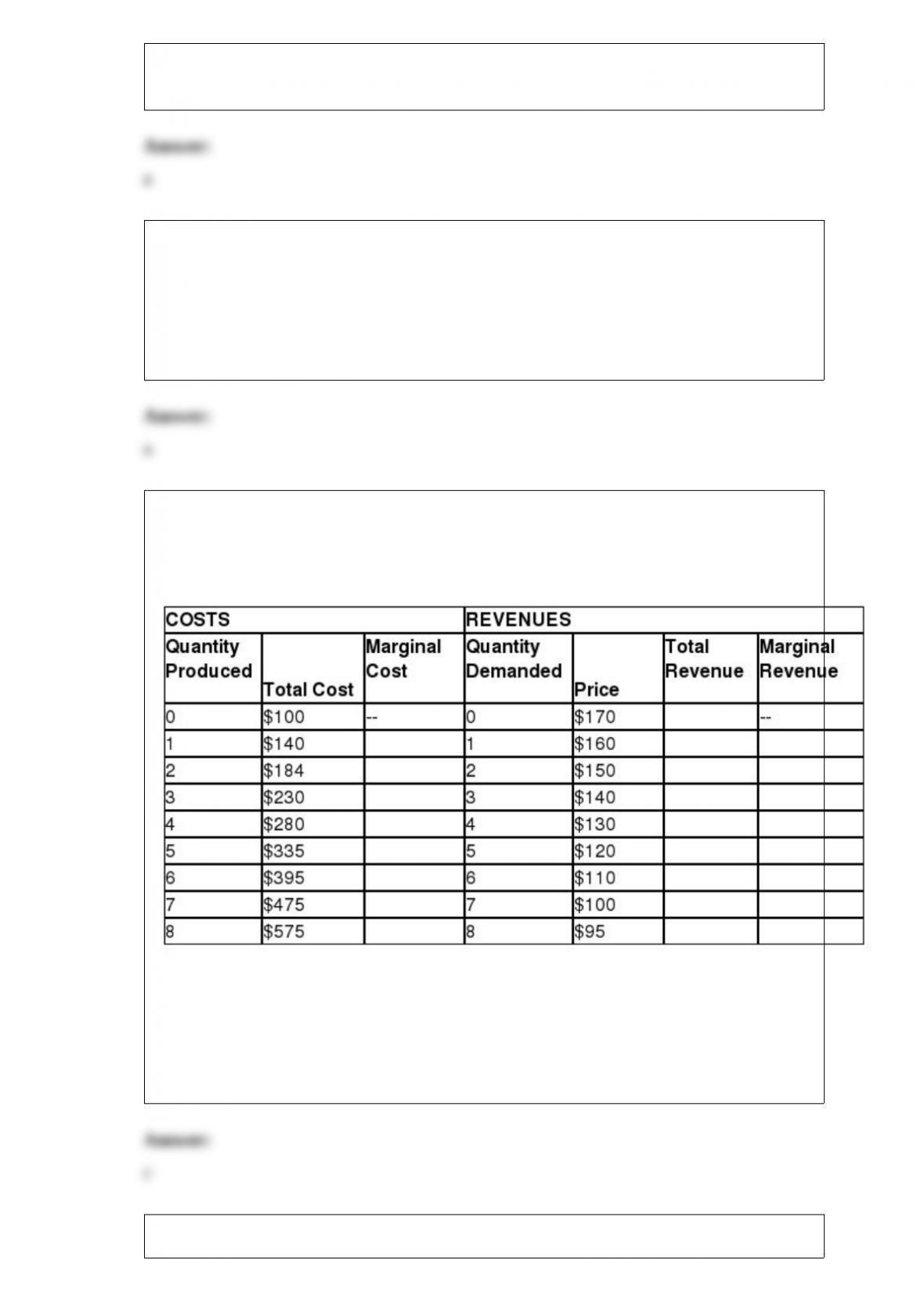
5) Table 15-21
Tommy’s Tie Company, a monopolist, has the following cost and revenue information.
Assume that Tommy’s is able to engage in perfect price discrimination.
If the monopolist can engage in perfect price discrimination, what is the total revenue
when 3 ties are sold?
a.$140
b.$420
c.$450
d.$620
6) Markets sometimes fail to allocate resources efficiently.
a.True
b.False
7) According to many economists, government restrictions on ticket scalping do all of
the following except
a.inconvenience the public.
b.reduce the audience for cultural and sports events.
c.waste police officers’ time.
d.keep the cost of tickets to all consumers low.
8) The supply of aged cheddar cheese is inelastic, and the supply of bread is elastic.
Both goods are considered to be normal goods by a majority of consumers. Suppose
that a large income tax increase decreases the demand for both goods by 10%.
The equilibrium quantity will
a.increase in both the aged cheddar cheese and bread markets.
b.increase in the aged cheddar cheese market and decrease in the bread market.
c.decrease in the aged cheddar cheese market and increase in the bread market.
d.decrease in both the aged cheddar cheese and bread markets.
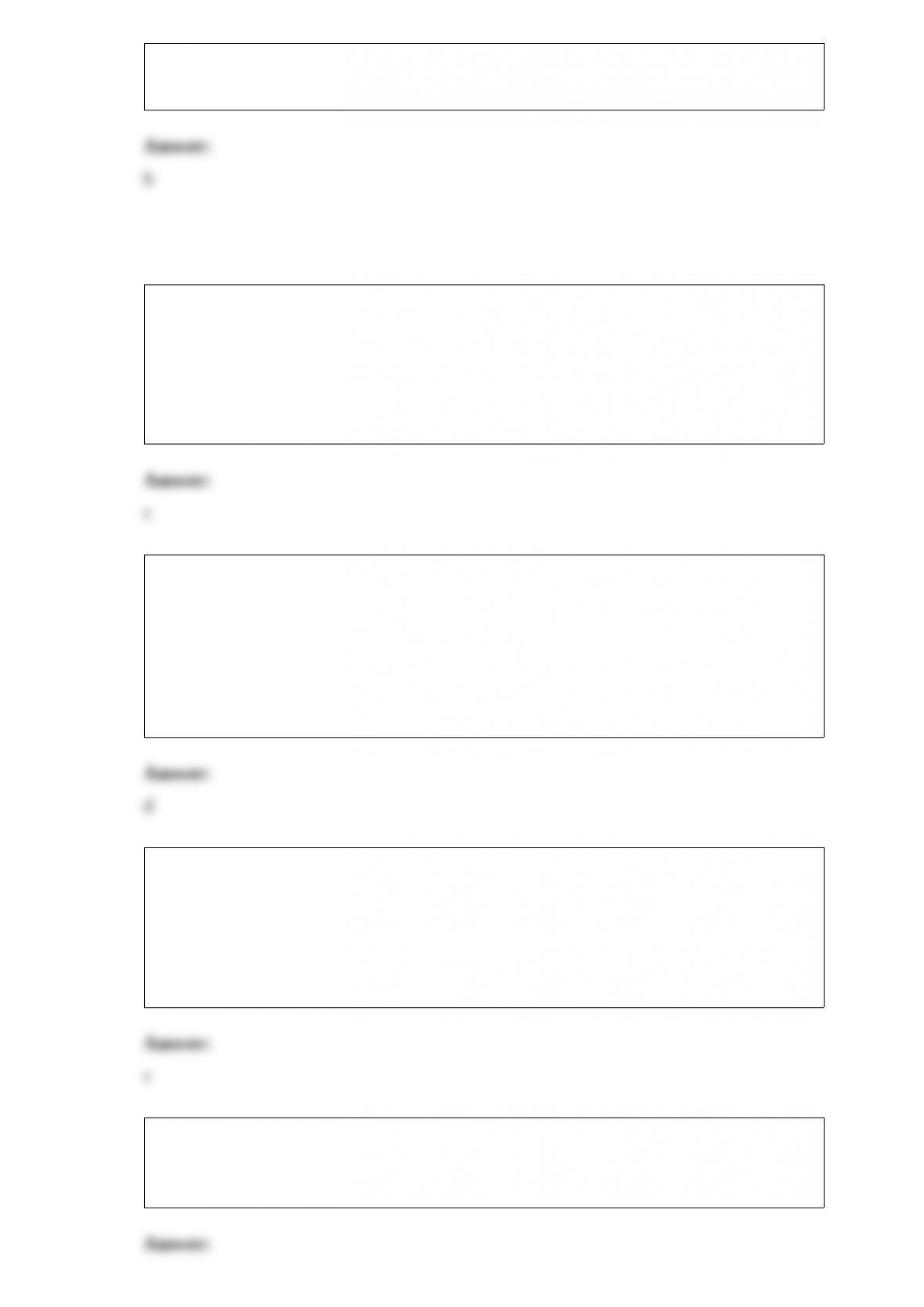
9) Figure 8-9
The vertical distance between points A and C represents a tax in the market.
The amount of amount of deadweight loss as a result of the tax is
a. $4,000.
b. $5,000.
c. $6,000.
d. $10,000.
10) In pursuing its own interest, an oligopoly firm will decide to increase production by
1 unit as long as
a.there is no output effect.
b.there is no price effect.
c.the output effect is larger than the price effect.
d.the price effect is larger than the output effect.
11) Which of the following is not an example of a barrier to entry?
a.Mighty Mitch’s Mining Company owns a unique plot of land in Tanzania, under
which lies the only large deposit of Tanzanite in the world.
b.A pharmaceutical company obtains a patent for a specific high blood pressure
medication.
c.A musician obtains a copyright for her original song.
d.An entrepreneur opens a popular new restaurant.
12) If a consumer consumes two goods, X and Y, and has indifference curves that are
bowed inward, the consumer’s optional choice occurs when
a.he consumes the maximum affordable quantity of good X.
b.he consumes the maximum affordable quantity of good Y.
c.his indifference curve is tangent to his budget constraint.
d.his indifference curve lies entirely above his budget constraint.
13) A firm’s total profit equals its marginal revenue minus its marginal cost.
a.True
b.False
14) Which of the following statements is not correct?
a.Some firms pay wages that are above the equilibrium wage.
b.Workers sometimes form labor unions to push their wages up.
c.Wages never deviate from the balance of supply and demand in the market for labor.
d.The federal government mandates that employers pay their workers at least as much
as the minimum wage.
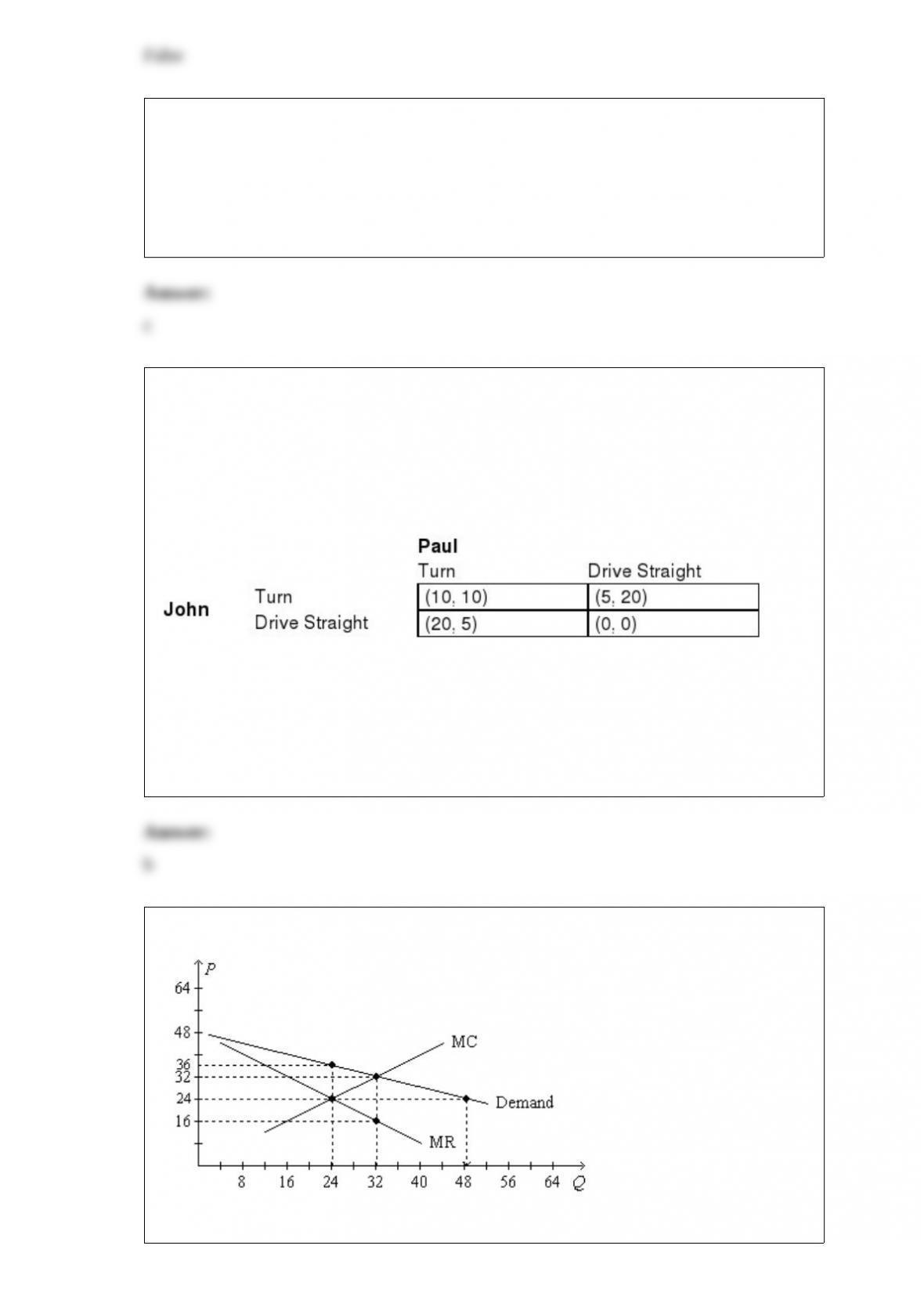
15) Table 17-21
The Chicken Game is named for a contest in which drivers test their courage by driving
straight at each other. John and Paul have a common interest to avoid crashing into each
other, but they also have a personal, competing interest to not turn first to demonstrate
their courage to those observing the contest. The payoff table for this situation is
provided below. The payoffs are shown as (John, Paul).
Refer to Table 17-21. If Paul chooses Turn, what will John choose to do and what will
John’s payoff equal?
a.Turn, 10
b.Drive Straight, 20
c.Turn, 5
d.Drive Straight, 0
16) Figure 16-2. The figure is drawn for a monopolistically competitive firm.
Suppose that average total cost is $36 when Q=24. What is the profit-maximizing price
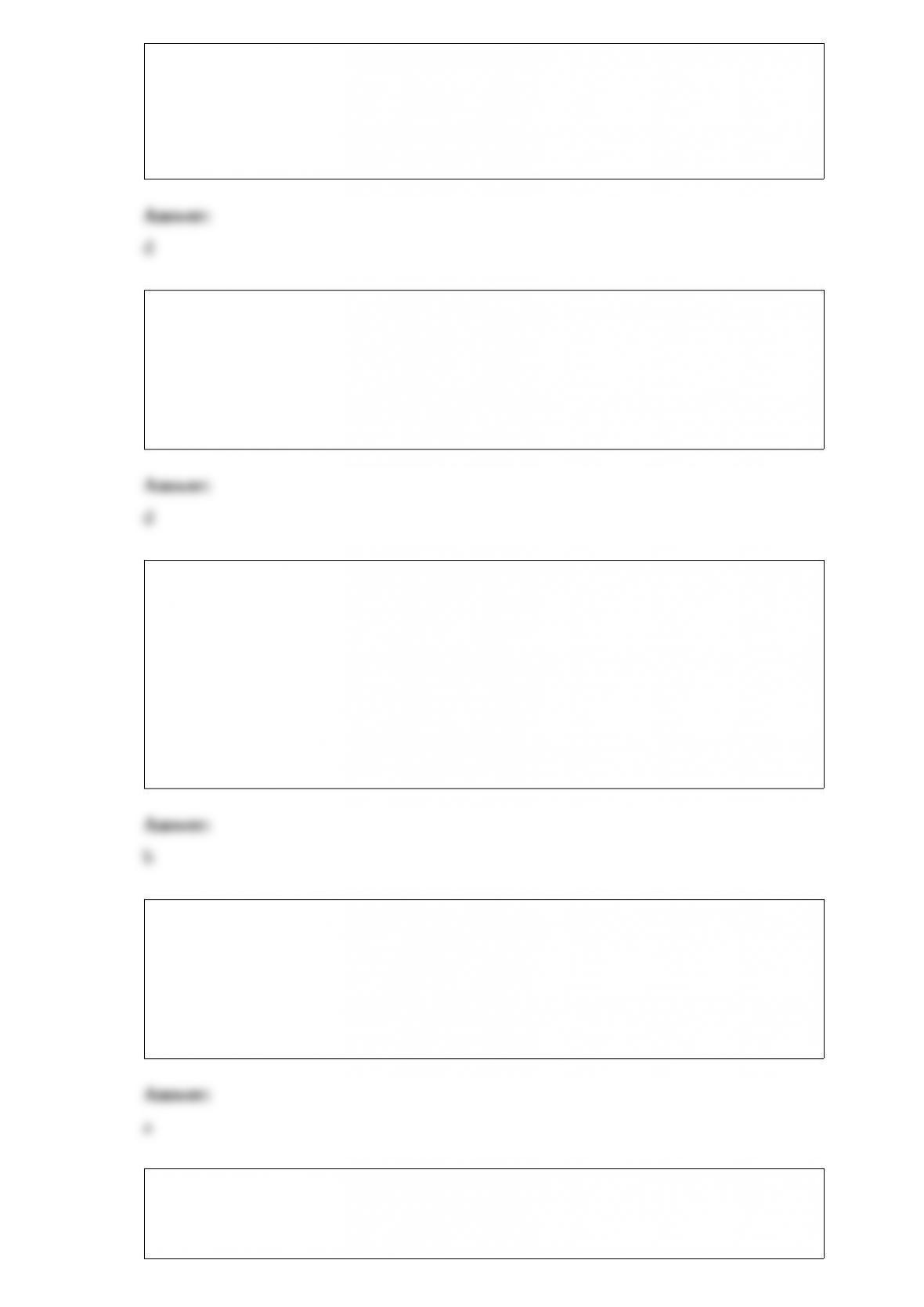
and resulting profit?
a.P=$24, profit=$0
b.P=$36, profit=$144
c.P=$36, profit=$48
d.P=$36, profit=$0
17) Table 10-3
What amount of subsidy per unit of output would move the market from the
equilibrium level of output to the socially optimal level of output?
a.$2
b.$3
c.$5 d. $10
18) Suppose an airline determines that its customers traveling for business have
inelastic demand and its customers traveling for vacations have an elastic demand. If
the airline’s objective is to increase total revenue, it should
a.increase the price charged to vacationers and decrease the price charged to business
travelers.
b.decrease the price charged to vacationers and increase the price charged to business
travelers.
c.decrease the price to both groups of customers.
d.increase the price for both groups of customers.
19) Suppose the demand for peanuts increases. What will happen to producer surplus in
the market for peanuts?
a.It increases.
b.It decreases.
c.It remains unchanged.
d.It may increase, decrease, or remain unchanged.
20) Figure 16-8
The lines in the figures below illustrate the potential effect of entry and exit in a
monopolistically competitive market on either the demand curve or the marginal cost
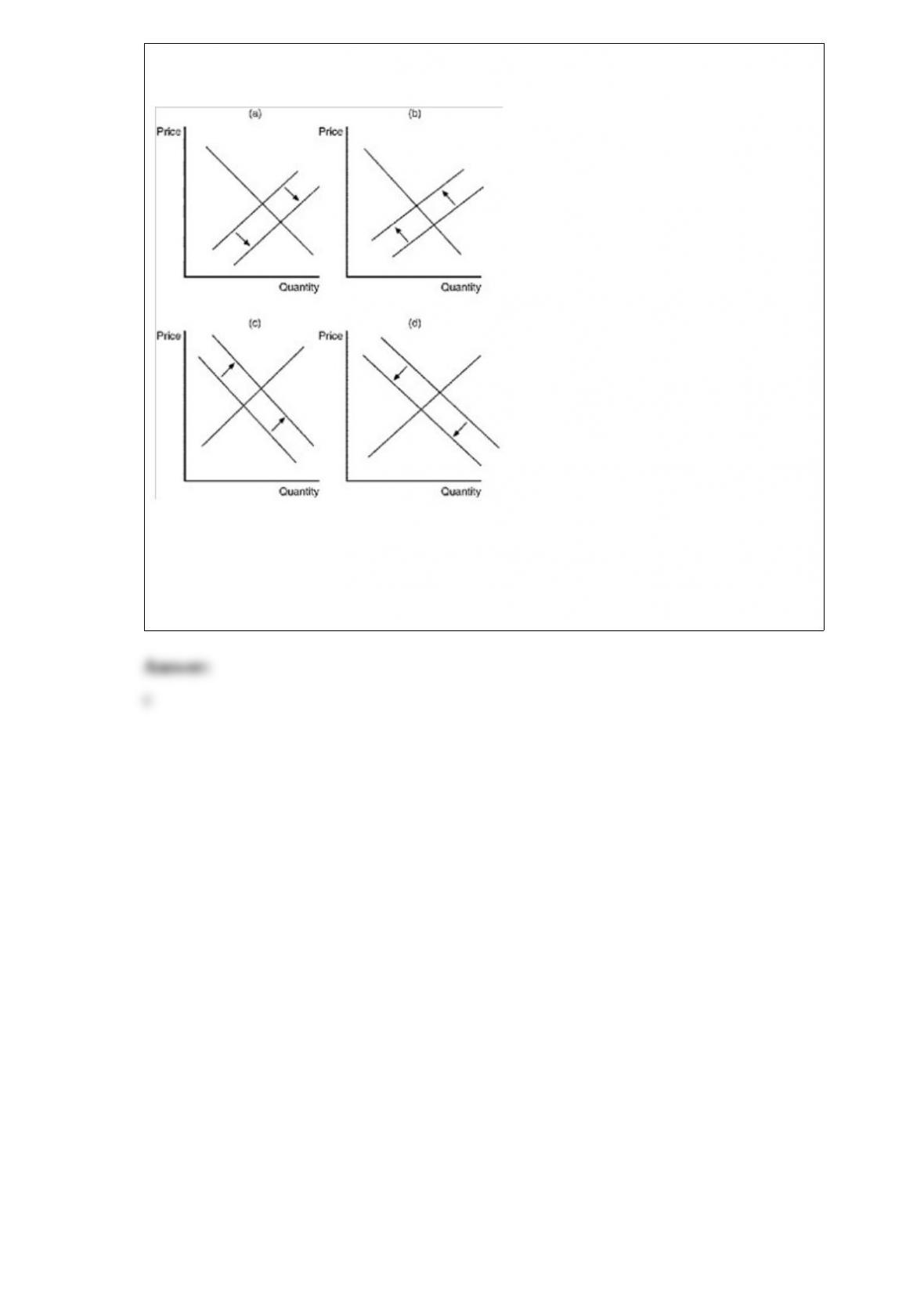
curve of existing firms.
Panel (d) illustrates the change that
would occur if existing firms faced
a.long-run economic losses.
b.a decrease in the diversity of products offered in the market.
c.new entrants in the market.
d.firms exiting the market.