1) New firms will likely enter a monopolistically competitive market when price
exceeds
a.marginal revenue.
b.average revenue.
c.marginal cost.
d.average total cost.
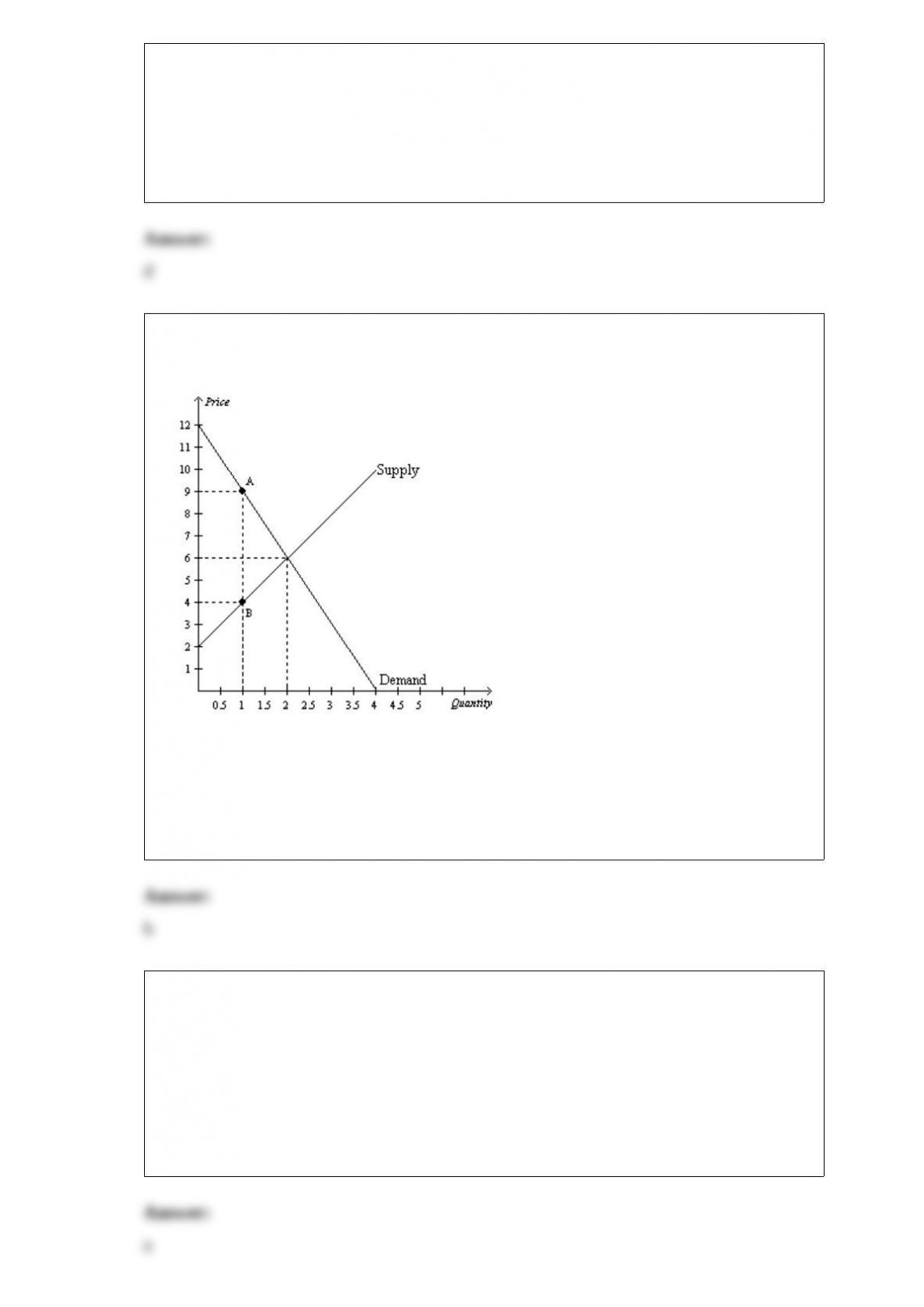
2) Figure 8-2
The vertical distance between points A and B represents a tax in the market.
The imposition of the tax causes the quantity sold to
a.increase by 1 unit.
b.decrease by 1 unit.
c.increase by 2 units.
d.decrease by 2 units.
3) Suppose the U.S. and Japan both produce airplanes and televisions and the U.S. has a
comparative advantage in the production of airplanes while Japan has a comparative
advantage in the production of televisions. If the U.S. exports airplanes to Japan and
imports televisions from Japan,
a.both countries, as a whole, will be better off.
b.all individuals in both countries will be better off.
c.both countries, as a whole, will be worse off.
d.all individuals in both countries will be worse off.
4) A profit-maximizing monopolist will produce the level of output at which
a.average revenue is equal to average total cost.
b.average revenue is equal to marginal cost.
c.marginal revenue is equal to marginal cost.
d.total revenue is equal to opportunity cost.
5) Suppose a country abandons a no-trade policy in favor of a free-trade policy. If, as a
result, the domestic price of pistachios decreases to equal the world price of pistachios,
then
a.that country becomes an exporter of pistachios.
b.that country has a comparative advantage in producing pistachios.
c.at the world price, the quantity of pistachios demanded in that country exceeds the
quantity of pistachios supplied in that country.
d.All of the above are correct.
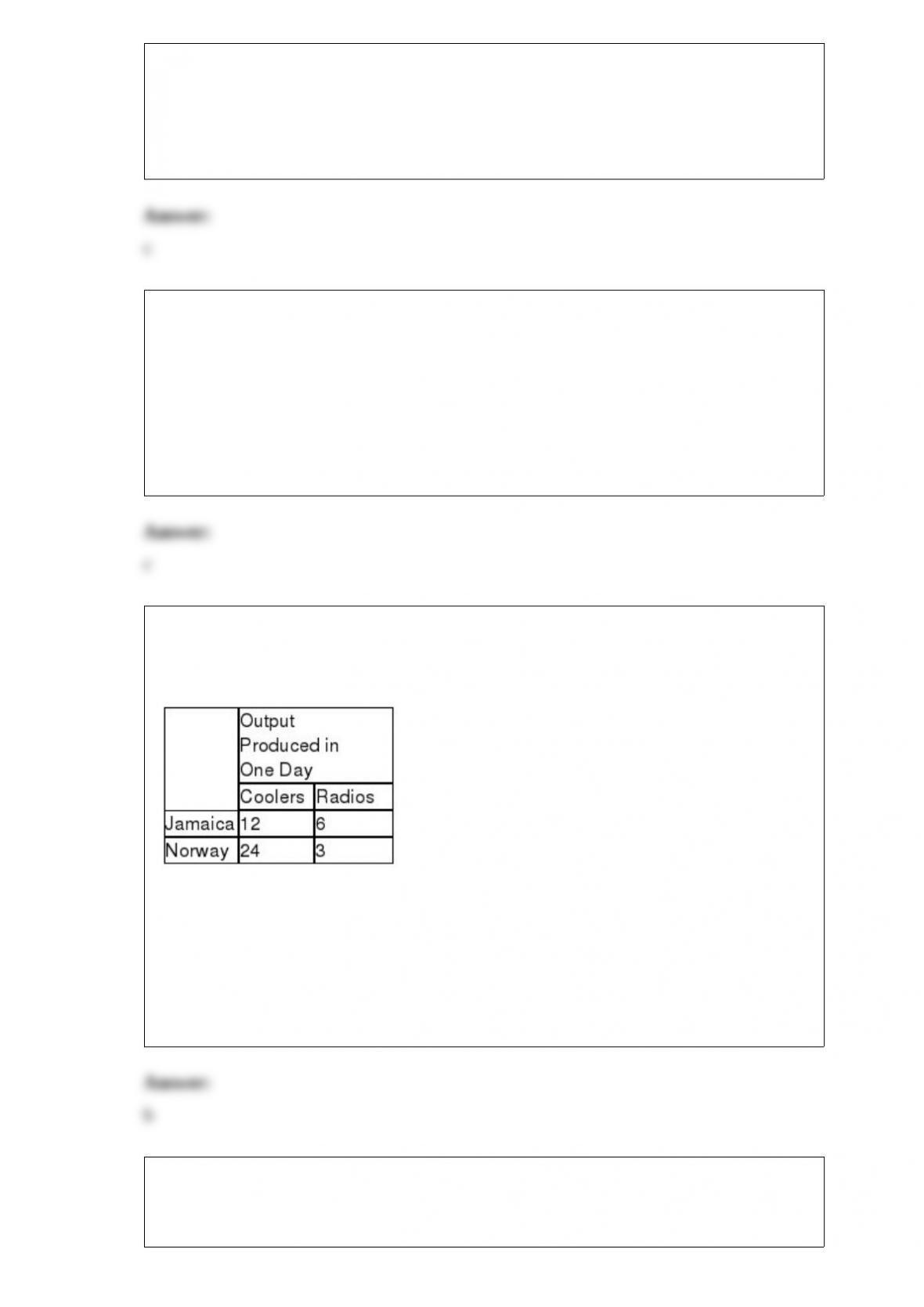
6) Assume that Jamaica and Norway can switch between producing coolers and
producing radios at a constant rate. The following table shows the number of coolers or
number of radios each country can produce in one day.
Jamaica has a comparative advantage in the production of
a.coolers and Norway has a comparative advantage in the production of radios.
b.radios and Norway has a comparative advantage in the production of coolers.
c.both goods and Norway has a comparative advantage in the production of neither
good.
d.neither good and Norway has a comparative advantage in the production of both
goods.
7) If a profit-maximizing monopolist faces a downward-sloping market demand curve,
its
a.average revenue is less than the price of the product.
b.average revenue is less than marginal revenue.
c.marginal revenue is less than the price of the product.
d.marginal revenue is greater than the price of the product.
8) In which of the following market structures do firms produce the
welfare-maximizing level of output?
a.perfect competition
b.monopolistic competition
c.monopoly
d.Both a and b are correct.
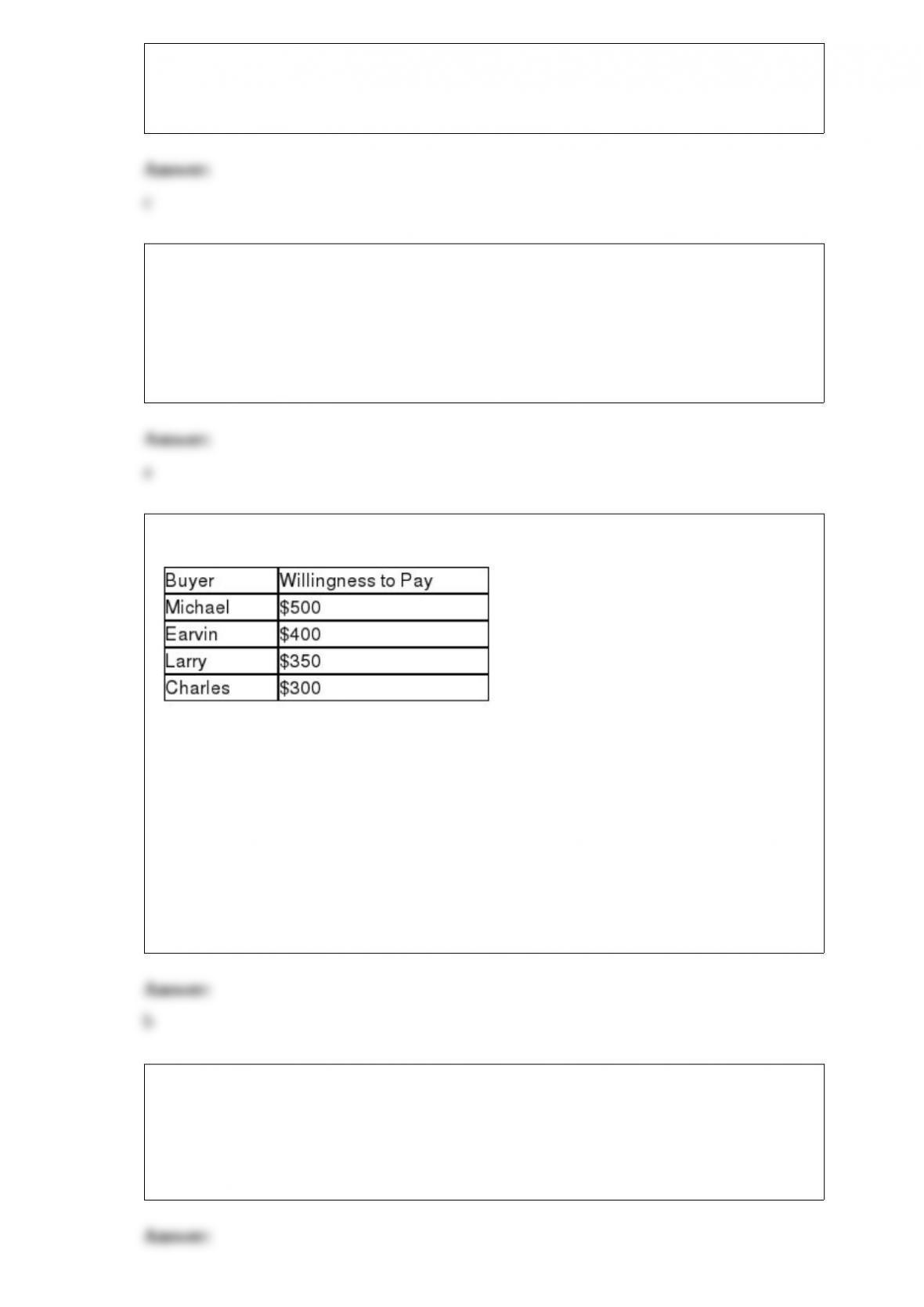
9) Table 7-7
You have an extra ticket to the Midwest Regional Sweet 16 game in the men’s NCAA
basketball tournament. The table shows the willingness to pay of the four potential
buyers in the market for a ticket to the game. You hold an auction to sell the ticket.
Michael bids $410 for the ticket, and you sell him the ticket. What is his consumer
surplus?
a.$410
b.$90
c.$10
d.
0
10) An improvement in production technology will
a.increase a firm’s costs and increase its supply.
b.increase a firm’s costs and decrease its supply.
c.decrease a firm’s costs and increase its supply.
d.decrease a firm’s costs and decrease its supply.
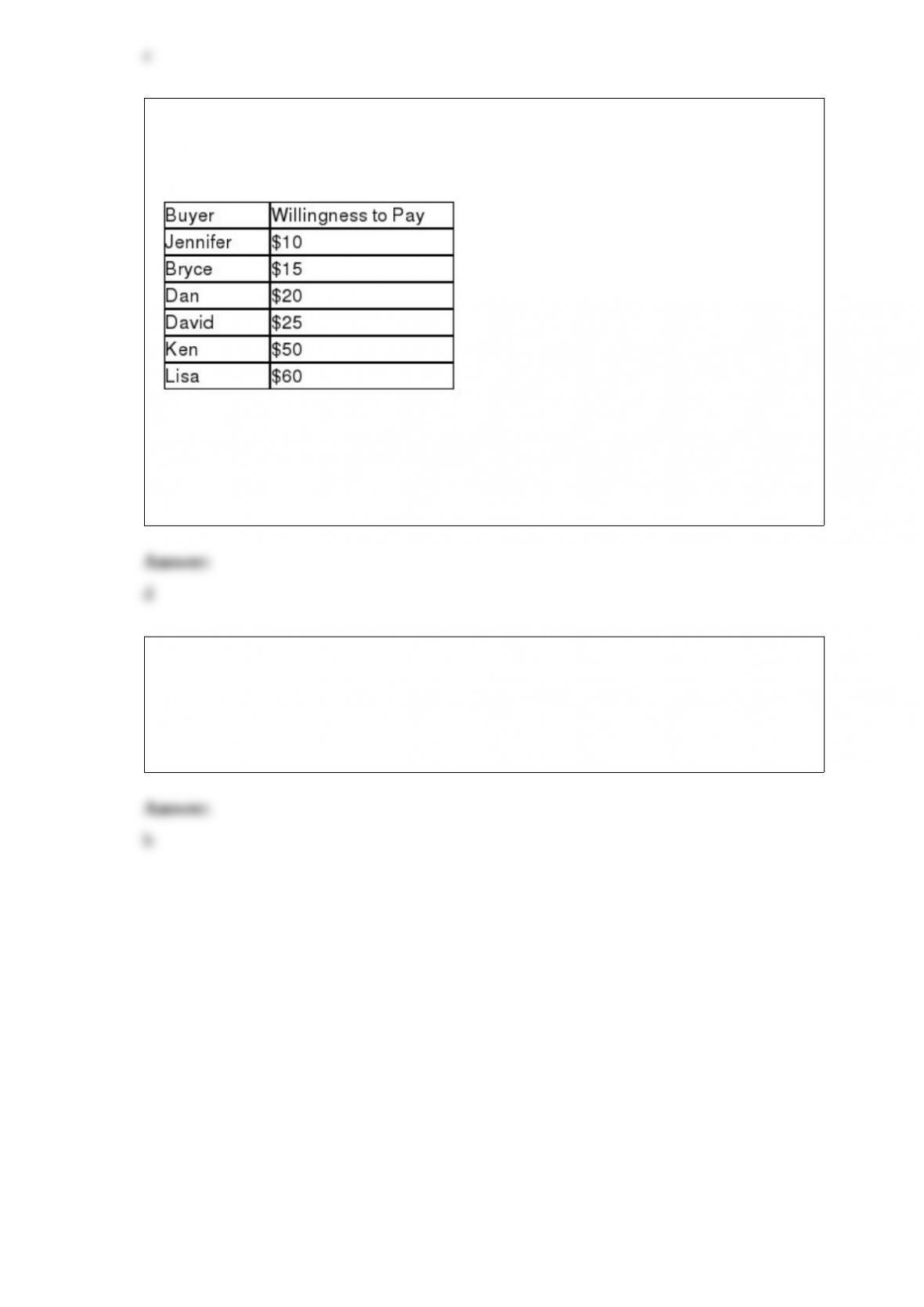
11) Table 7-4
The numbers in Table 7-1 reveal the maximum willingness to pay for a ticket to a
Chicago Cubs vs. St. Louis Cardinal’s baseball game at Wrigley Field.
If you have a ticket that you sell to the group in an auction, who will buy the ticket?
a.Dan
b.David
c.Ken
d.Lisa
12) Exclusive ownership of a key resource
a.is the most common cause of a monopoly.
b.is a potential but rare cause of a monopoly.
c.explains the monopoly ownership of the US Postal Service.
d.explains why a single firm distributes water to a community.