1) Which of the following is not possible?
a.Demand is elastic, and a decrease in price causes an increase in revenue.
b.Demand is unit elastic, and a decrease in price causes an increase in revenue.
c.Demand is inelastic, and an increase in price causes an increase in revenue.
d.Demand is perfectly inelastic, and an increase in price causes an increase in revenue.
2) When labor is the only input a firm uses, the marginal cost of a unit of output can be
defined as the
a.marginal revenue multiplied by the wage.
b.marginal product of labor multiplied by the wage.
c.marginal product of labor divided by the wage.
d.None of the above is correct.
3) To economists, good environmental policy begins by acknowledging one of the Ten
Principles of Economics:
a.Trade can make everyone better off.
b.People face trade-offs.
c.Markets are usually a good way to organize economic activity.
d.A country’s standard of living depends on its ability to produce goods and services.
4) The goal of libertarianism is to
a.redistribute income based on the assumption of diminishing marginal utility.
b.redistribute income in order to maximize the well-being of the worst-off person in
society.
c.punish crimes and enforce voluntary agreements but not to redistribute income.
d.measure happiness and satisfaction.
5) A market might have an upward-sloping long-run supply curve if
a.firms have different costs.
b.consumers exercise market power over producers.
c.all factors of production are essentially available in unlimited supply.
d.the entry of new firms into the market has no effect on the cost structure of firms in
the market.
6) Economic models
a.cannot be useful if they are based on false assumptions.
b.were once thought to be useful, but that is no longer true.
c.must incorporate all aspects of the economy if they are to be useful.
d.can be useful, even if they are not particularly realistic.
7) A market for pollution permits can efficiently allocate the right to pollute by using
the forces of supply and demand.
a.True
b.False
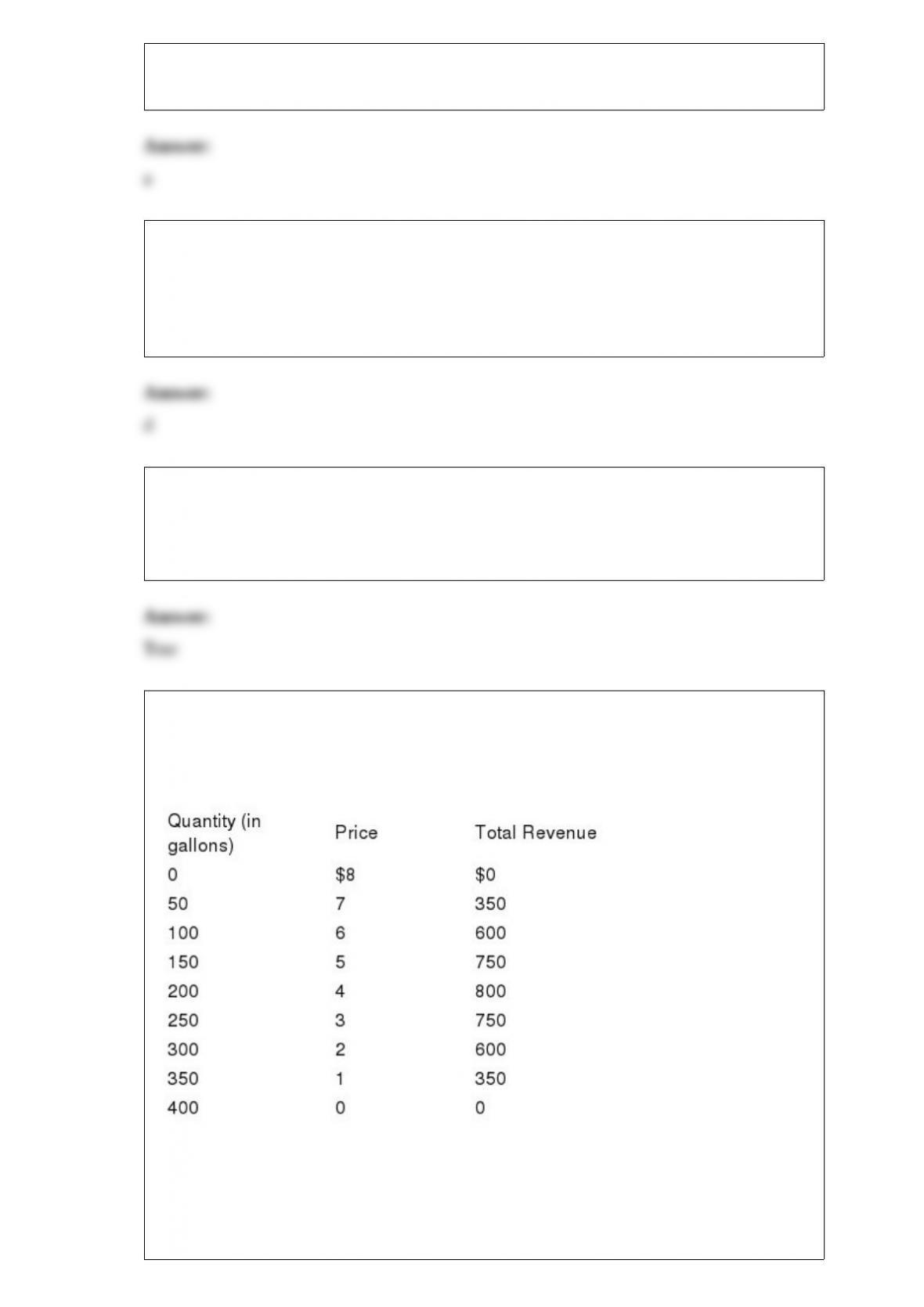
8) Table 17-12
The table shows the town of Driveaway’s demand schedule for gasoline. Assume the
town’s gasoline seller(s) incurs a cost of $2 for each gallon sold, with no fixed cost.
Refer to Table 17-12. Suppose we observe that the price of a gallon of gasoline in
Driveaway is $5; we observe as well that a particular seller’s profit is $150. Given this
observation, which of the following scenarios is most likely?
a.The market for gasoline in Driveaway is a monopoly.
b.There are two identical sellers of gasoline in Driveaway, and the sellers collude.
c.There are two identical sellers of gasoline in Driveaway, and the sellers do not
collude.
d.There are three identical sellers of gasoline in Driveaway, and the sellers collude.
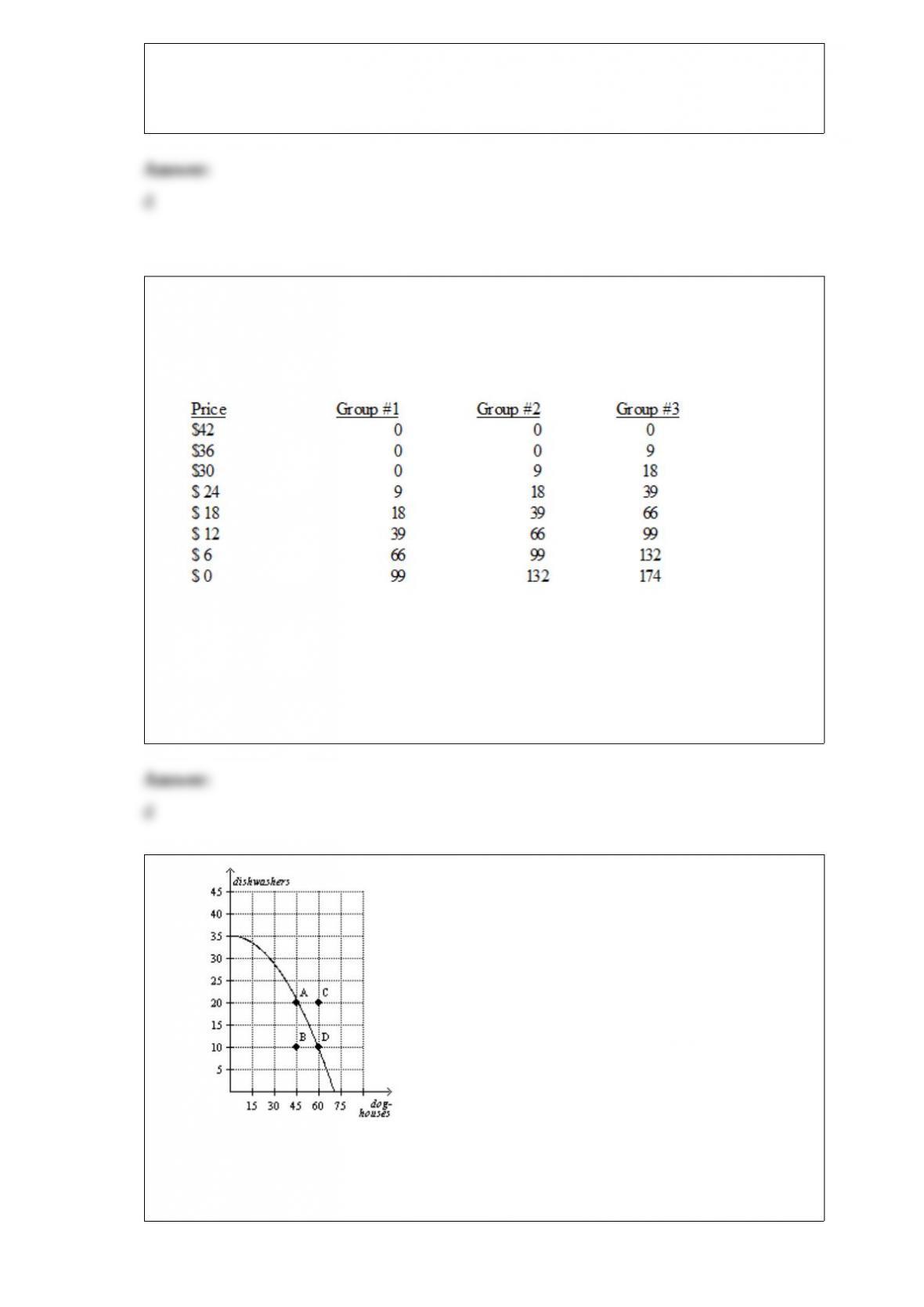
9) This table describes the police protection demands for three equal sized groups of
people in Safetyville. The second, third, and fourth columns show the number of
person-hours of police protection per day that a group will demand for a given price
(the first column).
What is the value of the 99th unit of police protection in Safetyville?
a.$0
b.$6
c.$12
d.$18
10) The opportunity cost of an additional doghouse
increases as more doghouses are produced.
a.True
b.False
11) Suppose that a firm in a competitive market is currently maximizing its short-run
profit at an output of 50 units. If the current price is $9, the marginal cost of the 50th
unit is $9, and the average total cost of producing 50 units is $4, what is the firm‘s
profit?
a.$0
b.$200
c.$250
d.$450
12) A utilitarian government will pursue policies that redistribute income from the rich
to the poor. One problem with these policies is that
a.everyone has less incentive to work hard.
b.the rich will work harder while the poor will not.
c.the poor will work harder while the rich will not.
d.everyone in the middle class ends up worse off.
13) Who once said that taxes are the price we pay for a civilized society?
a.Aristotle
b.George Washington
c.Oliver Wendell Holmes, Jr.
d.Ronald Reagan
14) The price of a good that prevails in a world market is called the
a.absolute price.
b.relative price.
c.comparative price.
d.world price.
15) Trade decisions are based on the principle of absolute advantage.
a.True
b.False
16) Anger over British taxes played a significant role in bringing about the
a.election of John Adams as the second American president.
b.American Revolution.
c.War of 1812
d.”no new taxes” clause in the U.S. Constitution.
17) Suppose buyers of computers and printers regard the two goods as complements.
Then an increase in the price of computers will cause a(n)
a.decrease in the demand for printers and a decrease in the quantity supplied of printers.
b.decrease in the supply of printers and a decrease in the quantity demanded of printers.
c.decrease in the equilibrium price of printers and an increase in the equilibrium
quantity of printers.
d.increase in the equilibrium price of printers and a decrease in the equilibrium quantity
of printers.
18) Between 1950 and today there was a
a.20 percent drop in the number of farmers, but farm output more than tripled.
b.30 percent drop in the number of farmers, but farm output more than tripled.
c.50 percent drop in the number of farmers, but farm output more than doubled.
d.70 percent drop in the number of farmers, but farm output more than doubled.