1) A competitive firm will hire workers up to the point at which the value of the
marginal product of labor equals the
a.average total cost.
b.average variable cost.
c.wage.
d.price per unit of output.
2) A positive externality occurs when
a.Jack receives a benefit from John’s consumption of a certain good.
b.Jack receives personal benefits from his own consumption of a certain good.
c.Jack’s benefit exceeds John’s benefit when they each consume the same good.
d.Jack’s receives a loss from John€s consumption of a certain good.
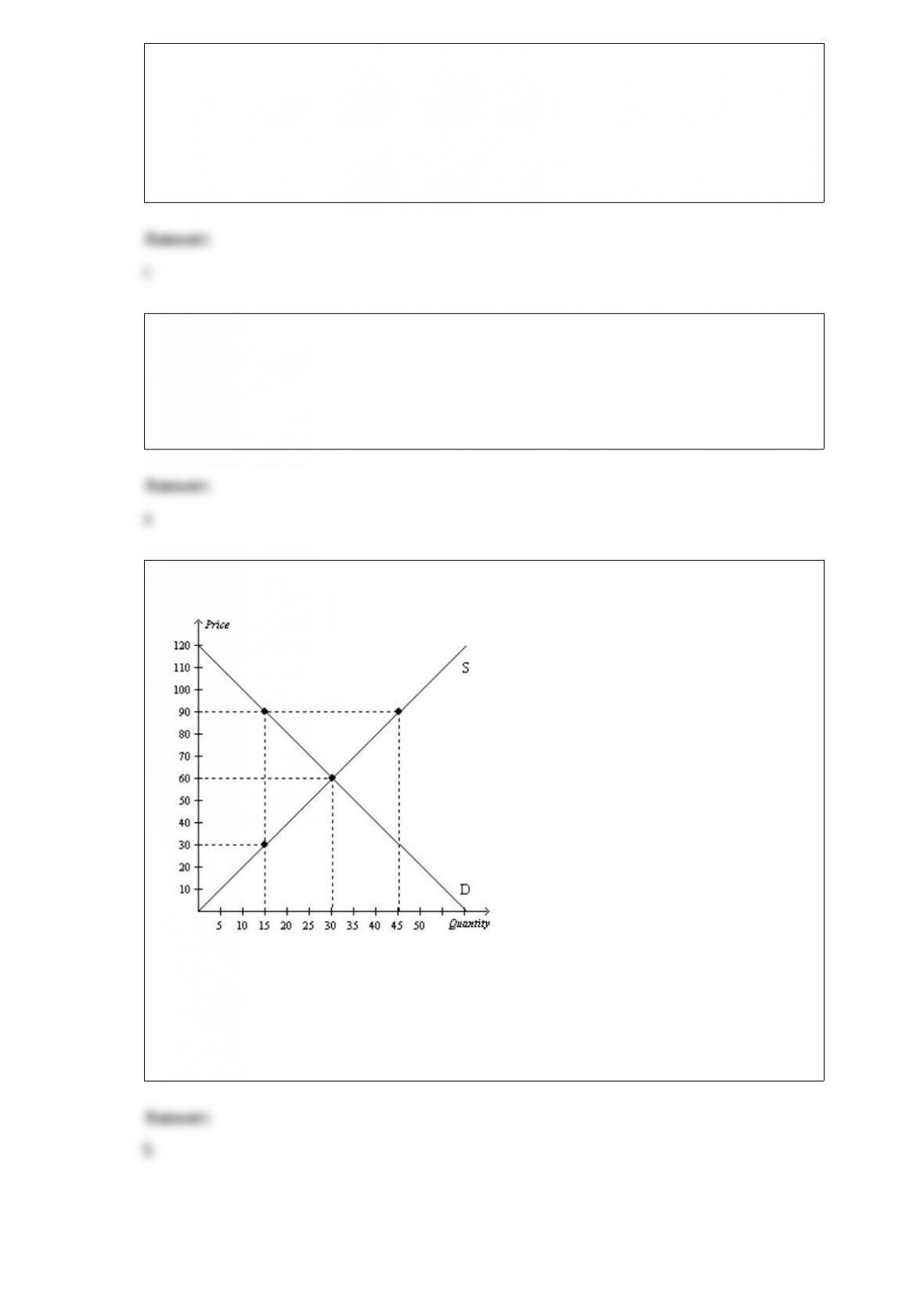
3) Figure 7-26
Refer to Figure 7-26. At the equilibrium price, consumer surplus is
a. $600.
b. $900.
c. $1,500.
d. $1,800.

4) If long-run average total cost decreases as the quantity of output increases, the firm is
experiencing
a.economies of scale.
b.diseconomies of scale.
c.coordination problems arising from the large size of the firm.
d.fixed costs greatly exceeding variable costs.
5) A utilitarian government must
a.calculate the utility of each individual in society.
b.avoid enacting any policies that redistribute income from the rich to the poor.
c.balance the gains from greater equality against the losses from distorted incentives.
d.pursue policies that do not affect the middle class.
6) There are fewer farmers in the United States today than 200 years ago because of
a.improvements in farm technology.
b.increased government regulations in farming.
c.an elastic demand for food.
d.environmental programs designed to reduce soil erosion.
7) The Tragedy of the Commons will be evident when a growing number of sheep
grazing on the town commons leads to a destruction of the grazing resource. To correct
for this problem, the town could
a.allow individual shepherds to choose their own flock sizes.
b.internalize the externality by subsidizing the production of sheep’s wool.
c.auction off a limited number of sheep-grazing permits.
d.wait until the market corrects the problem.
8) If Kevin’s children run a lemonade stand for a day and sell 200 glasses of lemonade
at $0.50 each, their total revenues are
a. $100.
b. $199.50.
c. $200.
d. $400.

9) Suppose the average income of a citizen of Poland is higher than the average income
of a citizen of Romania. You might conclude that
a.Polish firms are faced with stricter government regulations than Romanian firms.
b.total income is divided among fewer workers in Poland since it has a smaller labor
force than Romania.
c.Romania’s climate allows for longer growing seasons and therefore Romania can
produce large quantities of grain and other crops.
d.productivity in Poland is higher than in Romania.
10) Which of the following goods is excludable but not rival in consumption?
a.a congested toll road
b.fire protection in a small town
c.a tornado siren
d.whales in the ocean
11) Which of the following statements is correct about the roles of economists?
a.Economists are best viewed as policy advisers.
b.Economists are best viewed as scientists.
c.In trying to explain the world, economists are policy advisers; in trying to improve the
world, they are scientists.
d.In trying to explain the world, economists are scientists; in trying to improve the
world, they are policy advisers.
12) Figure 7-19
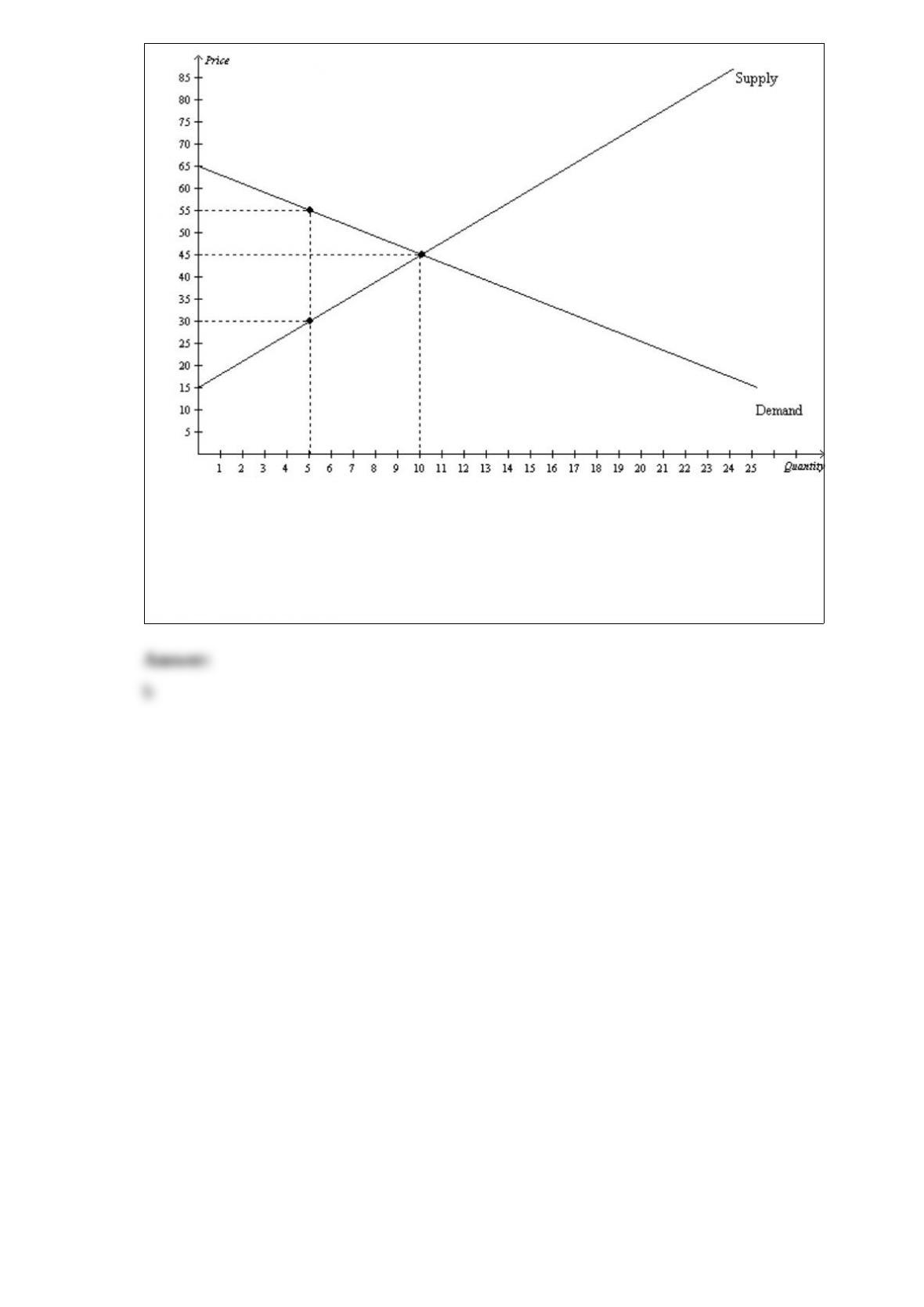
At the equilibrium price, producer surplus is
a. $300.
b. $150.
c. $450.
d. $125.