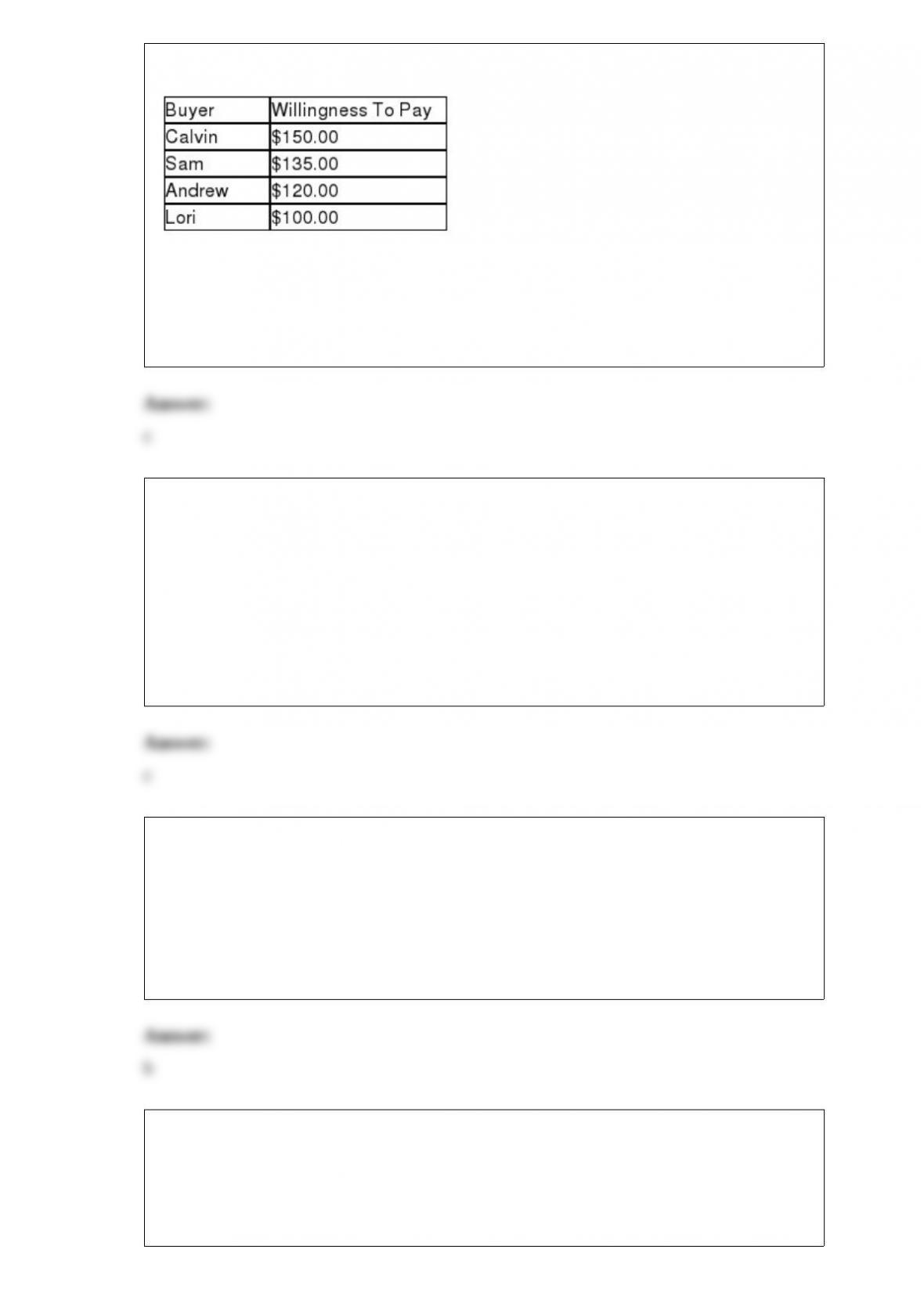
1) Table 7-1
If price of the product is $135, then the total consumer surplus is
a. $-50.
b. $-35.
c. $15.
d. $150.
2) Refer to Figure 9-16. The tariff
a.decreases producer surplus by the area C and decreases consumer surplus by the area
C + D + E + F.
b.decreases producer surplus by the area C + D and decreases consumer surplus by the
area D + E + F.
c.increases producer surplus by the area C and decreases consumer surplus by the area
C + D + E + F.
d.increases producer surplus by the area B + C and decrease consumer surplus by the
area D + E + F.
3) Which of the following statements is not correct?
a.Competitive markets tend to limit the impact of discrimination on wages.
b.Differences in earnings of whites and blacks or men and women provide clear
evidence of discrimination.
c.Some differences in earnings are attributable to discrimination based on race, sex, or
other factors.
d.Profit-maximizing behavior can reduce discriminatory wage differentials.
4) Consider the labor market for short-order cooks. A shortage in the availability of
frying pans will cause
a.both equilibrium wages and equilibrium employment to increase.
b.both equilibrium wages and equilibrium employment to decrease.
c.equilibrium wages to increase and equilibrium employment to decrease.
d.equilibrium wages to decrease and equilibrium employment to increase.
5) When the government enacts policies to make the distribution of income more
equitable, it distorts incentives, alters behavior, and makes the allocation of resources
less efficient.
a.True
b.False
6) Refer to Figure 9-17. With free trade, consumer surplus is
a.$400 and producer surplus is $200.
b.$400 and producer surplus is $800.
c.$1,600 and producer surplus is $200.
d.$1,600 and producer surplus is $800.
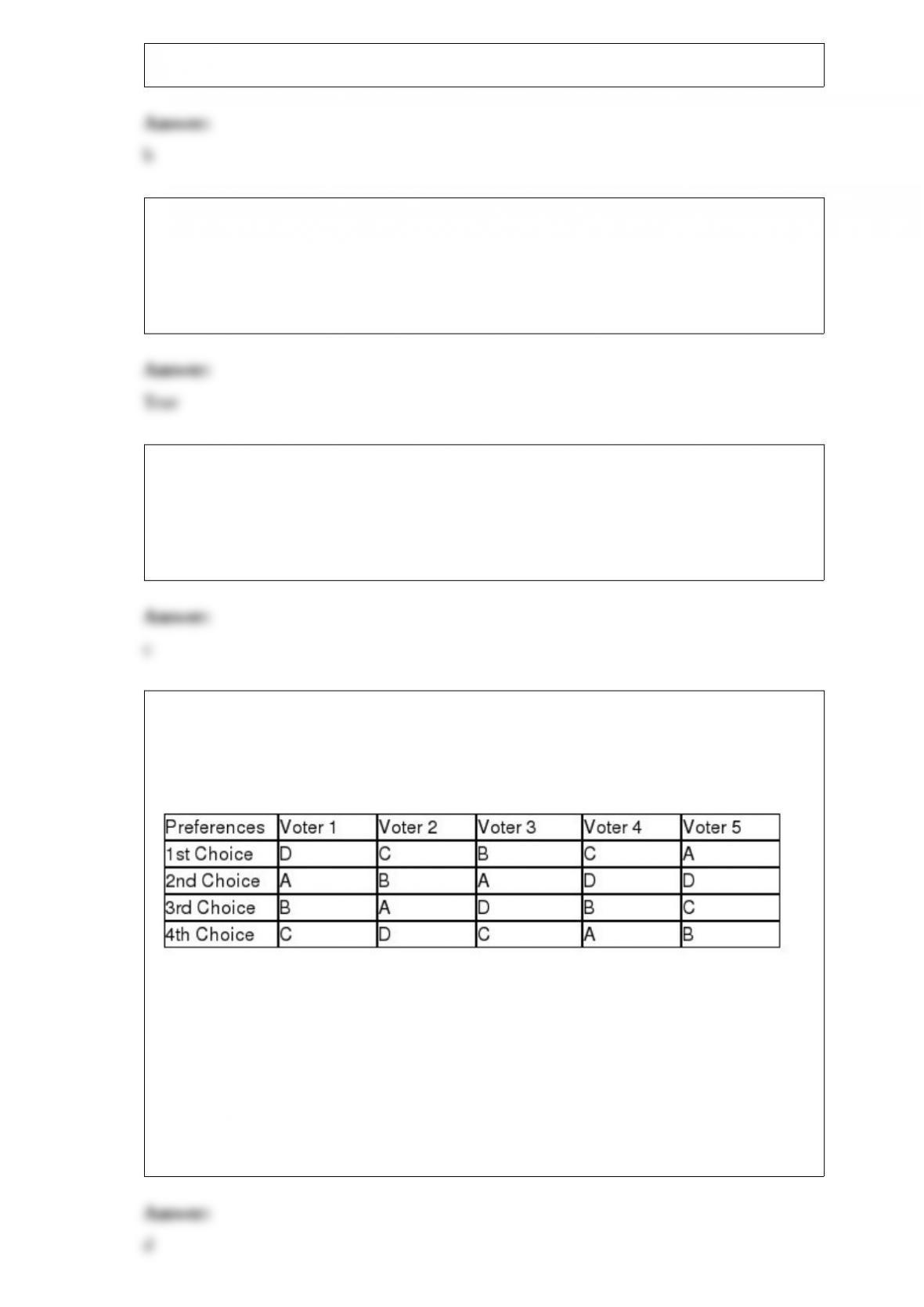
7) Table 22-11
Five voters must choose from among four options: A, B, C, or D. Each voter’s
preferences are summarized in the table below. Options higher in the table are more
preferred by the voter.
Refer to Table 22-11. Which pairwise voting scheme would result in outcome B?
a.First, choose between A and B. Second, voters choose between the winner of the first
vote and C. Third, voters choose between the winner of the second vote and D.
b.First, choose between B and C. Second, voters choose between the winner of the first
vote and A. Third, voters choose between the winner of the second vote and D.
c.First, choose between B and D. Second, voters choose between the winner of the first
vote and C. Third, voters choose between the winner of the second vote and A.
d.First, choose between C and D. Second, voters choose between the winner of the first
vote and A. Third, voters choose between the winner of the second vote and B.
8) Economists speaking like policy advisers make
a.claims about how the world is.
b.descriptive statements.
c.normative statements.
d.More than one of the above is correct.
9) Which of the following is not a consequence of above-equilibrium wages in a labor
market?
a.a surplus of labor
b.unemployment
c.more unionized jobs
d.All of the above are consequences of above-equilibrium wages.
10) A disadvantage associated with an Earned Income Tax Credit (EITC) program to
reduce poverty is that it
a.encourages illegitimate births because single women with children receive higher
payments.
b.rewards laziness because it provides payments to those with low incomes regardless
of their work effort.
c.does not help the poor who are unemployed.
d.creates unemployment by increasing the wage paid to unskilled workers above the
equilibrium wage.
11) Consider the labor market for computer programmers. During the late 1990s, the
value of the marginal product of all computer programmers increased dramatically.
Holding all else equal, the equilibrium wage in the labor market for computer
programmers
a.increased.
b.decreased.
c.did not change.
d.It is not possible to determine the equilibrium wage.
12) In which of the following situations would supply be the most elastic?
a.An auto parts manufacturer is operating at capacity.
b.A real estate developer in Boston is looking to build condos on the waterfront.
c.A furniture manufacturer is operating its factory 8 hours per day.
d.A hotel has all of its rooms booked for each night of the next 3 months.
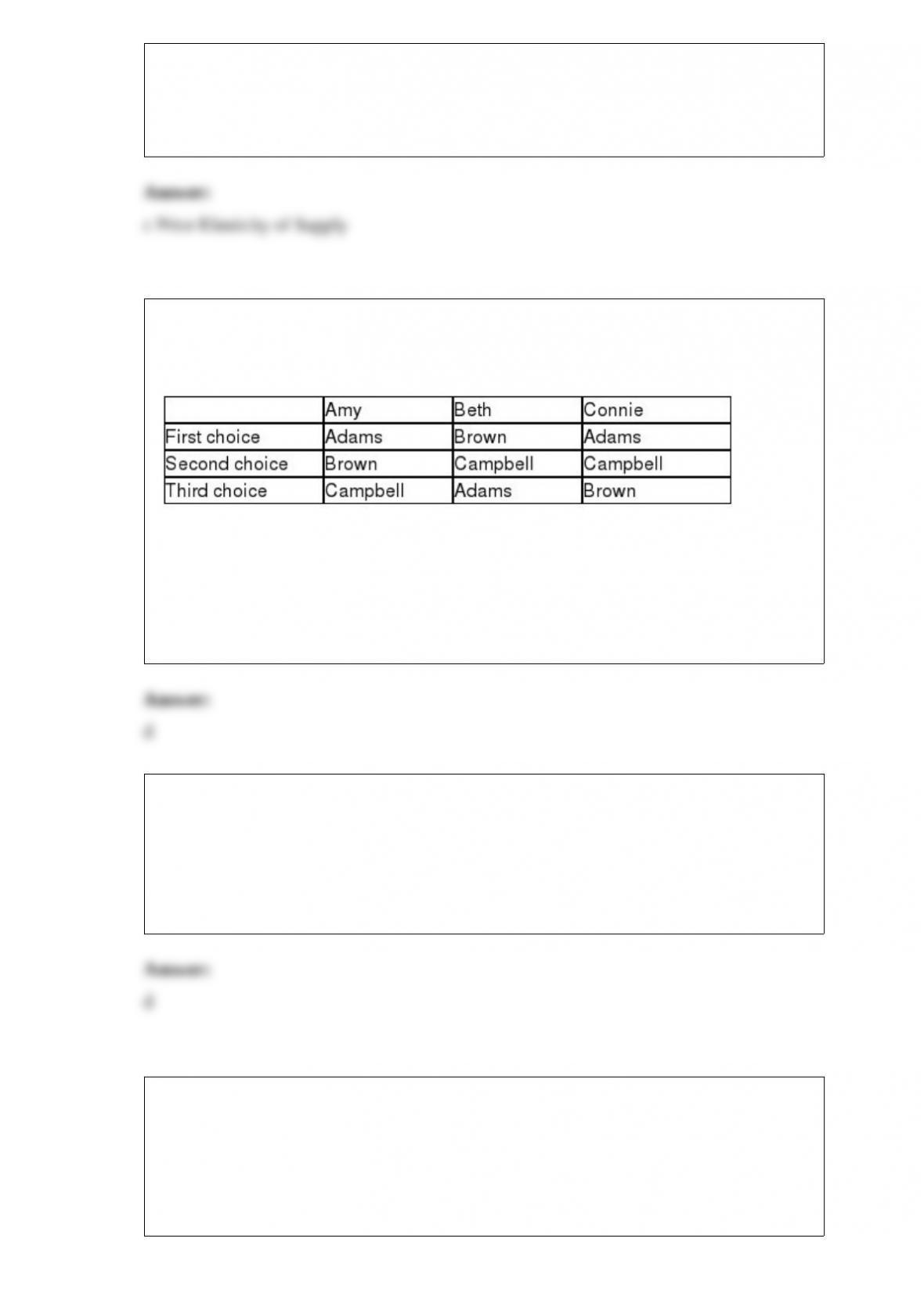
13) Table 22-14
Amy, Beth, and Connie are on a hiring committee. They have interviewed 3 candidates
identified by their last names and are going to vote on which one is hired.
Refer to Table 22-14. Adams calls and says she’s accepted another position. In which
case does Campbell win against Brown?
a.both a pairwise vote and a Borda Count vote
b.a pairwise vote, but not a Borda Count vote
c.a Borda Count vote, but not a pairwise vote
d.neither a Borda Count vote, nor a pairwise vote
14) Which of the following statements is not correct?
a.Two key elements of welfare reform are work requirements and limiting the time that
recipients can receive benefits.
b.The Earned Income Tax Credit (EITC) is very similar to a negative income tax.
c.Minimum wage laws will likely increase unemployment.
d.The elderly are more likely to be poor than single mothers.
15) If the for two goods is 1.25, then
a.the two goods are luxuries.
b.the two goods are substitutes.
c.one of the goods is normal and the other good is inferior.
d.the demand for one of the goods conforms to the law of demand, but the demand for
the other good violates the law of demand.
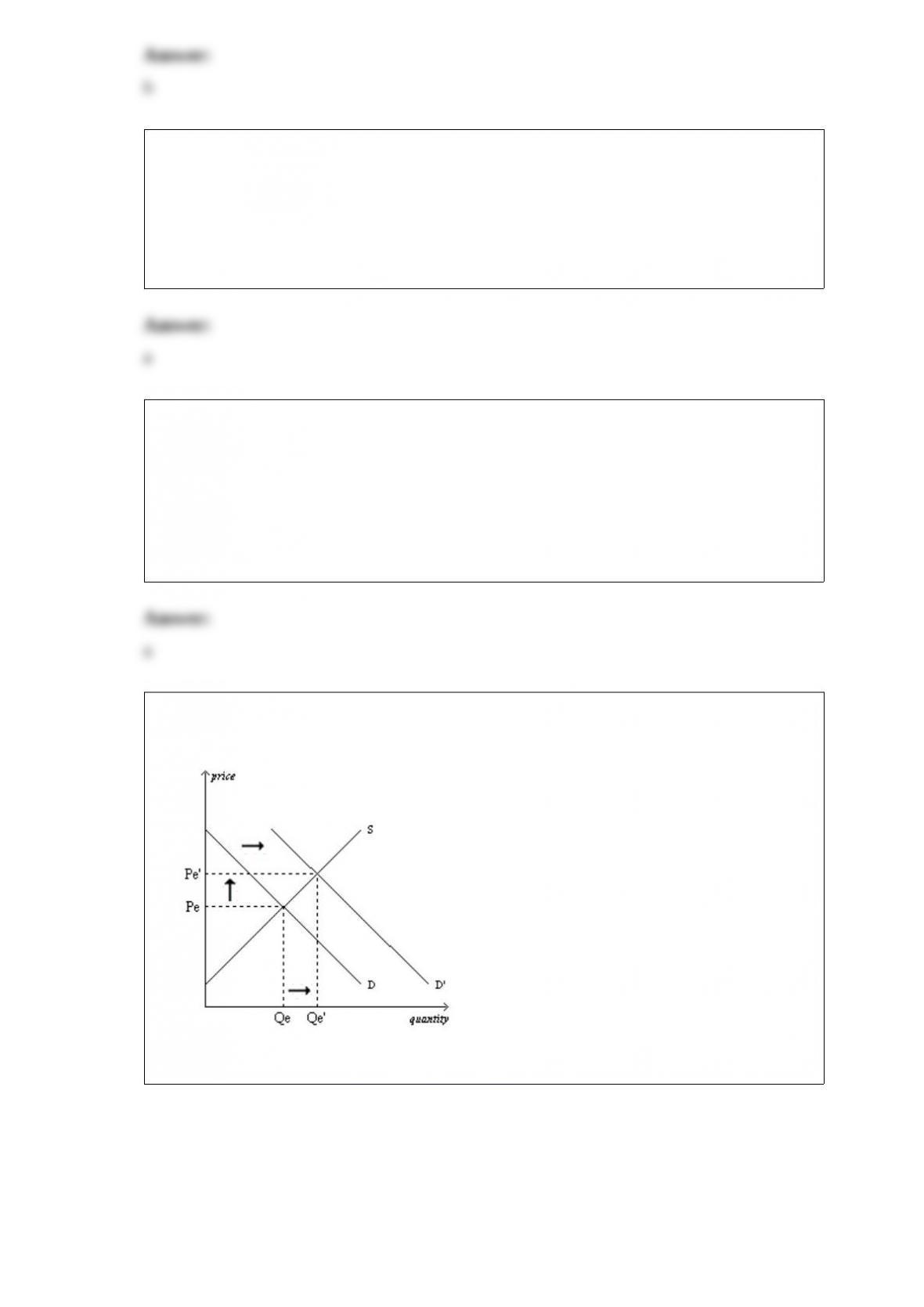
16) Which of the following statements is correct?
a.Based on studies of human decision making, most people are overconfident in their
own abilities.
b.Arrow’s impossibility theorem disproves the median voter theorem.
c.Romantic gifts are an example of adverse selection.
d.An efficiency wage encourages workers to shirk.
17) In a long-run equilibrium,
a.only a perfectly competitive firm operates at its efficient scale.
b.only a monopolistically competitive firm operates at its efficient scale.
c.neither a competitive firm nor a monopolistically competitive firm charges a markup
over marginal cost.
d.both a perfectly competitive firm and a monopolistically competitive firm operate at
their efficient scale of production.
18) Panel (a)
Panel (b)
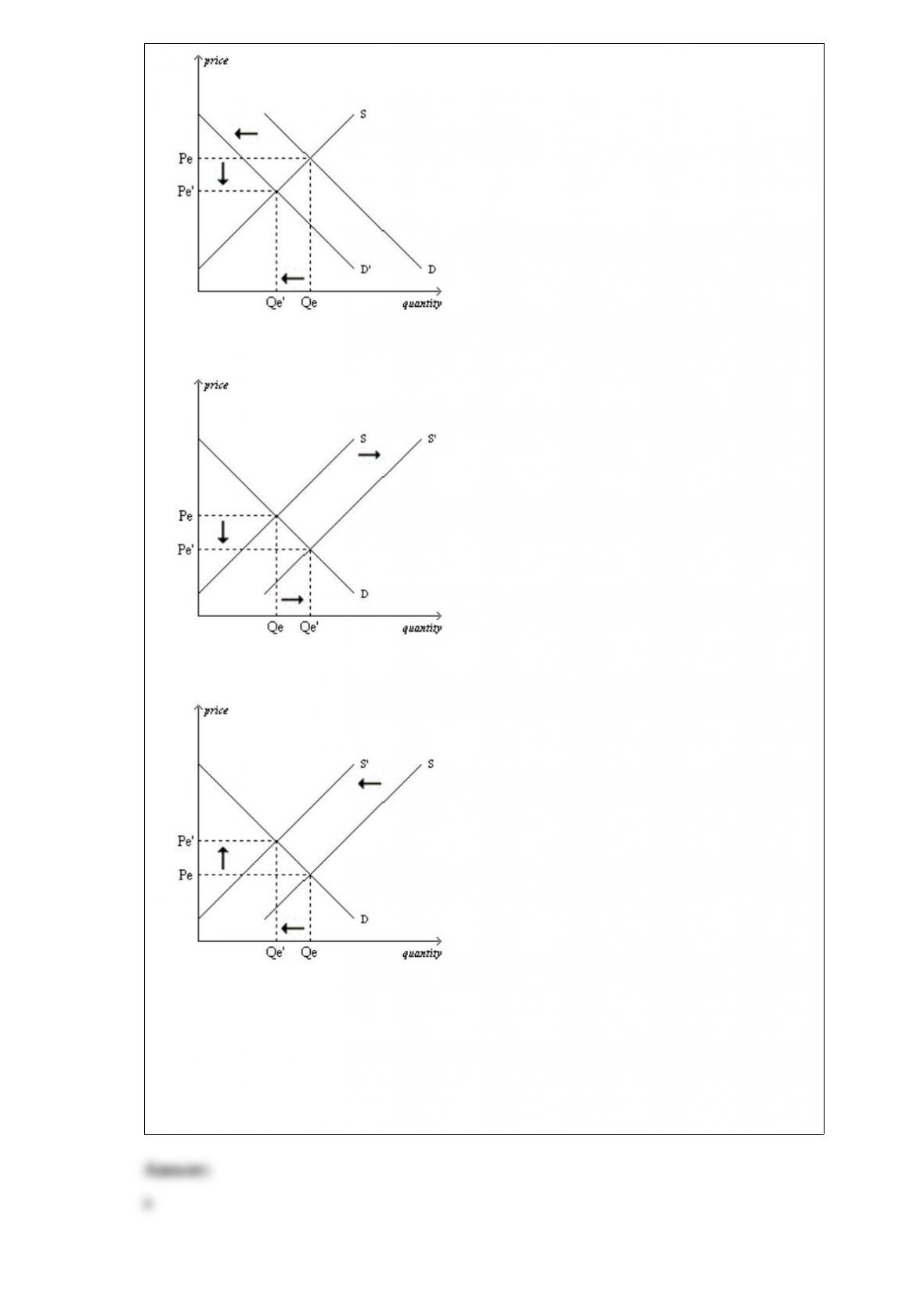
Panel (c)
Panel (d)
Which of the four panels represents the market for pizza delivery in a college town as
we go from summer to the beginning of the fall semester?
a.Panel (a)
b.Panel (b)
c.Panel (c)
d.Panel (d)