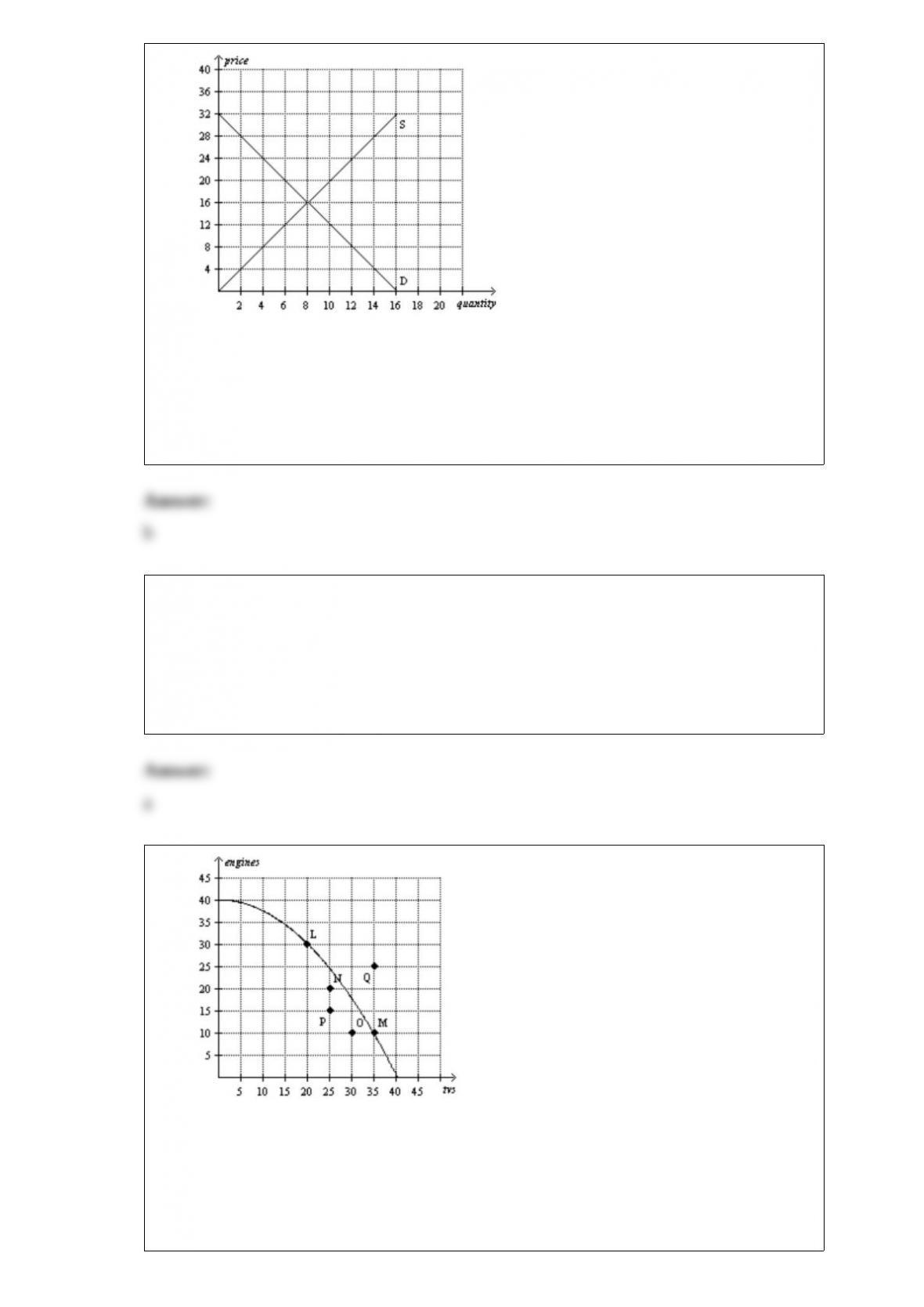
1) What is the equilibrium quantity in this
market?
a.4 units
b.8 units
c.12 units
d.16 units
2) The use of theory and observation is more difficult in economics than in sciences
such as physics due to the difficulty in
a.performing an experiment in an economic system.
b.applying mathematical methods to economic analysis.
c.analyzing available data.
d.formulating theories about economic events.
3)
What is the opportunity cost of moving from point L to point M?
a.zero
b.15 tvs
c.20 engines and 15 tvs
d.20 engines

4) An example of a perfectly competitive market would be the
a.cable TV market.
b.soybean market.
c.breakfast cereal market.
d.shampoo market.
5) For a profit-maximizing monopolistically competitive firm, marginal revenue
exceeds marginal cost in
a.the short run but not in the long run.
b.the long run but not in the short run.
c.both the short run and the long run.
d.neither the short run nor the long run.
6) A production possibilities frontier is a graph that shows the combination of outputs
that an economy should produce.
a.True
b.False
7) Which of the following markets is not likely characterized by a monopolistically
competitive market?
a.mobile telephone service
b.auto mechanic service
c.barbershops
d.jewelry
8) Pay-per-view broadcasts are
a.private goods.
b.club goods.
c.common resources.
d.public goods.
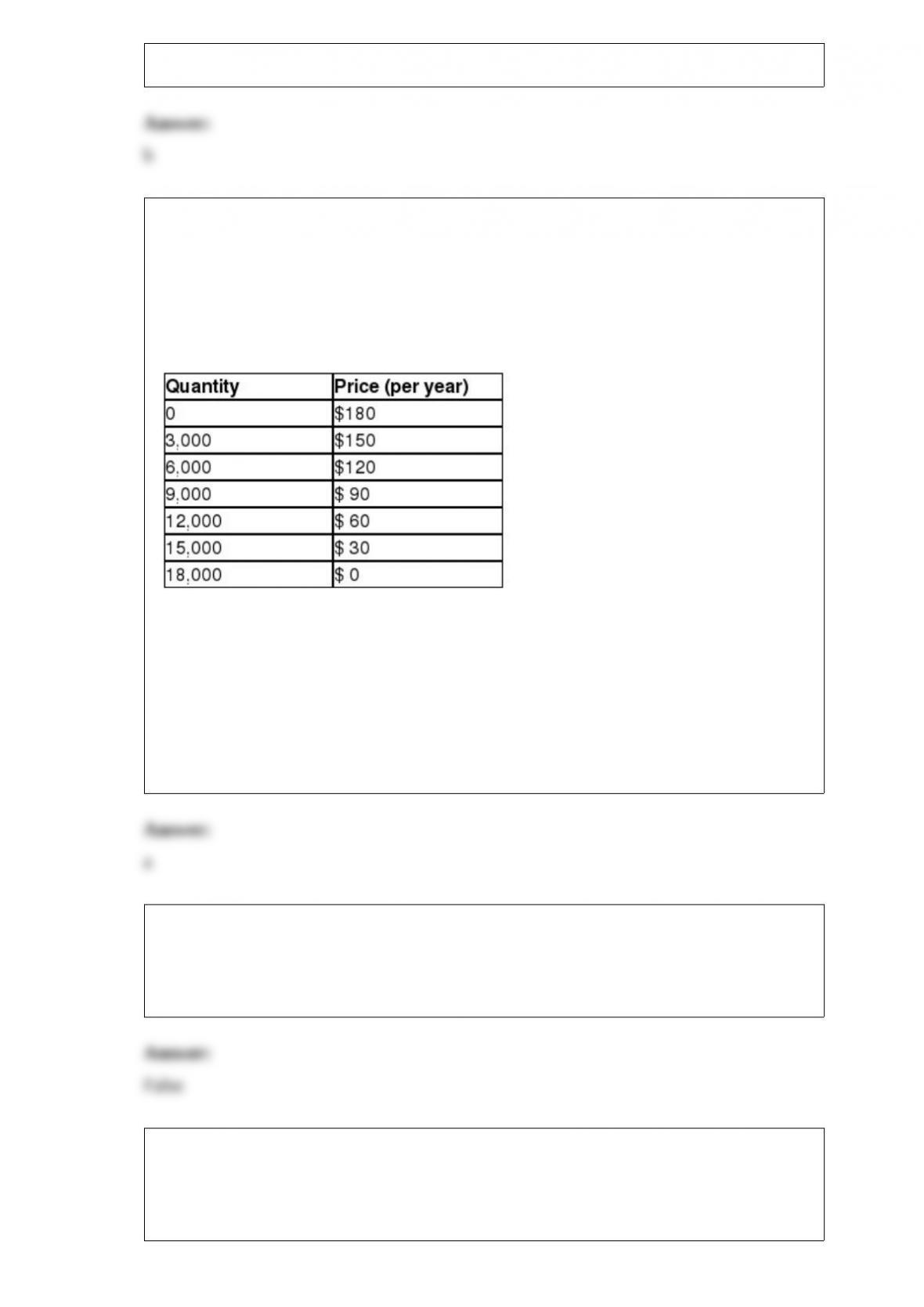
9) Table 17-5
The information in the table below shows the total demand for premium-channel digital
cable TV subscriptions in a small urban market. Assume that each digital cable TV
operator pays a fixed cost of $200,000 (per year) to provide premium digital channels in
the market area and that the marginal cost of providing the premium channel service to
a household is zero.
Refer to Table 17-5. Assume there are two digital cable TV companies operating in this
market. If they are able to collude on the quantity of subscriptions that will be sold and
on the price that will be charged for subscriptions, then their agreement will stipulate
that
a.each firm will charge a price of $90 and each firm will sell 4,500 subscriptions.
b.each firm will charge a price of $90 and each firm will sell 9,000 subscriptions.
c.each firm will charge a price of $120 and each firm will sell 3,000 subscriptions.
d.each firm will charge a price of $150 and each firm will sell 1,500 subscriptions.
10) If people with blue eyes earn more than people with brown eyes, we have proof of
discrimination against people with brown eyes.
a.True
b.False
11) As new firms enter a monopolistically competitive market, profits of existing firms
a.rise, and product diversity in the market increases.
b.rise, and product diversity in the market decreases.
c.decline, and product diversity in the market increases.

d.decline, and product diversity in the market decreases.
12) If producing a soccer ball costs Jake $5, and he sells it for $40, his producer surplus
is $45.
a.True
b.False
13) Dee loves to landscape her yard, but her neighbor Marvin places a low value on his
landscaping. When Marvin’s grass is neglected and gets long, Dee will mow it for
Marvin. This is an example of
a.a situation in which the Coase theorem fails to explain the lawn mowing arrangement.
b.an improper allocation of resources.
c.a private solution to a negative externality problem.
d.an exploitation of a common resource.
14) Producers have little incentive to produce a public good because
a.the social benefit is less than the private benefit.
b.the social benefit is less than the social cost.
c.there is a free-rider problem.
d.there is a Tragedy of the Commons.