
1) A disadvantage associated with in-kind transfers to reduce poverty is that they
a.alter peoples’ incentives, whereas a negative income tax does not alter peoples’
incentives.
b.do not allow poor families to make purchases based on their preferences.
c.can only be distributed by the federal government.
d.cannot restrict the group of recipients and some middle-class families may benefit
from them.
2) The quantity supplied of a good is the amount that
a.buyers are willing and able to purchase.
b.sellers are able to produce.
c.buyers and sellers agree will be brought to market.
d.sellers are willing and able to sell.
3) Scenario 13-8
Wanda owns a lemonade stand. She produces lemonade using five inputs: water, sugar,
lemons, paper cups, and labor. Her costs per glass are as follows: $0.01 for water, $0.02
for sugar, $0.03 for lemons, $0.02 for cups, and $0.10 for the opportunity cost of her
labor. She can sell 300 glasses for $0.50 each.
What are Wanda’s total accounting profits?
a.$150
b.$126
c.$96
d.$24
4) A firm that wants to achieve economies of scale could do so by
a.assigning limited tasks to its employees, so they can master those tasks.
b.employing a smaller number of workers.
c.producing a smaller quantity of output.
d.producing an output level higher than the efficient scale.
5) A consumer who doesn’t spend all of her income
a.would be at a point outside of her budget constraint.
b.would be at a point inside her budget constraint.
c.must not be consuming positive quantities of all goods.
d.must be consuming at a point where her budget constraint touches one of the axes.
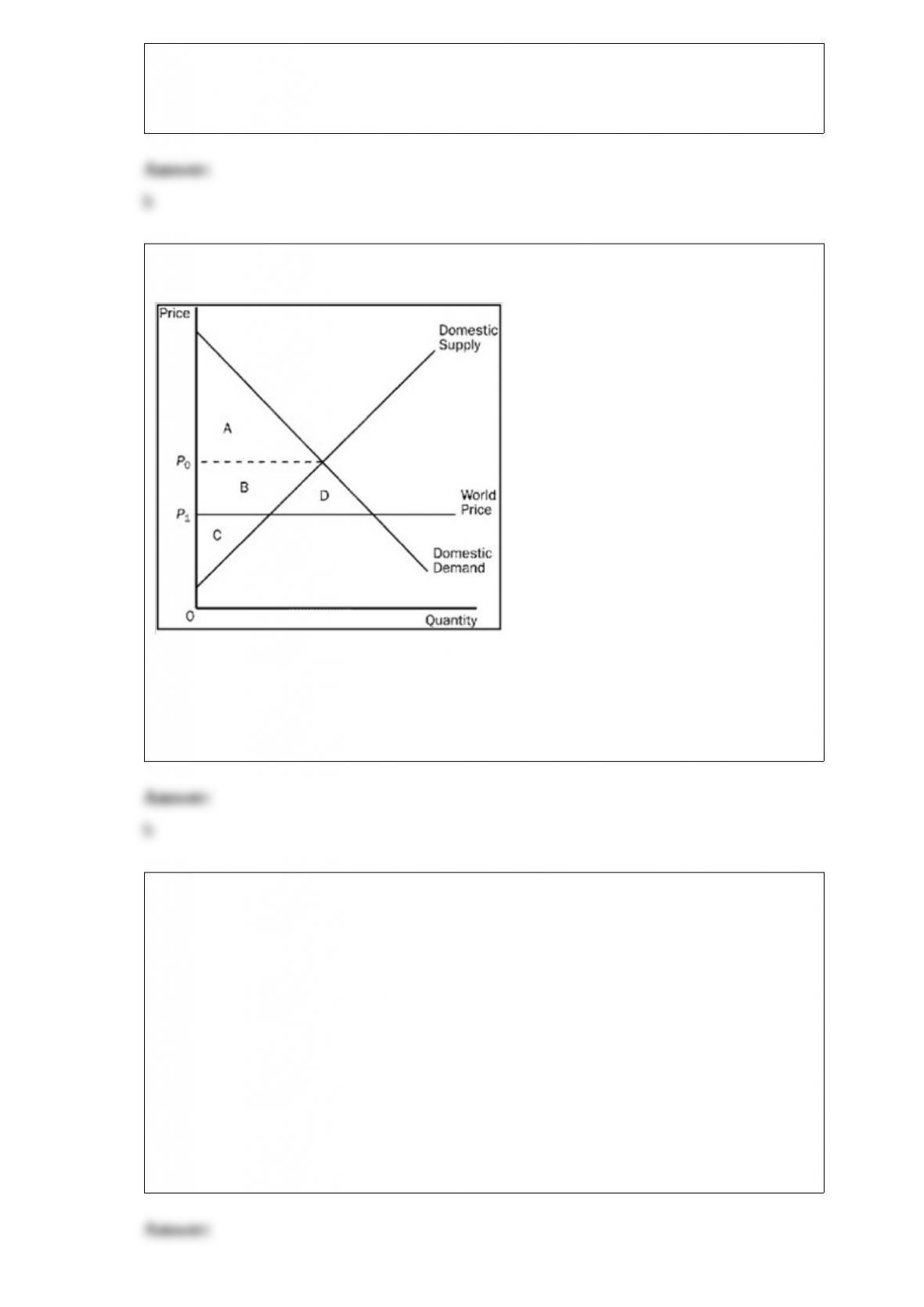
6) Figure 9-11
Producer surplus plus consumer surplus in this market before trade is
a.A + B.
b.A + B + C.
c.A + B + C + D.
d.B + C + D.
7) Scenario 14-5
A study sponsored by the Food Consumer Safety Board found that consumption of
irradiated tomatoes increased the health of laboratory rats. As a result of national press
coverage of the report, the demand for irradiated tomatoes increased dramatically.
Organic farmers were able to switch from organic production of tomatoes to irradiated
production with no additional cost. Assume that the tomato market satisfies all of the
assumptions of perfect competition.
As a result of the increase in the demand for tomatoes, we would predict that in the
short run that the
a.production of tomatoes would be at efficient scale.
b.price of tomatoes would rise.
c.total cost for existing irradiated tomato producers must rise.
d.number of firms in the market would fall as prices fall and firms exit the market.
8) The statement that “night shift workers make a higher wage than day shift workers”
is likely to reflect the fact that
a.most people’s preference is to work the day shift.
b.some people prefer to work a night shift for nonmonetary reasons.
c.night shift jobs are generally more technically difficult.
d.more women than men work the night shift.
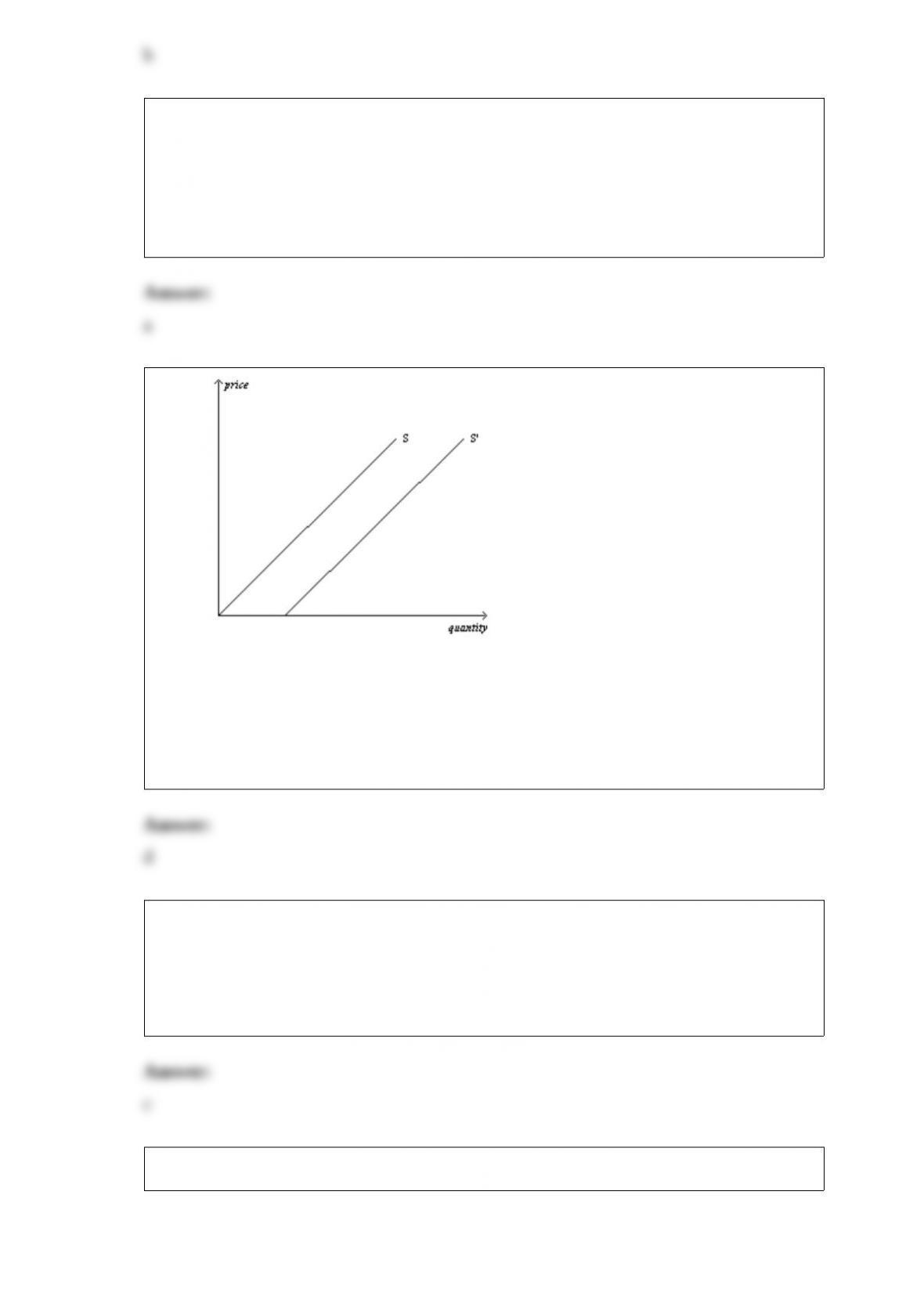
9)
The shift from S to S’ in the market for peaches could be caused by a(n)
a.increase in the price of peaches.
b.decrease in the price of pears.
c.increase in income.
d.decrease in the labor costs of the workers who pick peaches.
10) Demand is said to be inelastic if
a.buyers respond substantially to changes in the price of the good.
b.demand shifts only slightly when the price of the good changes.
c.the quantity demanded changes only slightly when the price of the good changes.
d.the price of the good responds only slightly to changes in demand.
11) Table 20-4
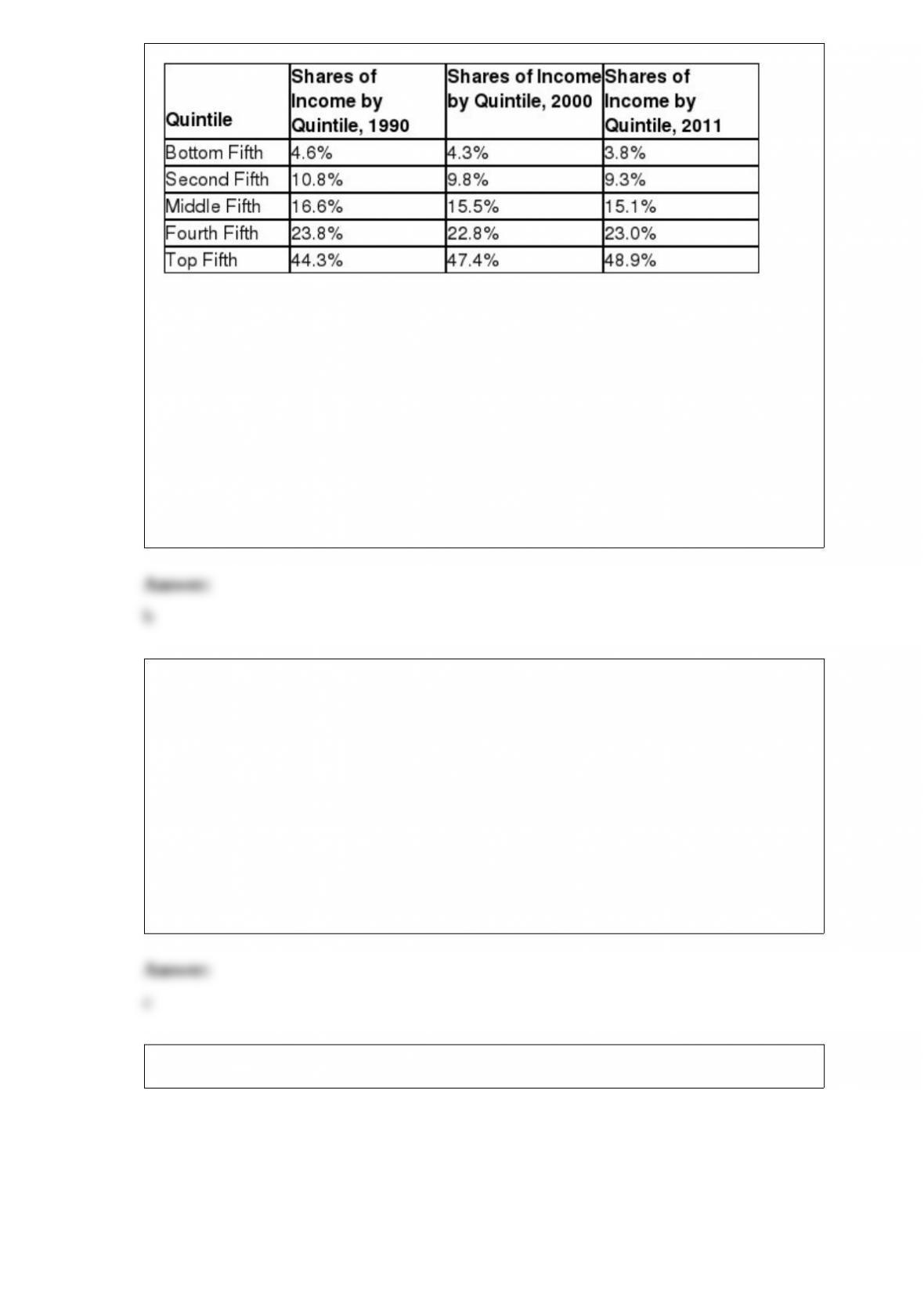
Source: U.S. Bureau of Census
Refer to Table 20-4. Comparing data from 2000 and 2011, which of the following
statements is correct?
a.There has been no change in overall income inequality because the share of income
held by the fourth fifth is nearly identical.
b.Overall income inequality has worsened slightly, as shown by the simultaneous
increase in the share of income held by the top fifth and the decrease in the share of
income held by the bottom fifth.
c.Overall income inequality has improved because the share held by the second fifth
has declined by 0.5%.
d.None of the above is correct.
12) The United States has imposed taxes on some imported goods that have been sold
here by foreign countries at below their cost of production. These taxes
a.benefit the United States as a whole, because they generate revenue for the
government. In addition, because the goods are priced below cost, the taxes do not harm
domestic consumers.
b.benefit the United States as a whole, because they generate revenue for the
government and increase producer surplus.
c.harm the United States as a whole, because they reduce consumer surplus by an
amount that exceeds the gain in producer surplus and government revenue.
d.harm the United States as a whole, because they reduce producer surplus by an
amount that exceeds the gain in consumer surplus and government revenue.
13) Figure 10-10
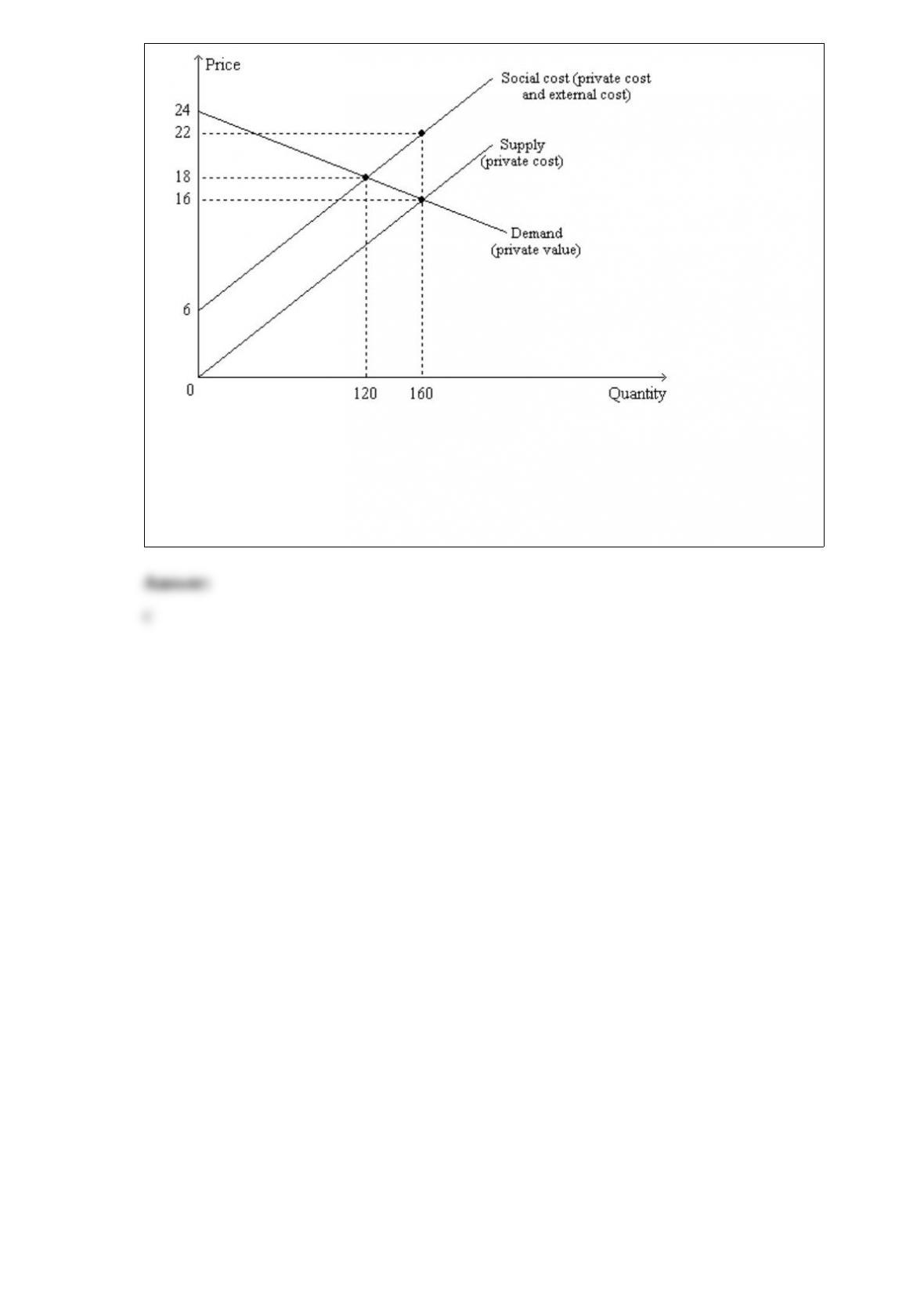
A decrease in output from 160 units to 120 units would
a.move the market from a socially efficient outcome to a socially inefficient outcome.
b.reduce the external cost per unit of output.
c.increase total economic well-being.
d.not be an action of which a benevolent social planner would approve.