Archives
BUS 21079
If a quota is set at the same quantity of imports that results from a tariff in Country A, A) the quantity consumed in Country A is less under the quota than under the tariff. B) the quantity consumed in […]
BUS 21669
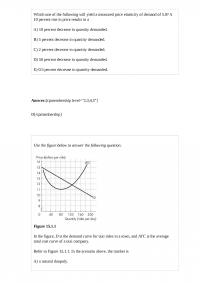
Use the figure below to answer the following questions. Figure 12.3.1 Refer to Figure 12.3.1, which shows the cost curves and marginal revenue curve of a firm in a perfectly competitive industry. In the short run, if the market price […]
BUS 30608
Among the following, the domestic government gains the most revenue when it A) imposes an import quota. B) eliminates an import quota. C) encourages freer trade. D) imposes a tariff. E) increases the demand for a domestically-produced good. The substitution […]
BUS 30898
Refer to Figure 19.1.1. The richest 20 percent of households receive what share of total income? A) 10 percent B) 30 percent C) 40 percent D) 60 percent E) 100 percent Choose the statement that is incorrect. A) A financial […]
BUS 37508
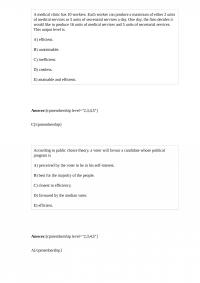
A medical clinic has 10 workers. Each worker can produce a maximum of either 2 units of medical services or 5 units of secretarial services a day. One day, the firm decides it would like to produce 16 units of […]
BUS 38280
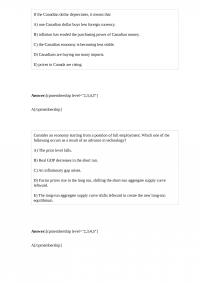
If the Canadian dollar depreciates, it means that A) one Canadian dollar buys less foreign currency. B) inflation has eroded the purchasing power of Canadian money. C) the Canadian economy is becoming less stable. D) Canadians are buying too many […]
BUS 42682
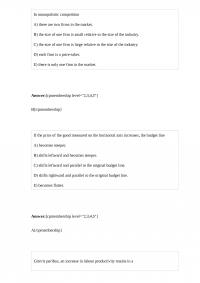
In monopolistic competition A) there are two firms in the market. B) the size of one firm is small relative to the size of the industry. C) the size of one firm is large relative to the size of the […]
BUS 64984
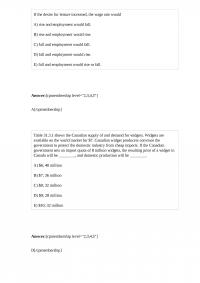
If the desire for leisure increased, the wage rate would A) rise and employment would fall. B) rise and employment would rise. C) fall and employment would fall. D) fall and employment would rise. E) fall and employment would rise […]
BUS 68820
Which one of the following will yield a measured price elasticity of demand of 5.0? A 10 percent rise in price results in a A) 10 percent decrease in quantity demanded. B) 5 percent decrease in quantity demanded. C) 2 […]
BUS 70874
The new growth theory holds that growth can persist indefinitely based on the major assumption that A) discoveries result from regulations. B) knowledge capital does not experience diminishing returns. C) knowledge is a public capital good. D) discoveries bring profit. […]
BUS 81773
If we produce one more bottle of water, A) we cannot be acting efficiently. B) we incur a marginal cost. C) we must move away from market equilibrium. D) the price of a bottle of water must rise. E) the […]
BUS 84646
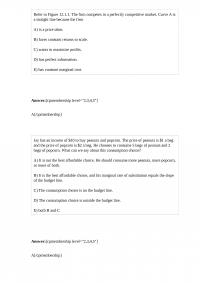
Refer to Figure 12.1.1. The firm competes in a perfectly competitive market. Curve A is a straight line because the firm A) is a price taker. B) faces constant returns to scale. C) wants to maximize profits. D) has perfect […]
BUS 86987
Real money is equal to A) nominal income divided by the velocity of circulation. B) nominal income divided by the price level. C) nominal money divided by the price level. D) the price level divided by nominal money. E) nominal […]
BUS 89272
The time spent looking for someone with whom to do business is called A) elasticity of time. B) market time. C) search activity. D) opportunity time. E) development time. When rent is not permitted to allocate scarce housing, what other […]
BUS 93171
A tax on interest income A) decreases the demand for loanable funds but does not change the real interest rate. B) increases the demand for loanable funds and raises the real interest rate. C) increases the supply of loanable funds […]
BUS 96554
The maximum level of real GDP that can be produced while avoiding shortages of labour, capital, land, and entrepreneurial ability that would bring rising inflation is A) real GDP. B) nominal GDP. C) actual GDP. D) potential GDP. E) productive […]
ECB 10958
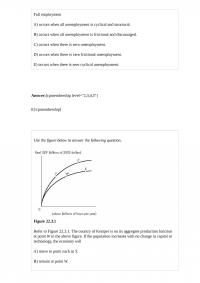
Full employment A) occurs when all unemployment is cyclical and structural. B) occurs when all unemployment is frictional and discouraged. C) occurs when there is zero unemployment. D) occurs when there is zero frictional unemployment. E) occurs when there is […]
ECB 11764
If the saving function is S = -25 + 0.4YD, then the consumption function is A) C = 25 + 0.6Y. B) C = -25 + 0.4YD. C) C = 25 – 0.4YD. D) C = 25 + 0.6YD. E) […]
ECB 22164
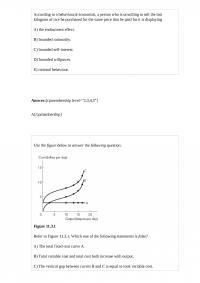
According to a behavioural economist, a person who is unwilling to sell the last kilogram of rice he purchased for the same price that he paid for it is displaying A) the endowment effect. B) bounded rationality. C) bounded self-interest. […]
ECB 22258
The Canadian short-run Phillips curve ________ when the expected inflation rate rises and ________ when the expected inflation rate falls. The Canadian short-run Phillips curve ________ when the natural unemployment rate increases and ________ when the natural unemployment rate decreases. […]
ECB 28252
Refer to Figure 16.2.1. The figure shows the marginal private cost curve, the marginal social cost curve and the market demand curve. If a constant per unit tax is imposed that generates an efficient allocation of resources, then consumers pay […]
ECB 31126
Prime Pharmaceuticals has developed a new asthma inhaler, for which it has a patent. An inhaler can be produced at a constant marginal cost of $2 per inhaler. The demand curve, marginal revenue curve, and marginal cost curve for this […]
ECB 42495
Approximately, the real interest rate ________ the inflation rate ________ the nominal interest rate. A) plus; equals B) equals; plus C) equals; minus D) minus; equals E) times; divided by 100 equals The minimum efficient scale is the smallest quantity […]
ECB 49290
Suppose that the Reserve Bank of New Zealand is following the Taylor rule. In 2009, it sets the official cash rate (the N.Z. equivalent of the overnight loans rate) at 4.0 percent a year. If the inflation rate in New […]
ECB 49684
The monetary base consists of the sum of A) Bank of Canada notes held within the Bank of Canada, bank deposits at the Bank of Canada, and coins held by banks. B) Bank of Canada notes held outside the Bank […]
ECB 54578
The maximum price a consumer is willing to pay for a good is the A) consumer surplus. B) value of the good. C) opportunity cost of producing the good. D) minimum supply-price. E) marginal cost of the good. The marginal […]
ECB 55026
If Canada imposes a tariff of $1 per imported shirt, the tariff A) raises the price of a shirt paid by Canadian consumers. B) benefits Canadian shirt producers. C) decreases imports of shirts into Canada. D) creates a social loss. […]
ECB 55305
Economists who have compared the incomes of never-married men and never-married women have found that with equal amounts of human capital A) men earn significantly more than women. B) women earn significantly more than men. C) the wages of the […]
ECB 64355
Refer to Figure 1A.1.5. Which graph or graphs indicates a positive relationship between x and y? A) (a) B) (b) C) (c) D) (d) E) (a) and (d) Which one of the following statements is false? A) If the indifference […]
ECB 70468
Whenever actual reserves exceed desired reserves, the bank A) can make new loans. B) will go out of business. C) needs to call in loans. D) will borrow funds from another bank. E) will raise the interest rate on its […]
ECB 70794
Economic efficiency and economic equity have what relationship? A) Redistribution of income reduces economic equality while it increases economic efficiency. B) Income is equitably distributed in free market systems without intervention by government. C) There is a no tradeoff between […]
ECB 70968
Effective strategies for addressing the problem of negative externalities include A) taxing the profit of polluting companies at twice the rate of non-polluting companies. B) imposing taxes on the activity that generates the pollution. C) stressing the use of renewable […]
ECB 76830
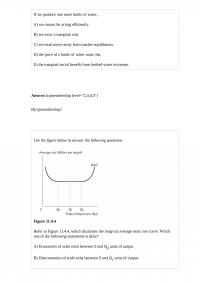
Refer to Figure 13.3.1. The efficient quantity is A) 20 units. B) 40 units. C) 60 units. D) 80 units. E) zero units. Refer to Figure 12.4.1, which shows the cost curves and marginal revenue curve of a firm in […]
ECB 77403
Larry consumes only beer (B) and chips (C). If beer is measured on the vertical axis, the relative price of chips in terms of beer is all of the following except A) PC/PB. B) the magnitude of the slope of […]
ECB 77765
To decrease aggregate demand, the Bank of Canada can A) raise the overnight loans rate, which decreases the quantity of money. B) lower the overnight loans rate, which increases the quantity of money. C) lower the overnight loans rate, which […]
ECB 80835
All of the following are possible sources of bias in using the Consumer Price Index to measure inflation except A) the introduction of new goods. B) an improvement in the quality of goods. C) commodity substitution. D) an increase in […]
ECB 82552
Choose the statement that is incorrect. A) Free trade destroys some jobs. B) Imports create jobs for retailers that sell imported goods and for firms that service those goods. C) Imports create income in the rest of the world, some […]
ECB 90265
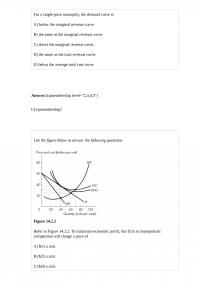
For a single-price monopoly, the demand curve is A) below the marginal revenue curve. B) the same as the marginal revenue curve. C) above the marginal revenue curve. D) the same as the total revenue curve. E) below the average […]
ECB 90352
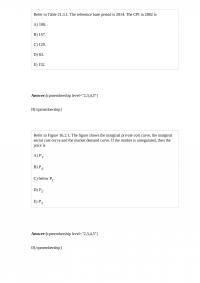
Refer to Table 21.3.1. The reference base period is 2014. The CPI in 2002 is A) 100. B) 157. C) 129. D) 63. E) 152. Refer to Figure 16.2.1. The figure shows the marginal private cost curve, the marginal social […]
ECB 94053
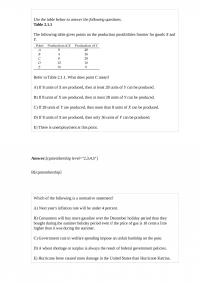
Use the table below to answer the following questions. Table 2.1.1 The following table gives points on the production possibilities frontier for goods X and Y. Refer to Table 2.1.1. What does point C mean? A) If 8 units of […]
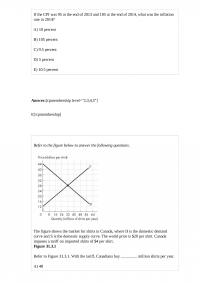
ECB 95897
If the CPI was 95 at the end of 2013 and 105 at the end of 2014, what was the inflation rate in 2014? A) 10 percent B) 105 percent C) 9.5 percent D) 5 percent E) 10.5 percent Refer […]
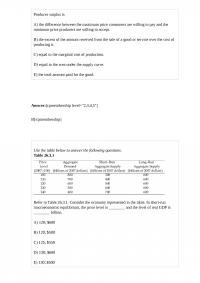
ECON 15388
Producer surplus is A) the difference between the maximum price consumers are willing to pay and the minimum price producers are willing to accept. B) the excess of the amount received from the sale of a good or service over […]
ECON 18289
An assumption of the new growth theory is that A) people earn a subsistence real wage in the long run. B) all technological advances are the result of chance. C) the marginal product of all types of capital increases as […]
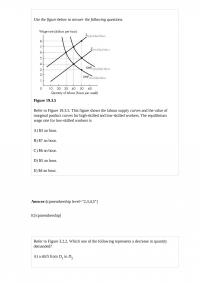
ECON 22295
Use the figure below to answer the following questions. Figure 19.3.5 Refer to Figure 19.3.5. This figure shows the labour supply curves and the value of marginal product curves for high-skilled and low-skilled workers. The equilibrium wage rate for low-skilled […]
ECON 27408
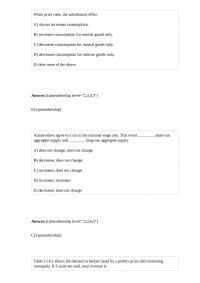
When price rises, the substitution effect A) always increases consumption. B) increases consumption for normal goods only. C) decreases consumption for normal goods only. D) decreases consumption for inferior goods only. E) does none of the above. Autoworkers agree to […]
ECON 30953
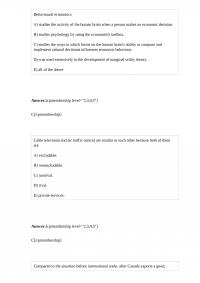
Behavioural economics A) studies the activity of the human brain when a person makes an economic decision. B) studies psychology by using the economist’s toolbox. C) studies the ways in which limits on the human brain’s ability to compute and […]
ECON 36476
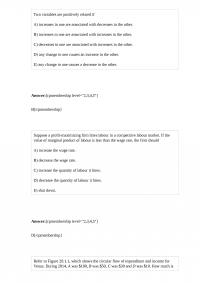
Two variables are positively related if A) increases in one are associated with decreases in the other. B) increases in one are associated with increases in the other. C) decreases in one are associated with increases in the other. D) […]
ECON 39227
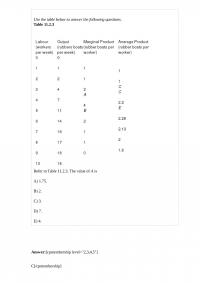
Use the table below to answer the following questions. Table 11.2.3 Refer to Table 11.2.3. The value of A is A) 1.75. B) 2. C) 3. D) 7. E) 4. Answer: C Use the figure below to answer the following […]
ECON 44981
If the marginal social cost of producing a public good is greater than the marginal social benefit, then A) more than the efficient quantity of the public good is being produced. B) less than the efficient quantity of the public […]
ECON 46976
Free riding can occur if a good is A) excludable and rival. B) excludable and nonrival. C) a private good. D) nonexcludable and rival. E) nonexcludable and nonrival. Which of the following situations illustrates how monetary policy can influence aggregate […]
ECON 48733
Choose the correct statement. A) Tax cuts increase aggregate supply and aggregate demand. B) Tax cuts strengthen the incentive to work and to invest. C) The tax multiplier becomes smaller as time passes. D) According to Barro and Uhlig, tax […]
ECON 48856
The demand for corn increases. As a result, the price of corn ________, and the less elastic the supply of corn, the ________ will be the effect on the price. A) falls; smaller B) falls; greater C) rises; smaller D) […]
ECON 50778
Refer to Table 27.1.1. The marginal propensity to consume is A) increasing as YD increases. B) equal to 1 when YD equals $600. C) 0.75. D) 0.25. E) 1.33. Refer to Fact 30.1.1. Choose the statement that is incorrect. A) […]
ECON 54426
If the price level in Canada is 120, the price level in South Africa is 140, and the exchange rate is 7 South African rands per dollar, then the real exchange rate is A) 8.2. B) 7. C) 6. D) […]
ECON 65929
Refer to Figure 3.5.2, which represents the market for tacos. A new scientific study reveals that tacos cause bad breath. Simultaneously, the cost of producing tacos decreases. What is the new equilibrium, ceteris paribus? A) 2 B) 3 C) 9 […]
ECON 82581
Suppose in an industry a firm realizes economies of scale over the entire length of its LRAC curve. In this situation, the firm is A) a natural monopoly. B) a fixed-cost monopoly. C) an output-discriminating monopoly. D) a perfect-price discriminating […]
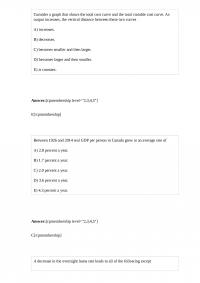
ECON 82663 Consider a graph that
Consider a graph that shows the total cost curve and the total variable cost curve. As output increases, the vertical distance between these two curves A) increases. B) decreases. C) becomes smaller and then larger. D) becomes larger and then […]
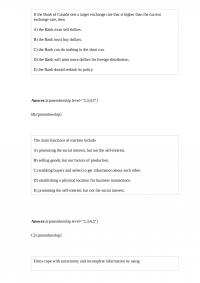
ECON 89934
If the Bank of Canada sets a target exchange rate that is higher than the current exchange rate, then A) the Bank must sell dollars. B) the Bank must buy dollars. C) the Bank can do nothing in the short […]
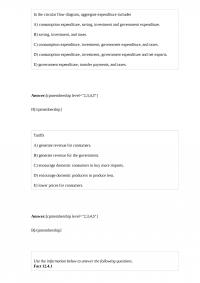
ECON A 11801
In the circular flow diagram, aggregate expenditure includes A) consumption expenditure, saving, investment and government expenditure. B) saving, investment, and taxes. C) consumption expenditure, investment, government expenditure, and taxes. D) consumption expenditure, investment, government expenditure and net exports. E) government […]
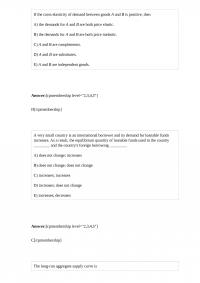
ECON A 18497
If the cross elasticity of demand between goods A and B is positive, then A) the demands for A and B are both price elastic. B) the demands for A and B are both price inelastic. C) A and B […]
ECON A 19821
Which one of the following must be true if demand is income elastic? A) A large percentage increase in income will result in a small percentage increase in quantity demanded. B) A small percentage increase in income will result in […]
ECON A 32369
Suppose the Nunavut government decides to repair Iqaluit roads. One way to generate sufficient funds for this plan is to increase taxes on gasoline. The government will be able to raise total revenue from gasoline sales only if the demand […]
ECON A 36615
The law of supply of foreign exchange tells us that, other things remaining the same, A) the lower the exchange rate, the greater is the quantity of Canadian dollars supplied. B) the higher the exchange rate, the greater is the […]
ECON A 37233
In monopolistically competitive industries, A) firms compete on quality, price and marketing. B) the range of choice of products is the same as in perfectly competitive industries. C) firms are insensitive to changes in consumer demand. D) all firms produce […]
ECON A 67932
The supply of loanable funds is the relationship between the quantity of loanable funds supplied and ________, other things remaining the same. A) real GDP B) the price level C) the real interest rate D) the inflation rate E) the […]
ECON A 80125
Refer to Fact 14.1.1. The market for batteries is ________ and the market for jewellery is ________. A) monopolistic competition; an oligopoly B) a monopoly; monopolistic competition C) a monopoly; perfectly competitive D) an oligopoly; monopolistic competition E) an oligopoly; […]
ECON A 90816
If the demand curve for a good is a horizontal line, then the good has A) zero income elasticity. B) price elasticity of demand equal to zero. C) infinite price elasticity of demand. D) a price elasticity of demand that […]
ECON A 95696
The largest component of GDP using the expenditure approach is A) investment. B) consumption expenditure. C) exports. D) government expenditure. E) imports. Refer to Figure 20.1.1, which shows the circular flow of expenditure and income for Venus. During 2014, A […]
ECON E 29726
Which is not a characteristic of oligopoly? A) Each firm faces a downward-sloping demand curve. B) Firms are profit-maximizers. C) The sales of one firm will not have a significant effect on other firms. D) There is more than one […]
ECON E 49892
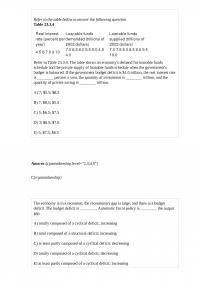
Refer to the table below to answer the following question. Table 23.3.4 Refer to Table 23.3.4. The table shows an economy’s demand for loanable funds schedule and the private supply of loanable funds schedule when the government’s budget is balanced. […]
ECON E 55729
Consider some type of industrial pollution that generates air pollution. This industry, if left unregulated, will produce A) more than the efficient level because they will ignore the marginal external costs. B) the efficient level of output. C) less than […]
ECON E 59313
When firms reduce their target level of inventories, equilibrium expenditure ________ and real GDP ________. A) increases; decreases B) decreases; increases C) decreases; decreases D) increases; increases E) decreases; does not change In real business cycle theory, ________ are the […]
ECON E 61555
If the price of a burger is $2.90 Canadian in Toronto and $3 U.S. in New York, and if purchasing power parity holds, then the exchange rate is A) $1 U.S. per Canadian dollar. B) $3 U.S. per Canadian dollar. […]
ECON E 62298
The magnitude of the slope of an indifference curve is A) the marginal rate of substitution. B) the marginal rate of transformation. C) the marginal propensity to consume. D) the marginal propensity to substitute. E) the relative price of good […]
ECON E 66740
If the money wage rate falls, then A) the AD curve shifts rightward. B) firms hire less labour. C) the LAS curve shifts rightward. D) the SAS curve shifts rightward. E) the LAS curve and the SAS curve shift rightward. […]
ECON E 67618
When a good is rival and excludable, it is a A) natural monopoly good. B) public good. C) regulated good. D) private good. E) common resource. One difference between oligopoly and monopolistic competition is A) there is a smaller number […]
ECON E 69533
The y– axis intercept of the supply curve is 40 and the slope is 6. The equation of the supply curve is A) P = 3 + 40QS. B) P = 40 + 6QS. C) P = 40 – 6QS. […]
ECON E 76800
Which of the following is a characteristic of a single-price monopoly? A) Many substitutes for the firm’s product exist. B) Price exceeds marginal revenue. C) Demand is perfectly elastic. D) The firm is a price taker. E) Marginal revenue is […]
ECON E 83420
The demand for a good will be more price inelastic, A) the higher is its price. B) the larger is the percentage of income spent on it. C) the longer is the passage of time since a price change. D) […]
ECON E 93845
Refer to Figure 16.3.1. The figure shows the marginal private benefit curve, the marginal social benefit curve, and the market supply curve. If a voucher is given to consumers that generates an efficient outcome, then consumers pay A) zero. B) […]
ECON E 96610
Which of the following statements concerning tariffs is NOT true? A) A tariff results in a deadweight loss. B) A tariff creates revenue for the government. C) A tariff decreases international trade. D) A tariff leaves the price of imports […]
Economics 14830
In Figure 2.2.1, when 4,000 bicycles are produced each month, A) the marginal benefit from another bicycle is greater than the marginal cost of another bicycle. B) more bicycles must be produced to reach the efficient level of output. C) […]
Economics 19430
Air pollution generated by a paper mill factory is an example of a A) positive production externality. B) positive consumption externality. C) negative consumption externality. D) marginal external benefit. E) negative production externality. Refer to Table 27.1.1. The marginal propensity […]
Economics 23240
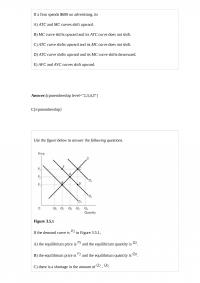
If a firm spends $600 on advertising, its A) ATC and MC curves shift upward. B) MC curve shifts upward and its ATC curve does not shift. C) ATC curve shifts upward and its MC curve does not shift. D) […]
Economics 23256
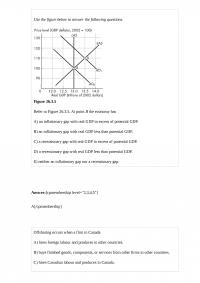
Use the figure below to answer the following questions. Figure 26.3.5 Refer to Figure 26.3.5. At point B the economy has A) an inflationary gap with real GDP in excess of potential GDP. B) an inflationary gap with real GDP […]
Economics 24974
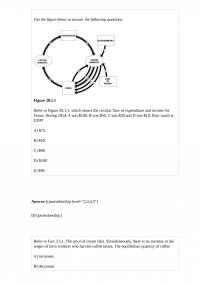
Use the figure below to answer the following questions. Figure 20.1.1 Refer to Figure 20.1.1, which shows the circular flow of expenditure and income for Venus. During 2014, A was $100, B was $50, C was $30 and D was […]
Economics 27706
R1 is A) long-term unemployment. B) the official unemployment rate. C) comparable to the official U.S. rate. D) short-term unemployment. E) the unemployment rate that adds discouraged searchers to the official rate. Which one of the following is false? A) […]
Economics 47473
Which one of the following people would be counted as unemployed in Canada? A) a part-time worker who repeatedly expresses a desire to become a full-time worker B) a person who has been seeking a job for the last six […]
Economics 50023
Consider the data in Table 1A.4.1. Suppose z increases from 4 to 5. What will happen to the graph of the relationship between x and y? A) It will shift to the right. B) It will shift to the left. […]
Economics 56612
Refer to Figure 6.1.1. If the demand for rental housing increases and the demand curve shifts rightward from D0 to D1, and the market is unregulated, the number of rooms rented is A) 1,500, and the rent rises to $200 […]
Economics 64860
Firms in monopolistic competition have rivals that A) will always match their price increases. B) will always match their price decreases but not their price increases. C) all agree on a common price. D) set their price where the demand […]
Economics 65000
Use the information below to answer the following question. Fact 10.2.2 A Medical Sensation Hospitals are buying da Vinci surgical robots. Surgeons, sitting comfortably at a da Vinci console, can use various robotic attachments to perform even the most complex […]
Economics 66518
The economy starts out at a full-employment equilibrium. Some events then occur that generate a cost-push inflation. Which of the following events might start a cost-push inflation? A) a decrease in exports B) an increase in the quantity of money […]
Economics 79189
The outcome from a voucher scheme is efficient when the government makes the value of the voucher equal to A) marginal external cost. B) marginal external benefit. C) private external cost. D) private external benefit. E) marginal social cost. Consider […]
Economics 79722
Refer to Figure 13.4.5. What is the redistribution of surplus from consumers to the producer with a perfect price-discriminating monopoly, as compared to a perfectly competitive market? A) EADH B) EABH C) ABD D) ACD E) KHD Table 15.2.2 gives […]
Economics 84052
For a cartel to succeed, A) it does not need the cooperation of a majority of firms in the industry. B) there must be free entry of rival firms. C) consumers must have alternative products available to satisfy the same […]
Economics 90285
In poorer countries, free trade ________ the demand for labour in these countries and ________ the wages paid in these countries. A) decreases; lowers B) decreases; raises C) increases; lowers D) increases; raises E) increases the supply and decreases; lowers […]
Economics 91407
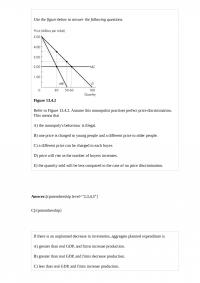
Use the figure below to answer the following questions. Figure 13.4.2 Refer to Figure 13.4.2. Assume this monopolist practises perfect price discrimination. This means that A) the monopoly’s behaviour is illegal. B) one price is charged to young people and […]
Economics 91782
One of the reasons why real GDP grows is that A) prices increase. B) governments collect more taxes. C) capital grows as a result of investment. D) imports increase. E) people have more income. The shape of a person’s indifference […]
Economics 97458
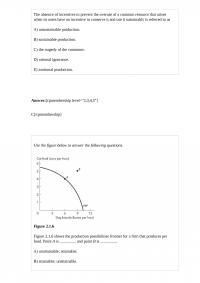
The absence of incentives to prevent the overuse of a common resource that arises when its users have no incentive to conserve it and use it sustainably is referred to as A) unsustainable production. B) sustainable production. C) the tragedy […]
Economics 99019
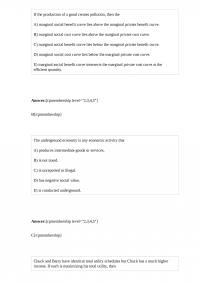
If the production of a good creates pollution, then the A) marginal social benefit curve lies above the marginal private benefit curve. B) marginal social cost curve lies above the marginal private cost curve. C) marginal social benefit curve lies […]
MicroEconomic 12514
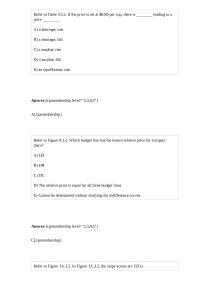
Refer to Table 3.5.2. If the price is set at $0.80 per cup, there is ________ leading to a price ________. A) a shortage; rise B) a shortage; fall C) a surplus; rise D) a surplus; fall E) an equilibrium; […]
MicroEconomic 13628
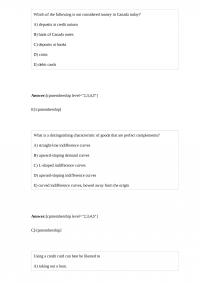
Which of the following is not considered money in Canada today? A) deposits at credit unions B) bank of Canada notes C) deposits at banks D) coins E) debit cards What is a distinguishing characteristic of goods that are perfect […]
MicroEconomic 13729
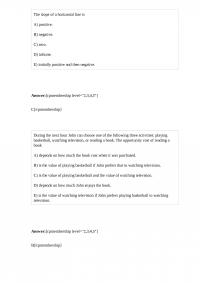
The slope of a horizontal line is A) positive. B) negative. C) zero. D) infinite. E) initially positive and then negative. During the next hour John can choose one of the following three activities: playing basketball, watching television, or reading […]
MicroEconomic 24557
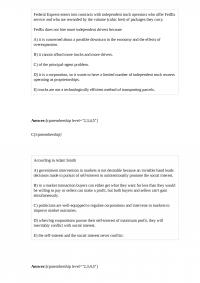
Federal Express enters into contracts with independent truck operators who offer FedEx service and who are rewarded by the volume (cubic feet) of packages they carry. FedEx does not hire more independent drivers because A) it is concerned about a […]
MicroEconomic 30371
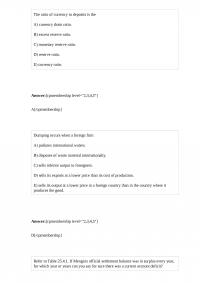
The ratio of currency to deposits is the A) currency drain ratio. B) excess reserve ratio. C) monetary reserve ratio. D) reserve ratio. E) currency ratio. Dumping occurs when a foreign firm A) pollutes international waters. B) disposes of waste […]
MicroEconomic 46548
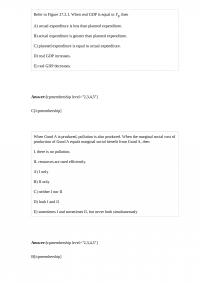
Refer to Figure 27.2.1. When real GDP is equal to Yb, then A) actual expenditure is less than planned expenditure. B) actual expenditure is greater than planned expenditure. C) planned expenditure is equal to actual expenditure. D) real GDP increases. […]
MicroEconomic 48745
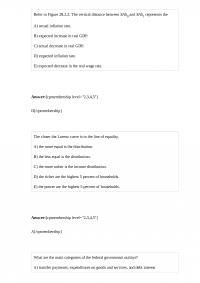
Refer to Figure 28.2.2. The vertical distance between SAS0 and SAS1 represents the A) actual inflation rate. B) expected increase in real GDP. C) actual decrease in real GDP. D) expected inflation rate. E) expected decrease in the real wage […]
MicroEconomic 49073
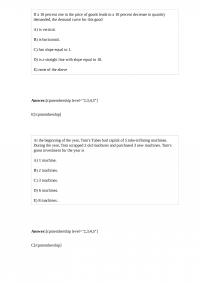
If a 10 percent rise in the price of goods leads to a 10 percent decrease in quantity demanded, the demand curve for this good A) is vertical. B) is horizontal. C) has slope equal to 1. D) is a […]
MicroEconomic 63823
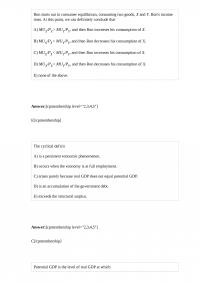
Ron starts out in consumer equilibrium, consuming two goods, X and Y. Ron’s income rises. At this point, we can definitely conclude that A) MUX/PX> MUY/PY, and then Ron increases his consumption of X. B) MUX/PX> MUY/PY, and then Ron […]
MicroEconomic 70617
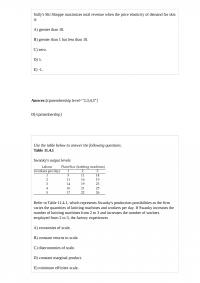
Sally’s Ski Shoppe maximizes total revenue when the price elasticity of demand for skis is A) greater than 10. B) greater than 1 but less than 10. C) zero. D) 1. E) -1. Use the table below to answer the […]
MicroEconomic 71206
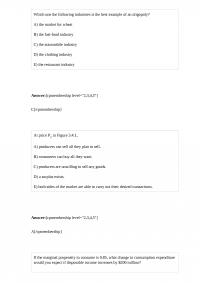
Which one the following industries is the best example of an oligopoly? A) the market for wheat B) the fast-food industry C) the automobile industry D) the clothing industry E) the restaurant industry At price P1 in Figure 3.4.1, A) […]
MicroEconomic 78718
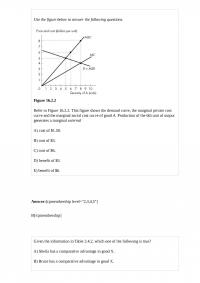
Use the figure below to answer the following questions. Figure 16.2.2 Refer to Figure 16.2.2. This figure shows the demand curve, the marginal private cost curve and the marginal social cost curve of good A. Production of the 6th unit […]
MicroEconomic 79827
When asked in an interview what she missed the most because of the time she spent training for the Olympics, a rower, who lived on her own, answered “a normal social life.” She also revealed that she had given up […]
MicroEconomic 81286
A firm’s efficient scale is the quantity at which ________ is a minimum. A firm has excess capacity if it produces ________ its efficient scale. A) average total cost; below B) marginal cost; above C) average total cost; above D) […]
MicroEconomic 81884
A forecast based on all the relevant information is A) an adaptive expectation. B) a future expectation. C) a rational expectation. D) always a correct expectation. E) a perfect forecast. Refer to Fact 9.3.2. If the price of used clothing […]
MicroEconomic 82802
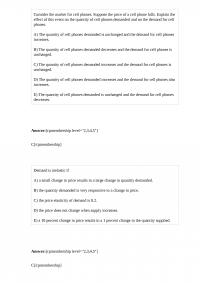
Consider the market for cell phones. Suppose the price of a cell phone falls. Explain the effect of this event on the quantity of cell phones demanded and on the demand for cell phones. A) The quantity of cell phones […]
MicroEconomic 83007
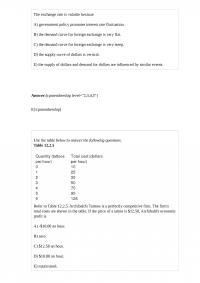
The exchange rate is volatile because A) government policy promotes interest rate fluctuation. B) the demand curve for foreign exchange is very flat. C) the demand curve for foreign exchange is very steep. D) the supply curve of dollars is […]
MicroEconomic 85653
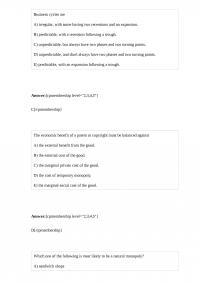
Business cycles are A) irregular, with some having two recessions and no expansion. B) predictable, with a recession following a trough. C) unpredictable, but always have two phases and two turning points. D) unpredictable, and don’t always have two phases […]
MicroEconomic 87614
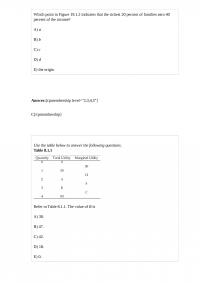
Which point in Figure 19.1.2 indicates that the richest 20 percent of families earn 40 percent of the income? A) a B) b C) c D) d E) the origin Use the table below to answer the following questions. Table […]
MicroEconomic 88638
If a profit-maximizing firm in a perfectly competitive market is incurring an economic loss, then it must be producing a level of output where A) price is greater than marginal cost. B) price is greater than marginal revenue. C) marginal […]
MicroEconomic 99635
When the Bank of Canada lowers the overnight loans rate, the Canadian dollar ________ on the foreign exchange market and ________. A) falls; aggregate demand decreases B) rises; aggregate demand decreases C) falls; the increase in imports is greater than […]