
If Canada imposes a tariff of $1 per imported shirt, the tariff
A) raises the price of a shirt paid by Canadian consumers.
B) benefits Canadian shirt producers.
C) decreases imports of shirts into Canada.
D) creates a social loss.
E) all of the above
A country opens up to trade and becomes an importer of some good. Consumer surplus
________, and producer surplus ________.
A) increases; decreases
B) decreases; decreases
C) decreases; increases
D) increases; increases
E) increases; does not change
The formula for the multiplier in an open economy is

A) 1/(1 + slope of the AE curve).
B) 1/(1 – marginal propensity to import).
C) 1/(1 + marginal propensity to import).
D) 1/(1 – slope of the AE curve).
E) 1/(1 – MPC).
The value of marginal product of labour is the revenue
A) generated by selling an additional unit of output.
B) needed to hire an additional unit of labour.
C) generated by the employment of an additional unit of labour.
D) needed to cover the cost of producing an additional unit of output.
E) generated to cover the cost of hiring an extra unit of labour.
Suppose the economy is experiencing frictional unemployment of 1 percent, structural
unemployment of 3 percent and cyclical unemployment of 4 percent. What is the
natural unemployment rate?
A) 3 percent

B) 4 percent
C) 5 percent
D) 7 percent
E) 8 percent
Refer to Table 20.4.4. The table provides data on the economy of Tropical Republic that
produces only bananas and coconuts. The chained-dollar real GDP in 2014 expressed in
2013 dollars is
A) $7,472.50
B) $7,500.00
C) $1.575.50
D) $7, 575.00
Use the figure below to answer the following question.

Figure 19.3.4
Refer to Figure 19.3.4. At an employment level of 30 hours per week, the compensation
required for the cost of acquiring human capital is
A) $0.
B) $2 an hour.
C) $4 an hour.
D) $6 an hour.
E) cannot be determined without knowing the demand for labour.
If a turnip is a normal good then
A) a small decrease in income increases the quantity of turnips demanded at the current
price by a large amount.
B) a large decrease in income increases the quantity of turnips demanded at the current
price by a small amount.
C) an increase in income increases the quantity demanded at the current price.

D) an increase in income decreases the quantity demanded at the current price.
E) an increase in price decreases the quantity demanded.
If income falls, then in the new consumer equilibrium
A) the marginal utility from normal goods increases.
B) the marginal utility from normal goods decreases.
C) the marginal utility from inferior goods increases.
D) total utility from normal goods increases.
E) total utility from inferior goods decreases.
Refer to Figure 27.1.1. The marginal propensity to consume for this economy is
A) 0.5.
B) 1.
C) 0.2.
D) 0.8.
E) 0.6.

Net investment equals
A) capital minus depreciation.
B) gross investment minus depreciation.
C) the total quantity of plant, equipment, and buildings.
D) gross investment divided by depreciation.
E) wealth minus saving.
Prior to World War II, the purpose of the federal budget was to
A) stabilize the economy.
B) achieve macroeconomic objectives such as full employment and price level stability.
C) finance the business of government.
D) provide incentives to encourage investment.
E) oversee revenue equalization among the provinces.

Suppose interest rates are 3 percent in Japan and 6 percent in Canada. The current value
of the exchange rate is 110 Japanese yen per dollar, and it is generally expected that in
one year the exchange rate will be 106.7 yen per dollar. Under these circumstances,
A) interest rate parity is violated.
B) an international investor could make money by borrowing in Japan and lending in
Canada, assuming no transaction costs.
C) an international investor could make money by borrowing in Canada and lending in
Japan, assuming no transaction costs.
D) interest rate parity is not violated.
E) A and C are true.
Refer to Fact 7.3.1. When Canadian tariffs are removed from a good, Canadian
consumers of the good ________, and Canadian producers of the good ________.
A) gain; lose
B) gain; gain
C) lose; gain
D) lose; lose
E) and the Canadian government gain; lose

If income increases, the budget line
A) becomes steeper.
B) becomes flatter.
C) shifts leftward and parallel to the original budget line.
D) shifts rightward and parallel to the original budget line.
E) shifts parallels either leftward or rightward depending on whether the goods
measured on the axes are normal or inferior.
Refer to Figure 28.4.1. The figure illustrates an economy’s Phillips curves. If the
expected inflation rate changes to 3 percent, the
A) short run Phillips curve will shift upward and the long run Phillips curve will not
change.
B) short run Phillips curve will shift downward and the long run Phillips curve will not
change.
C) short run Phillips curve will shift upward and the long run Phillips curve will shift
leftward.
D) short run Phillips curve will shift upward and the long run Phillips curve will shift
rightward.
E) short run Phillips curve will shift downward and the long run Phillips curve will shift
rightward.

What is the producer surplus for the market from the production of the 100th unit of a
good?
A) the marginal cost of producing the 100th unit
B) the marginal benefit from the 100th unit
C) the opportunity cost of producing the 100th unit
D) the marginal social benefit from the 100th unit minus the marginal cost of producing
the 100th unit
E) the price paid for the 100th unit minus the marginal social cost of producing the
100th unit
Which of the following quotations correctly describes the impact of monetary policy on
the economy?
A) “House sales are down lots, due to the higher money growth.”
B) “The extra money pumped into the economy by the central bank is creating less
exports.”
C) “The tightening of money growth is helping sell goods abroad.”
D) “Businesses are investing more, now that monetary policy has become less
expansionary.”

E) “The extra money pumped into the economy by the central bank is creating more
jobs.”
In the research and development game of chicken,
A) the best strategy for each player is to undertake research and development.
B) the best strategy is for neither player to undertake research and development.
C) the equilibrium is for only one firm to undertake research and development.
D) the equilibrium is unique.
E) no solution can be found.
Use the table below to answer the following questions.
Table 16.2.2
Chemical Fertilizer Market

Refer to Table 16.2.2. If the fertilizer market is perfectly competitive and unregulated,
output (in tonnes) is
A) 1.
B) 2.
C) 3.
D) 4.
E) 5.
The price of a good will rise if
A) demand for the good decreases.
B) supply of the good decreases.
C) there is a surplus of the good.
D) the price of a substitute for the good decreases.
E) the good is an inferior good and income increases.

Use the information below to answer the following question.
Fact 17.2.1 Should Childhood Vaccines Be Mandatory?
While Canadian vaccination rates are high, the outbreaks of measles in five provinces
during 2014 show that not everyone is getting them. There is no national policy making
vaccinations mandatory, although Ontario, New Brunswick and Manitoba require
public school students to show their immunization records to attend school.
Refer to Fact 17.2.1. Someone who doesn’t get vaccinated against measles is a “free
rider” because if everyone in a neighbourhood except one person gets vaccinated, then
the unvaccinated person
A) defeats the principle of minimum differentiation.
B) benefits from the neighbours’ vaccinations.
C) increases the risk of his neighbours getting measles.
D) changes the measles vaccination into a natural monopoly good.
E) changes the measles vaccination into a common resource.
If a producer can use its factors of production to produce either good A or good B, then
a rise in the price of A
A) increases the supply of B.
B) decreases the supply of A.
C) increases the supply of A.
D) decreases the supply of B.
E) increases the demand for A.
Use the figure below to answer the following questions.
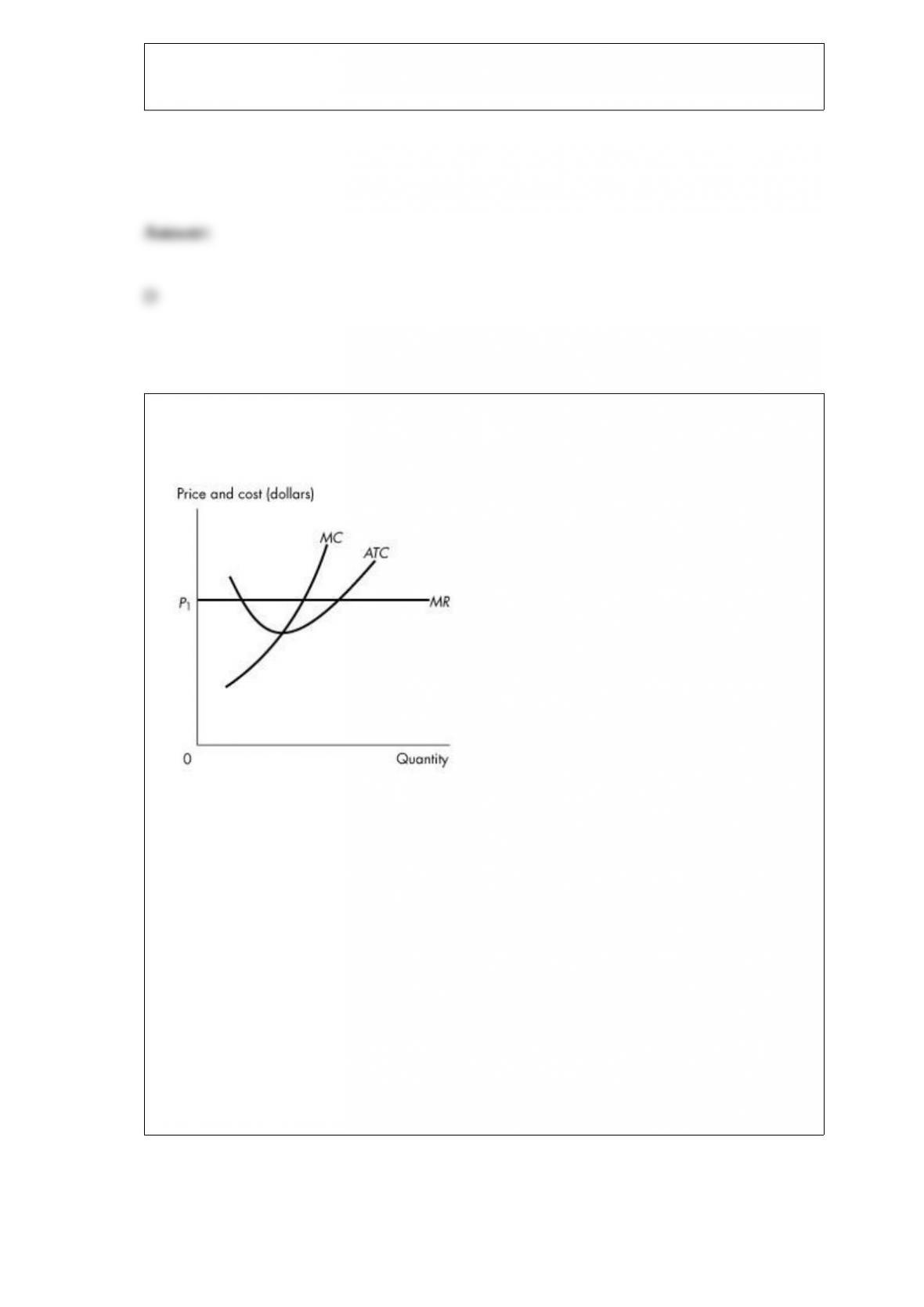
Figure 12.4.2
Refer to Figure 12.4.2, which shows the cost curves and marginal revenue curve of a
firm in a perfectly competitive market. In the long run, market
A) demand will increase.
B) demand will decrease.
C) supply will increase.
D) supply will decrease.
E) supply and market demand will decrease.

Use the information below to answer the following questions.
Fact 18.2.1
Wanda’s is a fish store that hires students to pack the fish. The fish market is
competitive. Originally the price is 50 a kilogram. The market for packers is
competitive and their market wage rate is $7.50 an hour. Then the market price of fish
falls to 33.33 a kilogram but the wage rate of fish packers remains at $7.50 an hour.
Refer to Fact 18.2.1. As a result, students’ marginal product ________ and students’
value of marginal product ________.
A) decreases; does not change
B) does not change; does not change
C) decreases; decreases
D) does not change; decreases
E) decreases; increases
Refer to Table 11.2.1 which gives Tania’s total product schedule. Marginal product of
labour reaches its maximum when the number of workers increases from
A) 0 to 1.
B) 1 to 2.
C) 2 to 3.
D) 3 to 4.
E) 4 to 5
Refer to the figure below to answer the following question.
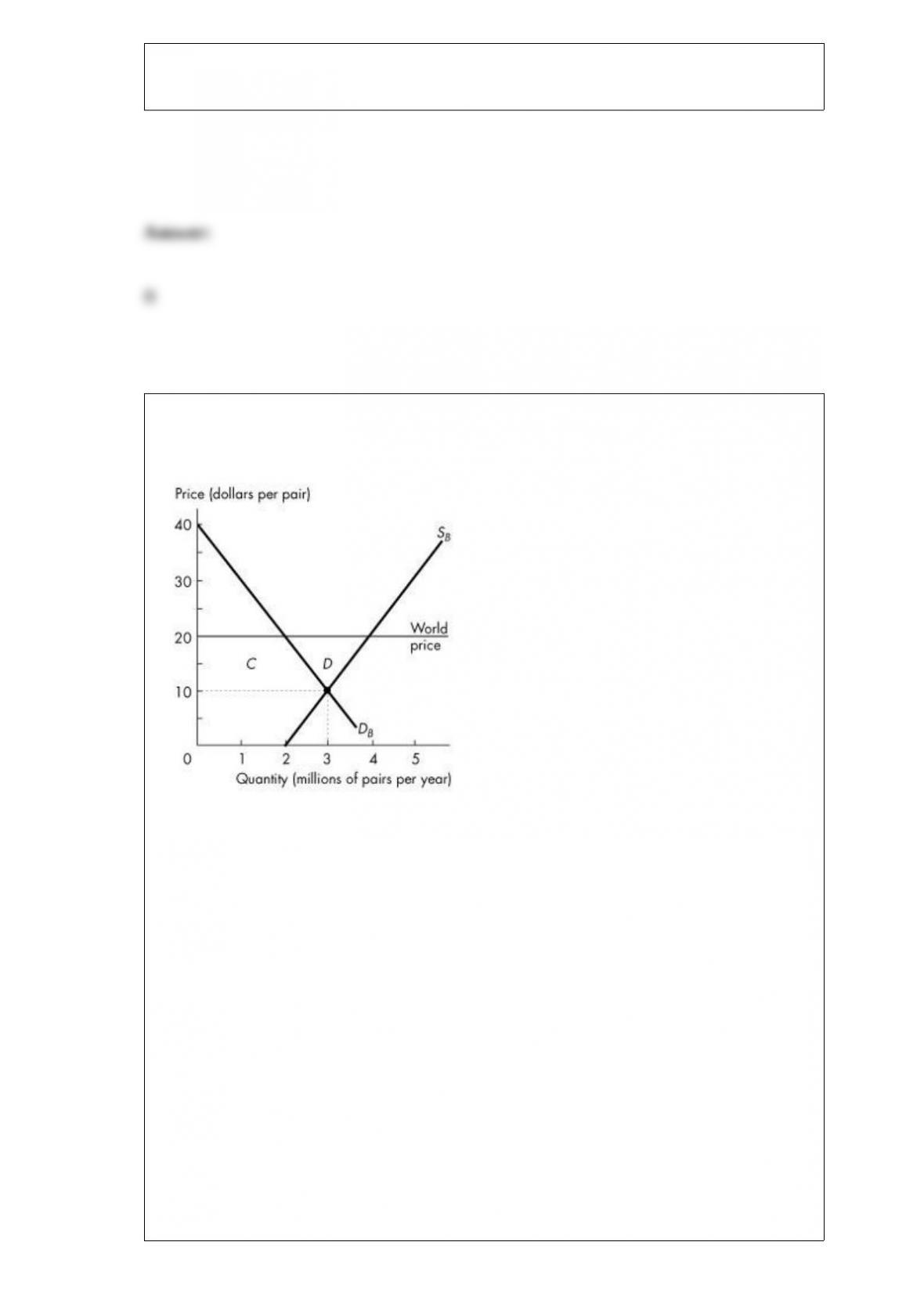
Figure 7.2.4
Refer to Figure 7.2.4. The graph shows the demand for shoes in Brazil, DB, the supply
of shoes produced in Brazil, SB, and the market equilibrium in Brazil when it does not
trade internationally. If the world price of a pair of shoes is $20 and Brazil opens up and
trades internationally, producer surplus in Brazil ________ and consumer surplus in
Brazil ________.
A) increases by area C + D; decreases by area C
B) increases by area C; decreases by area C and a deadweight loss equal to area D
arises
C) increases by area D; decreases by area D
D) decreases by area C; increases by area C + D
E) decreases by area C + D; increases by area C

If a large percentage fall in the price of good A results in a small percentage decrease in
the quantity supplied, then
A) demand is elastic.
B) demand is inelastic.
C) demand is income inelastic.
D) supply is inelastic.
E) supply is elastic.
When the price elasticity of demand is ________, demand for the good is perfectly
inelastic.
A) equal to infinity
B) greater than 1
C) equal to 1
D) between 1 and zero
E) equal to zero

In the market for loanable funds, as the real interest rate rises, the ________ and the
________.
A) quantity of loanable funds supplied increases; quantity of loanable funds demanded
decreases
B) quantity of loanable funds supplied decreases; quantity of loanable funds demanded
increases
C) supply of loanable funds increases; demand for loanable funds decreases
D) supply of loanable funds decreases; demand for loanable funds increases
E) quantity of loanable funds supplied increases; supply of loanable funds increases
Which one of the following is not a store of value?
A) credit cards
B) personal chequable deposits
C) fixed term deposits
D) non-personal chequable deposits
E) non-chequable deposits

Suppose that investment decreases by $15 billion. If the multiplier is 2.5, the aggregate
demand curve
A) shifts leftward by a horizontal distance of $37.5 billion.
B) shifts leftward by a horizontal distance greater than $37.5 billion.
C) shifts leftward by a horizontal distance less than $37.5 billion.
D) shifts upward by a vertical distance of $37.5 billion.
E) is not affected.
Use the information below to answer the following questions.
Fact 10.3.1 Executive Pay
Executive compensation, based on performance, can theoretically constrain pay, but
companies are paying their top executives more and more. The median compensation of
a CEO in 2013 was $13.9 million, up 9 percent from 2012
Refer to Fact 10.3.1. CEO compensation schemes are designed to solve
A) the principal-agent problem.
B) the problem of CEOs without long-term labour contracts.
C) the problem of slow and expansive decision-making in a complex management
structure.
D) the problem that many CEOs lose all of their wealth if the corporation goes
bankrupt.

E) the problem of the CEO being taxed twice”once on salary income and once on
dividend income.