
Which one of the following must be true if demand is income elastic?
A) A large percentage increase in income will result in a small percentage increase in
quantity demanded.
B) A small percentage increase in income will result in a large percentage increase in
quantity demanded.
C) An increase in income will decrease the quantity demanded.
D) The good is an inferior good.
E) A percentage change in price will lead to a larger percentage change in quantity
demanded.
Refer to Figure 14.2.3. Assume this firm faces demand curve D1. If this firm in
monopolistic competition is maximizing profit,
A) there will be entry of rival firms into the industry.
B) rival firms will exit the industry.
C) the market is efficient.
D) this firm will exit the industry in the long run.
E) its profit will rise over time.

Equilibrium expenditure occurs when
A) consumption equals real GDP.
B) aggregate planned expenditure equals real GDP.
C) aggregate planned expenditure equals consumption.
D) induced consumption equals aggregate planned expenditure.
E) the price level equals 100.
During a recession, firms decrease their profit expectations. As a result, there is a
________ shift of the ________ loanable funds curve.
A) rightward; supply of
B) leftward; demand for
C) rightward; demand for
D) rightward, supply of
E) leftward; demand for loanable funds curve and supply of
If the natural unemployment rate falls

A) the long-run Phillips curve shifts rightward and the short-run Phillips curve does not
change.
B) the long-run Phillips curve shifts leftward and the short-run Phillips curve does not
change.
C) the short-run Phillips curve shifts rightward.
D) the short-run and long-run Phillips curves both shift leftward.
E) the short-run and long-run Phillips curves both shift rightward.
One way to alleviate the tragedy of the commons is to
A) eliminate production quotas for using the common resource.
B) make the resource private property.
C) allow all individuals to use the common resource free of charge.
D) distribute common resources among those individuals who really need the resource
free of charge.
E) set a price of $1 per unit of the common resource because it is an affordable price.
Business people speak about income elasticity of demand without using the actual term.
Which one of the following statements reflects income elasticity of demand?

A) “A price cut won’t help me. It won’t increase sales, and I’ll just get less money for
each unit.”
B) “I don’t think a price cut will make any difference to my bottom line. What I may
gain from selling more I would lose on the lower price.”
C) “My customers are real bargain hunters. Since I set my prices just a few cents below
my competitors, customers have flocked to the store and sales are booming.”
D) “With the recent economic recovery, people have more income to spend and sales
are booming, even at the previous prices.”
E) “Since the price of gasoline fell at the neighbouring station, my milk sales have been
booming.”
The price of a good will fall if
A) demand for the good increases.
B) supply of the good decreases.
C) supply of the good increases.
D) demand for the good remains constant.
E) supply of the good remains constant.

Tom and Don have different opportunity costs of producing two goods. If Tom and Don
specialize in producing the goods in which each has a comparative advantage and they
exchange goods, then
A) they each lose because they are no longer able to produce and consume both goods.
B) one of them will gain and one of them will lose.
C) each will gain because each can consume a combination of goods that is outside his
production possibility frontier.
D) each will produce a combination of goods that is outside his production possibilities
frontier.
E) each will produce a combination of goods that is inside his production possibilities
frontier.
Goods and services that we buy from other countries are our
A) balance of payments.
B) exports.
C) imports.
D) terms of trade.
E) comparative goods and services.

According to Thomas Robert Malthus,
A) labour productivity increases continuously.
B) the population growth rate is fixed.
C) technological advances lead to permanent increases in real GDP per person.
D) increases in real GDP per person are only temporary.
E) knowledge capital does not experience diminishing returns.
Product differentiation is always a feature in
A) perfect competition.
B) monopolistic competition.
C) oligopoly.
D) monopoly.
E) all of the above
The y– axis intercept of the demand curve is 60 and the slope is – 8. The equation of the
demand curve is

A) P = 8 – 60QD.
B) P = 60 – 8QD.
C) QD = 60 – 8P.
D) P = 60 + 8QD.
E) QD = 60 + 8P.
The money multiplier will decrease if the currency drain ratio
A) increases or the desired reserve ratio increases.
B) decreases or the desired reserve ratio decreases.
C) decreases or the desired reserve ratio increases.
D) increases or the desired reserve ratio decreases.
E) decreases and the monetary base increases.
If consumption expenditure for a household increases from $300 to $500 when
disposable income increases from $200 to $500, the marginal propensity to consume is
A) equal to 1.

B) equal to 0.75.
C) equal to 1.33.
D) negative.
E) equal to 0.67.
Refer to Table 11.2.1 which gives Tania’s total product schedule. The average product
when the firm hires two workers is
A) 3 teapots per worker.
B) 6 teapots per worker.
C) 7 teapots per worker.
D) 9 teapots per worker.
E) 12 teapots per worker.
Refer to Figure 26.3.5. If the aggregate demand curve is AD2, real GDP is
A) $13 trillion.
B) $13.5 trillion.

C) more than $13 trillion and less than $13.5 trillion.
D) less than $13 trillion.
E) 100
Typical examples of a partnership would include which one of the following?
A) a law firm
B) a corner drugstore
C) an automobile manufacturer
D) a bank
E) a freelance writer
Which one of the following illustrates an inelastic demand?
A) A 10 percent rise in price leads to a 5 percent decrease in quantity demanded.
B) A 10 percent rise in price leads to a 20 percent decrease in quantity demanded.
C) A price elasticity of demand equal to infinity

D) A price elasticity of demand equal to 1.0.
E) A price elasticity of demand equal to 2.0
If a rent ceiling imposed by the government is greater than the equilibrium rent for
housing, then
A) the supply of rental housing will increase.
B) a shortage of housing will occur.
C) a surplus of housing will occur.
D) the equilibrium rent will prevail as long as all else remains constant.
E) the equilibrium rent will rise.
Refer to Figure 6.3.1 showing the market for frisbees before and after a tax is imposed.
On each frisbee, the sellers’ share of the tax is
A) $0.40.
B) $0.60.
C) $1.00.
D) $5.60.

E) $6.60.
Refer to Figure 13.2.2. If the single-price monopoly shown in Figure 13.2.2 is
maximizing profit, what is total economic profit?
A) $3
B) $4
C) $6
D) $9
E) $7
Refer to the figure below to answer the following questions.
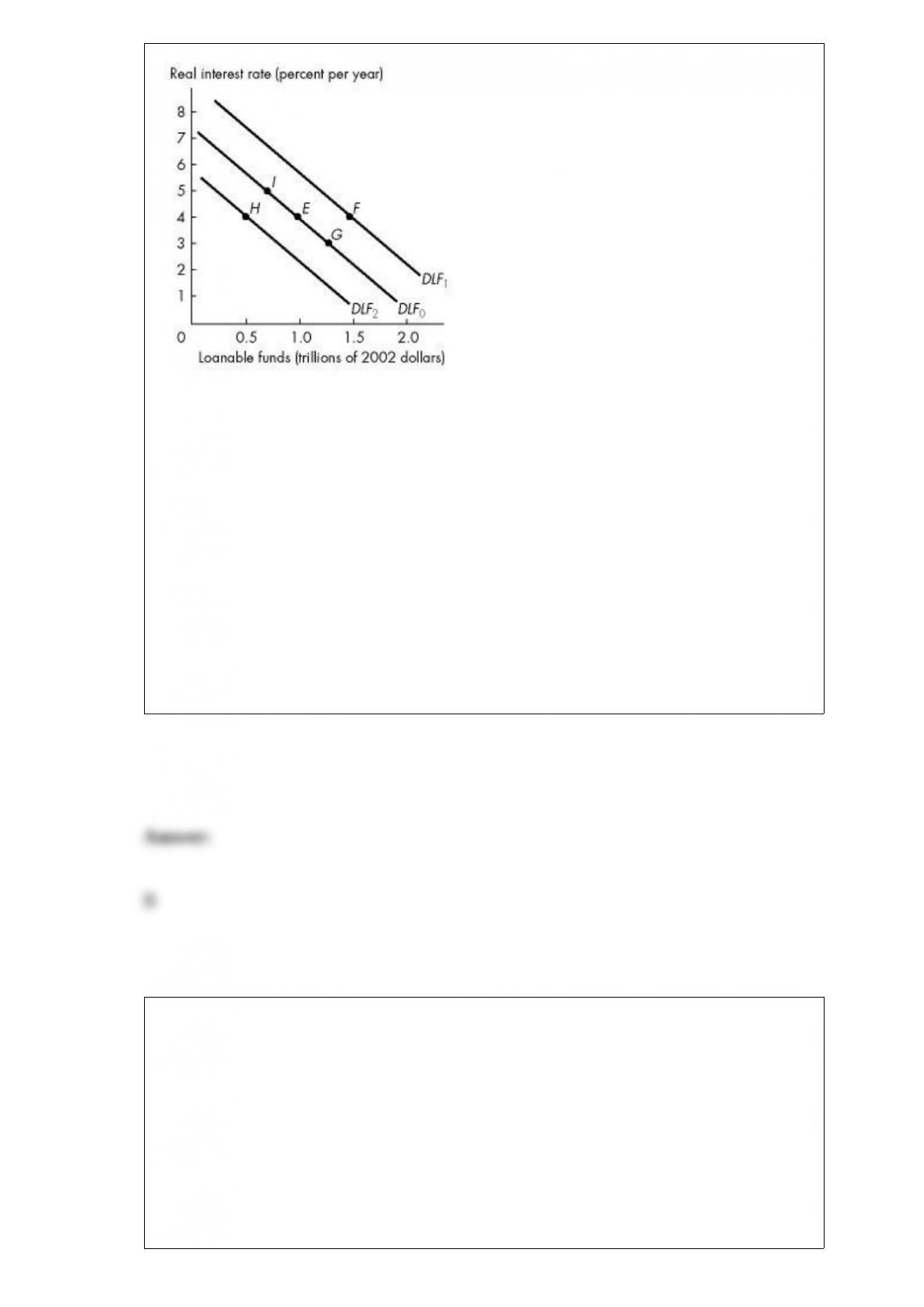
Figure 23.2.2
Refer to Figure 23.2.2. In Figure 23.2.2, a decrease in the real interest rate will result in
a movement from point E to
A) point F.
B) point G.
C) point H.
D) point I.
E) either point G or point F.
What is the consumer surplus for the market from the production of the 100th unit of a
good?
A) the marginal social cost of the 100th unit
B) the marginal social benefit from the 100th unit
C) the opportunity cost of producing the 100th unit
D) the marginal social benefit from the 100th unit minus the marginal social cost of the
100th unit
E) the marginal social benefit from the 100th unit minus the price paid for the 100th
unit
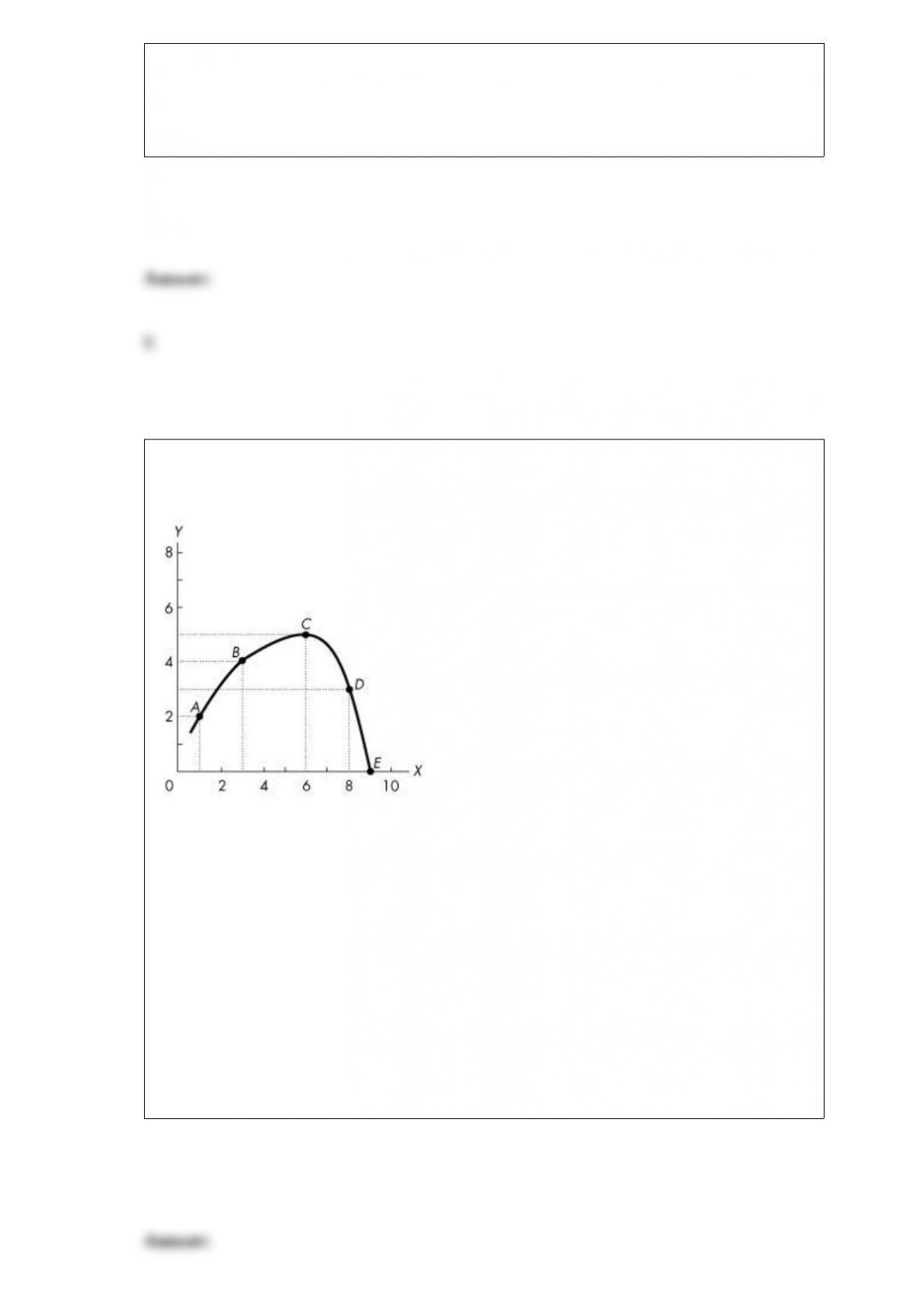
Use the figure below to answer the following question.
Figure 1A.2.5
Refer to Figure 1A.2.5. Which one of the following statements is true?
A) x and y are positively related at all points between A and D.
B) x and y are negatively related at all points between points B and D.
C) y reaches a maximum at point C.
D) y reaches a minimum at point C.
E) x and y are unrelated.

When the supply of good A decreases,
A) the equilibrium price and the equilibrium quantity will increase.
B) the equilibrium price will increase, but the equilibrium quantity will decrease.
C) the equilibrium price and the equilibrium quantity will decrease.
D) the equilibrium price will decrease, but the equilibrium quantity will increase.
E) a surplus will result.
In developing nations, microloans
A) have enabled small businesses with limited access to credit to purchase capital and
expand, allowing greater economic growth.
B) have increased the indebtedness of impoverished people, slowing economic growth.
C) are primarily used to finance consumption expenditure, leading to economic growth.
D) are far too small to have any discernible effect.
E) discourage saving and investment.

Which of the following would be classified as a fixed cost for the local supermarket?
A) the rent from the six-year lease on the building where the store is located
B) the cost of the boxes of cereal sold in the supermarket
C) the salary paid to the store’s manager
D) the overtime paid to the store’s manager
E) the Canada Pension payments that the supermarket makes to the government on the
workers’ income
The short-run aggregate supply curve is the relationship between the quantity of real
GDP supplied and
A) the quantity of real GDP demanded.
B) real income.
C) the inflation rate.
D) the real interest rate.
E) the price level.

The supply curve of a good slopes upward to the right because of
A) technological improvements over time.
B) the law of supply.
C) the law of demand.
D) the existence of substitutes in production.
E) the fact that prices tend to rise over time.
The relationship between two variables that move in opposite directions is shown
graphically by a line that is
A) positively sloped.
B) relatively steep.
C) relatively flat.
D) negatively sloped.
E) curved.
Speculation is

A) trading on the expectation of making a profit.
B) the same as arbitrage.
C) illegal in Canada.
D) a method of appreciating the Canadian dollar.
E) a method of depreciating the Canadian dollar.
Consider graph (d) of Figure 1A.1.5. Which one of the following statements is true?
A) x and y are negatively related.
B) x and y are unrelated.
C) x and y are positively related.
D) x and y move in opposite directions.
E) both A and D.
The number of pizza slices is plotted on the horizontal axis and number of hot dogs is
plotted on the vertical axis. If the price of a hot dog rises, the
A) x-intercept and the slope of the budget line increase.

B) y-intercept and the slope of the budget line increase.
C) x-intercept and the slope of the budget line decrease.
D) y-intercept decreases and the slope of the budget line does not change.
E) y-intercept and the slope of the budget line decrease.