
The Canadian short-run Phillips curve ________ when the expected inflation rate rises
and ________ when the expected inflation rate falls. The Canadian short-run Phillips
curve ________ when the natural unemployment rate increases and ________ when the
natural unemployment rate decreases.
A) shifts downward; shifts upward; shifts rightward; shifts leftward
B) does not shift; does not shift; shifts rightward; shifts leftward
C) shifts upward; shifts downward; does not shift; does not shift
D) shifts upward; shifts downward; shifts rightward; shifts leftward
E) shifts upward; does not shift; shifts rightward; does not shift
The change in the value of the variable measured on the y– axis divided by the change
in the value of the variable measured on the x-axis is
A) increasing.
B) slope.
C) decreasing.
D) constant.
E) a maximum or minimum.

In choosing among alternative models, economists generally have the strongest
preference for models that
A) have assumptions that are close to exact replicas of reality.
B) are detailed and complex, with every available fact and figure included.
C) have few assumptions and are as simple as possible, even if they cannot predict very
well.
D) predict better than any other that is available.
E) have assumptions that are complicated.
Homer’s Holesome Donuts has determined that its profit-maximizing quantity is 10,000
donuts per year. Homer’s total revenue from the sale of donuts is $12,000 a year.
Homer’s costs are $16,000 in annual rental payments for its five-year lease on its store
and $5,000 for ingredients. Should Homer’s exit the market in the long run?
A) Yes, because Homer’s is incurring an economic loss.
B) Yes, because all costs are fixed in the long run.
C) No, because Homer’s is covering its variable costs.
D) No, because Homer’s is covering its fixed costs.
E) No, because all costs are variable in the long run.

The profit-maximizing condition for a firm in monopolistic competition is to produce
the quantity at which
A) marginal cost equals price.
B) price equals marginal revenue.
C) average total cost equals price.
D) marginal cost equals marginal revenue.
E) average variable cost equals price.
If real GDP is $12,150 billion and aggregate labour hours are 270 billion, labour
productivity equals
A) $6.50 an hour.
B) $45 an hour.
C) $48 an hour.
D) $650 an hour.
E) $32.81 an hour.
Ron starts out in consumer equilibrium, consuming two goods, X and Y. The price of Y

rises. Immediately after the rise in price
A) MUX/PX> MUY/PY, and then Ron increases his consumption of Y.
B) MUX/PX> MUY/PY, and then Ron decreases his consumption of Y.
C) MUX/PX< MUY/PY, and then Ron increases his consumption of Y.
D) MUX/PX< MUY/PY, and then Ron decreases his consumption of Y.
E) MUX/PX> MUY/PY, and then Ron increases his consumption of X and Y.
Refer to Table 20.2.3. Consider the economy represented in the table. Total income, in
millions of dollars, is
A) $800,000.
B) $850,000.
C) $1,350,000.
D) $1,050,000.
E) $1,100,000.
The Bank of Canada raises the overnight loans rate. In the foreign exchange market

people ________ dollars and the price of the dollar ________ because the Canadian
interest rate differential ________.
A) sell; rises; falls
B) sell; falls; falls
C) buy; rises; rises
D) buy; falls; rises
E) buy; rises; falls
If Canada imposes a tariff of $1 per imported shirt, the tariff results in all of the
following except it
A) raises the price of a shirt paid by Canadian consumers.
B) benefits Canadian shirt producers.
C) decreases imports of shirts into Canada.
D) creates a deadweight loss.
E) increases total surplus.
Which one of the following will shift the demand for money curve rightward?

A) an increase in real GDP
B) an increase in the price level
C) a decrease in the price level
D) an increase in the interest rate
E) a decrease in the interest rate
Refer to Figure 7.3.1. Canadian consumers’ ________ from the tariff is ________.
A) loss; $176 million
B) gain; $64 million
C) loss; $80 million
D) gain; $128 million
E) gain; $176 million
If Northland is currently a net lender and a debtor nation,
A) it has loaned more than it borrowed from the rest of the world this year, but
borrowed more than it loaned during its history.

B) it has borrowed more from the rest of the world than it loaned this year and also
borrowed more than it loaned during its history.
C) it has loaned more than it borrowed from the rest of the world this year and has
loaned more than it borrowed during its history.
D) its accounting system must be in error if it shows the nation to be a net lender and a
debtor nation at the same time.
E) its debts must be currently growing.
If the world real interest rate falls, then a country that is an international lender
A) increases the amount of its lending.
B) does not change the amount of its lending.
C) decreases the amount of its lending.
D) changes from being a net foreign lender to a net foreign borrower.
E) none of the above
Use the figure below to answer the following questions.
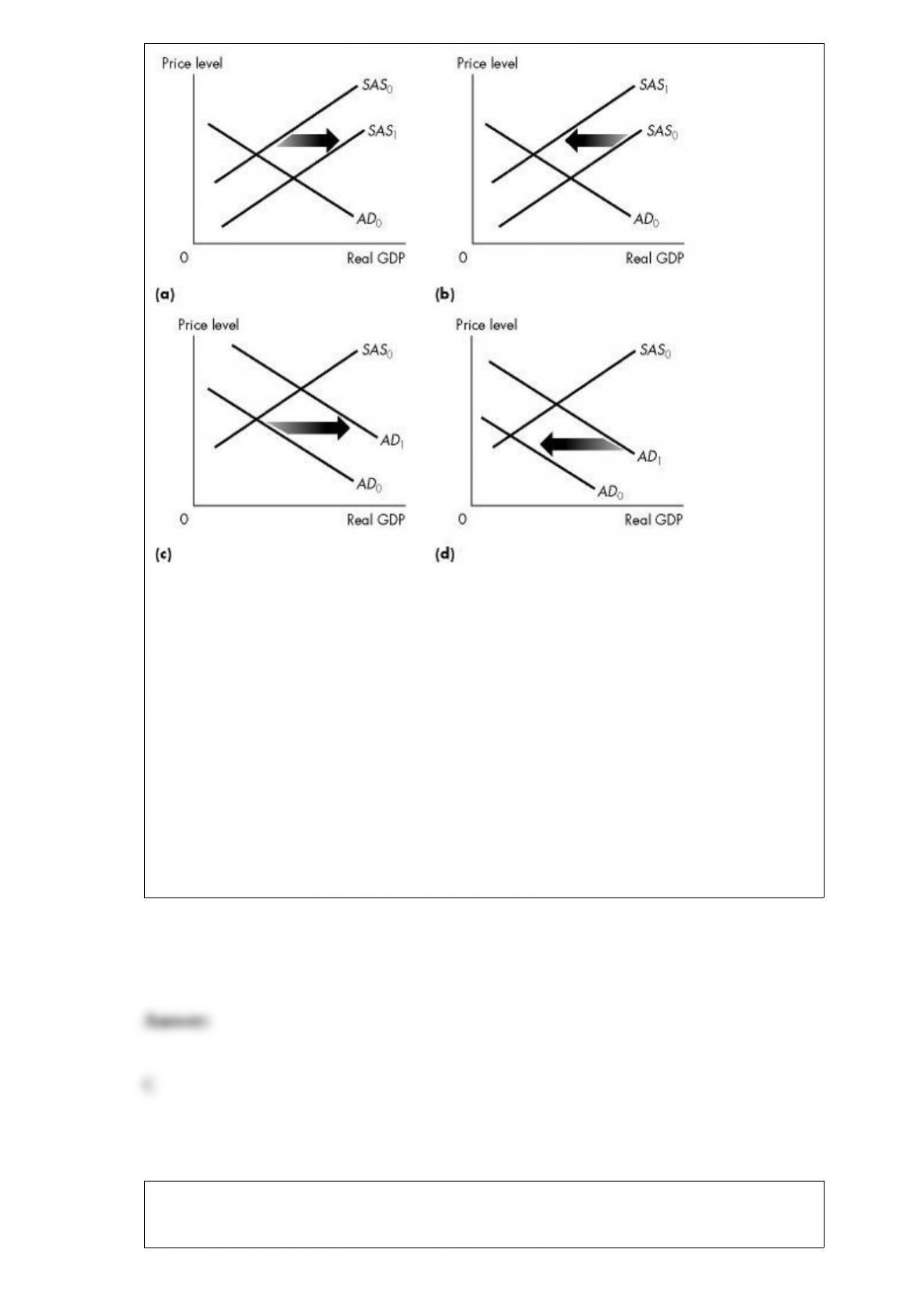
Figure 26.2.1
Refer to Figure 26.2.1. Which graph illustrates what happens when government
expenditure increases?
A) (a) only
B) (b) only
C) (c) only
D) (d) only
E) Both (a) and (c)
Which of the following quotations best describes interest rate parity in action?

A) “The demand for the Canadian dollar has increased due to the recent increase in the
Canadian interest rate.”
B) “The market feeling is that the Canadian dollar is overvalued and will likely
appreciate.”
C) “The price of bananas is the same in Canada and the United States, adjusting for the
exchange rate.”
D) “The expected appreciation of the Canadian dollar is currently lowering demand for
it.”
E) none of the above
The decision to undertake product development in monopolistic competition is made by
comparing the
A) marginal benefit of product development to the marginal cost of product
development.
B) marginal revenue of product development to the average total cost of product
development.
C) total revenue of product development to the total cost of product development.
D) firm’s expenditure on product development to expenditures by competing firms.
E) total benefit of product development to the total cost of advertising.

Refer to Table 16.2.1. Given in the table are the marginal private cost and the marginal
social cost of the production of chemical fertilizer and the marginal social benefit from
the consumption of fertilizer. If the market is unregulated, the market price is
A) $10 a unit.
B) $20 a unit.
C) $30 a unit.
D) $40 a unit.
E) $50 a unit.
Prisoners’ dilemma describes a case where
A) collusion of the participants leads to the best solution from their point of view.
B) rivalry among a large number of rivals leads to lower overall profit.
C) one prisoner has no chance to be acquitted since there is no other prisoner to support
his testimony.
D) a prisoner has no incentive to confess to his crime, and stands a greater chance of
not going to prison.
E) rivalry of the participants leads to the worst solution from their point of view.

Refer to Figure 16.2.1. The figure shows the marginal private cost curve, the marginal
social cost curve and the market demand curve. To promote an efficient allocation of
resources, the government could impose a constant per unit tax equal to
A) zero.
B) P1.
C) P3 – P1.
D) P4 – P1.
E) P3 – P2.
If two goods are perfect substitutes, then their
A) indifference curves are positively-sloped straight lines.
B) indifference curves are negatively-sloped straight lines.
C) indifference curves are L-shaped.
D) marginal rate of substitution is zero.
E) marginal rate of substitution is infinity.

What choices are best for the entire society?
A) self-interest choices
B) minority group choices
C) social interest choices
D) ethnic group choices
E) regional interest choices
The price of a cup of coffee is $2.00. The price of a cup of tea is $1.20. The relative
price of a cup of tea with respect to a cup of coffee is
A) 0.6 cups of coffee.
B) 1.67 cups of coffee.
C) 1.0 cup of coffee.
D) 1.25 cups of coffee.
E) 0.75 cups of coffee.
Choose the statement that is incorrect about Treasury bonds.

A) If the price of a Treasury bond rises, other things remaining the same, the interest
rate falls because the interest payment is a smaller percentage of the Treasury bond
price.
B) The price of a Treasury bond and the interest rate on a Treasury bond are determined
simultaneously.
C) If the demand for Treasury bonds increases, the interest rate on the Treasury bond
rises.
D) The interest rate is a percentage of the price of the Treasury bond.
E) When the interest rate on a Treasury bond rises, the supply of Treasury bonds
increases.
A firm maximizes profit by producing the output at which marginal cost equals
A) marginal revenue.
B) minimum average total cost.
C) minimum average variable cost.
D) average fixed cost.
E) total revenue.

Suppose we observe a fall in the price of good A and a decrease in the quantity of good
A bought and sold. Which one of the following is a likely explanation?
A) The law of demand is violated.
B) The demand for A decreased.
C) The demand for A increased.
D) The supply of A increased.
E) The supply of A decreased.
A decrease in the real interest rate leads to a ________ the demand for loanable funds
curve, and a decrease in expected profit leads to a ________ the demand for loanable
funds curve.
A) rightward shift of; leftward shift of
B) movement down along; movement up along
C) rightward shift of; movement up along
D) movement down along; leftward shift of
E) movement down along; rightward shift of

Suppose that the economy is at full employment, the price level is 100, and the
multiplier is 2. Investment increases by $100 billion. In the short run, the price level
________ because ________.
A) rises; the economy returns to full employment
B) rises; the short-run aggregate supply curve is upward sloping
C) remains at 100; the aggregate demand curve shifts horizontally, which keeps the
price level constant
D) remains at 100; the economy initially moves to an above full-employment
equilibrium. To return to full employment, aggregate demand decreases
E) falls; investment only increases as the price level falls
The longer the time that has elapsed since a price change the more time consumers will
have to respond to price changes. As a result, demand becomes
A) zero.
B) more inelastic.
C) more elastic.
D) perfectly inelastic.
E) unit elastic.

Refer to Table 20.2.4. Gross domestic product is equal to
A) $2,400.
B) $1,920.
C) $2,150.
D) $1,940.
E) $2,350.
Refer to Table 3.1.1. In 2014, the relative price of cola in terms of tea is
A) 1.00.
B) 1.20.
C) 0.83.
D) 1.25.
E) unknown without more information.
Consider the market for Canadian dollars. If the exchange rate rises from 2 Mexican
pesos per dollar to 4 Mexican pesos per dollar,

A) a movement up along the demand curve for Canadian dollars occurs.
B) a movement down along the demand curve for Canadian dollars occurs.
C) the demand for Canadian dollars increases.
D) the demand for Canadian dollars decreases.
E) the supply of Canadian dollars increases.
All of the following statements are true except
A) the three components of government outlays are transfer payments, expenditures on
goods and services, and debt interest.
B) debt interest has been steadily increasing since 1960.
C) expenditures on goods and services have a downward trend.
D) outlays increased steadily from 1971 through 1985.
E) transfer payments decreased sharply during the 1990s.
Which of the following is not a source of economic growth?
A) increasing stock market prices

B) better educated workers
C) growing physical capital
D) appropriate incentive system
E) advances in technology
Consider the following information on cola sales by number of cases for a typical
university residence floor:
Temp. Price (dollars per case)
(C) 10.00 12.50 15.00 17.50
15 50 40 30 20
20 60 50 40 30
25 70 60 50 40
30 80 70 60 50
35 90 80 70 60
Cola sales and cola prices are
A) inversely related.
B) positively related.
C) not affected by the temperature.
D) unrelated.
E) negatively related at low temperatures, but positively related at high temperatures.
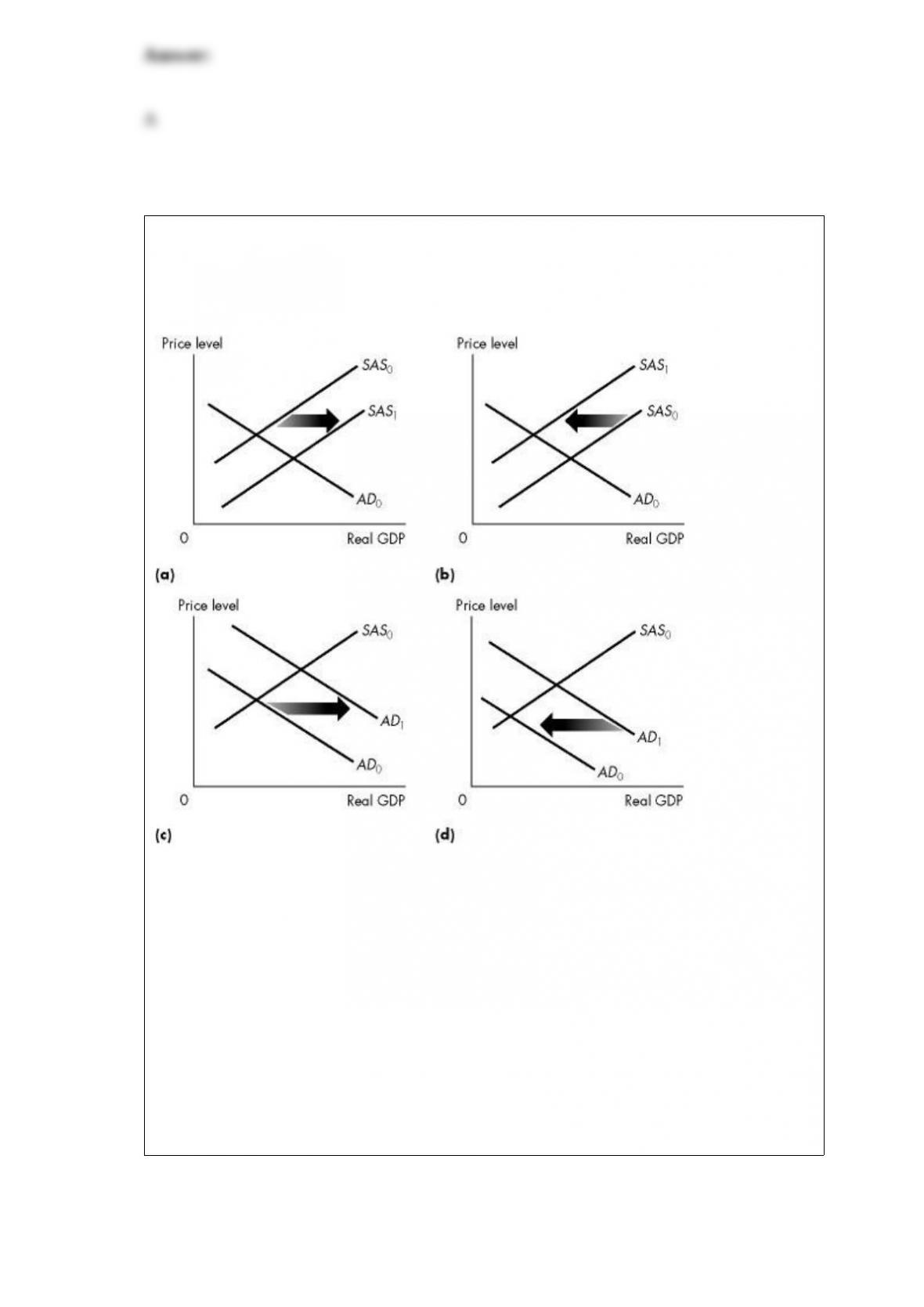
Use the figure below to answer the following questions.
Figure 26.1.1
Refer to Figure 26.1.1. Which graph illustrates what happens when factor prices
decrease?
A) (a)
B) (b)
C) (c)
D) (d)
E) (a) and (b)