
Refer to Figure 6.1.1. If the demand for rental housing increases and the demand curve
shifts rightward from D0 to D1, and the market is unregulated, the number of rooms
rented is
A) 1,500, and the rent rises to $200 a month.
B) 2,000, and the rent is at its initial level.
C) 1,750, and the rent rises to $175 a month.
D) 2,000, and the rent rises to $200 a month.
E) 1,750, and the rent rises to $200 a month.
Shelley is maximizing utility in her consumption of mansions and Porsches. If the
marginal utility of her last purchased mansion is twice the marginal utility of her last
purchased Porsche, then we know
A) Shelley buys twice as many mansions as Porsches.
B) Shelley buys twice as many Porsches as mansions.
C) Shelley buys more Porsches than mansions, but we do not know how many more.
D) the price of a mansion is twice the price of a Porsche.
E) the price of a Porsche is twice the price of a mansion.
Which theory of economic growth concludes that technological advances are influenced
by the profit motive?
A) classical growth theory
B) neoclassical growth theory
C) new growth theory
D) neogrowth theory
E) none of the theories
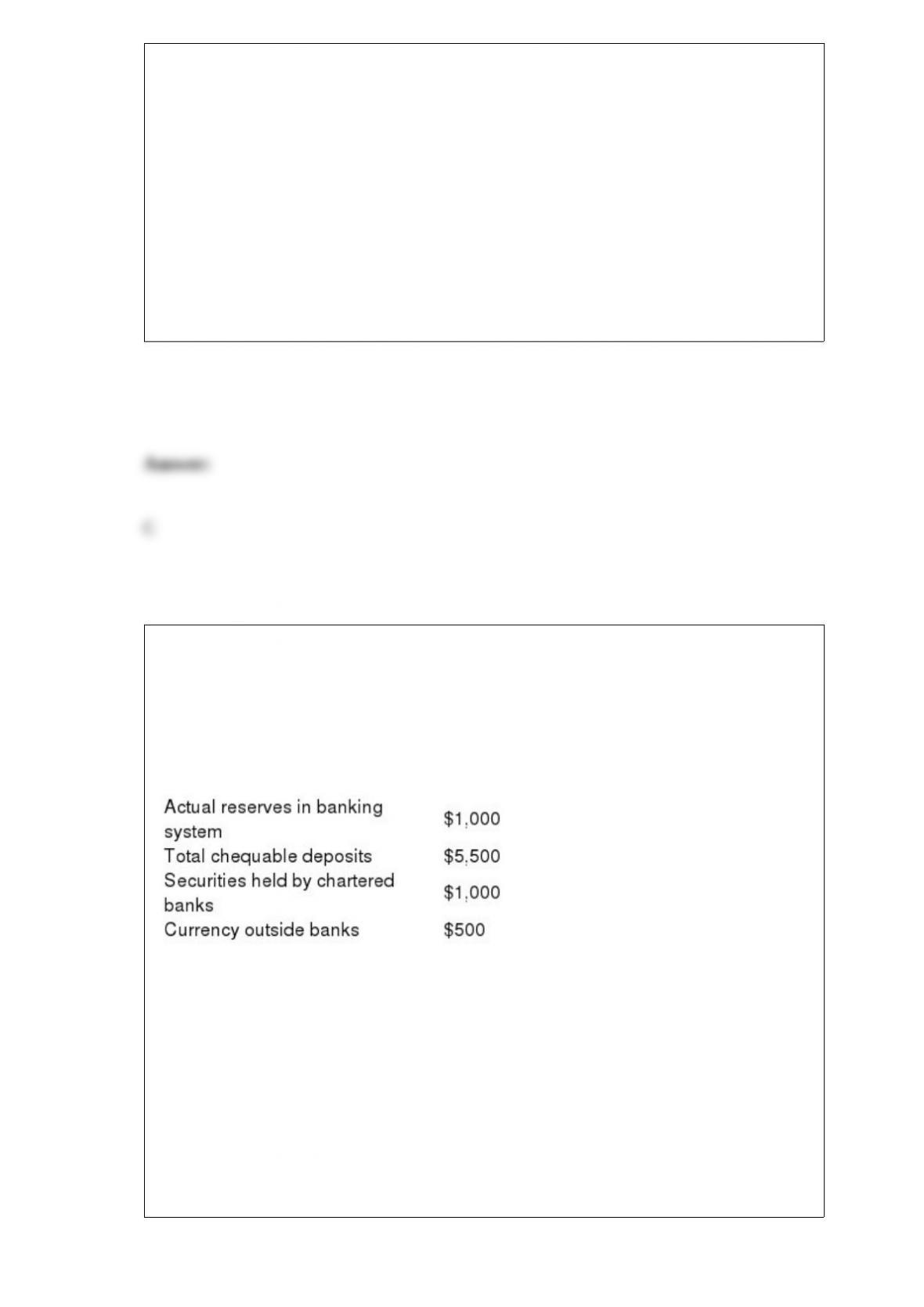
Use the information below to answer the following question.
Fact 24.1.1
The information describes a hypothetical banking system. Assume that all banks are
holding their desired reserves.
Refer to Fact 24.1.1. The quantity of money as measured by M1 is equal to
A) $2,500.
B) $1,500.
C) $6,500.
D) $7,000.
E) $6,000.

Which of the following is not a source of government revenues?
A) personal income taxes
B) transfer payments
C) corporate income taxes
D) indirect taxes
E) investment income
Refer to Figure 6.3.3. Suppose a tax of $1 is imposed. In which market would the buyer
pay the highest portion of the tax?
A) (a)
B) (b)
C) (c)
D) (d)
E) all markets equally

Use the information below to answer the following questions.
Fact 31.3.1
Before 1995, trade between Canada and Mexico was subject to tariffs. In 1995, Mexico
joined NAFTA and all Canadian and Mexican tariffs have gradually been removed.
Refer to Fact 31.3.1. With the removal of the tariffs, the quantity of Canadian imports
from Mexico ________ and the quantity of Canadian exports to Mexico ________.
A) increases; decreases
B) decreases; decreases
C) decreases; increases
D) increases; does not change
E) increases; increases
In Figure 16.3.2. The figure shows the market for good B. Which of the following
government policies creates an efficient outcome?
A) Tax the production of B by $3 per unit.
B) Tax the production of B by $4 per unit.
C) Provide vouchers for consumption of B of $1 per unit.
D) Provide vouchers for consumption of B of $3 per unit.
E) Provide vouchers for consumption of B of $4 per unit.

What is marginal utility?
A) the change in total utility divided by the price of a good
B) the maximum amount of satisfaction from consuming a good
C) the total satisfaction received from consuming as much of the good that is available
for consumption
D) the additional satisfaction received from consuming one more unit of a good
E) the change in the price of a good divided by the change in total utility
Which of the following factors move the demand curve for Canadian dollars and the
supply curve of Canadian dollars in opposite directions?
A) The interest rate differential increases or decreases.
B) The world demand for Canadian exports increases or decreases.
C) Canadian imports increase or decrease.
D) The expected future exchange rate rises or falls.
E) Both A and D above

A country opens up to trade. In an export industry,
A) domestic consumers lose and domestic producers win.
B) domestic producers lose and domestic consumers win.
C) domestic producers lose and the government wins.
D) the government loses and domestic consumers win.
E) none of the above
The sale of government bonds by the Bank of Canada
A) lowers interest rates.
B) decreases bank reserves.
C) increases the quantity of money.
D) increases the banks’ loans to the public.
E) increases bank reserves.

Refer to Figure 26.3.3. In which of the graphs would we predict that eventually the
price level will rise and real GDP will fall, all else remaining the same?
A) (a) only
B) (b) only
C) (c) only
D) (d) only
E) both (c) and (d)
Choose the correct statement.
A) When nominal GDP increases, real GDP decreases.
B) Nominal GDP is just a more precise name for real GDP.
C) We measure the change in production by comparing nominal GDP in one year with
real GDP in the previous year.
D) Nominal GDP is just a more precise name for GDP.
E) Nominal GDP and real GDP both increase when the average level of prices increase.

Sue, who has a law degree, earns $200,000 a year, while Chris, a high-school dropout,
earns $11.00 an hour. This is an example of an economy facing the ________ question.
A) “what”
B) “how”
C) “for whom”
D) “where”
E) “when”
Everything else remaining the same, an increase in the marginal propensity to consume
________ the slope of the AE curve and ________ equilibrium expenditure.
A) decreases; increases
B) increases; increases
C) decreases; decreases
D) increases; decreases
E) does not change; does not change

The natural unemployment rate is
A) equal to 0 percent.
B) the same as the cyclical unemployment rate.
C) the rate at which cyclical unemployment is equal to 6 percent.
D) the rate at which cyclical unemployment is equal to 0 percent.
E) the rate at which all unemployment is structural.
The largest source of revenues for the federal government is
A) transfer payments.
B) expenditures on goods and services.
C) personal income taxes.
D) corporate income taxes.
E) indirect taxes such as the GST.
Which of the following will increase the size of the money multiplier?
A) a decrease in the desired reserve ratio

B) an increase in the desired reserve ratio
C) a decrease in the currency drain ratio
D) an increase in the currency drain ratio
E) either A or C
Consider a country that sells some of its goods as exports. Who does NOT benefit?
A) domestic consumers
B) domestic producers
C) workers in the domestic industry
D) foreign consumers
E) everyone benefits
Figure 17.3.1 shows the marginal private cost curve, marginal social cost curve, and
marginal social benefit curve for cod, a common resource. The efficient quantity is
A) 0 kilograms a week.
B) 4,000 kilograms a week.

C) 3,000 kilograms a week.
D) 5,000 kilograms a week.
E) 1,000 kilograms a week.
If there is a fully anticipated increase in the inflation rate,
A) unemployment will be below the natural rate.
B) unemployment will be above the natural rate.
C) the natural unemployment rate will increase.
D) the economy is not operating on the LRPC curve.
E) the economy is operating on the LRPC curve.
Diseconomies of scale are present when
A) the LRAC curve slopes downward.
B) average total cost falls as input increases.
C) average total cost rises as output increases.

D) the LRAC curve is horizontal.
E) total fixed cost increases.
At all points along a straight line, slope is
A) positive.
B) negative.
C) constant.
D) zero.
E) infinity.
Autonomous consumption is 50. With every increase of one dollar in disposable
income, consumption increases 60 cents. The marginal tax rate is 10 percent. The
equation of the consumption function is
A) C = 50 + 0.6Y.
B) C = 50 + 0.54YD.
C) C = 50 + 0.5YD.
D) C = 50 + 0.06Y.

E) C = 50 + 0.54Y.
According to the Ricardo-Barro effect,
A) the government budget has no effect on the real interest rate.
B) a government budget deficit crowds out private investment.
C) financing government spending with taxes has a less severe effect on private
investment than financing through government borrowing.
D) a government budget surplus crowds out private investment.
E) a government budget surplus crowds out private saving.
What we produce during our working time is ________ as part of GDP and the
enjoyment we gain from our leisure time is ________ as part of GDP.
A) included; included
B) not included; not included
C) included; not included
D) not included; included

E) included; sometimes but not always included
If the overnight rate is above target, the Bank ________ securities to ________
reserves, which ________ the supply of overnight funds and ________ the overnight
rate.
A) buys; increase; decreases; raises
B) sells; increase; increases; lowers
C) buys; decrease; decreases; raises
D) sells; decrease; decreases; raises
E) buys; increase; increases; lowers
When the consumption function lies below the 45 line, households
A) spend all of any increase in disposable income.
B) consume more than their disposable income.
C) are saving some portion of their disposable income.
D) save all of any increase in disposable income.
E) are dissaving.

Firefox, Internet Explorer, and Google Chrome browsers are an example of
A) goods produced in perfectly competitive markets.
B) goods produced by monopolies.
C) product differentiation.
D) goods that are identical.
E) product similarity.