
Refer to Figure 13.4.5. What is the redistribution of surplus from consumers to the
producer with a perfect price-discriminating monopoly, as compared to a perfectly
competitive market?
A) EADH
B) EABH
C) ABD
D) ACD
E) KHD
Table 15.2.2 gives the payoff matrix in terms of economic profit for firms A and B when
there are two strategies facing each firm: (1) charge a low price, or (2) charge a high
price. Refer to the nonrepeated game in the table. If both firms could successfully
collude, what would be firm A‘s economic profit?
A) -$10
B) $2
C) $10
D) $20
E) $5

At the end of 2011, the government of China’s debt was 4,700 billion. ( is yuan, the
currency of China). In 2012, the government spent 6,000 billion and ended the year
with a debt of 5,300 billion. How much did the government receive in tax revenue in
2012?
A) 5,400 billion
B) 6,600 billion
C) 600 billion
D) 5,900 billion
E) 5,300 billion
Disposable income is
A) used for consumption only.
B) aggregate income minus taxes plus transfer payments.
C) aggregate income plus transfer payments.
D) aggregate income minus taxes.
E) aggregate income minus transfer payments.

Consider an initial budget line labelled RT in Figure 9.3.3. If the budget line becomes
RS, the substitution effect is illustrated by the move from point
A) A to C.
B) A to D.
C) B to D.
D) B to A.
E) C to D.
Labour productivity rises when
A) technological progress is stagnant.
B) firms invest more in hiring workers than in replacing worn-out capital.
C) the amount of capital per worker decreases.
D) the real wage rate falls.
E) the amount of capital per worker increases.
How does the Bank of Canada set the bank rate?

A) The Bank of Canada does not determine the bank rate.
B) The bank rate is set at a quarter percentage point above the prime lending rate.
C) The bank rate is set at a quarter percentage point above the target overnight loans
rate.
D) The bank rate is set at a quarter percentage point below the overnight loans rate.
E) The bank rate is set at 25 basis points above the operating band.
In Figure 7.2.1, international trade ________ total surplus in Canada by ________.
A) increases; $128 million
B) decreases; $192 million
C) increases; $320 million
D) decreases; $256 million
E) decreases; $128 million
Use the figure below to answer the following question.
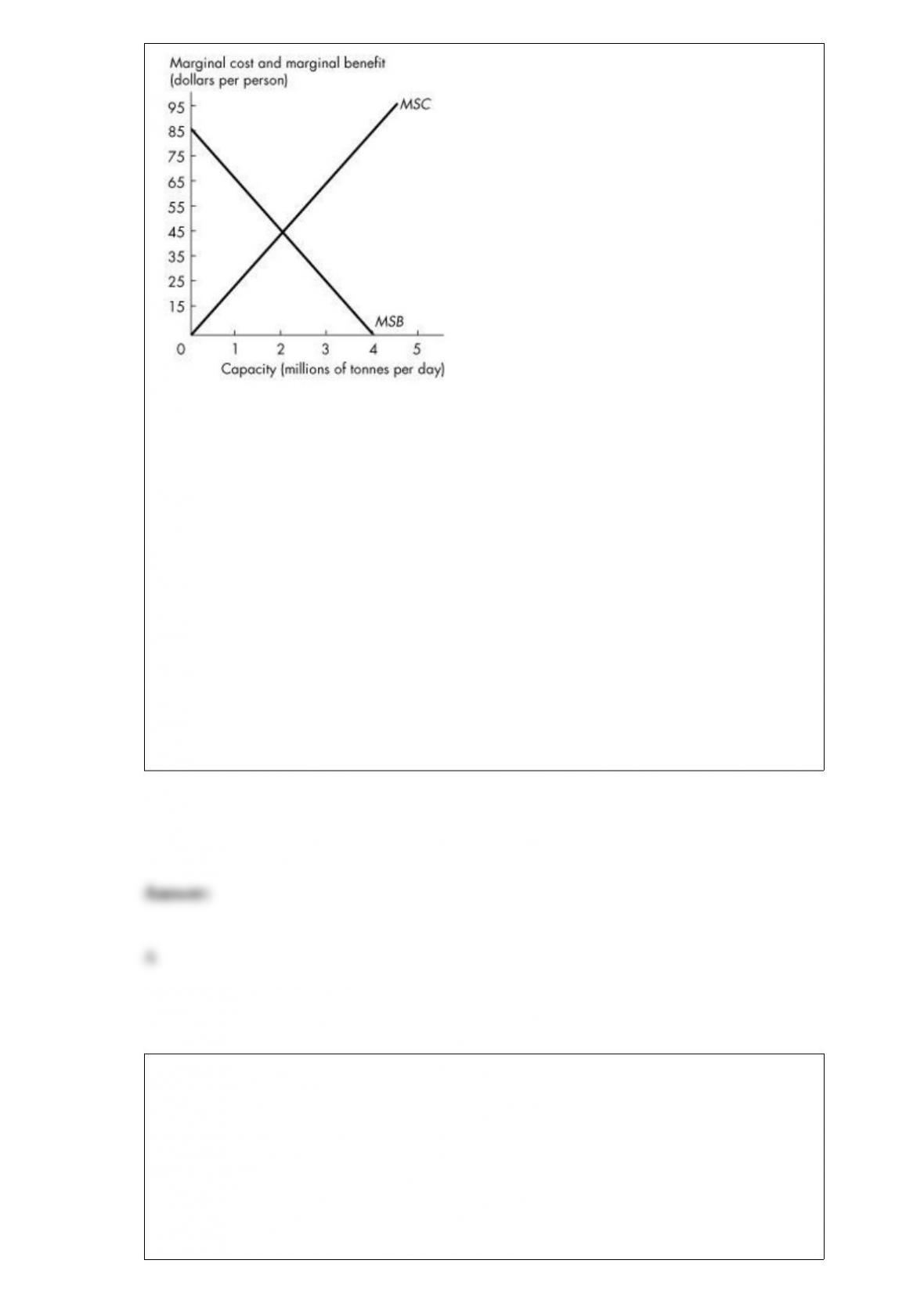
Figure 17.2.2
Refer to Figure 17.2.2. The graph shows the marginal social benefit and marginal social
cost of a garbage disposal system in a city of 1 million people. If voters are well
informed about the costs and benefits of the garbage disposal system, the political
equilibrium of garbage is
A) 2.0 million tonnes a day.
B) 1.5 million tonnes a day.
C) 2.5 million tonnes a day.
D) 4.0 million tonnes a day.
E) 0 million tonnes a day.
Supply is elastic if
A) a small percentage change in price results in a large percentage change in quantity
supplied.
B) a large percentage change in price results in a small percentage change in quantity
supplied.

C) a small percentage change in demand results in a large percentage change in quantity
supplied.
D) the good is an inferior good.
E) the good is a normal good.
Use the information below to answer the following questions.
Fact 28.4.2
The Reserve Bank of New Zealand signed an agreement with the New Zealand
government in which the Bank agreed to maintain inflation inside a low target range.
Failure to achieve the target would result in the governor of the Bank losing his job.
Consider Fact 28.4.2. Choose the correct statement.
A) The short-run Phillips curve shifted downward because people believed that the
Bank of New Zealand was serious about meeting the new low inflation target.
B) A movement occurred down along the short-run Phillips curve because although the
inflation rate fell, expectations did not change.
C) Neither actual inflation nor expected inflation changed, and there was no change in
the short-run Phillips curve.
D) The short-run Phillips curve was abolished and New Zealand now has only a
long-run Phillips curve.
E) The short-run Phillips curve shifted leftward because when inflation expectations
fall, the natural unemployment rate decreases.

Childcare workers often get paid fairly low wages, yet it is said that they have “the most
important job in the world.” This paradox can be resolved by
A) distinguishing between price and value.
B) distinguishing between marginal utility and total utility.
C) noting that childcare yields no utility since it is a service.
D) noting that marginal utility does not diminish for childcare.
E) noting that marginal utility is constant for childcare.
Good A is a normal good if
A) a rise in the price of a complement causes the demand for A to decrease.
B) income and the demand for A are negatively related.
C) a rise in the price of a substitute causes the demand for A to increase.
D) the demand for A increases when income rises.
E) good A satisfies the law of demand.

Investment will be higher if
A) the government deficit is higher.
B) national saving is higher.
C) net exports are higher.
D) the real interest rate is higher.
E) government spending is higher.
Refer to Table 20.2.4. Net domestic income at market prices is equal to
A) $2,150.
B) $1,920.
C) $2,400.
D) $1,940.
E) $2,350.
Sara’s income is $12 a week. The price of popcorn is $3 a bag, and the price of a
smoothie is $3. The opportunity cost of a smoothie is

A) $3.
B) 4 bags of popcorn.
C) 1.00 smoothie.
D) 1.0 bag of popcorn.
E) $1.
Plant refers to those factors of production
A) that are too expensive for the firm to purchase.
B) that must be held in storage for at least one year.
C) that are fixed in the short run.
D) that have a decreasing marginal product as more of the factor is used.
E) which can be purchased only in fixed quantity lots.
GDP is $2,000 billion, the GDP deflator is 100 (a price level of 1), and the velocity of
circulation is 5. The quantity of money is
A) $10,000 billion.

B) $2,000 billion.
C) $400 billion.
D) $20 billion.
E) $500 billion.
In the nation of Transporta, the income elasticity of demand for used cars is -2.66. If
incomes in this nation increase by 10 percent,
A) the quantity of used cars demanded increase by 26.6 percent.
B) used cars will be normal goods.
C) the quantity of used cars demanded decrease by 26.6 percent.
D) the demand curve for used cars shifts rightward.
E) the supply curve of used cars shifts rightward.
A homeowner planting an attractive garden in front of his house creates ________.
A bakery baking bread creates ________.
A) no externality; a positive production externality

B) a positive consumption externality; no externality
C) no externality; no externality
D) a positive consumption externality; a positive production externality
E) a positive production externality; no externality
An effective production quota
A) is efficient because it results in overproduction.
B) is efficient because it results in underproduction.
C) is inefficient because it results in underproduction.
D) is inefficient because it results in overproduction.
E) is efficient for quantities below the equilibrium quantity and is inefficient for
quantities above the equilibrium quantity.
A firm that is technologically efficient
A) always makes an economic profit.
B) must be economically efficient, but a firm that is economically efficient is not always
technologically efficient.

C) must be economically efficient, and a firm that is economically efficient must always
be technologically efficient.
D) is not always economically efficient, and a firm that is economically efficient is not
always technologically efficient.
E) is not always economically efficient, but a firm that is economically efficient must
always be technologically efficient.
When the Bank of Canada makes an open market purchase, its assets ________ and its
liabilities ________.
A) decrease; decrease
B) decrease; increase
C) increase; increase
D) increase; decrease
E) decrease; do not change
Refer to Table 1A.3.3. When x equals 5,
A) y is at a maximum.

B) y is at a minimum.
C) the slope is positive.
D) the slope is negative.
E) the slope is first positive and then becomes negative.
The world goes into an expansion. Starting from a position of long-run equilibrium,
what effect does this event have on Canada’s economy in the short run?
A) Real GDP increases and the price level rises.
B) Real GDP decreases and the price level falls.
C) Real GDP increases and the price level falls.
D) Real GDP decreases and the price level rises.
E) There is no change in either real GDP or the price level.
When the price elasticity of demand is ________, demand for the good is unit elastic.
A) equal to infinity
B) greater than 1

C) equal to 1
D) between 1 and zero
E) equal to zero.
In January 2014, Tim’s Gyms, Inc. owned machines valued at $1 million. During the
year, the market value of the machines fell by 10 percent. During 2014, Tim spent
$200,000 on new machines. During 2014, Tim’s net investment was
A) $1 million.
B) $300,000.
C) $200,000.
D) $100,000.
E) $1.1 million.
Refer to Figure 5.2.2. If the price rises from P0 to P1, the change in consumer surplus is
A) A.
B) B plus C.
C) D plus E.

D) A plus B plus C.
E) A plus B plus C plus D plus E.
Refer to Figure 6.3.3. Suppose a tax of $1 is imposed. In which market would tax
revenue be the lowest?
A) (a)
B) (b)
C) (c)
D) (d)
E) all markets equally
When labour productivity decreases, there is ________ the production function and
________ in potential GDP.
A) a movement down along; no change
B) a movement down along; a decrease
C) a downward shift of; no change

D) a downward shift of; a decrease
E) neither a movement along nor a shift of; no change
Refer to Table 16.2.1. Given in the table are the marginal private cost and the marginal
social cost of the production of chemical fertilizer and the marginal social benefit from
the consumption of fertilizer. If the market is unregulated
A) the quantity produced is the efficient quantity.
B) the quantity produced is greater than the efficient quantity.
C) the quantity produced is less than the efficient quantity.
D) marginal external cost is maximized.
E) production is technologically inefficient.
Refer to Figure 14.2.3. Assume this firm faces demand curve D2. When the firm
produces the efficient quantity, it produces
A) 100 units.
B) 140 units.
C) 200 units.

D) 220 units.
E) 250 units.
When total utility is increasing, marginal utility
A) is negative.
B) must be between zero and one.
C) is either increasing or decreasing.
D) is either positive or negative.
E) is also increasing.
As we increase the production of X, we find we must give up larger and larger amounts
of Y per unit of X. Select the best statement.
A) This illustrates increasing opportunity cost.
B) As a result, we should not specialize in the production of X.
C) The production possibilities frontier for X and Y is a straight line.
D) Good Y will be more highly regarded by consumers than good X.

E) We must be producing inside the production possibilities frontier.