Archives: Quiz
978-0134674148 Chapter 2 Part 4
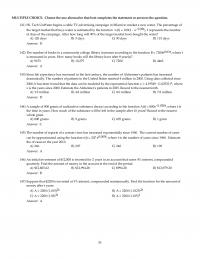
MULTIPLE CHOICE. Choose the one alternative that best completes the statement or answers the question. 141) Hi–Tech UnWater begins a cable TV advertising campaign in Miami to market a new water. The percentage of the target market that buys water […]
978-0134674148 Chapter 2 Part 3
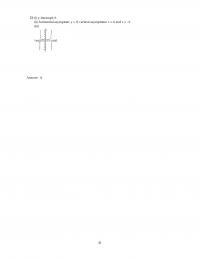
D) (i) y intercept: 6 (ii) horizontal asymptote: y = 0; vertical asymptotes: x =6 and x = – 6 (iii) Answer: A 41 Sketch the graph of the function. 118) f(x) =x + 1 x2+ x –12 A) B) […]
978-0134674148 Chapter 2 Part 2
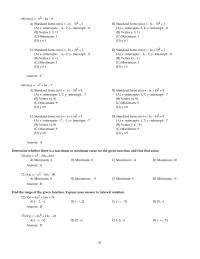
68) m(x) = – x2– 6x – 8 A) Standard form: m(x) = – (x – 3)2+ 1 (A) x–intercepts: – 4, –2; y–intercept: –8 (B) Vertex (–3, 1) (C) Minimum: 1 (D) y 1 B) Standard form: m(x) = […]
978-0134674148 Chapter 2 Part 1
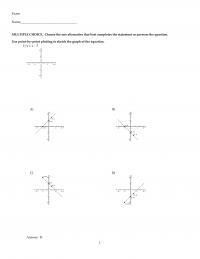
Exam Name___________________________________ MULTIPLE CHOICE. Choose the one alternative that best completes the statement or answers the question. Use point–by–point plotting to sketch the graph of the equation. 1) y = x – 5 A) B) C) D) Answer: D 1 […]
978-0134674148 Chapter 1
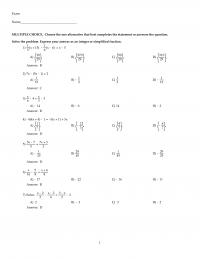
Exam Name___________________________________ MULTIPLE CHOICE. Choose the one alternative that best completes the statement or answers the question. Solve the problem. Express your answer as an integer or simplified fraction. 1) 1 5(x + 15) –1 6(x – 6) = x […]
978-0134734217 Chapter 27 Part 2
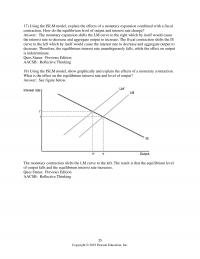
17) Using the ISLM model, explain the effects of a monetary expansion combined with a fiscal contraction. How do the equilibrium level of output and interest rate change? Answer: The monetary expansion shifts the LM curve to the right which […]
978-0134734217 Chapter 27 Part 1
Economics of Money, Banking, and Financial Markets, 12e (Mishkin) Chapter 27 Web Chapter 2: The ISLM Model 27.1 Keynes’s Fixed Price Level Assumption and the IS Curve 1) Because inflation was not a serious problem during the Great Depression, Keynes’s […]
978-0134734217 Chapter 26
Economics of Money, Banking, and Financial Markets, 12e (Mishkin) Chapter 26 Web Chapter 1: Financial Crises in Emerging Market Economies 26.1 Dynamics of Financial Crises in Emerging Market Economies 1) Financial crises generally develop along two basic paths A) mismanagement […]
978-0134734217 Chapter 25
Economics of Money, Banking, and Financial Markets, 12e (Mishkin) Chapter 25 Transmission Mechanisms of Monetary Policy 25.1 Transmission Mechanism of Monetary Policy 1) Economic theory suggests that ________ interest rates are ________ important than ________ interest rates in explaining investment […]
978-0134734217 Chapter 24
Economics of Money, Banking, and Financial Markets, 12e (Mishkin) Chapter 24 The Role of Expectations in Monetary Policy 24.1 Lucas Critique of Policy Evaluation 1) Whether one views the discretionary policies of the 1960s and 1970s as destabilizing or believes […]
978-0134734217 Chapter 23
Economics of Money, Banking, and Financial Markets, 12e (Mishkin) Chapter 23 Monetary Policy Theory 23.1 Response of Monetary Policy to Shocks 1) Policy makers cannot achieve both price stability and economic activity stability when facing A) temporary supply shocks. B) […]
978-0134734217 Chapter 22 Part 2
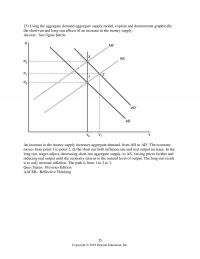
15 15) Using the aggregate demand-aggregate supply model, explain and demonstrate graphically the short-run and long-run effects of an increase in the money supply. Answer: See figure below. An increase in the money supply increases aggregate demand, from AD to […]
978-0134734217 Chapter 22 Part 1
Economics of Money, Banking, and Financial Markets, 12e (Mishkin) Chapter 22 Aggregate Demand and Supply Analysis 22.1 Aggregate Demand 1) The aggregate demand curve is the total quantity of an economy’s A) intermediate goods demanded at different inflation rates. B) […]
978-0134734217 Chapter 21
Economics of Money, Banking, and Financial Markets, 12e (Mishkin) Chapter 21 The Monetary Policy and Aggregate Demand Curves 21.1 The Federal Reserve and Monetary Policy 1) Because prices are slow to move in the short-run, when the Federal Reserve lowers […]
978-0134734217 Chapter 20 Part 2
36) In an open economy, aggregate demand is the sum of A) consumer expenditure, actual investment spending, and government spending. B) consumer expenditure, planned investment spending, and government spending. C) consumer expenditure, actual investment spending, government spending, and net exports. […]
978-0134734217 Chapter 20 Part 1
Economics of Money, Banking, and Financial Markets, 12e (Mishkin) Chapter 20 The IS Curve 20.1 Planned Expenditure and Aggregate Demand 1) His analysis started with the recognition that the total quantity demanded of an economy’s output was the sum of […]
978-0134734217 Chapter 19 Part 2
10) Because Keynes assumed that the expected return on money was zero, he argued that people would A) never hold money. B) never hold money as a store of wealth. C) hold money as a store of wealth when the […]
978-0134734217 Chapter 19 Part 1
Economics of Money, Banking, and Financial Markets, 12e (Mishkin) Chapter 19 Quantity Theory, Inflation and the Demand for Money 19.1 Quantity Theory of Money 1) The quantity theory of money is a theory of how A) the money supply is […]
978-0134734217 Chapter 18 Part 2
35) Under the Exchange Rate Mechanism of the European Monetary System, when the British pound depreciated below its lower limit against the German mark, the German central bank was required to buy ________ and sell ________, thereby ________ international reserves. […]
978-0134734217 Chapter 18 Part 1
Economics of Money, Banking, and Financial Markets, 12e (Mishkin) Chapter 18 The International Financial System 18.1 Intervention in the Foreign Exchange Market 1) A central bank ________ of domestic currency and corresponding ________ of foreign assets in the foreign exchange […]
978-0134734217 Chapter 17 Part 2
4) A decrease in the domestic interest rate causes the demand for domestic assets to shift to the ________ and the domestic currency to ________, everything else held constant. A) right; appreciate B) right; depreciate C) left; appreciate D) left; […]
978-0134734217 Chapter 17 Part 1
Economics of Money, Banking, and Financial Markets, 12e (Mishkin) Chapter 17 The Foreign Exchange Market 17.1 Foreign Exchange Market 1) The exchange rate is A) the price of one currency relative to gold. B) the value of a currency relative […]
978-0134734217 Chapter 16 Part 2
5) If the Fed pursues a strategy of targeting an interest rate when fluctuations in money demand are prevalent A) fluctuations of nonborrowed reserves will be small. B) fluctuations of nonborrowed reserves will be large. C) the Fed will probably […]
978-0134734217 Chapter 16 Part 1
Economics of Money, Banking, and Financial Markets, 12e (Mishkin) Chapter 16 The Conduct of Monetary Policy: Strategy and Tactics 16.1 The Price Stability Goal and The Nominal Anchor 1) The most common definition that monetary policymakers use for price stability […]
978-0134734217 Chapter 15 Part 2
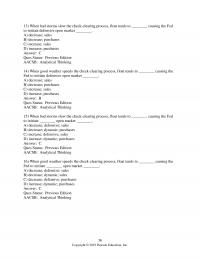
13) When bad storms slow the check-clearing process, float tends to ________ causing the Fed to initiate defensive open market ________. A) decrease; sales B) decrease; purchases C) increase; sales D) increase; purchases Answer: C Ques Status: Previous Edition AACSB: […]
978-0134734217 Chapter 15 Part 1
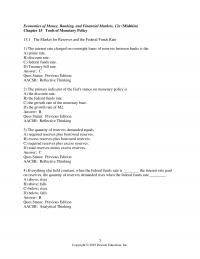
Economics of Money, Banking, and Financial Markets, 12e (Mishkin) Chapter 15 Tools of Monetary Policy 15.1 The Market for Reserves and the Federal Funds Rate 1) The interest rate charged on overnight loans of reserves between banks is the A) […]
978-0134734217 Chapter 14 Part 3
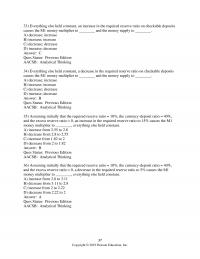
33) Everything else held constant, an increase in the required reserve ratio on checkable deposits causes the M1 money multiplier to ________ and the money supply to ________. A) decrease; increase B) increase; increase C) decrease; decrease D) increase; decrease […]
978-0134734217 Chapter 14 Part 2
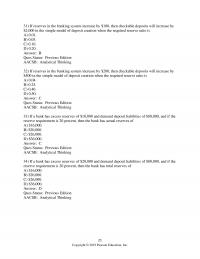
31) If reserves in the banking system increase by $100, then checkable deposits will increase by $2,000 in the simple model of deposit creation when the required reserve ratio is A) 0.01. B) 0.05. C) 0.10. D) 0.20. Answer: B […]
978-0134734217 Chapter 14 Part 1
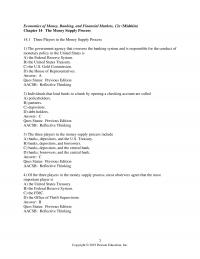
Economics of Money, Banking, and Financial Markets, 12e (Mishkin) Chapter 14 The Money Supply Process 14.1 Three Players in the Money Supply Process 1) The government agency that oversees the banking system and is responsible for the conduct of monetary […]
978-0134734217 Chapter 13
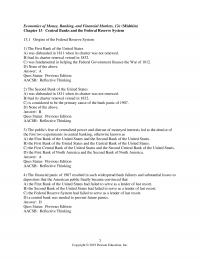
Economics of Money, Banking, and Financial Markets, 12e (Mishkin) Chapter 13 Central Banks and the Federal Reserve System 13.1 Origins of the Federal Reserve System 1) The First Bank of the United States A) was disbanded in 1811 when its […]
978-0134734217 Chapter 12
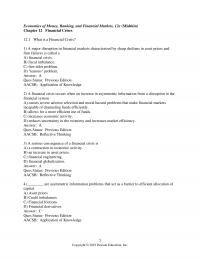
Economics of Money, Banking, and Financial Markets, 12e (Mishkin) Chapter 12 Financial Crises 12.1 What is a Financial Crisis? 1) A major disruption in financial markets characterized by sharp declines in asset prices and firm failures is called a A) […]
978-0134734217 Chapter 11 Part 2
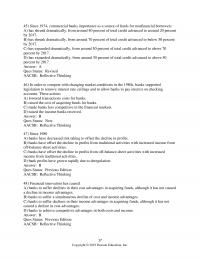
45) Since 1974, commercial banks importance as a source of funds for nonfinancial borrowers A) has shrunk dramatically, from around 40 percent of total credit advanced to around 20 percent by 2017. B) has shrunk dramatically, from around 70 percent […]
978-0134734217 Chapter 11 Part 1
Economics of Money, Banking, and Financial Markets, 12e (Mishkin) Chapter 11 Banking Industry: Structure and Competition 11.1 Historical Development of the Banking System 1) The modern commercial banking system began in America when the A) Bank of United States was […]
978-0134734217 Chapter 10 Part 2
23) Regulations designed to provide information to the marketplace so that investors can make informed decisions are called A) disclosure requirements. B) efficient market requirements. C) asset restrictions. D) capital requirements. Answer: A Ques Status: Previous Edition AACSB: Application of […]
978-0134734217 Chapter 10 Part 1
Economics of Money, Banking, and Financial Markets, 12e (Mishkin) Chapter 10 Economic Analysis of Financial Regulation 10.1 Asymmetric Information as a Rationale for Financial Regulation 1) Depositors lack of information about the quality of bank assets can lead to A) […]
978-0134734217 Chapter 9 Part 2
28) Net profit after taxes per dollar of equity capital is a basic measure of bank profitability called A) return on assets. B) return on capital. C) return on equity. D) return on investment. Answer: C Ques Status: Previous Edition […]
978-0134734217 Chapter 9 Part 1
Economics of Money, Banking, and Financial Markets, 12e (Mishkin) Chapter 9 Banking and the Management of Financial Institutions 9.1 The Bank Balance Sheet 1) Which of the following statements are TRUE? A) A bank’s assets are its sources of funds. […]
978-0134734217 Chapter 8 Part 2
9) That most used cars are sold by intermediaries (i.e., used car dealers) provides evidence that these intermediaries A) have been afforded special government treatment, since used car dealers do not provide information that is valued by consumers of used […]
978-0134734217 Chapter 8 Part 1
Economics of Money, Banking, and Financial Markets, 12e (Mishkin) Chapter 8 An Economic Analysis of Financial Structure 8.1 Basic Facts About Financial Structure Throughout the World 1) American businesses get their external funds primarily from A) bank loans. B) bonds […]
978-0134734217 Chapter 7 Part 2
3) If the optimal forecast of the return on a security exceeds the equilibrium return, then A) the market is inefficient. B) no unexploited profit opportunities exist. C) the market is in equilibrium. D) the market is myopic. Answer: A […]
978-0134734217 Chapter 7 Part 1
Economics of Money, Banking, and Financial Markets, 12e (Mishkin) Chapter 7 The Stock Market, the Theory of Rational Expectations, and the Efficient Market Hypothesis 7.1 Computing the Price of Common Stock 1) A stockholder’s ownership of a company’s stock gives […]
978-0134734217 Chapter 6 Part 2
60) If the federal government were to guarantee payment on municipal bonds, the yield on municipal bonds would ________ and the yield on U.S. Treasury bonds would ________, all else equal. A) decrease; increase B) increase; increase C) increase; decrease […]
978-0133832396 Chapter 8
Chapter 8 Velasquez Test Bank MULTIPLE CHOICE 1. Which of the following is considered to be the most fundamental elements of a rational organization? a. Top managers b. Organizational charts c. Formal hierarchies of authority d. Operations Answer: C Topic: […]
978-0133832396 Chapter 7
Chapter 7 Velasquez Test Bank MULTIPLE CHOICE 1. Which of the following arguments are used by those organizations that support the goal of diversity in the workforce? a. Affirmative action plans eliminate reverse discrimination. b. Global marketplaces can only be […]
978-0133832396 Chapter 6
Chapter 6 Velasquez Test Bank MULTIPLE CHOICE 1. Which of the following unethical practices occurs when consumers are signed up and billed for third-party services without their knowledge or consent? a. Fraud and deception b. Due care c. Coercion d. […]
978-0133832396 Chapter 5
Chapter 5 Velasquez Test Bank MULTIPLE CHOICE 1. From which external environment does a corporation draw the raw materials needed for a finished product? a. Consumer b. Natural c. Competition d. Social Answer: B Topic: The Dimensions of Pollution and […]
978-0133832396 Chapter 4
Chapter 4 Velasquez Test Bank MULTIPLE CHOICE 1. Which of the following models results in just outcomes, respects moral rights, and satisfies utilitarianism? a. Pure monopoly b. Equilibrium point c. Oligopoly d. Perfect market competition Answer: D Topic: Applying Ethics […]
978-0133832396 Chapter 3
Chapter 3 Velasquez Test Bank MULTIPLE CHOICE 1. Distributing goods and services, and determining which members of society will receive what, is one of the tasks that must be achieved to have a. a utilitarian economy. b. an economic system. […]
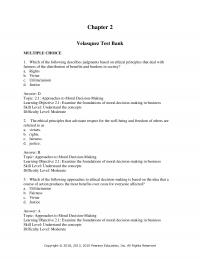
978-0133832396 Chapter 2
Chapter 2 Velasquez Test Bank MULTIPLE CHOICE 1. Which of the following describes judgments based on ethical principles that deal with fairness of the distribution of benefits and burdens in society? a. Rights b. Virtue c. Utilitarianism d. Justice Answer: […]
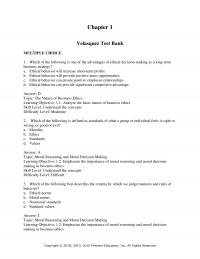
978-0133832396 Chapter 1
Chapter 1 Velasquez Test Bank MULTIPLE CHOICE 1. Which of the following is one of the advantages of ethical decision-making as a long-term business strategy? a. Ethical behavior will increase short-term profits. b. Ethical behavior will provide positive press opportunities. […]