10) Because Keynes assumed that the expected return on money was zero, he argued that people
would
A) never hold money.
B) never hold money as a store of wealth.
C) hold money as a store of wealth when the expected return on bonds was negative.
D) hold money as a store of wealth only when forced to by government policy.
11) The Keynesian theory of money demand predicts that people will increase their money
holdings if they believe that
A) interest rates are about to fall.
B) bond prices are about to rise.
C) expected inflation is about to fall.
D) bond prices are about to fall.
12) If people expect nominal interest rates to be higher in the future, the expected return to bonds
________, and the demand for money ________.
A) rises; increases
B) rises; decreases
C) falls; increases
D) falls; decreases
13) If people expect nominal interest rates to be lower in the future, the expected return to bonds
________, and the demand for money ________.
A) increases; increases
B) increases; decreases
C) decreases; increases
D) decreases; decreases
14) Keynes argued that when interest rates were low relative to some normal value, people
would expect bond prices to ________ so the quantity of money demanded would ________.
A) increase; increase
B) increase; decrease
C) decrease; increase
D) decrease; decrease
15) Keynes argued that when interest rates were high relative to some normal value, people
would expect bond prices to ________, so the quantity of money demanded would ________.
A) increase; increase
B) increase; decrease
C) decrease; decrease
D) decrease; increase
16) According to Keynes’s theory of liquidity preference, velocity increases when
A) income increases.
B) wealth increases.
C) brokerage commissions increase.
D) interest rates increase.
17) Keynes’s theory of the demand for money implies that velocity is
A) not constant but fluctuates with movements in interest rates.
B) not constant but fluctuates with movements in the price level.
C) not constant but fluctuates with movements in the time of year.
D) a constant.
18) Because interest rates have substantial fluctuations, the ________ theory of the demand for
money indicates that velocity has substantial fluctuations as well.
A) classical
B) Cambridge
C) liquidity preference
D) Pigouvian
19) Keynes’s liquidity preference theory indicates that the demand for money
A) is purely a function of income, and interest rates have no effect on the demand for money.
B) is purely a function of interest rates, and income has no effect on the demand for money.
C) is a function of both income and interest rates.
D) is a function of both government spending and income.
20) Keynes’s theory of the demand for money is consistent with
A) countercyclical movements in velocity.
B) a constant velocity.
C) procyclical movements in velocity.
D) a relatively stable velocity.
21) Keynes’s theory of the demand for money is consistent with ________ movements in
________.
A) countercyclical; velocity
B) procyclical; velocity
C) countercyclical; expectations
D) procyclical; expectations
22) Keynes’s model of the demand for money suggests that velocity is
A) constant.
B) positively related to interest rates.
C) negatively related to interest rates.
D) positively related to bond values.
23) Keynes’s liquidity preference theory indicates that the demand for money is
A) constant.
B) positively related to interest rates.
C) negatively related to interest rates.
D) negatively related to bond values.
24) Keynes’s model of the demand for money suggests that velocity is ________ related to
________.
A) positively; interest rates
B) negatively; interest rates
C) positively; bond values
D) positively; stock prices
25) Keynes’s liquidity preference theory indicates that the demand for money is ________
related to ________.
A) negatively; interest rates
B) positively; interest rates
C) negatively; income
D) negatively; wealth
26) The Keynesian demand for real balances can be expressed as
A) Md = f(i,Y).
B) Md/P = f(i).
C) Md/P = f(Y).
D) Md/P = f(i,Y).
27) Explain the Keynesian theory of money demand. What motives did Keynes think determined
money demand? What are the two reasons why Keynes thought velocity could NOT be treated as
a constant?
18
Copyright © 2019 Pearson Education, Inc.
19.4 Portfolio Theories of Money Demand
1) The portfolio theories of money demand state that the demand for real money balances is
________ related to income and ________ related to the nominal interest rate.
A) positively; negatively
B) positively; positively
C) negatively; negatively
D) negatively; positively
2) The portfolio theories of money demand state that when income (and therefore, wealth) is
higher, the demand for the money asset will ________ and the demand for real money balances
will be ________.
A) rise; higher
B) rise; lower
C) fall; higher
D) fall; lower
3) As interest rates rise, the expected absolute return of money ________, money’s expected
return relative to bonds ________.
A) does not change; decrease
B) rises; decrease
C) does not change; increase
D) falls; decrease
4) The theory of portfolio choice indicates that higher interest rates make money ________
desirable, and the demand for real money balances ________.
A) less; falls
B) more; falls
C) less; rises
D) more; rises
5) The theory of portfolio choice indicates that factors affecting the demand for money include
A) income.
B) nominal interest rate.
C) liquidity of other assets.
D) all the above.
6) The theory of portfolio choice indicates that factors affecting the demand for money include
A) income.
B) nominal interest rate.
C) riskiness of money.
D) all the above.
19.5 Empirical Evidence for the Demand for Money
1) The evidence on the interest sensitivity of the demand for money suggests that the demand for
money is ________ to interest rates, and there is ________ evidence that a liquidity trap exists.
A) sensitive; substantial
B) sensitive; little
C) insensitive; substantial
D) insensitive; little
2) In the liquidity trap a small change in interest rates produces ________ change in the quantity
of money demanded.
A) a small
B) no
C) a proportionate
D) a very large
3) In a liquidity trap, monetary policy has ________ effect on aggregate spending because a
change in the money supply has ________ effect on interest rates.
A) no; no
B) no; a large
C) no; a small
D) a large; a large
4) In the liquidity trap, monetary policy
A) has a large impact on interest rates.
B) has a small impact on interest rates.
C) has no impact on interest rates.
D) has a proportionate impact on interest rates.
5) In the liquidity trap, the money demand curve
A) is horizontal.
B) is vertical.
C) is negatively sloped.
D) is positively sloped.
6) Evidence suggests that a liquidity trap is possible when
A) real interest rates are at zero.
B) real interest rates are at or just above zero.
C) nominal interest rates are at zero.
D) nominal interest rates are at or just above zero.
7) The reason that economists are so interested in the stability of velocity is because if the
demand for money is not stable, then steady growth of the money supply
A) is going to promote price stability at the expense of low unemployment.
B) is going to promote low unemployment at the expense of price stability.
C) is an ineffective way to conduct monetary policy.
D) can still be used to conduct monetary policy if the goal is price stability.
8) Describe what the liquidity trap is. Explain how it can be problematic for monetary
policymakers.
19.6 Web Appendix 1: The Baumol-Tobin and Tobin Mean Variance Model of the Demand for
Money
1) The absence of money illusion means that
A) as real income doubles, the demand for money doubles.
B) as interest rates double, the demand for money doubles.
C) as the money supply doubles, the demand for money doubles.
D) as the price level doubles, the demand for money doubles.
2) If there are economies of scale in the transactions demand for money, as income increases,
money demand
A) increases proportionately.
B) increases less than proportionately.
C) increases more than proportionately.
D) does not change.
3) Comparing Tobin’s model of the speculative demand for money with Keynesian speculative
demand
A) both models imply that individuals hold only money or only bonds.
B) the Keynesian model implies individuals diversify their asset holdings, while the Tobin model
predicts that individuals hold only money or only bonds.
C) the Tobin model implies individuals diversify their asset holdings, while the Keynesian model
predicts that individuals hold only money or only bonds.
D) both models imply that individuals diversify their asset holdings.
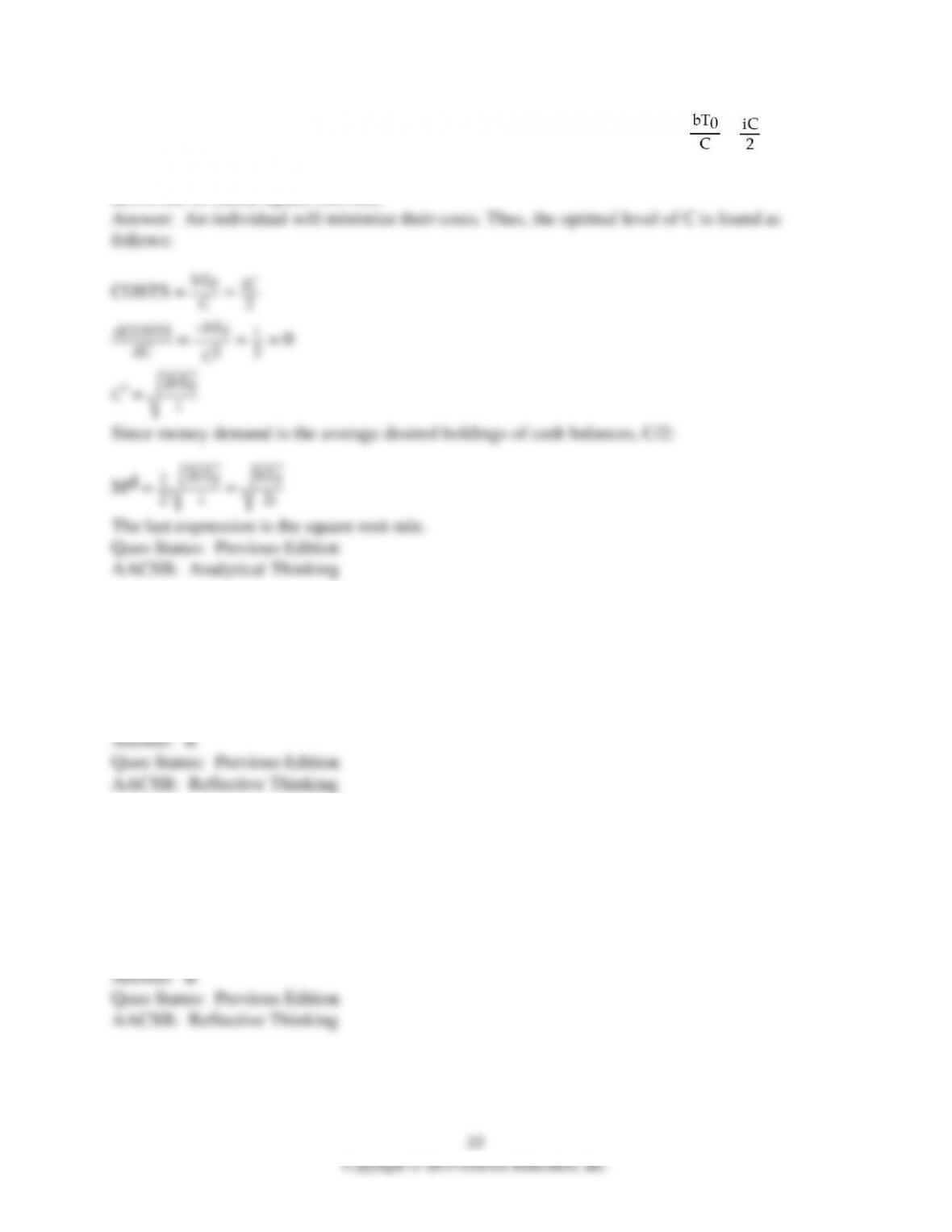
4) In the Baumol-Tobin model, given that total costs for an individual equals + , where
T0 = monthly income, b = brokerage costs, and C = amount raised from each bond transaction,
derive the so-called square root rule.
5) The Baumol-Tobin analysis suggests that
A) velocity is relatively constant.
B) the transactions component of the demand for money is negatively related to the level of
interest rates.
C) the speculative motive is nonexistent.
D) velocity is unrelated to the transactions motive.
6) The Baumol-Tobin analysis suggests that an increase in the brokerage fee for buying and
selling bonds will cause the demand for money to ________ and the demand for bonds to
________.
A) increase; increase
B) increase; decrease
C) decrease; increase
D) decrease; decrease
7) The Baumol-Tobin analysis suggests that a decrease in the brokerage fee for buying and
selling bonds will cause the demand for money to ________ and the demand for bonds to
________.
A) increase; increase
B) increase; decrease
C) decrease; decrease
D) decrease; increase
8) In the Baumol-Tobin analysis of transactions demand for money, either an increase in
________ or a decrease in ________ increases money demand.
A) income; interest rate
B) interest rates; brokerage fees
C) brokerage fees; income
D) interest rate; income
9) In the Baumol-Tobin analysis of the demand for money, either an increase in ________ or an
increase in ________ increases money demand.
A) income; interest rates
B) brokerage fees; interest rates
C) interest rates; the price level
D) brokerage fees; income
10) In the Baumol-Tobin analysis of transactions demand, scale economies imply that an
increase in real income increases the quantity of money demanded ________, while an increase
in the price level increases the quantity of money demanded ________.
A) proportionately; less than proportionately
B) more than proportionately; proportionately
C) less than proportionately; proportionately
D) proportionately; more than proportionately
11) Tobin’s model of the speculative demand for money improves on Keynes’s analysis by
showing that
A) the speculative demand for money is interest insensitive.
B) the transactions demand for money is interest insensitive.
C) people will hold a diversified portfolio.
D) people will hold money or bonds but not both.
12) Tobin’s model of the speculative demand for money shows that people hold money as a store
of wealth as a way of
A) reducing risk.
B) reducing income.
C) avoiding taxes.
D) reducing transactions cost.
13) Tobin’s model of the speculative demand for money shows that people hold money as a
________ as a way of reducing ________.
A) medium of exchange; transaction costs
B) medium of exchange; risk
C) store of wealth; transaction costs
D) store of wealth; risk
14) Tobin’s model of the speculative demand for money shows that people can reduce their
________ by ________ their asset holdings.
A) wealth; diversifying
B) risk; specializing
C) return; diversifying
D) risk; diversifying
15) Because Treasury bills pay a higher return than money and have no risk
A) the transactions demand for money may be zero.
B) the precautionary demand for money may be zero.
C) the speculative demand for money may be zero.
D) all three of the above motives for holding money will be zero.
16) The speculative demand for money may not exist because
A) banks now pay interest on some types of checkable deposits.
B) there are alternative riskless assets paying higher returns than the return on money.
C) the transactions demand can be shown to depend on interest rates.
D) government regulations have eliminated risk in the financial markets.
17) What factors determine the demand for money in the Baumol-Tobin analysis of transactions
demand for money? How does a change in each factor affect the quantity of money demanded?
19.7 Web Appendix 2: Empirical Evidence on the Demand for Money
1) In one of the earliest studies on the link between interest rates and money demand using
United States data, James Tobin concluded that the demand for money is
A) sensitive to interest rates.
B) not sensitive to interest rates.
C) not sensitive to changes in income.
D) not sensitive to changes in bond values.
2) Starting in 1974, the conventional M1 money demand function began to
A) severely underpredict the demand for money.
B) severely overpredict the demand for money.
C) predict more precisely the demand for money.
D) do none of the above.
3) Starting in 1974, the conventional M1 money demand function began to severely ________
the demand for money. Stephen Goldfeld labeled this phenomenon “the case of the missing
________.”
A) underpredict; velocity
B) overpredict; velocity
C) underpredict; money
D) overpredict; money
4) Conventional money demand functions tended to ________ money demand in the middle and
late 1970s, and ________ velocity beginning in 1982.
A) overpredict; overpredict
B) overpredict; underpredict
C) underpredict; overpredict
D) underpredict; underpredict
5) Researchers at the Federal Reserve found that M2 money demand functions performed
________ in the 1980s, with M2 velocity moving ________ with the opportunity cost of holding
M2.
A) poorly; erratically
B) poorly; closely
C) well; erratically
D) well; closely
6) In the early 1990s, M2 growth underwent a dramatic ________, which some researchers
believe ________ be explained by traditional money demand functions.
A) surge; cannot
B) surge; can
C) slowdown; cannot
D) slowdown; can
7) In the late 1990s, M2 velocity ________, suggesting a ________ normal relationship between
M2 and macroeconomic variables.
A) stabilized; less
B) stabilized; more
C) slowed; less
D) slowed; more