Chapter 8
Velasquez Test Bank
MULTIPLE CHOICE
1. Which of the following is considered to be the most fundamental elements of a rational
organization?
a. Top managers
b. Organizational charts
c. Formal hierarchies of authority
d. Operations
2. Who directly produces the goods and services that are the essential outputs of an
organization?
a. Agents
b. Middle managers
c. Consumers
d. Operating layer employees
3. Which of the following indicates an employee’s moral responsibility to obey the employer
and the employer’s moral responsibility to provide wages and working conditions it agreed to
provide?
a. Contractual agreements
b. Rational agreements
c. Moral obligations
d. Rational obligations
Copyright © 2018, 2013, 2010 Pearson Education, Inc. All Rights Reserved
Learning Objective 8.1: Describe the rational model of the business organization in terms of
structure and the obligations of employee and employer
Skill Level: Understand the concept
Difficulty Level: Moderate
4. Which of the following is a type of conflict of interest based on emotional ties and
relationships?
a. Actual
b. Subjective
c. Apparent
d. Objective
5. Which of the following exists when there is no conflict of interest, but other people who
consider the employee’s situation believe that the employee has a conflict of interest?
a. Actual
b. Subjective
c. Apparent
d. Ethical
6. Which of the following is an example of commercial extortion?
a. Something of value is offered to an employee if the employee deals favorably with the firm.
b. Payment, preferential treatment, or goods are offered when an employee shows preference to
an organization.
c. An employee uses the resources of the employer for his or her own benefit without the
consent of the employer.
d. An employee demands a payment of money or goods from an organization in order to
continue doing business together.
Copyright © 2018, 2013, 2010 Pearson Education, Inc. All Rights Reserved
Skill Level: Analyze it
Difficulty Level: Moderate
7. Which of the following is proprietary information that concerns a company’s activities,
technologies, plans, policies, and other information that, if known to competitors, could affect
the company’s ability to compete?
a. Trade secrets
b. Commercial extortion
c. Conflict of interest
d. Insider trading
8. Which of the following describes an organization model that focuses less on formal lines of
authority and communication, and more on the lines of competing power coalitions and lines of
influence and communication that stem from these coalitions?
a. Rational
b. Political
c. Justice-based
d. Goal-directed
9. Which of the following represents the three basic differences between the power of corporate
managers and the power of government officials?
a. Centralization, decision-making process, and legal authority
b. Economic leverage, mobility, and decentralization
c. Consent, limits, and mobility
d. Monopoly power, legal authority, and consent
10. The right of people to determine what, to whom, and how much information they disclose to
others is called
a. psychological privacy.
b. physical privacy.
c. the technological dilemma of modern organizations.
d. the right to privacy.
11. Which element of privacy limits the personal information an employer can pursue to
information that is directly relevant to the issue at hand, such as performance on the job?
a. Relevance
b. Consent
c. Methods
d. Ordinary
12. Which of the following offers protection to employees who report the wrongdoings of an
organization that violates the law?
a. Freedom of conscience
b. Whistleblowing
c. Right to privacy
d. Organizational democracy
13. Which of the following is achieved when decisions that affect a group are made by the
majority of its members after full, free, and open discussion?
a. Freedom of conscience
b. Rational agreement
c. Organizational democracy
d. Formal hierarchies of authority
14. Which political tactic creates the appearance of being thoughtful, honest, and sensitive and
can aid in making a decision maker well-liked and confident?
a. Image building
b. Ingratiation
c. Controlling information
d. Forming power coalitions
15. Often considered unethical, which political tactic contradicts utilitarian principles?
a. Those that knowingly involve laminating inefficiency and waste
b. Those that take advantage of emotional dependencies when promoting products
c. Those that eliminate moral disrespect in the decision-making process
d. Those that involve the pursuit of personal goals at the expense of the organization’s
productive goals
16. Which of the following political tactics creates a dependency as a source of power?
a. Getting control over scarce resources desired by others
b. Eliminating obligations and friendships in relationships
c. Allowing others to have power for decision making.
d. Integrating the workforce and helping workers pursue the organization’s interests
Copyright © 2018, 2013, 2010 Pearson Education, Inc. All Rights Reserved
Topic: Informal Power Relationships in Organizations
Learning Objective 8.3: Explain informal power relationships in organizations from an ethical
perspective
Skill Level: Apply what you know
Difficulty Level: Moderate
17. The value of work as a basic economic contribution and as a tool to develop potential is
the _____ of work.
a. instrumental value
b. due process outcome
c. intrinsic value
d. doctrine of employment principles
18. Which of the following supports the view that managers are authoritarian and controlling,
and therefore less democratic?
a. Theory Y
b. Rensis Likert’s view
c. Theory X
d. Raymond Miles’s view
19. Which of the following is derived from the right of all people to be treated as free and equal
persons, and has acted as a method to balance the power between a corporation and its
employees?
a. The right to advance notice of plant closings and layoffs
b. Free trade agreements
c. The intrinsic value of work
d. A worker’s right to organize into a union
Copyright © 2018, 2013, 2010 Pearson Education, Inc. All Rights Reserved
Skill Level: Analyze it
Difficulty Level: Moderate
20. Which of the following concepts is based on the close interpersonal relationships that extend
between an organization and those external individuals with whom the organization interacts?
a. Connected selves
b. The justice of results
c. The impact of caring
d. Sense of responsibility
21. Which of the following is an aspect of the caring model of the organization?
a. Caring is focused on how to best improve profits and quality.
b. Caring is done as a way to enhance quality and profits.
c. Caring is directed at groups and is objective based on quality of output.
d. Caring aims to enhance the growth of others by helping them develop their full capacities.
22. Which of the following arguments in favor of the caring organization include the idea of
caring about those external people and companies we do business with?
a. Increased economic performance
b. The creation of customer value
c. The enhanced growth of full capacities
d. Fulfillment of needs and aspirations
23. Which of the following best describes the caring model of the organization?
a. Caring is focused on quality and profitability.
b. Caring should be viewed as a way to increase productivity.
c. Caring is personal in nature.
d. Caring will enhance the performance of those who receive the care.
24. Which of the following best describes why insider trading is said to be unethical?
a. The theft of information gives the insider an unfair advantage in the organization and the
markets.
b. The theft of information can change the value of the stock so that it reflects the true value of
the organization.
c. Insider trading harms relationships between the organization and its customers.
d. Insider trading increases society’s overall utility by increasing the size of the market.
25. Which of the following should be at the foundation of a global company’s basis of
determining wages in developing nations?
a. Wages should be set at the same rate as wages in the company’s home country.
b. Wages should be set based on supply and demand in the local economy.
c. Wages should be set based on the local labor market.
d. Wages should be set based on the retail price of a product in the United States.
SHORT ANSWER
26. Describe the functions of a rational model of an organization.
Copyright © 2018, 2013, 2010 Pearson Education, Inc. All Rights Reserved
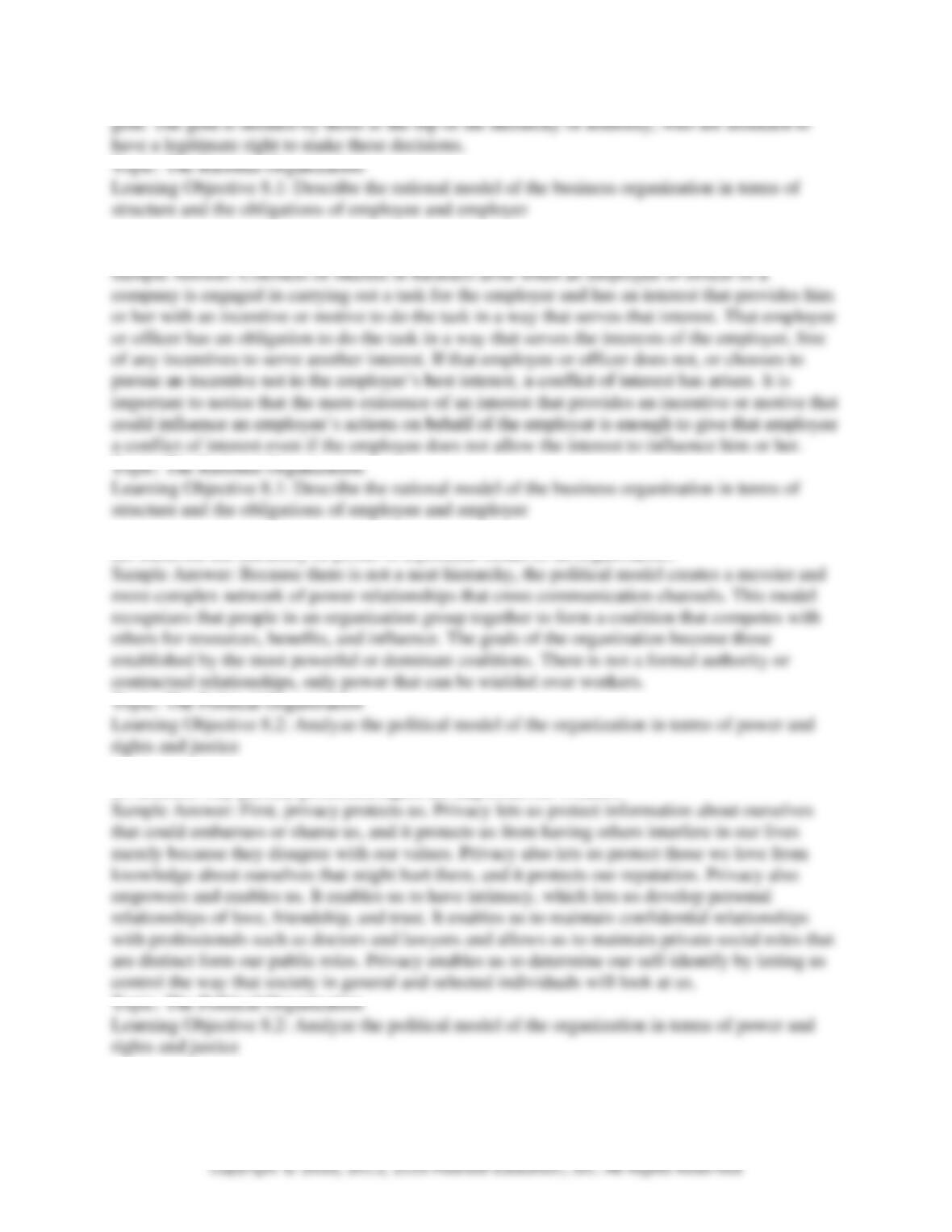
goal. The goal is defined by those at the top of the hierarchy of authority, who are assumed to
have a legitimate right to make these decisions.
Topic: The Rational Organization
Learning Objective 8.1: Describe the rational model of the business organization in terms of
structure and the obligations of employee and employer
27. How are conflicts of interest created in an organization?
28. Describe the hierarchy of power in a political model of an organization.
29. Discuss why privacy protection rights are important for workers.
30. Discuss the ways political tactics can create injustice among those employees with no
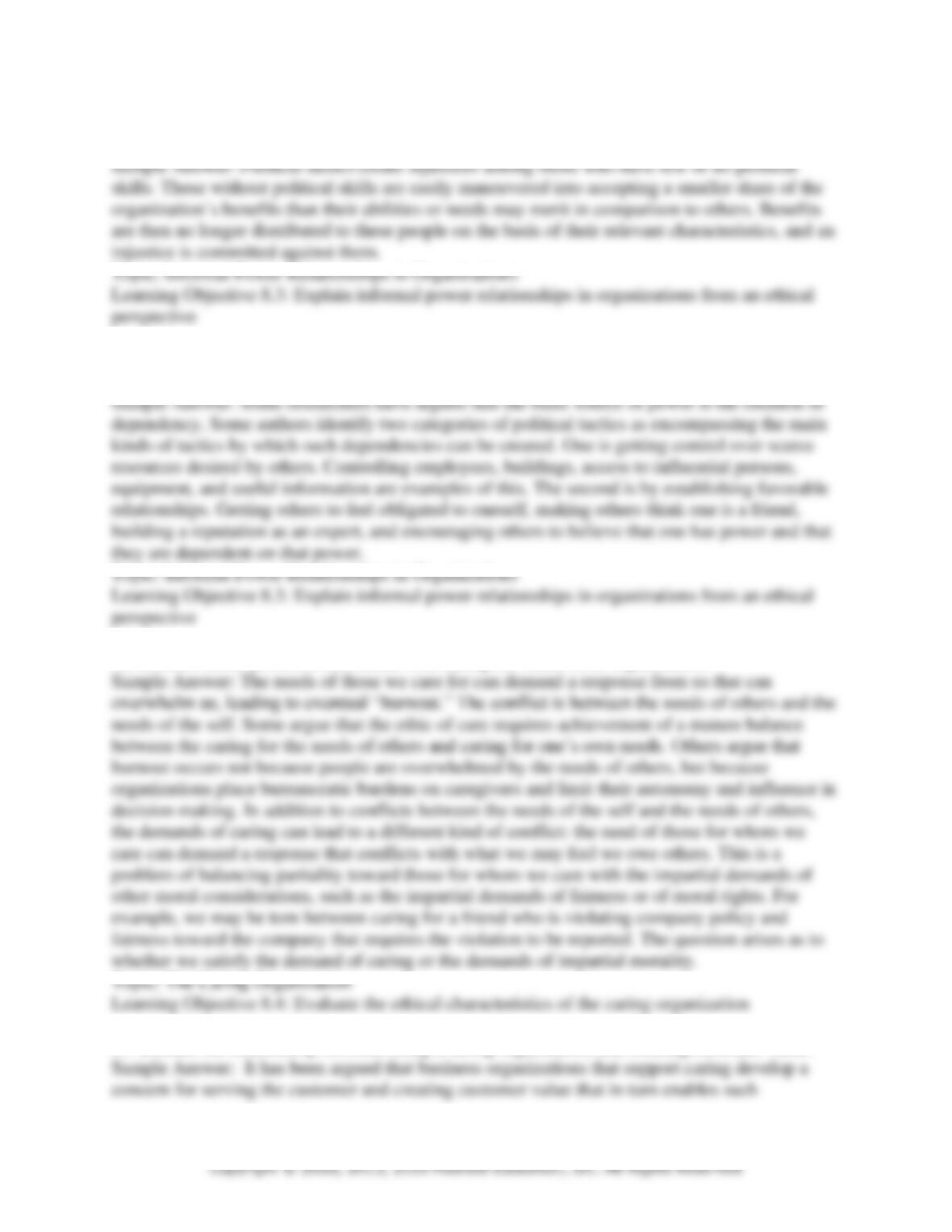
political skills.
31. Discuss the political tactics used by those with power in an organization to create
dependency.
32. Discuss moral problems associated with caring too much in an organization.
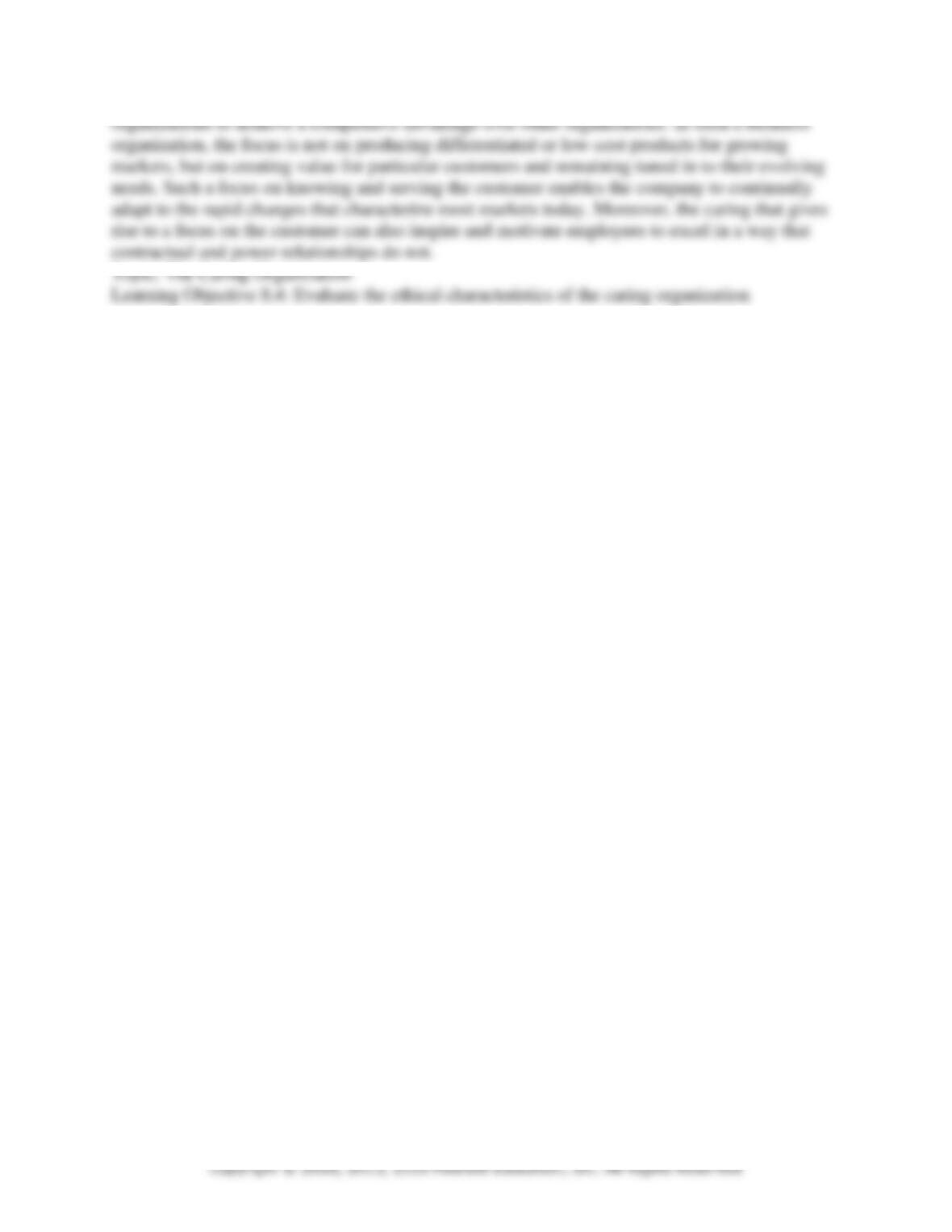
33. Discuss the relationship between being a caring organization and creating customer value.
Copyright © 2018, 2013, 2010 Pearson Education, Inc. All Rights Reserved
organizations to achieve a competitive advantage over other organizations. In such a business
organization, the focus is not on producing differentiated or low-cost products for growing
markets, but on creating value for particular customers and remaining tuned in to their evolving
needs. Such a focus on knowing and serving the customer enables the company to continually
adapt to the rapid changes that characterize most markets today. Moreover, the caring that gives
rise to a focus on the customer can also inspire and motivate employees to excel in a way that
contractual and power relationships do not.
Topic: The Caring Organization
Learning Objective 8.4: Evaluate the ethical characteristics of the caring organization