28) Net profit after taxes per dollar of equity capital is a basic measure of bank profitability
called
A) return on assets.
B) return on capital.
C) return on equity.
D) return on investment.
29) The amount of assets per dollar of equity capital is called the
A) asset ratio.
B) equity ratio.
C) equity multiplier.
D) asset multiplier.
30) For a given return on assets, the lower is bank capital
A) the lower is the return for the owners of the bank.
B) the higher is the return for the owners of the bank.
C) the lower is the credit risk for the owners of the bank.
D) the lower the possibility of bank failure.
31) Bank capital has both benefits and costs for the bank owners. Higher bank capital ________
the likelihood of bankruptcy, but higher bank capital ________ the return on equity for a given
return on assets.
A) reduces; reduces
B) increases; increases
C) reduces; increases
D) increases; reduces
32) In the absence of regulation, banks would probably hold
A) too much capital, reducing the efficiency of the payments system.
B) too much capital, reducing the profitability of banks.
C) too little capital.
D) too much capital, making it more difficult to obtain loans.
33) Banks hold capital because
A) they are required to by regulatory authorities.
B) higher capital increases the returns to the owners.
C) it increases the likelihood of bankruptcy.
D) higher capital increases the return on equity.
34) Conditions that likely contributed to a credit crunch during the global financial crisis include
A) capital shortfalls caused in part by falling real estate prices.
B) regulated hikes in bank capital requirements.
C) falling interest rates that raised interest rate risk, causing banks to choose to hold more capital.
D) increases in reserve requirements.
35) Which of the following would NOT be a way to increase the return on equity?
A) Buy back bank stock.
B) Pay higher dividends.
C) Acquire new funds by selling negotiable CDs and increase assets with them.
D) Sell more bank stock.
36) If a bank needs to raise the amount of capital relative to assets, a bank manager might choose
to
A) buy back bank stock.
B) pay higher dividends.
C) reduce the bank’s assets by making fewer loans.
D) sell securities the bank owns and put the funds into the reserve account.
37) Your bank has the following balance sheet:
Assets Liabilities
Reserves $50 million Checkable deposits $200 million
Securities 50 million
Loans 150 million Bank capital 50 million
If the required reserve ratio is 10%, what actions should the bank manager take if there is an
unexpected deposit outflow of $50 million?
9.4 Managing Credit Risk
1) Banks face the problem of ________ in loan markets because bad credit risks are the ones
most likely to seek bank loans.
A) adverse selection
B) moral hazard
C) moral suasion
D) intentional fraud
2) If borrowers with the most risky investment projects seek bank loans in higher proportion to
those borrowers with the safest investment projects, banks are said to face the problem of
A) adverse credit risk.
B) adverse selection.
C) moral hazard.
D) lemon lenders.
3) Because borrowers, once they have a loan, are more likely to invest in high-risk investment
projects, banks face the
A) adverse selection problem.
B) lemon problem.
C) adverse credit risk problem.
D) moral hazard problem.
4) In order to reduce the ________ problem in loan markets, bankers collect information from
prospective borrowers to screen out the bad credit risks from the good ones.
A) moral hazard
B) adverse selection
C) moral suasion
D) adverse lending
5) In one sense ________ appears surprising since it means that the bank is not ________ its
portfolio of loans and thus is exposing itself to more risk.
A) specialization in lending; diversifying
B) specialization in lending; rationing
C) credit rationing; diversifying
D) screening; rationing
6) From the standpoint of ________, specialization in lending is surprising but makes perfect
sense when one considers the ________ problem.
A) moral hazard; diversification
B) diversification; moral hazard
C) adverse selection; diversification
D) diversification; adverse selection
7) Provisions in loan contracts that prohibit borrowers from engaging in specified risky activities
are called
A) proscription bonds.
B) restrictive covenants.
C) due-on-sale clauses.
D) liens.
8) To reduce moral hazard problems, banks include restrictive covenants in loan contracts. In
order for these restrictive covenants to be effective, banks must also
A) monitor and enforce them.
B) be willing to rewrite the contract if the borrower cannot comply with the restrictions.
C) trust the borrower to do the right thing.
D) be prepared to extend the deadline when the borrower needs more time to comply.
9) Long-term customer relationships ________ the cost of information collection and make it
easier to ________ credit risks.
A) reduce; screen
B) increase; screen
C) reduce; increase
D) increase; increase
10) Unanticipated moral hazard contingencies can be reduced by
A) screening.
B) long-term customer relationships.
C) specialization in lending.
D) credit rationing.
11) A bank’s commitment to provide a firm with loans up to pre-specified limit at an interest rate
that is tied to a market interest rate is called
A) an adjustable gap loan.
B) an adjustable portfolio loan.
C) loan commitment.
D) pre-credit loan line.
12) Property promised to the lender as compensation if the borrower defaults is called
A) collateral.
B) deductibles.
C) restrictive covenants.
D) contingencies.
13) Collateral requirements lessen the consequences of ________ because the collateral reduces
the lender’s losses in the case of a loan default and it reduces ________ because the borrower has
more to lose from a default.
A) adverse selection; moral hazard
B) moral hazard; adverse selection
C) adverse selection; diversification
D) diversification; moral hazard
14) A bank that wants to monitor the check payment practices of its commercial borrowers, so
that moral hazard can be reduced, will require borrowers to
A) place a bank officer on their board of directors.
B) place a corporate officer on the bank’s board of directors.
C) keep compensating balances in a checking account at the bank.
D) purchase the bank’s CDs.
15) Of the following methods that banks might use to reduce moral hazard problems, the one not
legally permitted in the United States is the
A) requirement that firms keep compensating balances at the banks from which they obtain their
loans.
B) requirement that firms place on their board of directors an officer from the bank.
C) inclusion of restrictive covenants in loan contracts.
D) requirement that individuals provide detailed credit histories to bank loan officers.
16) When a lender refuses to make a loan, although borrowers are willing to pay the stated
interest rate or even a higher rate, the bank is said to engage in
A) coercive bargaining.
B) strategic holding out.
C) credit rationing.
D) collusive behavior.
17) When banks offer borrowers smaller loans than they have requested, banks are said to
A) shave credit.
B) rediscount the loan.
C) raze credit.
D) ration credit.
18) Credit risk management tools include
A) deductibles.
B) collateral.
C) interest rate swaps.
D) duration analysis.
19) How can specializing in lending help to reduce the adverse selection problem in lending?
25
Copyright © 2019 Pearson Education, Inc.
9.5 Managing Interest-Rate Risk
1) Risk that is related to the uncertainty about interest rate movements is called
A) default risk.
B) interest-rate risk.
C) the problem of moral hazard.
D) security risk.
2) All else the same, if a bank’s liabilities are more sensitive to interest rate fluctuations than are
its assets, then ________ in interest rates will ________ bank profits.
A) an increase; increase
B) an increase; reduce
C) a decline; reduce
D) a decline; not affect
3) If a bank has ________ rate-sensitive assets than liabilities, then ________ in interest rates
will increase bank profits.
A) more; a decline
B) more; an increase
C) fewer; an increase
D) fewer; a surge
4) If a bank has ________ rate-sensitive assets than liabilities, a ________ in interest rates will
reduce bank profits, while a ________ in interest rates will raise bank profits.
A) more; rise; decline
B) more; decline; rise
C) fewer; decline; decline
D) fewer; rise; rise
5) If a bank’s liabilities are more sensitive to interest rate movements than are its assets, then
A) an increase in interest rates will reduce bank profits.
B) a decrease in interest rates will reduce bank profits.
C) interest rates changes will not impact bank profits.
D) an increase in interest rates will increase bank profits.
6) If a bank has $50 million in rate-sensitive assets and $20 million in rate-sensitive liabilities
then
A) an increase in interest rates will reduce bank profits.
B) a decrease in interest rates will reduce bank profits.
C) interest rate changes will not impact bank profits.
D) a decrease in interest rates will increase bank profits.
7) The difference of rate-sensitive liabilities and rate-sensitive assets is known as the
A) duration.
B) interest-sensitivity index.
C) rate-risk index.
D) gap.
8) If the First National Bank has a gap equal to a negative $30 million, then a 5 percentage point
increase in interest rates will cause profits to
A) increase by $15 million.
B) increase by $1.5 million.
C) decline by $15 million.
D) decline by $1.5 million.
9) Measuring the sensitivity of bank profits to changes in interest rates by multiplying the gap
times the change in the interest rate is called
A) basic duration analysis.
B) basic gap analysis.
C) interest-exposure analysis.
D) gap-exposure analysis.
10) Measuring the sensitivity of bank profits to changes in interest rates by multiplying the gap
for several maturity subintervals times the change in the interest rate is called
A) basic gap analysis.
B) the maturity bucket approach to gap analysis.
C) the segmented maturity approach to gap analysis.
D) the segmented maturity approach to interest-exposure analysis.
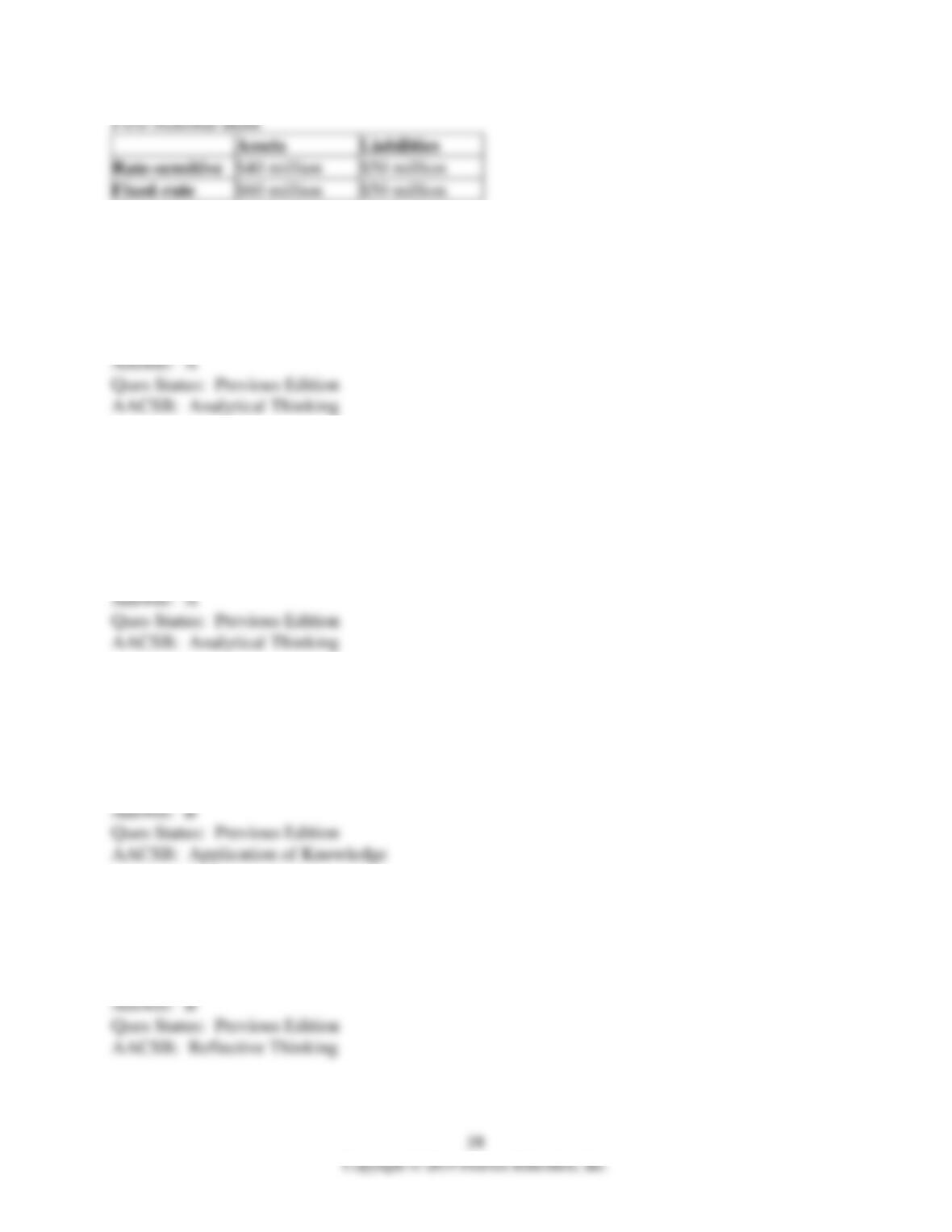
First National Bank
Assets
Liabilities
Rate-sensitive
$40 million
$50 million
Fixed-rate
$60 million
$50 million
13) If interest rates rise by 5 percentage points, say from 10 to 15%, bank profits (measured
using gap analysis) will
A) decline by $0.5 million.
B) decline by $1.5 million.
C) decline by $2.5 million.
D) increase by $2.0 million.
14) Assuming that the average duration of its assets is four years, while the average duration of
its liabilities is three years, then a 5 percentage point increase in interest rates will cause the net
worth of First National to ________ by ________ of the total original asset value.
A) decline; 5 percent
B) decline; 10 percent
C) decline; 15 percent
D) increase; 20 percent
15) Duration analysis involves comparing the average duration of the bank’s ________ to the
average duration of its ________.
A) securities portfolio; non-deposit liabilities
B) assets; liabilities
C) loan portfolio; deposit liabilities
D) assets; deposit liabilities
16) Because of an expected rise in interest rates in the future, a banker will likely
A) make long-term rather than short-term loans.
B) buy short-term rather than long-term bonds.
C) buy long-term rather than short-term bonds.
D) make either short or long-term loans; expectations of future interest rates are irrelevant.
17) If a banker expects interest rates to fall in the future, her best strategy for the present is
A) to increase the duration of the bank’s liabilities.
B) to buy short-term bonds.
C) to sell long-term certificates of deposit.
D) to increase the duration of the bank’s assets.
18) Bruce the Bank Manager can reduce interest rate risk by ________ the duration of the bank’s
assets to increase their rate sensitivity or, alternatively, ________ the duration of the bank’s
liabilities.
A) shortening; lengthening
B) shortening; shortening
C) lengthening; lengthening
D) lengthening; shortening
19) Your bank has the following balance sheet
Assets Liabilities
Rate-sensitive $100 million Rate-sensitive $75 million
Fixed-rate 100 million Fixed-rate 125 million
What would happen to bank profits if the interest rates in the economy go down? Is there
anything that you could do to keep your bank from being so vulnerable to interest rate
movements?

9.6 Off-Balance-Sheet Activities
1) Examples of off-balance-sheet activities include
A) trading activities.
B) extending loans to depositors.
C) borrowing from other banks.
D) selling negotiable CDs.
2) Banks earn profits from off-balance sheet loan sales
A) by foreclosing on delinquent accounts.
B) by selling the loans at discounted prices.
C) by selling existing loans for more than the original loan amount.
D) by calling-in loans before the maturity date.
3) All of the following are examples of off-balance sheet activities that generate fee income for
banks EXCEPT
A) foreign exchange trades.
B) guaranteeing debt securities.
C) back-up lines of credit.
D) selling negotiable CDs.
4) Which of the following is NOT an example of a backup line of credit?
A) loan commitments
B) overdraft privileges
C) standby letters of credit
D) mortgages
5) Off-balance sheet activities involving guarantees of securities and back-up credit lines
A) have no impact on the risk a bank faces.
B) greatly reduce the risk a bank faces.
C) increase the risk a bank faces.
D) slightly reduce the risk a bank faces.
6) When banks involved in trading activities attempt to outguess markets, they are
A) forecasting.
B) diversifying.
C) speculating.
D) engaging in riskless arbitrage.
7) Traders working for banks are subject to the
A) principal-agent problem.
B) free-rider problem.
C) double-jeopardy problem.
D) exchange-risk problem.
8) A reason why rogue traders have bankrupt their banks is due to
A) the separation of trading activities from the bookkeepers.
B) stringent supervision of trading activities by bank management.
C) accounting errors.
D) a failure to maintain proper internal controls.
9) One way for banks to reduce the principal-agent problems associated with trading activities is
to
A) set limits on the total amount of a traders’ transactions.
B) make sure that the person conducting the trades is also the person responsible for recording
the transactions.
C) encourage traders to take on more risk if the potential rewards are higher.
D) reduce the regulations on the traders so that they have more flexibility in conducting trades.
10) The principal-agent problem that exists for bank trading activities can be reduced through
A) creation of internal controls that combine trading activities with bookkeeping.
B) creation of internal controls that separate trading activities from bookkeeping.
C) elimination of regulation of banking.
D) elimination of internal controls.
11) Banks develop statistical models to calculate their maximum loss over a given time period.
This approach is known as the
A) stress-testing approach.
B) value-at-risk approach.
C) trading-loss approach.
D) doomsday approach.
12) When banks calculate the losses the institution would incur if an unusual combination of bad
events happened, the bank is using the ________ approach.
A) stress-test
B) value-at-risk
C) trading-loss
D) maximum value
1) Assume a bank has $200 million of assets with a duration of 2.5, and $190 million of
liabilities with a duration of 1.05. If interest rates increase from 5 percent to 6 percent, the net
worth of the bank falls by
A) $1 million.
B) $2.4 million.
C) $3.6 million.
D) $4.8 million.
2) Assume a bank has $200 million of assets with a duration of 2.5, and $190 million of
liabilities with a duration of 1.05. The duration gap for this bank is
A) 0.5 year.
B) 1 year.
C) 1.5 years.
D) 2 years.
3) If interest rates increase from 9 percent to 10 percent, a bank with a duration gap of 2 years
would experience a decrease in its net worth of
A) 0.9 percent of its assets.
B) 0.9 percent of its liabilities.
C) 1.8 percent of its liabilities.
D) 1.8 percent of its assets.
4) One of the problems in conducting a duration gap analysis is that the duration gap is
calculated assuming that interest rates for all maturities are the same. That means that the yield
curve is
A) flat.
B) slightly upward sloping.
C) steeply upward sloping.
D) downward sloping.
1) Most of a bank’s operating income results from
A) interest on assets.
B) service charges on deposit accounts.
C) off-balance-sheet activities.
D) fees from standby lines of credit.
2) All of the following are operating expenses for a bank EXCEPT
A) service charges on deposit accounts.
B) salaries and employee benefits.
C) rent on buildings.
D) servicing costs of equipment such as computers.
3) When a bank suspects that a $1 million loan might prove to be bad debt that will have to be
written off in the future the bank
A) can set aside $1 million of its earnings in its loan loss reserves account.
B) reduces its reported earnings by $1, even though it has not yet actually lost the $1 million.
C) reduces its assets immediately by $1 million, even though it has not yet lost the $1 million.
D) reduces its reserves by $1 million, so that they can use those funds later.
4) For banks
A) return on assets exceeds return on equity.
B) return on assets equals return on equity.
C) return on equity exceeds return on assets.
D) return on equity is another name for net interest margin.
5) Interest income minus interest expenses divided by assets is a measure of bank performance
known as the
A) operating income.
B) net interest margin.
C) return on assets.
D) return on equity.
6) Based on the Net Interest Margin the poor bank performance in the late 1980s
A) was not the result of interest-rate movements.
B) was not the result of risky loans made in the early 1980s.
C) resulted from a narrowing of the gap between interest earned on assets and inters paid on
liabilities.
D) resulted from a huge decrease in provisions for loan losses.