Archives: Quiz
Economics 506 Test 2
1) The endowment effect describes when people value a good more when they own it than when they don’t. 2) Neoclassical theory suggests that to the extent impulse buying occurs, it is infrequent and does not affect the ability of […]
ECON A 799 Quiz 3
1) Voters’ preference for having government programs serve them is inherently in conflict with their preference to pay no taxes. 2) Allocative efficiency occurs where (for the last unit) maximum willingness to pay exceeds minimum acceptable price by the greatest […]
MicroEconomic 485
1) The concept of parity has provided a rationale for government price supports for farm products. 2) The U.S. breakfast cereal industry is an example of differentiated oligopoly. Answer: TRUE 3) When a consumer is maximizing total utility, he or […]
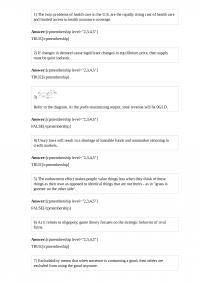
ECB 598 Quiz 1
1) The twin problems of health care in the U.S. are the rapidly rising cost of health care and limited access to health insurance coverage. 2) If changes in demand cause significant changes in equilibrium price, then supply must be […]
ECON 525 Midterm
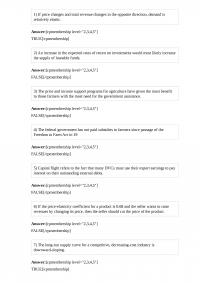
1) If price changes and total revenue changes in the opposite direction, demand is relatively elastic. 2) An increase in the expected rates of return on investments would most likely increase the supply of loanable funds. Answer: FALSE 3) The […]
ECB 622 Quiz 2
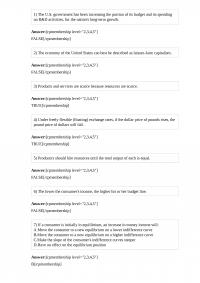
1) The U.S. government has been increasing the portion of its budget and its spending on R&D activities, for the nation’s long-term growth. 2) The economy of the United States can best be described as laissez-faire capitalism. Answer: FALSE 3) […]
ECON A 513
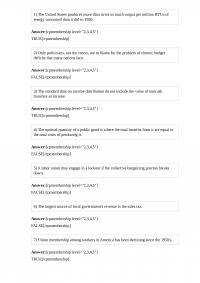
1) The United States produces more than twice as much output per million BTUs of energy consumed than it did in 1950. 2) Only politicians, not the voters, are to blame for the problem of chronic budget deficits that many […]
ECON A 422 Midterm 2
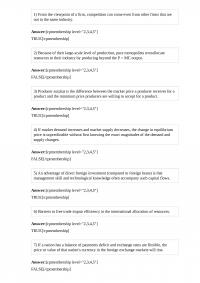
1) From the viewpoint of a firm, competition can come even from other firms that are not in the same industry. 2) Because of their large-scale level of production, pure monopolists overallocate resources to their industry by producing beyond the […]
ECON A 175
1) Some employers have reacted to rising health care costs by hiring more part-time and temporary workers. 2) Income elasticity measures the effect of a change in income on the purchases of some good or service. Answer: TRUE 3) If […]
ECON E 534 Test 1
1) An economy will always operate at some point on its production possibilities curve. 2) The probable incidence of the tax on business property is on consumers. Answer: TRUE 3) A major factor explaining economies of scale is increased specialization […]
ECB 588 Quiz
1) In the extraction of a nonrenewable resource, increased current extraction will reduce the extraction firm’s user costs. 2) The price elasticity of demand for most agricultural products is relatively low. Answer: TRUE 3) In the demand-enhancing union model, a […]
Economics 542
1) Technological advances have occurred throughout the history of agriculture, resulting in higher productivity but lower incomes to farmers. 2) Among the principal exports of the United States are agricultural products. Answer: TRUE 3) Monopolistically competitive sellers produce efficiently because […]
BUS 890 Quiz 1
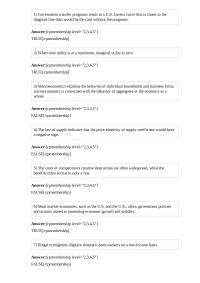
1) Government transfer programs result in a U.S. Lorenz curve that is closer to the diagonal line than would be the case without the programs. 2) When total utility is at a maximum, marginal utility is zero. Answer: TRUE 3) […]
MicroEconomic 295
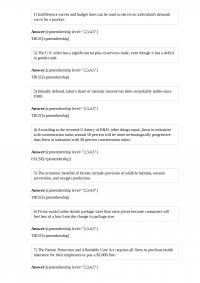
1) Indifference curves and budget lines can be used to derive an individual’s demand curve for a product. 2) The U.S. often has a significant surplus in services trade, even though it has a deficit in goods trade. Answer: TRUE […]
ECON A 288 Test 2
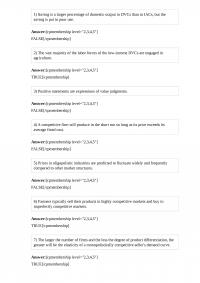
1) Saving is a larger percentage of domestic output in DVCs than in IACs, but the saving is put to poor use. 2) The vast majority of the labor forces of the low-income DVCs are engaged in agriculture. Answer: TRUE […]
BUS 655 Midterm 2
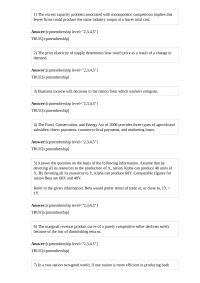
1) The excess capacity problem associated with monopolistic competition implies that fewer firms could produce the same industry output at a lower total cost. 2) The price elasticity of supply determines how much price as a result of a change […]
ECON 447 Quiz
1) The fundamental economic question regarding the distribution of output in the economy is equivalent to the question of who will produce the output. 2) The dictator and ultimatum games reveal that fairness and concern for others motivate people’s behavior. […]
ECON 655
1) Economists widely support deregulation of industries that tend toward monopoly or generate substantial negative externalities. 2) The simple immigration model suggests that labor migration raises the wage rate in the country of origin while reducing the wage rate in […]
MicroEconomic 141 Final
1) If the demand for agricultural products is inelastic, a relatively small increase in supply will cause farm prices and incomes to decline. 2) Because economic generalizations are simplifications from reality, they are impractical and useless. Answer: FALSE 3) When […]
ECON A 502 Midterm 2
1) The marginal cost to a firm of R&D expenditures is the market interest rate the firm must pay to obtain the needed financing. 2) Present value allows us to weigh the benefits and costs of using resources today or […]
ECB 713 Quiz
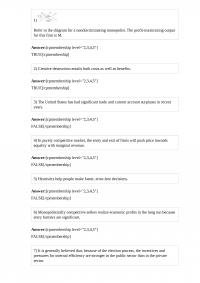
1) Refer to the diagram for a nondiscriminating monopolist. The profit-maximizing output for this firm is M. 2) Creative destruction entails both costs as well as benefits. Answer: TRUE 3) The United States has had significant trade and current account […]
Economics 474
1) When new firms enter a purely competitive industry, the market supply curve will shift to the left. 2) Land reform (or the reform of land ownership) is a relatively minor institutional obstacle to economic growth in many developing countries. […]
ECB 448
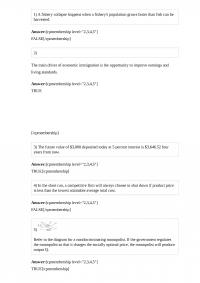
1) A fishery collapse happens when a fishery’s population grows faster than fish can be harvested. 2) The main driver of economic immigration is the opportunity to improve earnings and living standards. Answer: TRUE 3) The future value of $3,000 […]
MicroEconomic 659 Test 1
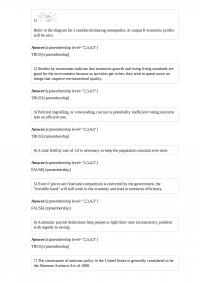
1) Refer to the diagram for a nondiscriminating monopolist. At output R economic profits will be zero. 2) Studies by economists indicate that economic growth and rising living standards are good for the environment because as societies get richer, they […]
MicroEconomic 381 1 The US Census
1) The U.S. Census Bureau estimates that more than one million illegal immigrants enter the United States each year. 2) In order to achieve economic efficiency in market economies like the U.S., the government must be stripped of its power […]
BUS 373
1) Some low-income workers are not covered by Medicaid because of the income that they are earning from their jobs. 2) In 2011, China overtook Mexico to become the number one country of origin of U.S. legal immigrants. Answer: FALSE […]
ECB 786 Quiz 2
1) Precommitments must impose costs on people to be effective. 2) The World Trade Organization (WTO) is an international organization designed to provide short-term advances of foreign monies to those nations faced with trade deficits. Answer: FALSE 3) The Food, […]
ECON A 612 1 If the demand for wheat
1) If the demand for wheat is highly price inelastic, an extraordinarily large crop may reduce farm incomes. 2) The problems of central planning become less complex as an economy grows in size over time. Answer: FALSE 3) Hiring the […]
ECON E 744 Quiz
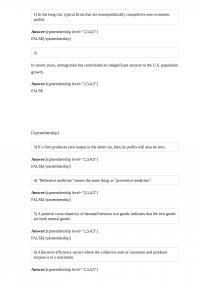
1) In the long run, typical firms that are monopolistically competitive earn economic profits. 2) In recent years, immigration has contributed an insignificant amount to the U.S. population growth. Answer: FALSE 3) If a firm produces zero output in the […]
Economics 542 1 If a public good
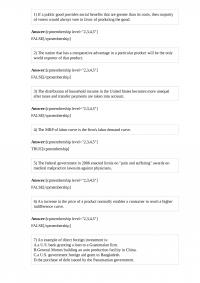
1) If a public good provides social benefits that are greater than its costs, then majority of voters would always vote in favor of producing the good. 2) The nation that has a comparative advantage in a particular product will […]
Economics 442 Midterm 1
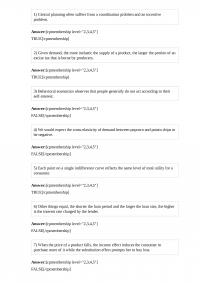
1) Central planning often suffers from a coordination problem and an incentive problem. 2) Given demand, the more inelastic the supply of a product, the larger the portion of an excise tax that is borne by producers. Answer: TRUE 3) […]
ECB 703 Midterm 2
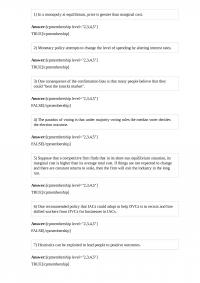
1) In a monopoly at equilibrium, price is greater than marginal cost. 2) Monetary policy attempts to change the level of spending by altering interest rates. Answer: TRUE 3) One consequence of the confirmation bias is that many people believe […]
MicroEconomic 293
1) Consumers will buy a new product instead of an old one that they are used to buying, if the MU of the new product is larger than the MU of the old product. 2) A firm should reduce its […]
ECB 660
1) Price and marginal revenue are identical for an individual purely competitive seller. 2) In a well-functioning “cap-and-trade system” for pollution rights, society benefits because pollution will be brought down to insignificant levels. Answer: FALSE 3) There is no evidence […]
BUS 336 Midterm 2
1) Unlike most demand curves, the demand curve for loanable funds is upsloping. 2) Patents and copyrights were established by the government to reduce oligopoly and monopoly power. Answer: FALSE 3) The Social Security program is financed with funds from […]
ECON 652 Test
1) Maximum profits are what motivate consumers to decide who will get the goods and services in a market system. 2) The era after the Industrial Revolution proved that it was impossible to have improved standards of living with large […]
Economics 391 Midterm 2
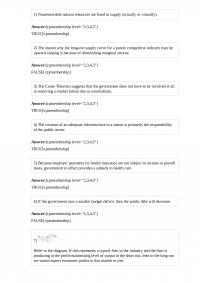
1) Nonrenewable natural resources are fixed in supply (actually or virtually). 2) The reason why the long-run supply curve for a purely competitive industry may be upward-sloping is because of diminishing marginal returns. Answer: FALSE 3) The Coase Theorem suggests […]
ECON E 501 Homework
1) Elephants are moving closer to extinction in places where they are treated as private property. 2) An economy cannot produce at a point outside of its production possibilities curve because human economic wants are insatiable. Answer: FALSE 3) Normal […]
MicroEconomic 456
1) The interest-rate cost-of-funds curve is perfectly elastic because firms can borrow as much or as little as they want at market interest rates. 2) Mutually-cancelling advertising by oligopolistic firms tend to improve economic efficiency in the industry. Answer: FALSE […]
BUS 820 Quiz
1) Total allowable catch policies promote economic efficiency better than individual transferable quotas. 2) Self-control problems, say among people on a diet, is caused by the cognitive bias known as time inconsistency. Answer: TRUE 3) Government guarantees that socialize losses […]
BUS 327 Test 1
1) Environmentalists generally support price supports because these subsidies motivate additional farm production. 2) It is impossible for a nation to have a comparative advantage in producing everything. Answer: TRUE 3) A government tax per unit of output reduces supply. […]
ECON A 314 1 When a competitive
1) When a competitive firm is in long-run equilibrium, its accounting profits are greater than zero. 2) Answer the question on the basis of the following information. Assume that by devoting all its resources to the production of X, nation […]
ECON A 655 Quiz 2
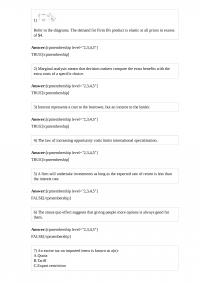
1) Refer to the diagrams. The demand for Firm B’s product is elastic at all prices in excess of $4. 2) Marginal analysis means that decision makers compare the extra benefits with the extra costs of a specific choice. Answer: […]
ECON E 866
1) Whenever a foreign producer is selling a product like steel at a lower price than domestic producers, then dumping is being practiced and must be corrected. 2) Given supply, the more inelastic the demand for a product, the larger […]
Economics 438 Final
1) Fiscal policy is more susceptible to politicization than monetary policy. 2) If the minimum efficient scale in an industry is smaller than the size of the market of that industry, then we would have a natural-monopoly situation. Answer: FALSE[/cpmembership] […]
BUS 570 Quiz 2
1) Regulatory capture in government often happens because the people who are most qualified to supervise and regulate an industry oftentimes are or have been the leaders of the industry. 2) The demand curve for loanable funds illustrates the behavior […]
ECB 498 Quiz 3
1) Minimum wage laws have contributed to higher unemployment levels among teenagers and minorities. 2) Unintended consequences can result from the government’s desire to enforce laws uniformly. Answer: TRUE 3) Refer to the diagrams. Both firms are selling their products […]
ECON A 296 Midterm 2
1) The low-energy mental shortcuts or heuristics that the human brain commonly employs is one major reason for the systematic errors in decision-making that people make which is the focus of behavioral economics. 2) Noncash gift-giving involves value loss when […]
ECON E 634 Test 2
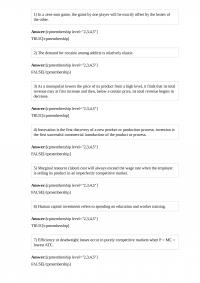
1) In a zero-sum game, the gains by one player will be exactly offset by the losses of the other. 2) The demand for cocaine among addicts is relatively elastic. Answer: FALSE 3) As a monopolist lowers the price of […]
MicroEconomic 120
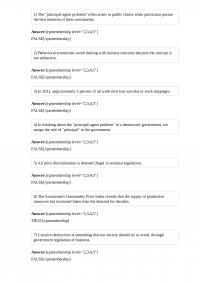
1) The “principal-agent problem” often arises in public choice when politicians pursue the best interests of their constituents. 2) Behavioral economists avoid dealing with fairness concerns because the concept is too subjective. Answer: FALSE 3) In 2011, approximately 5 percent […]