Archives: Quiz
ECON A 638 Midterm
1) Price support programs for agricultural products tend to cause shortages of these products. 2) Restricting the supply of labor is a means of increasing wage rates more commonly used by industrial unions than craft unions. Answer: FALSE 3) The […]
ECON E 780 Quiz 2
1) If the price in a competitive market falls and goes below the equilibrium price, then consumer surplus might increase, but producer surplus will definitely decrease. 2) Because of the ability to influence price, a pure monopolist can increase price […]
ECON E 765 Test 2
1) Export subsidies tend to hurt domestic consumers and benefit the foreign consumers. 2) Answer the question on the basis of the following information. Assume that by devoting all its resources to the production of X, nation Alpha can produce […]
BUS 787
1) Insurance co-pays and deductibles are methods used by insurance companies to reduce moral hazard. 2) Reducing the payment of rent to land-owners will decrease the quantity of land supplied. Answer: FALSE 3) If MRP of labor < wage rate, […]
ECON 494 Quiz
1) In the dollar/yen market, if the supply of yen increases other things being equal, the dollar will appreciate. 2) If a purely competitive firm is producing a level of output greater than its profit-maximizing output, then its profits must […]
Economics 898 Midterm 2
1) Managed-care organizations attempt to control their enrolled members’ use of health care as a way of containing costs. 2) Granting property rights to forest land tends to increase the rate at which the land is deforested. Answer: FALSE 3) […]
MicroEconomic 697 Quiz
1) Economic profits are usually larger than accounting profits. 2) The interest-rate cost-of-funds curve is perfectly elastic because expected rates of return on R&D are constant. Answer: FALSE 3) There is a consensus among economists that the amount of resources […]
ECON 401 Test
1) To maximize profits, a competitive firm will maximize the difference between MRP and the wage rate for the laborers it hires. 2) In the U.S., the taxes mostly come from the rich and government spending mostly goes to programs […]
Economics 446 Quiz 1
1) Shirking refers to the behavior of workers who provide less-than-expected effort on the job. 2) Economic models of illegal immigration suggest that domestic-born workers avoid certain types of work more because the inflow of immigrants has reduced wages, rather […]
ECON A 367 Test
1) The parity concept of agricultural policy suggests that farmers should obtain a constant ratio of the prices they receive for their farm products and the prices they pay for goods and services in general. 2) Industrial unions are more […]
ECON 380 Homework
1) About two-thirds of U.S. electricity is generated at coal and gas plants. 2) A purely competitive firm that is earning positive profits in its short-run equilibrium situation will continue to earn positive profits at the long-run equilibrium. Answer: FALSE […]
MicroEconomic 543 Midterm 1
1) The legal cartel theory indicates that, in any industry where market demand and the long-run average total cost curve intersect close to the latter’s minimum, government regulation is mandatory and desirable. 2) One basic argument for redistributing income to […]
MicroEconomic 112
1) It is possible for a competitive firm that is maximizing profits in the short run to make its profits even bigger in the long run by expanding its plant. 2) Labor’s share of income earned by Americans is smaller […]
ECON E 662
1) If the demand for a product produced by an input decreases, the demand for the input will also decrease. 2) The basic function of profits and losses is to allocate society’s scarce resources to their highest valued uses. Answer: […]
ECB 266 Quiz 1
1) OPEC functions as a classic example of a kinked demand curve oligopoly. 2) Rivalry means that when one person buys and consumes a product, it is not available for purchase and consumption by another person. Answer: TRUE 3) The […]
ECB 198
1) The income effect explains an exception to the law of demand. 2) The fee-for-service arrangement for paying doctors is one way to reduce health care costs. Answer: FALSE 3) The world price for a traded product will be between […]
MicroEconomic 780 1 quotInformal
1) “Informal payments” or “under-the table fees” are a common form of corruption. 2) Changes in tax rates are a form of monetary policy. Answer: FALSE 3) If the lumber companies are required to internalize the negative externalities of deforestation, […]
ECON 892
1) An increase in the mobility of labor across nations tends to decrease the world’s output of goods and services. 2) If the real outputs per capita of a rich nation and a poor nation grow at the same percentage […]
MicroEconomic 596
1) In a purely competitive labor market, a profit-maximizing firm will hire labor up to the point where the marginal resource cost equals the wage rate. 2) Tying agreements are contracts by which retailers agree to charge the prices that […]
BUS 659 Homework
1) China is very close to catching up with the United States in its standard of living as measured by per capita income. 2) If all nations prohibited the international migration of labor, we would expect world output to decline. […]
ECON E 473 Quiz
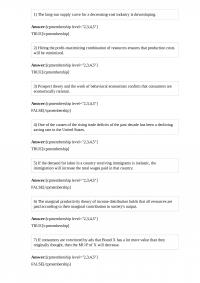
1) The long-run supply curve for a decreasing-cost industry is downsloping. 2) Hiring the profit-maximizing combination of resources ensures that production costs will be minimized. Answer: TRUE 3) Prospect theory and the work of behavioral economists confirm that consumers are […]
MicroEconomic 786
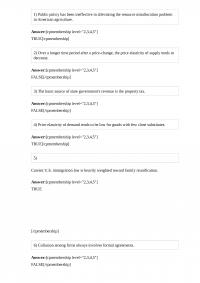
1) Public policy has been ineffective in alleviating the resource misallocation problem in American agriculture. 2) Over a longer time period after a price-change, the price elasticity of supply tends to decrease. Answer: FALSE 3) The basic source of state […]
Economics 800 Final
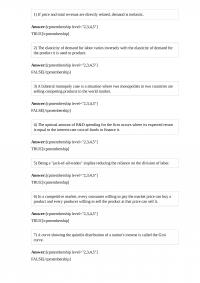
1) If price and total revenue are directly related, demand is inelastic. 2) The elasticity of demand for labor varies inversely with the elasticity of demand for the product it is used to produce. Answer: FALSE 3) A bilateral monopoly […]
ECON A 792
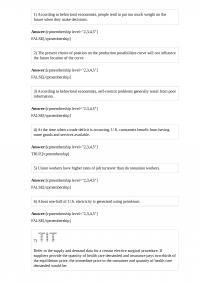
1) According to behavioral economists, people tend to put too much weight on the future when they make decisions. 2) The present choice of position on the production possibilities curve will not influence the future location of the curve. Answer: […]
BUS 426 Midterm
1) A patent for a new product or a new business process is typically granted for a hundred years. 2) A total fertility rate of approximately 1.0 will cause each generation to be half as large as the preceding generation. […]
Economics 886
1) Property rights give to some people the right to coerce others into giving up their property. 2) The Celler-Kefauver Act outlawed interlocking directorates. Answer: FALSE 3) One of the world’s greatest economic challenges over the coming decades will be […]
ECON A 478 Homework
1) The largest source of tax revenue for state governments is the property tax. 2) A decrease in supply of X increases the equilibrium price of X, which reduces the demand for X and automatically returns the price of X […]
ECB 336 Quiz 2
1) The building of a new factory by a corporation would be an example of increasing the infrastructure in a developing nation. 2) Reduction of tariff barriers against DVC imports would benefit both the DVCs and the IACs. Answer: TRUE […]
ECON 694
1) Normal profit is considered an economic cost. 2) The fundamental reason that newspapers have such high prices is the high production costs from diseconomies of scale. Answer: FALSE 3) One implication of the median-voter model as applied to a […]
Economics 637 Test 1
1) That government that has the smallest budget is the most efficient in the economic sense. 2) U.S. immigrants (legal and illegal combined) have lower prison rates than the native-born population. Answer: TRUE 3) When the government is doing “deficit […]
MicroEconomic 414 Midterm
1) If the quantity of X is measured on the horizontal axis and the quantity of Y on the vertical, then the slope of the budget line is equal to the price of X divided by the price of Y. […]
ECON 368 Midterm 1
1) After the implementation of TANF, the U.S. welfare rolls fell by more than one-half between 1996 and 2007. 2) If neither player has an incentive to deviate from the outcome of a game, the outcome is a Nash equilibrium. […]
MicroEconomic 349 Midterm 1
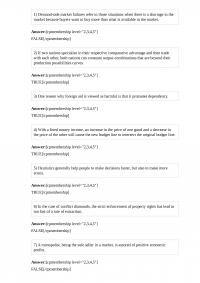
1) Demand-side market failures refer to those situations when there is a shortage in the market because buyers want to buy more than what is available in the market. 2) If two nations specialize in their respective comparative advantage and […]
ECON E 342 Homework
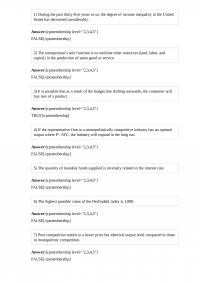
1) During the past thirty-five years or so, the degree of income inequality in the United States has decreased considerably. 2) The entrepreneur’s sole function is to combine other resources (land, labor, and capital) in the production of some good […]
Economics 149 Test 1
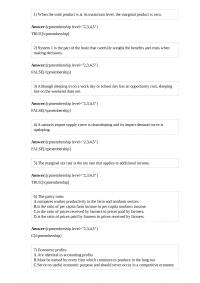
1) When the total product is at its maximum level, the marginal product is zero. 2) System 1 is the part of the brain that carefully weighs the benefits and costs when making decisions. Answer: FALSE 3) Although sleeping in […]
ECON E 710 Quiz 3
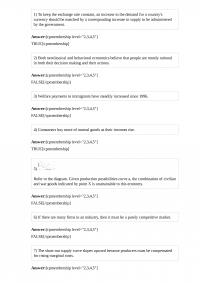
1) To keep the exchange rate constant, an increase in the demand for a country’s currency should be matched by a corresponding increase in supply to be administered by the government. 2) Both neoclassical and behavioral economics believe that people […]
ECON E 358 1 The exchange rate
1) The exchange rate system that we now have for major currencies like the U.S. dollar, yen, and euro is a “managed-floating” system. 2) The short-run supply curve of a purely competitive industry tends to be steeper than the long-run […]
MicroEconomic 802 Test
1) A decrease in the supply of loanable funds would tend to lower the interest rate. 2) Trade adjustment assistance provides subsidies to companies that have lost business to foreign firms. Answer: FALSE 3) The government’s ability to coerce people […]
ECON A 460 Midterm 1
1) Normative statements are expressions of facts. 2) An increase in the supply of farm products relative to the demand for them tends to cause farm incomes to decline. Answer: TRUE 3) The Temporary Assistance for Needy Families (TANF) that […]
BUS 694 Quiz 3
1) Generally speaking, the smaller the percentage of one’s total budget devoted to a particular product, the more price elastic will be the demand for that product. 2) The presence of an agency shop requires all workers to join the […]
MicroEconomic 122 Quiz
1) If the consumer is willing to pay a price higher than the actual price of a product, then the consumer will not buy the product because the consumer surplus will be negative. 2) In the extraction of a nonrenewable […]
BUS 224 Midterm 1
1) The optimal level of immigration occurs where marginal benefit is at its greatest. 2) The substitution effect of a price-decrease for a good causes an increase in the consumption of the good, regardless of whether the good is normal […]
BUS 888 – Profits are the primary success indicator for firms in a centrally planned economy
1) Profits are the primary ‘success indicator” for firms in a centrally planned economy. 2) In the U.S., the progressive income-tax system substantial redistributes income. Answer: FALSE 3) Even if a majority of the population wants a law and the […]
Economics 641 Quiz 2
1) As a percentage of GDP, U.S. health care spending is higher than that of any other major industrial country. 2) The smaller the number of good substitutes for a product, the greater will be the price elasticity of demand […]
MicroEconomic 855
1) The demand for computers is derived from the demand for the capital resources that are used to produce computers. 2) Process innovation raises the firm’s total product curve and lowers its average total cost curve. Answer: TRUE 3) The […]
ECON A 261 Midterm 2
1) When critics of unemployment insurance claim that some of the unemployed are not exerting much effort to find jobs because of the unemployment benefits, they are referring to the moral hazard problem. 2) If the nominal rate of interest […]
MicroEconomic 542 Final
1) Sales taxes on consumer goods are regressive because poor people consume a larger proportion of their incomes than do rich people. 2) Refer to the diagram. If demand fell to the level of FNJ, there would be no output […]
Economics 635
1) The moral hazard problem is the tendency of some parties to a contract to alter their behavior as a result of the contract in ways that are costly to the other party. 2) The “hedonic treadmill” of prospect theory […]
Economics 890
1) In drawing a particular budget line, money income and the prices of the two products are fixed. 2) The marginal productivity theory of resource demand suggests that those resources whose productivity levels are high will end up getting a […]
BUS 678 Quiz 2
1) “Price maker” means that a monopoly can decide whatever price it wants to, in order to sell a specific given quantity of its product. 2) In general for an excise tax on a product, given supply, the more elastic […]