Archives: Quiz
ECB 52250
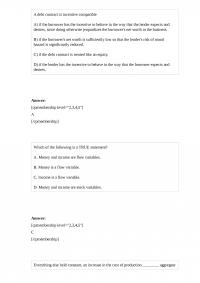
A debt contract is incentive compatible A) if the borrower has the incentive to behave in the way that the lender expects and desires, since doing otherwise jeopardizes the borrower’s net worth in the business. B) if the borrower’s net […]
Economics 87818
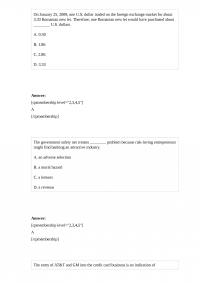
On January 25, 2009, one U.S. dollar traded on the foreign exchange market for about 3.33 Romanian new lei. Therefore, one Romanian new lei would have purchased about ________ U.S. dollars. A. 0.30 B. 1.86 C. 2.86 D. 3.33 Answer: […]
ECB 22874
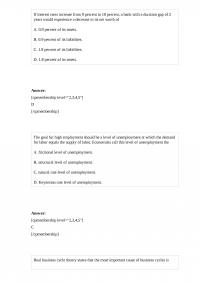
If interest rates increase from 9 percent to 10 percent, a bank with a duration gap of 2 years would experience a decrease in its net worth of A. 0.9 percent of its assets. B. 0.9 percent of its liabilities. […]
ECB 43363
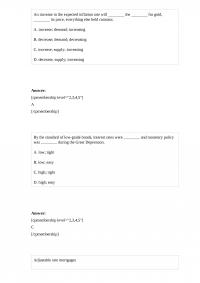
An increase in the expected inflation rate will ________ the ________ for gold, ________ its price, everything else held constant. A. increase; demand; increasing B. decrease; demand; decreasing C. increase; supply; increasing D. decrease; supply; increasing Answer: By the standard […]
MicroEconomic 49730
The economist who proposed that, “Inflation is always and everywhere a monetary phenomenon” was A. John Maynard Keynes. B. John R. Hicks. C. Milton Friedman. D. Franco Modigliani. Answer: In May 1991, the FDIC announced that it would sell the […]
Economics 44185
Although the Fed professed employment of ________ targeting during the 1970s, its behavior suggests that it emphasized ________ targeting. A. free-reserve; interest-rate B. interest-rate; monetary aggregate C. monetary aggregate; interest-rate D. free reserve; monetary aggregate Answer: A disadvantage of ________made […]
ECON E 98112
The long-run neutrality of money refers to the fact that in the long run, monetary policy A. changes only real output. B. changes only the real interest rate. C. changes both real output and the real interest rate. D. has […]
Economics 11301
Which of the following is most likely to result from a stronger dollar? A. U.S. goods exported aboard will cost less in foreign countries, and so foreigners will buy more of them. B. U.S. goods exported aboard will cost more […]
ECON A 65955
According to the liquidity premium theory of the term structure, a steeply upward sloping yield curve indicates that short-term interest rates are expected to A. rise in the future. B. remain unchanged in the future. C. decline moderately in the […]
ECB 17079
Which of the following is NOT included in the measure of M1? A. NOW accounts B. demand deposits C. currency D. savings deposits Answer: An appreciation of the U.S. dollar makes foreign goods cheaper relative to American goods, resulting in […]
ECON 20512
Funds held in ________ are subject to reserve requirements. A. all checkable deposits B. all checkable and time deposits C. all checkable, time, and money market fund deposits D. all time deposits Answer: Experts predict that the future structure of […]
Economics 92008
Under the current managed float exchange rate regime; countries with surpluses in their balance of payments frequently do not want to see their currencies appreciate because it makes their goods ________ expensive abroad and foreign goods ________ in their countries. […]
BUS 65696
When output is below potential and the policy rate has hit the floor of zero, the resulting fall in inflation leads to ________ real interest rates, which ________ output further, which causes inflation to fall further. A. lower; increase B. […]
Economics 60810
If net exports decrease by 250 and the mpc is 0.75, equilibrium aggregate output A. increases by 1000. B. increases by 750. C. decreases by 750. D. decreases by 1000. Answer: The nominal interest rate minus the expected rate of […]
BUS 36413
Everything else held constant, if a central bank makes an unsterilized purchase of foreign assets, then the domestic money supply will ________ and the domestic currency will ________. A) increase; appreciate B) increase; depreciate C) decrease; appreciate D) decrease; depreciate […]
ECB 28866
Using Taylor’s rule, when the equilibrium real federal funds rate is 2 percent, there is no output gap, the actual inflation rate is zero, and the target inflation rate is 2 percent, the nominal federal funds rate should be A. […]
ECON E 33428
A temporary supply shock that raises prices will cause the real interest rate to A. rise in both the short and long runs. B. rise in the short run but not in the long run. C. fall in both the […]
ECON E 44118
A problem for equity contracts is a particular type of ________ called the ________ problem. A) adverse selection; principal-agent B) moral hazard; principal-agent C) adverse selection; free-rider D) moral hazard; free-rider Answer: If the interest rate is 7 percent on […]
ECB 49000
The increase in the currency ratio during World War II was due to a. bank panics. b. a drop in the rate of interest paid on checking deposits. c. the spread of ATMs. d. high taxes and illegal activities. Answer: […]
Economics 87616
If you sell a $100,000 interest-rate futures contract for 110, and the price of the Treasury securities on the expiration date is 106, your ________ is ________. A. profit; $4000 B. loss; $4000 C. profit; $6000 D. loss; $6000 Answer: […]
ECON A 37927
The decision by inflation targeters to choose inflation targets ________ zero reflects the concern of monetary policymakers that particularly ________ inflation can have substantial negative effects on real economic activity. A. below; high B. below; low C. above; high D. […]
Economics 70826
The chartering process is especially designed to deal with the ________ problem, and regular bank examinations help to reduce the ________ problem. A. adverse selection; adverse selection B. adverse selection; moral hazard C. moral hazard; adverse selection D. moral hazard; […]
ECB 64632
The relationship between borrowed reserves (BR), the nonborrowed monetary base (MBn), and the monetary base (MB) is A. MB = MBn – BR. B. BR = MBn – MB. C. BR = MB – MBn. D. MB = BR – […]
BUS 97150
If during the past decade the average rate of monetary growth has been 5% and the average inflation rate has been 5%, everything else held constant, when the Federal Reserve announces that the new rate of monetary growth will be […]
ECON E 78325
His analysis started with the recognition that the total quantity demanded of an economy’s output was the sum of four types of spending: consumer expenditure, planned investment spending, government spending, and net exports. A. John Maynard Keynes B. Sir John […]
ECON E 83654
Reasons for holding Eurodollars include A) the fact that Eurodollar deposits are insured by the FDIC. B) the fact that dollars are widely used to conduct international transactions. C) the fact that minimum transaction sizes are very low, making Eurodollars […]
ECON E 55829
Mutual funds in which a fixed number of nonredeemable shares are sold at an initial offering and are then traded in the over-the-counter market, like shares of common stock, are called A. open-end funds. B. close-end funds. C. OTC funds. […]
ECB 68062
An increase in the monetary base that goes into currency is ________, while an increase that goes into deposits is ________. a. multiplied; multiplied b. not multiplied; multiplied c. multiplied; not multiplied d. not multiplied; not multiplied Answer: A debit […]
MicroEconomic 50251
In the simple deposit expansion model, a decline in checkable deposits of $500 when the required reserve ratio is equal to 10 percent implies that the Fed A. sold $500 in government bonds. B. sold $50 in government bonds. C. […]
MicroEconomic 46359
What is the return on a 5 percent coupon bond that initially sells for $1,000 and sells for $1,200 next year? A. 5 percent B. 10 percent C. -5 percent D. 25 percent Answer: The Federal Reserve System was created […]
MicroEconomic 67678
________ imposes a conceptual structure and inherent discipline on policy makers, but without eliminating all flexibility. A. Constrained discretion B. A policy rule C. A discretionary policy D. The Taylor rule Answer: The problem created by asymmetric information before the […]
ECB 25727
In the market for reserves, when the federal funds interest rate is below the discount rate, the supply curve of reserves is A. vertical. B. horizontal. C. positively sloped. D. negatively sloped. Answer: Some automobile owners will drive faster knowing […]
ECON 76211
For the classical economists, the quantity theory of money provided an explanation of movements in the price level. Changes in the price level result A. from proportional changes in the quantity of money. B. primarily from changes in the quantity […]
ECON E 58466
The Fed’s use of the federal funds rate as an operating target in the 1970s resulted in A. countercyclical monetary policy. B. too slow growth in M1 throughout the decade. C. procyclical monetary policy. D. too rapid growth in M1 […]
ECON A 24670
An autonomous depreciation of the U.S. dollar makes American goods ________ relative to foreign goods and results in a ________ in U.S. net exports, everything else held constant. A. cheaper; decline B. cheaper; rise C. more expensive; decline D. more […]
ECB 74388
Everything else held constant, an increase in the excess reserve ratio will mean ________ in the M2 money multiplier and ________ in the M2 money supply. a. an increase; an increase b. an increase; a decrease c. a decrease; an […]
MicroEconomic 50854
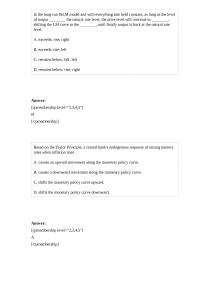
In the long-run ISLM model and with everything else held constant, as long as the level of output ________ the natural rate level, the price level will continue to ________, shifting the LM curve to the ________, until finally output […]
ECON 62842
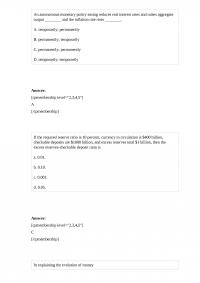
An autonomous monetary policy easing reduces real interest rates and raises aggregate output ________ and the inflation rate rises ________. A. temporarily; permanently B. permanently; temporarily C. permanently; permanently D. temporarily; temporarily Answer: If the required reserve ratio is 10 […]
Economics 99210
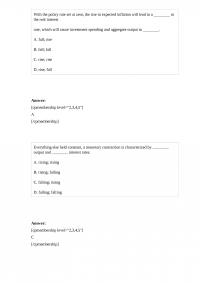
With the policy rate set at zero, the rise in expected inflation will lead to a ________ in the real interest rate, which will cause investment spending and aggregate output to ________. A. fall; rise B. fall; fall C. rise; […]
MicroEconomic 97076
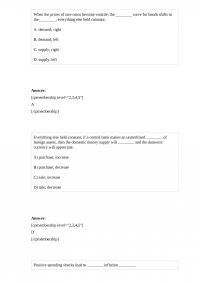
When the prices of rare coins become volatile, the ________ curve for bonds shifts to the ________, everything else held constant. A. demand; right B. demand; left C. supply; right D. supply; left Answer: Everything else held constant, if a […]
ECB 24617
Parties who have sold a futures contract and thereby agreed to ________ (deliver) the bonds are said to have taken a ________ position. A. sell; short B. buy; short C. sell; long D. buy; long Answer: Loss aversion can explain […]
ECB 49561
In the basic closed-economy ISLM model, the LM curve can be described by an equation where A. output is a function of consumption. B. money is a function of interest rates. C. output is a function of money. D. interest […]
ECB 53390
The Fed accidentally discovered open market operations when A. it came to the rescue of failing banks in the early 1930s, and found that its purchases of bank loans injected reserves into the banking system. B. it purchased securities for […]
BUS 77738
Moral hazard and adverse selection problems increased in prominence in the 1980s A. as deregulation required savings and loans and mutual savings banks to be more cautious. B. following a burst of financial innovation in the 1970s and early 1980s […]
ECON A 75170
All else the same, if a bank’s liabilities are more sensitive to interest rate fluctuations than are its assets, then ________ in interest rates will ________ bank profits. A. an increase; increase B. an increase; reduce C. a decline; reduce […]
ECB 38146
The Second Bank of the United States A) was disbanded in 1811 when its charter was not renewed. B) had its charter renewal vetoed in 1832. C) is considered to be the primary cause of the bank panic of 1907. […]
ECON 82284
If a central bank does not want to allow the domestic currency to appreciate, it will ________ international reserves by selling its currency, thereby ________ the monetary base and increasing the risk of higher inflation. A) lose; decreasing B) lose; […]
ECON E 63603
Using the one-period valuation model, assuming a year-end dividend of $0.11, an expected sales price of $110, and a required rate of return of 10%, the current price of the stock would be A. $110.11. B. $121.12. C. $100.10. D. […]
ECON E 45505
Everything else held constant, a decrease in the required reserve ratio on checkable deposits will mean a. a decrease in the money supply. b. an increase in the money supply. c. a decrease in checkable deposits. d. an increase in […]
Economics 53147
The Baumol-Tobin analysis suggests that A. velocity is relatively constant. B. the transactions component of the demand for money is negatively related to the level of interest rates. C. the speculative motive is nonexistent. D. velocity is unrelated to the […]