
With the policy rate set at zero, the rise in expected inflation will lead to a ________ in
the real interest
rate, which will cause investment spending and aggregate output to ________.
A. fall; rise
B. fall; fall
C. rise; rise
D. rise; fall
Answer:
Everything else held constant, a monetary contraction is characterized by ________
output and ________ interest rates.
A. rising; rising
B. rising; falling
C. falling; rising
D. falling; falling
Answer:
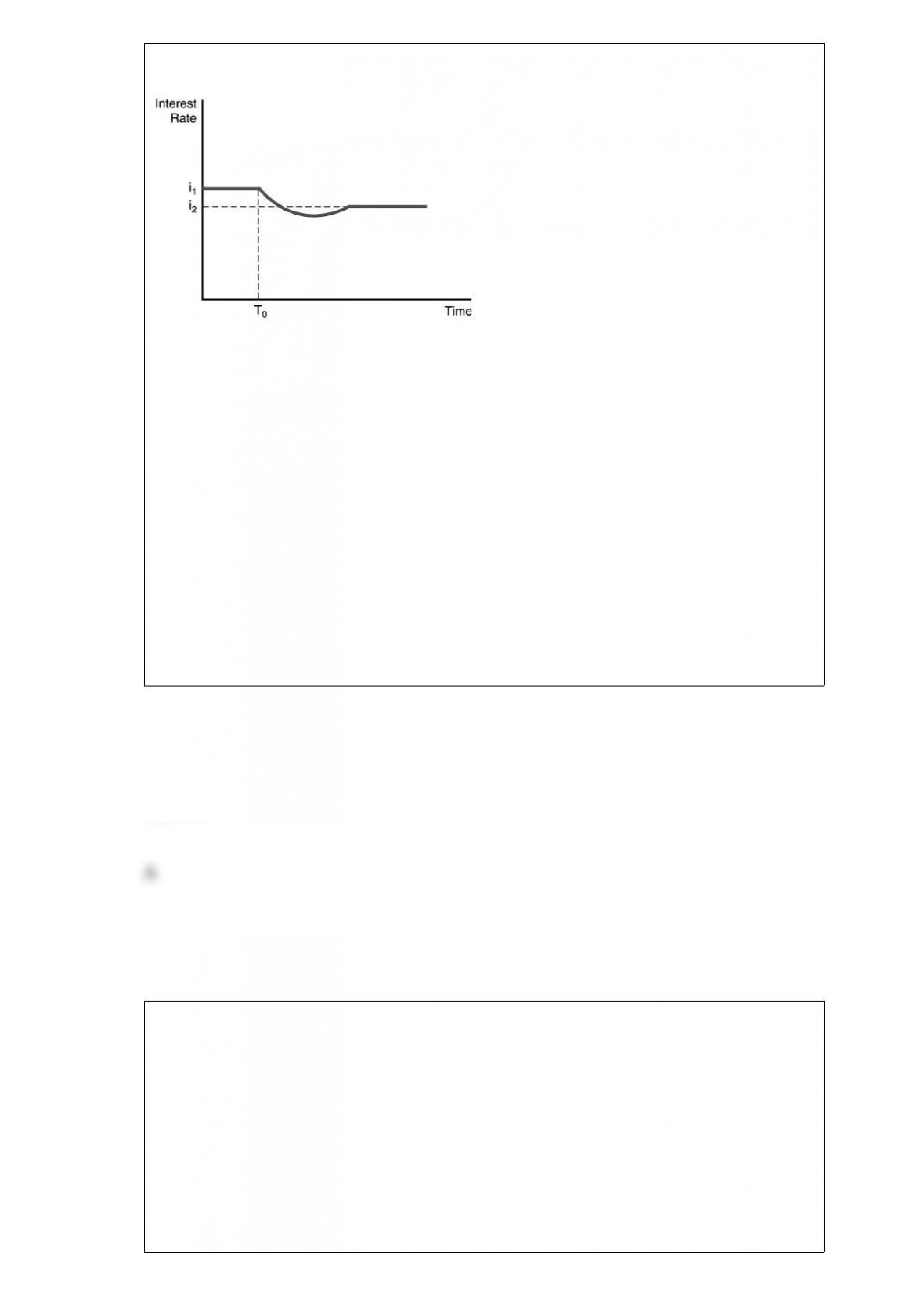
The figure above illustrates the effect of an increased rate of money supply growth at
time period T0. From the figure, one can conclude that the
A. Fisher effect is dominated by the liquidity effect and interest rates adjust slowly to
changes in expected inflation.
B. liquidity effect is dominated by the Fisher effect and interest rates adjust slowly to
changes in expected inflation.
C. liquidity effect is dominated by the Fisher effect and interest rates adjust quickly to
changes in expected inflation.
D. Fisher effect is smaller than the expected inflation effect and interest rates adjust
quickly to changes in expected inflation.
Answer:
________ occurs when market participants observe returns on a security that are larger
than what is justified by the characteristics of that security and take action to quickly
eliminate the unexploited profit opportunity.
A. Arbitrage
B. Mediation
C. Asset capitalization

D. Market intercession
Answer:
Under exchange-rate targeting, the central bank in the targeting country ________ lose
the ability to pursue its own independent monetary policy and any shocks to the anchor
country is ________ transmitted to the targeting country.
A) does; directly
B) does not; directly
C) does; not directly
D) does not; not directly
Answer:
If the probability of a bond default increases because corporations begin to suffer large
losses, then the default risk on corporate bonds will ________ and the expected return
on these bonds will ________, everything else held constant.
A. decrease; increase
B. decrease; decrease
C. increase; increase

D. increase; decrease
Answer:
________ in the domestic interest rate causes the demand for domestic assets to shift to
the right and the domestic currency to ________, everything else held constant.
A. An increase; appreciate
B. An increase; depreciate
C. A decrease; appreciate
D. A decrease; depreciate
Answer:
Which of the following do NOT provide charters?
A. the Office of the Comptroller of the Currency
B. the Federal Reserve System
C. the National Credit Union Administration
D. state banking and insurance commissions

Answer:
When banks calculate the losses the institution would incur if an unusual combination
of bad events happened, the bank is using the ________ approach.
A. stress-test
B. value-at-risk
C. trading-loss
D. maximum value
Answer:
A(n) ________ in the liquidity of corporate bonds will ________ the price of corporate
bonds and ________ the yield on corporate bonds, all else equal.
A. increase; increase; decrease
B. increase; decrease; decrease
C. decrease; increase; increase
D. decrease; decrease; decrease
Answer:

In the simple deposit expansion model, a decline in checkable deposits of $500 when
the required reserve ratio is equal to 20 percent implies that the Fed
A. sold $250 in government bonds.
B. sold $100 in government bonds.
C. sold $50 in government bonds.
D. purchased $100 in government bonds.
Answer:
A ________ makes investment in established businesses which are publicly traded and
takes them private.
A. sovereign wealth fund
B. capital buyout fund
C. hedge fund
D. venture capital fund
Answer:

Suppose the economy is producing at the natural rate of output. A decrease in consumer
and business confidence will cause ________ in real GDP in the long run and ________
in inflation in the long run, everything else held constant.
A. an increase; an increase
B. a decrease; a decrease
C. no change; an increase
D. no change; a decrease
Answer:
Keynes was especially interested in explaining movements of ________ because he
wanted to explain why the Great Depression had occurred and how government policy
could be used to increase ________ in a similar economic situation.
A. aggregate output; wages
B. aggregate output; employment
C. wage rates; wages
D. wage rates; employment
Answer:

Assume that autonomous consumption equals $200 and disposable income equals
$1000. If total consumption equal $800, then the mpc equals
A. 0.2.
B. 0.6.
C. 0.8.
D. 1.0.
Answer:
When there are many goods is that in a barter system
A. transactions costs are minimized.
B. there exists a multiple number of prices for each good.
C. there is only one store of value.
D. exchange of services is impossible.
Answer:
The Federal Reserve Act of 1913 required that

A. state banks be subject to the same regulations as national banks.
B. national banks establish branches in the cities containing Federal Reserve banks.
C. national banks join the Federal Reserve System.
D. state banks could not join the Federal Reserve System.
Answer:
If you bought a long contract on financial futures you hope that interest rates
A. rise.
B. fall.
C. are stable.
D. fluctuate.
Answer:
In the Keynesian model of income determination, consumer expenditure includes
spending by
A. consumers on personal computers.

B. businesses on personal computers.
C. governments on personal computers.
D. foreigners on domestic personal computers.
Answer:
If reserves in the banking system increase by $100, then checkable deposits will
increase by $100 in the simple model of deposit creation when the required reserve
ratio is
A. 0.01.
B. 0.10.
C. 0.20.
D. 1.00.
Answer:
Financial intermediaries provide customers with liquidity services. Liquidity services
A. make it easier for customers to conduct transactions.
B. allow customers to have a cup of coffee while waiting in the lobby.

C. are a result of the asymmetric information problem.
D. are another term for asset transformation.
Answer:
When Americans or foreigners expect the return on dollar assets to be high relative to
the return on foreign assets, there is a ________ demand for dollar assets and a
correspondingly ________ demand for foreign assets.
A. higher; higher
B. higher; lower
C. lower; higher
D. lower; lower
Answer:
If nominal GDP is $10 trillion, and velocity is 10, the money supply is
A. $1 trillion.
B. $5 trillion.
C. $10 trillion.

D. $100 trillion.
Answer:
If Treasury deposits at the Fed are predicted to fall, the manager of the trading desk at
the New York Fed bank will likely conduct ________ open market operations to
________ reserves.
A. defensive; inject
B. defensive; drain
C. dynamic; inject
D. dynamic; drain
Answer:
An increase in the expected future domestic exchange rate causes the demand for
domestic assets to ________ and the domestic currency to ________, everything else
held constant.
A. increase; appreciate
B. increase; depreciate
C. decrease; appreciate

D. decrease; depreciate
Answer:
Options on futures contracts are referred to as
A. stock options.
B. futures options.
C. American options.
D. individual options.
Answer:
Nonfinancial businesses in Germany, Japan, and Canada raise most of their funds
A. by issuing stock.
B. by issuing bonds.
C. from nonbank loans.
D. from bank loans.

Answer:
Financial markets improve economic welfare because
A. they channel funds from investors to savers.
B. they allow consumers to time their purchase better.
C. they weed out inefficient firms.
D. they eliminate the need for indirect finance.
Answer:
Keynes believed that changes in autonomous spending were dominated by unstable
fluctuations in ________, which are influenced by emotional waves of optimism and
pessimismfactors he referred to as “animal spirits.”
A. unplanned investment spending
B. actual investment spending
C. planned investment spending
D. autonomous consumer expenditures
Answer:

Evidence from business cycle fluctuations in the United States indicates that
A. a negative relationship between money growth and general economic activity exists.
B. recessions are usually preceded by declines in bond prices.
C. recessions are usually preceded by dollar depreciation.
D. recessions are usually preceded by a decline in the growth rate of money.
Answer:
When the interest rate on a bond is above the equilibrium interest rate, in the bond
market there is excess ________ and the interest rate will ________.
A. demand; rise
B. demand; fall
C. supply; fall
D. supply; rise
Answer: