Archives: Quiz
MicroEconomic 78733
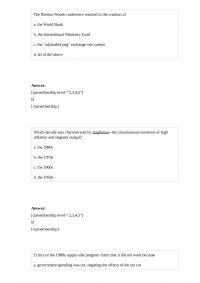
The Bretton Woods conference resulted in the creation of a. the World Bank b. the International Monetary Fund c. the “adjustable peg” exchange rate system d. all of the above Answer: Which decade was characterized by stagflation–the simultaneous existence of […]
Economics 83537
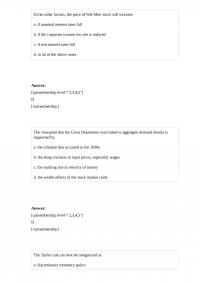
Given other factors, the price of Wal-Mart stock will increase a. if nominal interest rates fall b. if the corporate income tax rate is reduced c. if real interest rates fall d. in all of the above cases Answer: The […]
MicroEconomic 26914
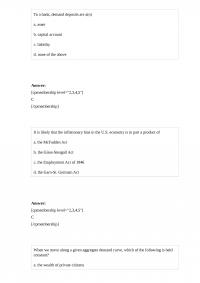
To a bank, demand deposits are a(n) a. asset b. capital account c. liability d. none of the above Answer: It is likely that the inflationary bias in the U.S. economy is in part a product of a. the McFadden […]
Economics 55418
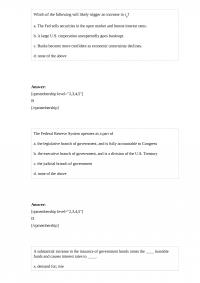
Which of the following will likely trigger an increase in re? a. The Fed sells securities in the open market and boosts interest rates. b. A large U.S. corporation unexpectedly goes bankrupt. c. Banks become more confident as economic uncertainty […]
ECON 49741
The forward exchange market is a. used by speculators to turn large profits on a small initial investment b. used by traders of goods to hedge against exchange rate risk c. used by traders in international assets to equalize returns […]
ECB 23418
Most of the wartime stimulus to aggregate demand comes from a. increases in consumption b. increases in investment c. increases in government spending d. increases in net exports Answer: Households that are surplus units must transfer their surplus funds to […]
BUS 83055
Anything that causes the demand for money relative to income to increase a. will cause velocity to increase b. will cause velocity to decrease c. will have no impact on velocity d. will have an unpredictable effect on velocity Answer: […]
ECON 69877
Which of the following are positively or directly related? a. liquidity and yield b. risk and yield c. risk and liquidity d. none of the above Answer: An increase in market interest rates will cause the excess reserve ratio to […]
MicroEconomic 89106
Banks create money when they a. expand loans and buy securities b. expand loans and sell securities c. reduce loans and buy securities d. reduce loans and sell securities Answer: Which of the following is listed on the asset side […]
ECON E 52717
Assume Bank A chooses to hold no excess reserves and receives a new deposit of $4,000. If the reserve requirement is 10 percent, how much can the bank loan out? a. $3,600 b. $4,000 c. $36,000 d. $40,000 Answer: The […]
BUS 28156
How many of the U.S. economic downturns since 1929 have been characterized by deflation? a. none b. one c. five d. most Answer: International comparisons of CPI price inflation rates show that, during 1970 – 1990, a. the United States […]
ECON A 40669
The FDICIA requires a. extremely undercapitalized banks to close their doors before they become insolvent b. banks with riskier asset structures to pay higher deposit insurance premiums c. banks with less capital to pay higher deposit insurance premiums d. all […]
Economics 80098
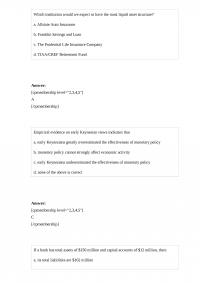
Which institution would we expect to have the most liquid asset structure? a. Allstate Auto Insurance b. Franklin Savings and Loan c. The Prudential Life Insurance Company d. TIAA/CREF Retirement Fund Answer: Empirical evidence on early Keynesian views indicates that […]
ECB 60194
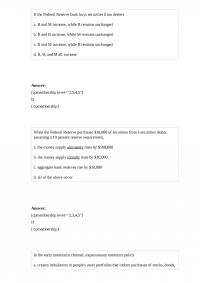
If the Federal Reserve bank buys securities from dealers a. B and M increase, while R remains unchanged b. R and B increase, while M remains unchanged c. R and M increase, while B remains unchanged d. R, B, and […]
MicroEconomic 83963
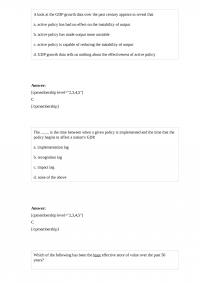
A look at the GDP growth data over the past century appears to reveal that a. active policy has had no effect on the instability of output b. active policy has made output more unstable c. active policy is capable […]
ECON 24077
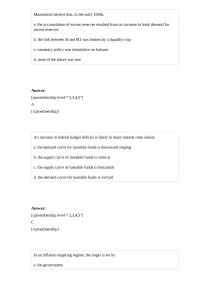
Monetarists believe that, in the early 1930s, a. the accumulation of excess reserves resulted from an increase in bank demand for excess reserves b. the link between B and M1 was broken by a liquidity trap c. monetary policy was […]
ECON A 81317
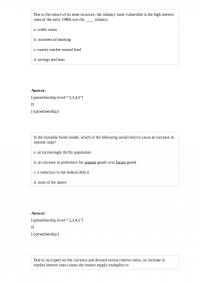
Due to the nature of its asset structure, the industry most vulnerable to the high interest rates of the early 1980s was the ____ industry. a. credit union b. commercial banking c. money market mutual fund d. savings and loan […]
ECON 72762
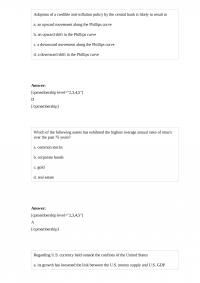
Adoption of a credible anti-inflation policy by the central bank is likely to result in a. an upward movement along the Phillips curve b. an upward shift in the Phillips curve c. a downward movement along the Phillips curve d. […]
BUS 86776
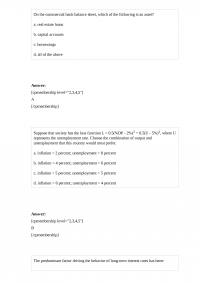
On the commercial bank balance sheet, which of the following is an asset? a. real estate loans b. capital accounts c. borrowings d. all of the above Answer: Suppose that society has the loss function L = 0.5(%DP – 2%)2 […]
ECON A 68154
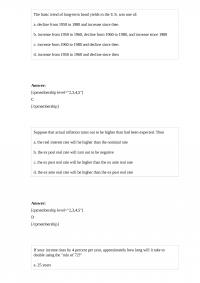
The basic trend of long-term bond yields in the U.S. was one of: a. decline from 1950 to 1980 and increase since then b. increase from 1950 to 1960, decline from 1960 to 1980, and increase since 1980 c. increase […]
MicroEconomic 37347
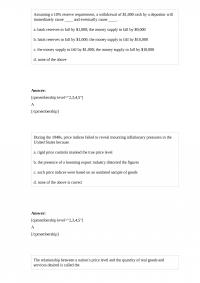
Assuming a 10% reserve requirement, a withdrawal of $1,000 cash by a depositor will immediately cause ____ and eventually cause ____. a. bank reserves to fall by $1,000; the money supply to fall by $9,000 b. bank reserves to fall […]
ECON 88413
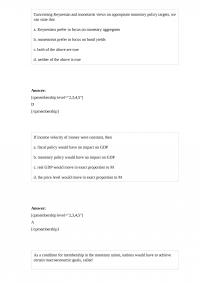
Concerning Keynesian and monetarist views on appropriate monetary policy targets, we can state that a. Keynesians prefer to focus on monetary aggregates b. monetarists prefer to focus on bond yields c. both of the above are true d. neither of […]
BUS 67843
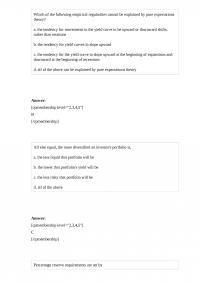
Which of the following empirical regularities cannot be explained by pure expectations theory? a. the tendency for movements in the yield curve to be upward or downward shifts, rather than rotations b. the tendency for yield curves to slope upward […]
ECON E 91202
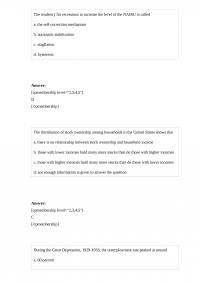
The tendency for recessions to increase the level of the NAIRU is called a. the self-correction mechanism b. automatic stabilization c. stagflation d. hysteresis Answer: The distribution of stock ownership among households in the United States shows that a. there […]
ECON E 69363
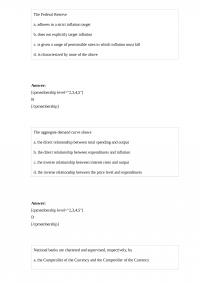
The Federal Reserve a. adheres to a strict inflation target b. does not explicitly target inflation c. is given a range of permissible rates in which inflation must fall d. is characterized by none of the above Answer: The aggregate […]
ECB 68101
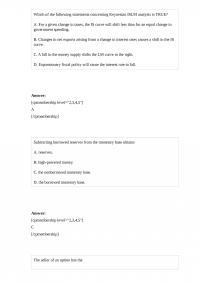
Which of the following statements concerning Keynesian ISLM analysis is TRUE? A. For a given change in taxes, the IS curve will shift less than for an equal change in government spending. B. Changes in net exports arising from a […]
ECON E 86379
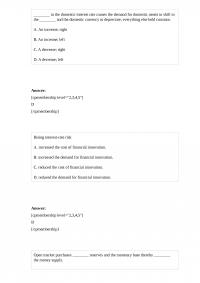
________ in the domestic interest rate causes the demand for domestic assets to shift to the ________ and the domestic currency to depreciate, everything else held constant. A. An increase; right B. An increase; left C. A decrease; right D. […]
ECON E 83691
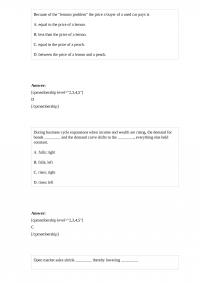
Because of the “lemons problem” the price a buyer of a used car pays is A. equal to the price of a lemon. B. less than the price of a lemon. C. equal to the price of a peach. D. […]
BUS 53919
In a liquidity trap, monetary policy has ________ effect on aggregate spending because a change in the money supply has ________ effect on interest rates. A. no; no B. no; a large C. no; a small D. a large; a […]
MicroEconomic 50728
Automated teller machines A. are more costly to use than human tellers, so banks discourage their use by charging more for use of ATMs. B. cost about the same to use as human tellers in banks, so banks discourage their […]
ECON 32972
When the financial crisis started in August 2007, inflation was rising and the Fed began an aggressive easing lowering of the federal funds rate, which indicated that A. there was an upward movement along the monetary policy curve. B. there […]
ECON A 90878
The portfolio theories of money demand state that the demand for real money balances is ________ related to income and ________ related to the nominal interest rate. A. positively; negatively B. positively; positively C. negatively; negatively D. negatively; positively Answer: […]
MicroEconomic 54180
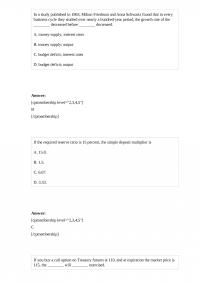
In a study published in 1963, Milton Friedman and Anna Schwartz found that in every business cycle they studied over nearly a hundred-year period, the growth rate of the ________ decreased before ________ decreased. A. money supply; interest rates B. […]
ECON E 35736
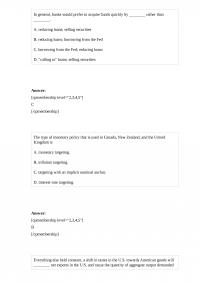
In general, banks would prefer to acquire funds quickly by ________ rather than ________. A. reducing loans; selling securities B. reducing loans; borrowing from the Fed C. borrowing from the Fed; reducing loans D. “calling in” loans; selling securities Answer: […]
MicroEconomic 81749
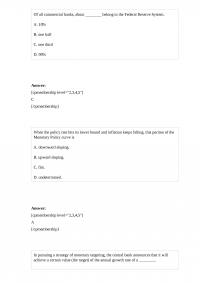
Of all commercial banks, about ________ belong to the Federal Reserve System. A. 10% B. one half C. one third D. 90% Answer: When the policy rate hits its lower bound and inflation keeps falling, this portion of the Monetary […]
MicroEconomic 83634
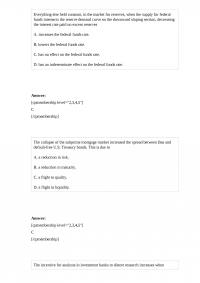
Everything else held constant, in the market for reserves, when the supply for federal funds intersects the reserve demand curve on the downward sloping section, decreasing the interest rate paid on excess reserves A. increases the federal funds rate. B. […]
BUS 34249
The agency that was created to protect depositors after the banking failures of 1930-1933 is the A. Federal Reserve System. B. Federal Deposit Insurance Corporation. C. Treasury Department. D. Office of the Comptroller of the Currency. Answer: China is trying […]
ECON 40208
A central bank that does NOT follow the Taylor principle will fail to raise nominal interest rates by more than the increase in expected inflation. As a result, the monetary policy curve is ________ sloping and the aggregate demand curve […]
MicroEconomic 52162
If a bank has excess reserves of $7,000 and demand deposit liabilities of $100,000, and if the reserve requirement is 10 percent, then the bank has actual reserves of A. $14,000. B. $17,000. C. $22,000. D. $27,000. Answer: Assuming initially […]
Economics 59269
Which of the following is NOT a secondary market? A. foreign exchange market B. futures market C. options market D. IPO market Answer: The credit derivative that, for a fee, gives the purchaser the right to receive profits that are […]
ECON 88939
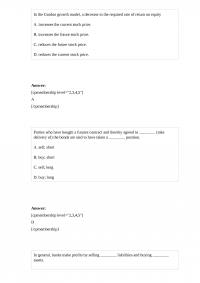
In the Gordon growth model, a decrease in the required rate of return on equity A. increases the current stock price. B. increases the future stock price. C. reduces the future stock price. D. reduces the current stock price. Answer: […]
MicroEconomic 65988
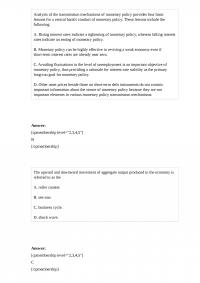
Analysis of the transmission mechanisms of monetary policy provides four basic lessons for a central bank’s conduct of monetary policy. These lessons include the following. A. Rising interest rates indicate a tightening of monetary policy, whereas falling interest rates indicate […]
ECB 82905
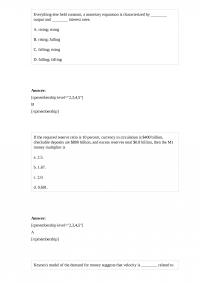
Everything else held constant, a monetary expansion is characterized by ________ output and ________ interest rates. A. rising; rising B. rising; falling C. falling; rising D. falling; falling Answer: If the required reserve ratio is 10 percent, currency in circulation […]
MicroEconomic 82096
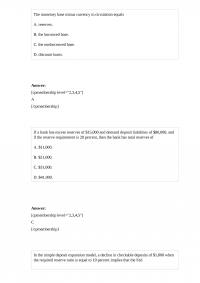
The monetary base minus currency in circulation equals A. reserves. B. the borrowed base. C. the nonborrowed base. D. discount loans. Answer: If a bank has excess reserves of $15,000 and demand deposit liabilities of $80,000, and if the reserve […]
ECON 11352
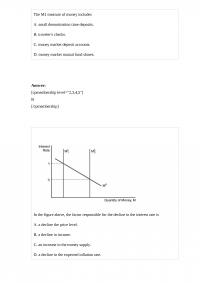
The M1 measure of money includes A. small denomination time deposits. B. traveler’s checks. C. money market deposit accounts. D. money market mutual fund shares. Answer: In the figure above, the factor responsible for the decline in the interest rate […]
ECON A 50883
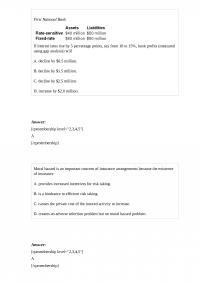
First National Bank If interest rates rise by 5 percentage points, say from 10 to 15%, bank profits (measured using gap analysis) will A. decline by $0.5 million. B. decline by $1.5 million. C. decline by $2.5 million. D. increase […]
BUS 98320
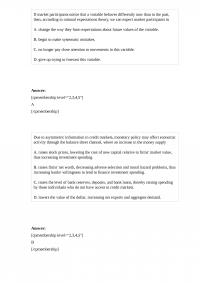
If market participants notice that a variable behaves differently now than in the past, then, according to rational expectations theory, we can expect market participants to A. change the way they form expectations about future values of the variable. B. […]
BUS 62939
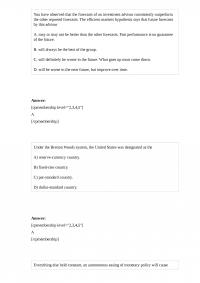
You have observed that the forecasts of an investment advisor consistently outperform the other reported forecasts. The efficient markets hypothesis says that future forecasts by this advisor A. may or may not be better than the other forecasts. Past performance […]
MicroEconomic 49739
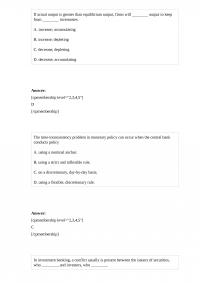
If actual output is greater than equilibrium output, firms will ________ output to keep from ________ inventories. A. increase; accumulating B. increase; depleting C. decrease; depleting D. decrease; accumulating Answer: The time-inconsistency problem in monetary policy can occur when the […]
BUS 92022
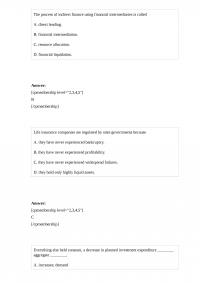
The process of indirect finance using financial intermediaries is called A. direct lending. B. financial intermediation. C. resource allocation. D. financial liquidation. Answer: Life insurance companies are regulated by state governments because A. they have never experienced bankruptcy. B. they […]