
Analysis of the transmission mechanisms of monetary policy provides four basic
lessons for a central bank’s conduct of monetary policy. These lessons include the
following.
A. Rising interest rates indicate a tightening of monetary policy, whereas falling interest
rates indicate an easing of monetary policy.
B. Monetary policy can be highly effective in reviving a weak economy even if
short-term interest rates are already near zero.
C. Avoiding fluctuations in the level of unemployment is an important objective of
monetary policy, thus providing a rationale for interest-rate stability as the primary
long-run goal for monetary policy.
D. Other asset prices beside those on short-term debt instruments do not contain
important information about the stance of monetary policy because they are not
important elements in various monetary policy transmission mechanisms.
Answer:
The upward and downward movement of aggregate output produced in the economy is
referred to as the
A. roller coaster.
B. see saw.
C. business cycle.
D. shock wave.
Answer:

If the consumption function is expressed as C = a + mpc × YD, then “mpc” represents
A. autonomous consumer expenditure.
B. the marginal propensity to consume.
C. the expenditure multiplier.
D. disposable income.
Answer:
The collapse of the subprime mortgage market
A. did not affect the corporate bond market.
B. increased the perceived riskiness of Treasury securities.
C. reduced the Baa-Aaa spread.
D. increased the Baa-Aaa spread.
Answer:
If net exports increase by 100 and the mpc is 0.75, equilibrium aggregate output
increases by

A. 100.
B. 250.
C. 400.
D. 750.
Answer:
Prior to 1980, member banks left the Federal Reserve System due to
A. the high cost of discount loans.
B. the high cost of required reserves.
C. a desire to avoid interest rate regulations.
D. a desire to avoid credit controls.
Answer:
The immediate (two-day) exchange of one currency for another is a
A. forward transaction.
B. spot transaction.

C. money transaction.
D. exchange transaction.
Answer:
Arguments for adopting a policy rule include
A. discretion avoids the straightjacket that would lock in the wrong policy if the model
that was used to derive the policy rule proved to be incorrect.
B. discretion enables policy makers to change policy settings when an economy
undergoes structural changes.
C. discretionary policies pursue overly expansionary monetary policies to boost
employment in the short run but generate higher inflation in the long run.
D. all of the above.
Answer:
If you sold a short futures contract you will hope that bond prices
A. rise.
B. fall.

C. are stable.
D. fluctuate.
Answer:
In the liquidity preference framework, a one-time increase in the money supply results
in a price level effect. The maximum impact of the price level effect on interest rates
occurs
A. at the moment the price level hits its peak (stops rising) because both the price level
and expected inflation effects are at work.
B. immediately after the price level begins to rise, because both the price level and
expected inflation effects are at work.
C. at the moment the expected inflation rate hits its peak.
D. at the moment the inflation rate hits it peak.
Answer:
When banks offer borrowers smaller loans than they have requested, banks are said to
A. shave credit.
B. rediscount the loan.

C. raze credit.
D. ration credit.
Answer:
The total amount of required reserves in the banking system is equal to the ________
the required reserve ratio and checkable deposits.
a. sum of
b. difference between
c. product of
d. ratio between
Answer:
According to aggregate demand and supply analysis, the favorable supply shock of
1995-1999 had the effect of
A. increasing aggregate output, lowering unemployment, and raising inflation.
B. decreasing aggregate output, raising unemployment, and raising inflation.
C. increasing aggregate output, lowering unemployment, and lowering inflation.
D. decreasing aggregate output, raising unemployment, and lowering inflation.
Answer:
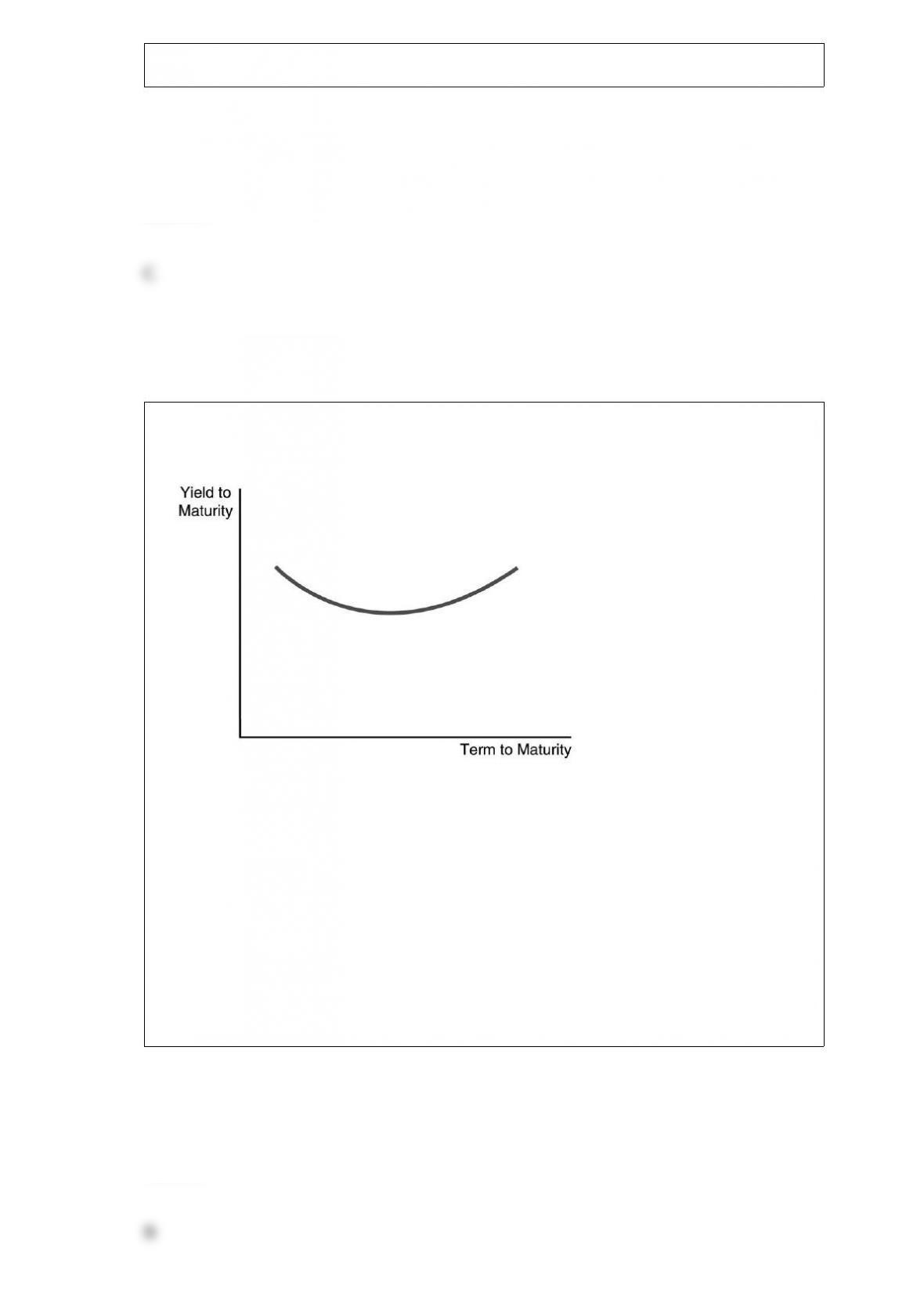
The U-shaped yield curve in the figure above indicates that the inflation rate is expected
to
A. remain constant in the near-term and fall later on.
B. fall sharply in the near-term and rise later on.
C. rise moderately in the near-term and fall later on.
D. remain constant in the near-term and rise later on.
Answer:

According to aggregate demand and supply analysis, the negative supply shocks of
1973-1975 and 1978-1980 had the effect of
A. increasing aggregate output, lowering unemployment, and raising the inflation.
B. decreasing aggregate output, raising unemployment, and raising the inflation.
C. increasing aggregate output, raising unemployment, and raising the inflation.
D. decreasing aggregate output, raising unemployment, and lowering the inflation.
Answer:
The revenue a government gains from issuing money is________
A) interest.
B) rent.
C) seignorage.
D) the national dividend.
E) the inflation tax.
Answer:

If a $5,000 coupon bond has a coupon rate of 13 percent, then the coupon payment
every year is
A. $650.
B. $1,300.
C. $130.
D. $13.
Answer:
If merchants in the country Zed choose to close their doors, preferring to be stuck with
rotting merchandise rather than worthless currency, then one can conclude that Zed is
experiencing a
A. superdeflation.
B. hyperdeflation.
C. disinflation.
D. hyperinflation.
Answer:

Which of the following $1,000 face-value securities has the highest yield to maturity?
A. a 5 percent coupon bond selling for $1,000
B. a 10 percent coupon bond selling for $1,000
C. a 12 percent coupon bond selling for $1,000
D. a 12 percent coupon bond selling for $1,100
Answer:
Excess reserves are equal to
A. total reserves minus discount loans.
B. vault cash plus deposits with Federal Reserve banks minus required reserves.
C. vault cash minus required reserves.
D. deposits with the Fed minus vault cash plus required reserves.
Answer:
Poorly performing financial markets can be the cause of
A. wealth.

B. poverty.
C. financial stability.
D. financial expansion.
Answer:
A decline in autonomous planned investment spending causes the equilibrium level of
aggregate output to ________ and shifts the ________ curve to the ________,
everything else held constant.
A. rise; LM; right
B. rise; IS; right
C. fall; IS; left
D. fall; LM; left
Answer:
The predominant form of household debt is
A. consumer installment debt.
B. collateralized debt.

C. unsecured debt.
D. unrestricted debt.
Answer:
A situation in which the quantity of bonds supplied exceeds the quantity of bonds
demanded is called a condition of excess supply; because people want to sell ________
bonds than others want to buy, the price of bonds will ________.
A. fewer; fall
B. fewer; rise
C. more; fall
D. more; rise
Answer:
An increase in the domestic interest rate causes the demand for domestic assets to
________ and the domestic currency to ________, everything else held constant.
A. increase; appreciate
B. increase; depreciate
C. decrease; appreciate

D. decrease; depreciate
Answer:
The financing of government spending by issuing debt
A. causes both reserves and the monetary base to rise.
B. causes both reserves and the monetary base to decline.
C. causes reserves to rise, but the monetary base to decline.
D. has no net effect on the monetary base.
Answer:
The spectacular growth in international banking can be explained by
A) the rapid growth in international trade.
B) the 1988 Basel Agreement.
C) the collapse of the Bretton Woods system.
D) the creation of the World Trade Organization.

Answer:
If the economy is on the IS curve, but is to the left of the LM curve, aggregate output
will ________ and the interest rate will ________.
A. rise; rise
B. rise; fall
C. fall; rise
D. fall; fall
Answer:
A permanent negative supply shock leads to ________ real interest rates ________.
A. higher; in both the short and long runs
B. higher; in the short run but not in the long run
C. lower; in both the short and long runs
D. lower; in the short run but not in the long run
Answer:

In the liquidity trap, the money demand curve
A. is horizontal.
B. is vertical.
C. is negatively sloped.
D. is positively sloped.
Answer:
When the Fed decreases the money stock, the money supply curve shifts to the
________ and the interest rate ________, everything else held constant.
A. right; rises
B. right; falls
C. left; falls
D. left; rises
Answer:

The most significant change in the economic environment that changed the demand for
financial products in recent years has been
A. the aging of the baby-boomer generation.
B. the dramatic increase in the volatility of interest rates.
C. the dramatic increase in competition from foreign banks.
D. the deregulation of financial institutions.
Answer:
Even if the Fed could completely control the money supply, monetary policy would
have critics because
A. the Fed is asked to achieve many goals, some of which are incompatible with others.
B. the Fed’s goals do not include high employment, making labor unions a critic of the
Fed.
C. the Fed’s primary goal is exchange rate stability, causing it to ignore domestic
economic conditions.
D. it is required to keep Treasury security prices high.
Answer:

Under a fixed exchange rate regime, if a country has an ________ exchange rate, then
its central bank’s attempt to keep its currency from appreciating will result in a
________ of international reserves.
A) undervalued; gain
B) undervalued; loss
C) overvalued; gain
D) overvalued; loss
Answer:
Financial markets have the basic function of
A) getting people with funds to lend together with people who want to borrow funds.
B) assuring that the swings in the business cycle are less pronounced.
C) assuring that governments need never resort to printing money.
D) providing a risk-free repository of spending power.
Answer: