The M1 measure of money includes
A. small denomination time deposits.
B. traveler’s checks.
C. money market deposit accounts.
D. money market mutual fund shares.
Answer:
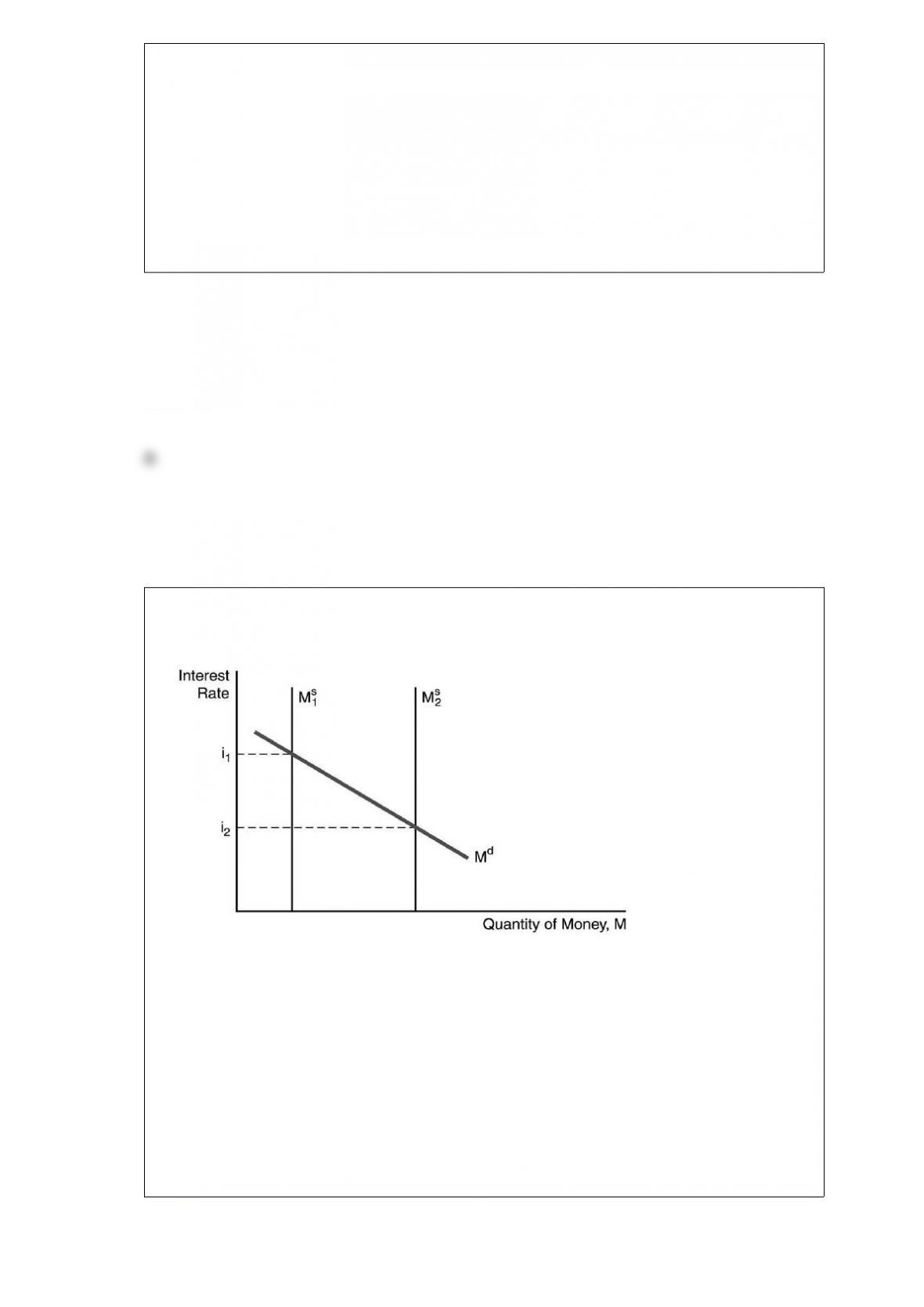
In the figure above, the factor responsible for the decline in the interest rate is
A. a decline the price level.
B. a decline in income.
C. an increase in the money supply.
D. a decline in the expected inflation rate.

Answer:
Everything else held constant, when actual output exceeds the natural rate of output
________ aggregate supply ________.
A. short-run; decreases
B. short-run; increases
C. long-run; increases
D. long-run; decreases
Answer:
When the European System of Central Banks uses long-term refinancing operations, it
is similar to the Federal Reserve using
A. dynamic open market operations.
B. defensive open market operations.
C. discount policy.
D. reserve requirements.
Answer:

The long-run aggregate supply curve shifts to the right when there is
A. a decrease in the total amount of capital in the economy.
B. a decrease in the total amount of labor supplied in the economy.
C. a decrease in the available technology.
D. a decline in the natural rate of unemployment.
Answer:
Which of the following accurately summarize the empirical evidence about technical
analysis?
A. Technical analysts fare no better than other financial analysison average they do not
outperform the market.
B. Technical analysts tend to outperform other financial analysis, but on average they
nevertheless under-perform the market.
C. Technical analysts fare no better than other financial analysis, and like other
financial analysts they outperform the market.
D. Technical analysts fare no better than other financial analysis, and like other
financial analysts they under-perform the market.
Answer:

Although it has a population about half that of the United States, Japan has
A) many more banks.
B) about 25 percent of the number of banks.
C) more than 5000 commercial banks.
D) fewer than 100 commercial banks.
Answer:
A continuing increase in the growth of the money supply is likely followed by
A. a recession.
B. a depression.
C. an increase in the price level.
D. no change in the economy.
Answer:

The high growth rate in China in the last twenty years has similarities to the high
growth rate of ________ during the 1950s and 1960s.
A) the United States
B) the Soviet Union
C) Brazil
D) Mexico
Answer:
If initially the money supply is $2 trillion, velocity is 5, the price level is 2, and real
GDP is $5 trillion, a fall in the money supply to $1 trillion
A. reduces real GDP to $2.5 trillion.
B. causes velocity to rise to 10.
C. decreases the price level to 1.
D. decreases the price level to 1 and decreases velocity to 2.5.
Answer:

Potential advantages of nominal GDP targeting include
A. it implies that the central bank will respond to slowdowns in the real economy even
if inflation is not falling.
B. real GDP growth that is below potential or inflation that is below the inflation
objective will encourage more expansionary monetary policy.
C. it focuses not only on controlling inflation but also explicitly on stabilizing real GDP.
D. all of the above.
Answer:
Elimination of riskless profit opportunities in the futures market is
A. hedging.
B. arbitrage.
C. speculation.
D. underwriting.
Answer:
If the yield curve slope is flat for short maturities and then slopes steeply upward for
longer maturities, the liquidity premium theory (assuming a mild preference for

shorter-term bonds) indicates that the market is predicting
A. a rise in short-term interest rates in the near future and a decline further out in the
future.
B. constant short-term interest rates in the near future and further out in the future.
C. a decline in short-term interest rates in the near future and a rise further out in the
future.
D. constant short-term interest rates in the near future and a decline further out in the
future.
Answer:
Which of the following does NOT shift the IS curve?
A. an increase in autonomous consumption
B. an increase in government spending
C. a decline in government spending
D. a fall in the interest rate
Answer:
________ quantity theory of money suggests that the demand for money is purely a

function of income, and interest rates have no effect on the demand for money.
A. Keynes’s
B. Fisher’s
C. Friedman’s
D. Tobin’s
Answer:
Over the next three years, the expected path of 1-year interest rates is 4, 1, and 1
percent. The expectations theory of the term structure predicts that the current interest
rate on 3-year bond is
A. 1 percent.
B. 2 percent.
C. 3 percent.
D. 4 percent.
Answer:
Everything else held constant, a credit-drive bubble is generally considered to have the
potential to cause ________ damage to an economy compared to an irrational

exuberance bubble.
A. less
B. about the same amount of
C. more
D. either more, less, or the same amount of
Answer:
The central bank which is generally regarded as the most independent in the world
because its charter cannot be changed by legislation is the
A. Bank of England.
B. Bank of Canada.
C. European Central Bank.
D. Bank of Japan.
Answer:
A central bank ________ of domestic currency and corresponding ________ of foreign
assets in the foreign exchange market leads to an equal increase in its international
reserves and the monetary base, everything else held constant.

A) sale; purchase
B) sale; sale
C) purchase; sale
D) purchase; purchase
Answer:
The mandate for the monetary policy goals that has been given to the European Central
Bank is an example of a ________ mandate.
A. primary
B. dual
C. secondary
D. hierarchical
Answer:
________ are financial intermediaries that acquire funds by selling shares to many
individuals and using the proceeds to purchase diversified portfolios of stocks and
bonds.

A. Mutual funds
B. Investment banks
C. Finance companies
D. Credit unions
Answer:
Which of the following is not a financial derivative?
A) stock
B) futures
C) options
D) forward contracts
Answer:
Ranking assets from most liquid to least liquid, the correct order is
A. savings bonds; house; currency.
B. currency; savings bonds; house.

C. currency; house; savings bonds.
D. house; savings bonds; currency.
Answer:
In the market for reserves, if the federal funds rate is above the interest rate paid on
excess reserves, an open market sale ________ the ________ of reserves, causing the
federal funds rate to increase, everything else held constant.
A. increases; supply
B. increases; demand
C. decreases; supply
D. decreases; demand
Answer:
In asset markets, an asset’s price is
A. set equal to the highest price a seller will accept.
B. set equal to the highest price a buyer is willing to pay.
C. set equal to the lowest price a seller is willing to accept.

D. set by the buyer willing to pay the highest price.
Answer:
Sustained downward movements in the business cycle are referred to as
A. inflation.
B. recessions.
C. economic recoveries.
D. expansions.
Answer:
Assuming initially that the required reserve ratio = 15%, the currency-deposit ratio =
40%, and the excess reserve ratio = 5%, a decrease in the excess reserve ratio to 0%
causes the M1 money multiplier to ________, everything else held constant.
a. increase from 2.33 to 2.55
b. decrease from 2.55 to 2.33
c. increase from 1.67 to 1.82
d. decrease from 1.82 to 1.67

Answer:
The monetarist statistical evidence examines the correlations between both ________
and ________ with ________.
A. money; aggregate spending; the unemployment rate
B. money; autonomous expenditures; the unemployment rate
C. money; consumption spending; aggregate spending
D. money; autonomous expenditures; aggregate spending
Answer:
An investment intermediary that lends funds to consumers is
A. a finance company.
B. an investment bank.
C. a finance fund.
D. a consumer company.
Answer:

If you buy a put option on treasury futures at 110, and at expiration the market price is
115, the ________ will ________ exercised.
A. call; be
B. put; be
C. call; not be
D. put; not be
Answer:
Both the CAPM and APT suggest that an asset should be priced so that it has a higher
expected return
A. when it has a greater systematic risk.
B. when it has a greater risk in isolation.
C. when it has a lower systematic risk.
D. when it has a lower systematic risk and a lower risk in isolation.
Answer:

Both ________ and ________ are monetary liabilities of the Fed.
A. securities; loans to financial institutions
B. currency in circulation; reserves
C. securities; reserves
D. currency in circulation; loans to financial institutions
Answer: