
The agency that was created to protect depositors after the banking failures of
1930-1933 is the
A. Federal Reserve System.
B. Federal Deposit Insurance Corporation.
C. Treasury Department.
D. Office of the Comptroller of the Currency.
Answer:
China is trying to move its banking system from being strictly ________ owned by
having them issue shares overseas.
A. state
B. domestic investor
C. depositor
D. domestic corporate
Answer:
The M2 money supply is represented by
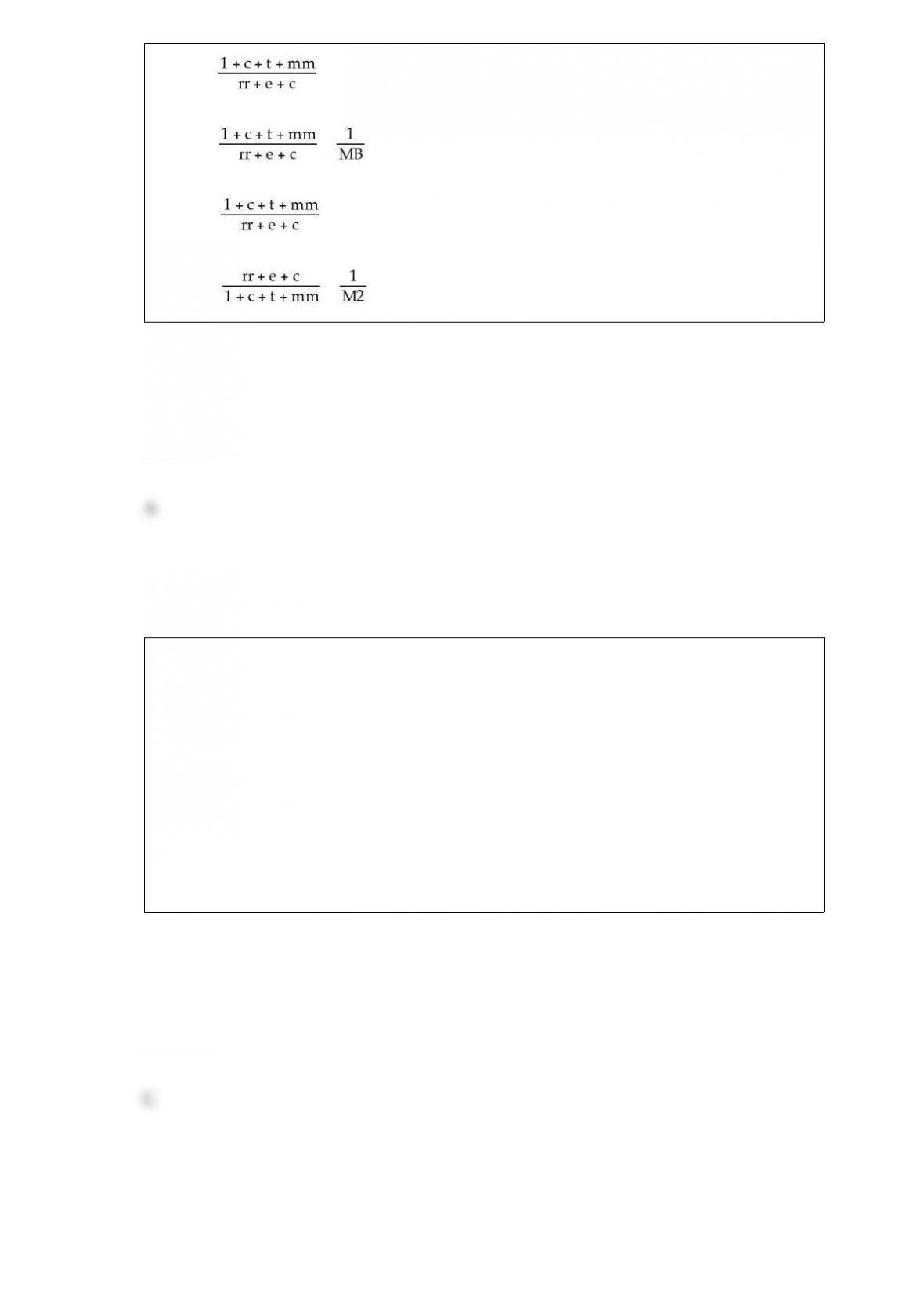
a. M2 = × MB.
b. M2 = × .
c. MB = × M2.
d. MB = × .
Answer:
If the required reserve ratio is 15 percent, currency in circulation is $400 billion,
checkable deposits are $800 billion, and excess reserves total $0.8 billion, then the M1
money multiplier is
a. 2.5.
b. 1.67.
c. 2.3.
d. 0.651.
Answer:

When the domestic currency is initially undervalued in a fixed exchange rate regime,
the central bank must intervene in the foreign exchange market to ________ the
domestic currency, thereby allowing the money supply to ________.
A) purchase; decline
B) sell; decline
C) purchase; increase
D) sell; increase
Answer:
Government regulations designed to reduce the moral hazard problem include
A) laws that force firms to adhere to standard accounting principles.
B) light sentences for those who commit the fraud of hiding and stealing profits.
C) state verification subsidies.
D) state licensing restrictions.
Answer:
The subprime financial crisis caused a recession because of the ________ in adverse
selection and moral hazard problems and the ________ in housing prices.

A. increase; increase
B. increase; decrease
C. decrease; increase
D. decrease; decrease
Answer:
Everything else held constant, an increase in the liquidity of bonds results in a
________ in demand for bonds and the demand curve shifts to the ________.
A. rise; right
B. rise; left
C. fall; right
D. fall; left
Answer:
The time it takes to pass legislation to implement a particular policy is called
A. the data lag.

B. the recognition lag.
C. the legislative lag.
D. the implementation lag.
E. the effectiveness lag.
Answer:
Suppose on any given day there is an excess demand of reserves in the federal funds
market. If the Federal Reserve wishes to keep the federal funds rate at its current level,
then the appropriate action for the Federal Reserve to take is a ________ open market
________, everything else held constant.
A. defensive; sale
B. defensive; purchase
C. dynamic; sale
D. dynamic; purchase
Answer:
A ________ is a provision that restricts or specifies certain activities that a borrower
can engage in.

A. residual claimant
B. risk hedge
C. restrictive barrier
D. restrictive covenant
Answer:
Financial institutions that accept deposits and make loans are called ________
institutions.
A. investment
B. contractual savings
C. depository
D. underwriting
Answer:
In recent years the interest paid on checkable and nontransaction deposits has accounted
for around ________ of total bank operating expenses, while the costs involved in
servicing accounts have been approximately ________ of operating expenses.
A. 45 percent; 55 percent

B. 55 percent; 4 percent
C. 25 percent; 50 percent
D. 50 percent; 30 percent
Answer:
A bank has excess reserves of $1,000 and demand deposit liabilities of $80,000 when
the reserve requirement is 20 percent. If the reserve requirement is lowered to 10
percent, the bank’s excess reserves will be
A. $1,000.
B. $8,000.
C. $9,000.
D. $17,000.
Answer:
When the growth rate of the money supply increases, interest rates end up being
permanently lower if
A. the liquidity effect is larger than the other effects.

B. there is fast adjustment of expected inflation.
C. there is slow adjustment of expected inflation.
D. the expected inflation effect is larger than the liquidity effect.
Answer:
Of the remedies for conflicts of interest, which one is the most intrusive?
A. regulate for transparency
B. separation of functions
C. supervisory oversight
D. socialization of information production
Answer:
If you purchase a $100,000 interest-rate futures contract for 105, and the price of the
Treasury securities on the expiration date is 108, your ________ is ________.
A. profit; $3000
B. loss; $3000
C. profit; $8000

D. loss; $8000
Answer:
The Fed can engage in preemptive strikes against a rise in inflation by ________ the
federal funds interest rate; it can act preemptively against negative demand shocks by
________ the federal funds interest rate.
A. raising; lowering
B. raising; raising
C. lowering; lowering
D. lowering; raising
Answer:
If the economy is on the LM curve, but is to the right of the IS curve, aggregate output
will ________ and the interest rate will ________.
A. rise; rise
B. rise; fall
C. fall; rise

D. fall; fall
Answer:
If reserves in the banking system increase by $100, then checkable deposits will
increase by $1000 in the simple model of deposit creation when the required reserve
ratio is
A. 0.01.
B. 0.10.
C. 0.05.
D. 0.20.
Answer:
In the Keynesian cross diagram, a decrease in investment spending because companies
become more pessimistic about investment profitability causes the aggregate demand
function to shift down, the equilibrium level of aggregate output to ________, and the
IS curve to shift to the ________, everything else held constant.
A. rise; left
B. rise; right
C. fall; left

D. fall; right
Answer:
The payoffs for financial derivatives are linked to
A. securities that will be issued in the future.
B. the volatility of interest rates.
C. previously issued securities.
D. government regulations specifying allowable rates of return.
Answer:
External financing by ________ should be more important in developing countries than
in industrialized countries because information about private firms is more difficult to
collect in developing countries.
A. financial intermediaries
B. bonds
C. stock
D. direct lending

Answer:
The ________ interest rate is adjusted for expected changes in the price level.
A. ex ante real
B. ex post real
C. ex post nominal
D. ex ante nominal
Answer:
The financial intermediaries that the average person interacts with most frequently are
A. exchanges.
B. over-the-counter markets.
C. finance companies.
D. banks.
Answer:

In a barter economy the number of prices in an economy with N goods is
A. [N(N – 1)]/2.
B. N(N/2).
C. 2N.
D. N(N/2) – 1.
Answer:
Because policies in the United States were too expansionary from 1965 through 1973,
the U.S. suffered
A. demand-pull inflation.
B. cost-push inflation, as workers sought higher wages in order to keep up with
inflation.
C. both demand-pull and cost-push inflation.
D. neither demand-pull nor cost-push inflation.
Answer:

Which of the following is NOT a disadvantage of exchange-rate targeting?
A) It relies on a stable money-inflation relationship.
B) The targeting country gives up an independent monetary policy.
C) The targeting country is left open for a speculative attack.
D) It can weaken the accountability of policymakers.
Answer:
Everything else held constant, a decrease in wealth
A. increases the demand for stocks.
B. increases the demand for bonds.
C. reduces the demand for silver.
D. increases the demand for gold.
Answer:
In the early 1970s, the U.S. ran large balance of payments ________, causing an
________ dollar and an ________ German mark.
A) deficits; undervalued; overvalued
B) deficits; overvalued; undervalued
C) surpluses; undervalued; overvalued
D) surpluses; overvalued; undervalued
Answer: