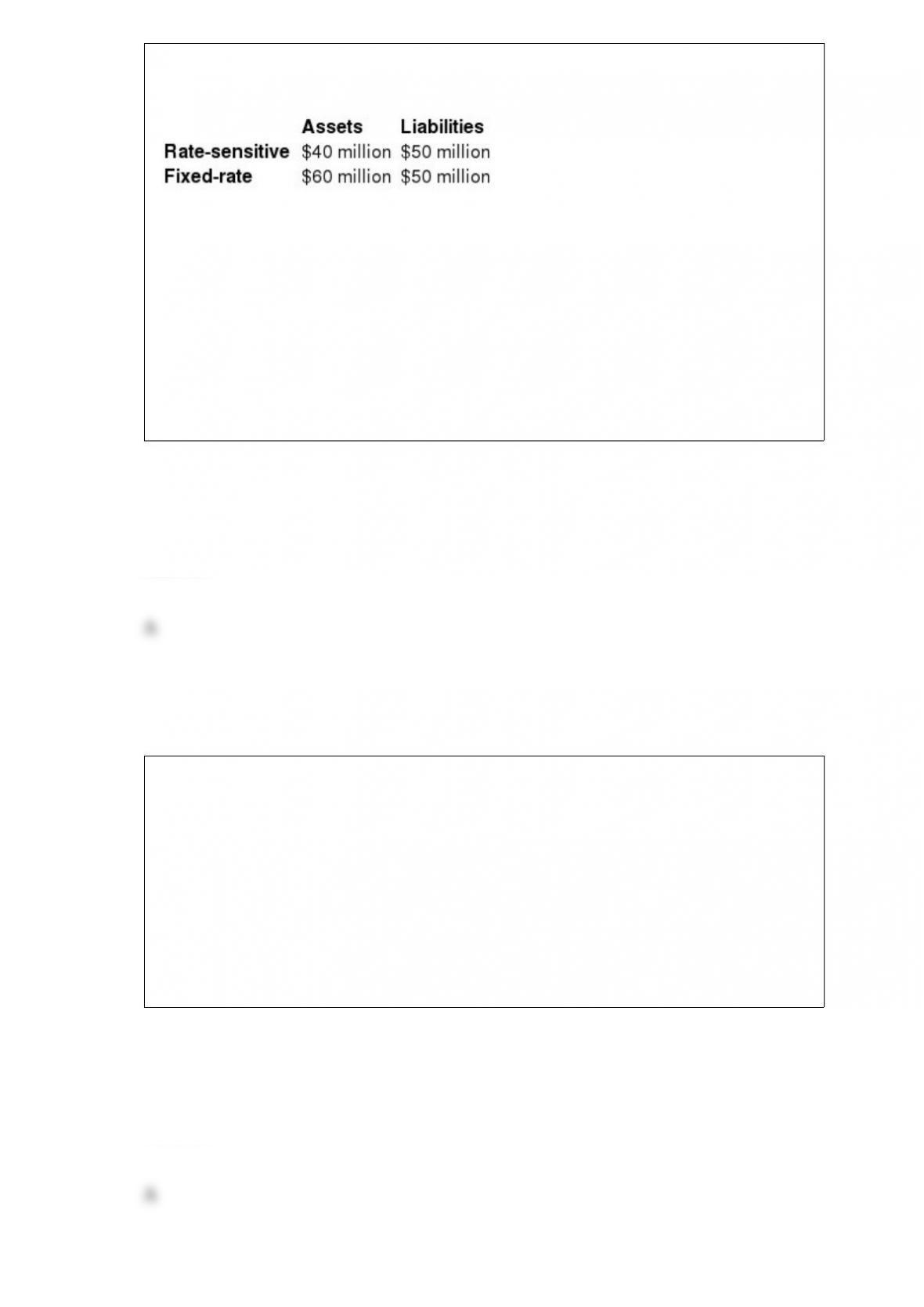
First National Bank
If interest rates rise by 5 percentage points, say from 10 to 15%, bank profits (measured
using gap analysis) will
A. decline by $0.5 million.
B. decline by $1.5 million.
C. decline by $2.5 million.
D. increase by $2.0 million.
Answer:
Moral hazard is an important concern of insurance arrangements because the existence
of insurance
A. provides increased incentives for risk taking.
B. is a hindrance to efficient risk taking.
C. causes the private cost of the insured activity to increase.
D. creates an adverse selection problem but no moral hazard problem.
Answer:

The policy of ________ exacerbated ________ problems as savings and loans took on
increasingly huge levels of risk on the slim chance of returning to solvency.
A. regulatory forbearance; moral hazard
B. regulatory forbearance; adverse hazard
C. regulatory agnosticism; moral hazard
D. regulatory agnosticism; adverse hazard
Answer:
If the interest rate is 7 percent on euro-denominated assets and 5 percent on
dollar-denominated assets, and if the dollar is expected to appreciate at a 4 percent rate,
the expected return on ________-denominated assets in ________ percent.
A. dollar; euros is 3
B. euro; dollars is 1
C. dollar; euros is 1
D. euro; dollars is 3
Answer:

When the IS and LM curves are combined in the same diagram, the intersection of the
two curves determines the equilibrium level of ________ as well as the ________.
A. aggregate output; price level
B. aggregate output; interest rate
C. money supply; price level
D. consumer expenditures; interest rate
Answer:
If the Fed expects currency holdings to fall, it conducts open market ________ to offset
the expected ________ in reserves.
A. purchases; increase
B. purchases; decrease
C. sales; increase
D. sales; decrease
Answer:
One suggested method of dealing with the too-big-to-fail problem is to reimpose the
restrictions that were in place under

A. Glass-Steagall.
B. McFadden.
C. the Edge Act.
D. the Federal Reserve Act.
Answer:
Today 1 euro can be purchased for $1.10. This is the
A. spot exchange rate.
B. forward exchange rate.
C. fixed exchange rate.
D. financial exchange rate.
Answer:
People have a strong incentive to form rational expectations because
A. they are guaranteed of success in the stock market.
B. it is costly not to do so.

C. it is costly to do so.
D. everyone wants to be rational.
Answer:
Countries with balance of payments deficits do not want to see their currencies
________ because it makes foreign goods ________ expensive for domestic
consumers.
A) appreciate; less
B) appreciate; more
C) depreciate; less
D) depreciate; more
Answer:
Everything else held constant, if the federal government were to guarantee today that it
will pay creditors if a corporation goes bankrupt in the future, the interest rate on
corporate bonds will ________ and the interest rate on Treasury securities will
________.
A. increase; increase

B. increase; decrease
C. decrease; increase
D. decrease; decrease
Answer:
The measure of the aggregate price level that is frequently the focus of Federal Reserve
officials is the
A. consumer price index.
B. producer price index.
C. GDP deflator.
D. PCE deflator.
Answer:
Tobin’s model of the speculative demand for money shows that people can reduce their
________ by ________ their asset holdings.
A. wealth; diversifying
B. risk; specializing

C. return; diversifying
D. risk; diversifying
Answer:
Which of the following is NOT included in the M1 measure of money but is included in
the M2 measure of money?
A. currency
B. traveler’s checks
C. demand deposits
D. small-denomination time deposits
Answer:
If policymakers set a target for unemployment that is too low because it is less than the
natural rate of unemployment, this can set the stage for a higher rate of money growth
and
A. cost-push inflation.
B. demand-pull inflation.
C. cost-pull inflation.

D. demand-push inflation.
Answer:
A tax cut ________ disposable income, ________ consumption expenditure, and shifts
the IS curve to the ________, everything else held constant.
A. increases; increases; right
B. increases; decreases; right
C. decreases; increases; left
D. decreases; decreases; left
Answer:
Keynes’s theory of the demand for money implies that velocity is
A. not constant but fluctuates with movements in interest rates.
B. not constant but fluctuates with movements in the price level.
C. not constant but fluctuates with movements in the time of year.
D. a constant.

Answer:
Using the Gordon growth model, if D1 is $.50, ke is 7%, and g is 5%, then the present
value of the stock is
A. $2.50.
B. $25.
C. $50.
D. $46.73.
Answer:
If young business professionals in America suddenly decide that driving German-made
cars is an important status symbol, net exports will tend to ________ causing aggregate
demand to ________, everything else held constant.
A. fall; fall
B. fall; rise
C. rise; fall
D. rise; rise

Answer:
Prior to the 1980s, S&Ls and mutual savings banks were restricted almost entirely to
A. commercial real estate loans.
B. home mortgages.
C. education loans.
D. vacation loans.
Answer:
Everything else held constant, increased demand for a country’s ________ causes its
currency to appreciate in the long run, while increased demand for ________ causes its
currency to depreciate.
A. imports; imports
B. imports; exports
C. exports; imports
D. exports; exports
Answer:

The Basel Accord requires banks to hold as capital an amount that is at least ________
of their risk-weighted assets.
A. 10%
B. 8%
C. 5%
D. 3%
Answer:
A decline in the money supply shifts the LM curve to the left, causing the interest rate
to ________ and output to ________, everything else held constant.
A. rise; rise
B. rise; fall
C. fall; rise
D. fall; fall
Answer:

The Resolution Trust Corporation was created by the FIRREA in order to
A. manage and resolve insolvent S&Ls.
B. build up trust in government regulation.
C. regulate the S&L industry.
D. purchase large amounts of government debt.
Answer:
If the incentive to take advantage of a conflict of interest is high
A. removing the economies of scope that created the conflict may induce higher costs
because of the decrease in the flow of reliable information.
B. then the government must step in to remove the conflict.
C. the costs of non-action in removing the conflict will always be higher than the cost
of removing the conflict.
D. firms will always step in and work to remove the conflict.
Answer:

Which of the following $1,000 face-value securities has the lowest yield to maturity?
A. a 5 percent coupon bond selling for $1,000
B. a 10 percent coupon bond selling for $1,000
C. a 15 percent coupon bond selling for $1,000
D. a 15 percent coupon bond selling for $900
Answer:
When interest rates fall in the United States (with the price level fixed), the value of the
dollar ________, domestic goods become ________ expensive, and net exports
________.
A. falls; less; fall
B. falls; less; rise
C. falls; more; fall
D. rises; less; fall
Answer:
Keynes’s liquidity preference theory indicates that the demand for money is ________
related to ________.

A. negatively; interest rates
B. positively; interest rates
C. negatively; income
D. negatively; wealth
Answer:
The ________ is calculated by multiplying the coupon rate times the par value of the
bond.
A. present value
B. face value
C. coupon payment
D. maturity payment
Answer:
Arguments for discretionary policies include
A. policy rules can be too rigid because they cannot foresee every contingency.

B. policy rules do not easily incorporate the use of judgment.
C. discretion avoids the straightjacket that would lock in the wrong policy if the model
that was used to derive the policy rule proved to be incorrect.
D. discretion enables policy makers to change policy settings when an economy
undergoes structural changes.
E. all of the above.
Answer:
If the Federal Reserve conducts open market ________, the money supply ________,
shifting the LM curve to the right, everything else held constant.
A. purchases; decreases
B. sales; decreases
C. purchases; increases
D. sales; increases
Answer:
A firm issuing credit cards earns income from
A. loans it makes to credit card holders.

B. subsidies from the local governments.
C. payments made to it by manufacturers of the products sold in stores on credit card
purchases.
D. sales of the card in foreign countries.
Answer:
Having interest rate stability
A. allows for less uncertainty about future planning.
B. leads to demands to curtail the Fed’s power.
C. guarantees full employment.
D. leads to problems in financial markets.
Answer:
In response to the early Keynesians, monetarists contended that
A. monetary policy during the Great Depression was not easy.
B. bank failures during the Great Depression were not the cause of the decline in the
money supply.

C. evidence from the Great Depression demonstrated the ineffectiveness of monetary
policy.
D. there is a weak link between interest rates and investment spending.
Answer:
Whatever a society uses as money, the distinguishing characteristic is that it must
A. be completely inflation proof.
B. be generally acceptable as payment for goods and services or in the repayment of
debt.
C. contain gold.
D. be produced by the government.
Answer: