
You have observed that the forecasts of an investment advisor consistently outperform
the other reported forecasts. The efficient markets hypothesis says that future forecasts
by this advisor
A. may or may not be better than the other forecasts. Past performance is no guarantee
of the future.
B. will always be the best of the group.
C. will definitely be worse in the future. What goes up must come down.
D. will be worse in the near future, but improve over time.
Answer:
Under the Bretton Woods system, the United States was designated as the
A) reserve-currency country.
B) fixed-rate country.
C) par-standard country.
D) dollar-standard country.
Answer:
Everything else held constant, an autonomous easing of monetary policy will cause

A. aggregate demand to increase.
B. aggregate demand to decrease.
C. the quantity of aggregate demand to increase.
D. the quantity of aggregate demand to decrease.
Answer:
If you bought a long futures contract you hope that bond prices
A. rise.
B. fall.
C. are stable.
D. fluctuate.
Answer:
The value of any investment is found by computing the
A. present value of all future sales.
B. present value of all future liabilities.

C. future value of all future expenses.
D. present value of all future cash flows.
Answer:
When Americans or foreigners expect the return on ________ assets to be high relative
to the return on ________ assets, there is a ________ demand for dollar assets,
everything else held constant.
A. dollar; foreign; constant
B. dollar; foreign; higher
C. foreign; dollar; higher
D. foreign; dollar; constant
Answer:
An advantage to exchange-rate targeting is it helps keep inflation under control by tying
the inflation rate for ________ traded goods to what is found in the ________ country.
A) domestically; anchor
B) domestically, domestic

C) internationally; anchor
D) internationally; domestic
Answer:
When housing prices began to decline after their peak in 2006, many subprime
borrowers found that their mortgages were “underwater.” This meant that
A. the value of the house fell below the amount of the mortgage.
B. the basement flooded since they could not afford to fix the leaky plumbing.
C. the roof leaked during a rainstorm.
D. the amount that they owed on their mortgage was less than the value of their house.
Answer:
If a mutual fund outperforms the market in one period, evidence suggests that this fund
is
A. highly likely to consistently outperform the market in subsequent periods due to its
superior investment strategy.
B. likely to under-perform the market in subsequent periods to average its overall
returns.

C. not likely to consistently outperform the market in subsequent periods.
D. not likely to outperform the market in any subsequent period.
Answer:
When the value of the British pound changes from $1.25 to $1.50, the pound has
________ and the U.S. dollar has ________.
A. appreciated; appreciated
B. depreciated; appreciated
C. appreciated; depreciated
D. depreciated; depreciated
Answer:
A lesson of the Enron collapse is that government regulation
A. always fails.
B. can reduce but not eliminate asymmetric information.
C. increases the problem of asymmetric information.
D. should be reduced.
Answer:
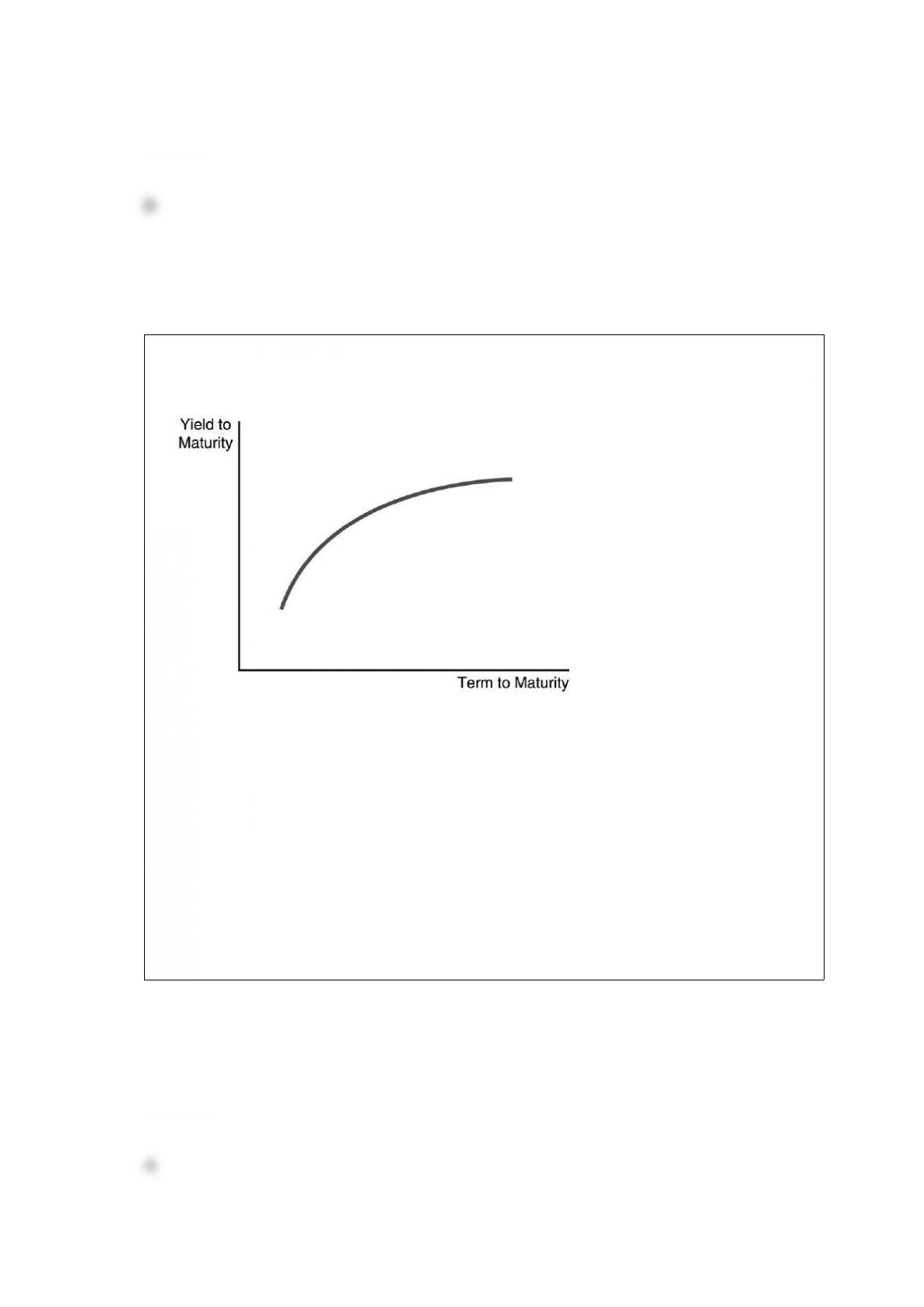
The steeply upward sloping yield curve in the figure above indicates that ________
interest rates are expected to ________ in the future.
A. short-term; rise
B. short-term; fall moderately
C. short-term; remain unchanged
D. long-term; fall moderately
Answer:

In one of the earliest studies on the link between interest rates and money demand using
United States data, James Tobin concluded that the demand for money is
A. sensitive to interest rates.
B. not sensitive to interest rates.
C. not sensitive to changes in income.
D. not sensitive to changes in bond values.
Answer:
When the price level ________, the demand curve for money shifts to the ________
and the interest rate ________, everything else held constant.
A. falls; right; rises
B. rises; right; falls
C. falls; left; rises
D. rises; right; rises
Answer:
According to aggregate demand and supply analysis, the rising oil prices coupled with
the global financial crisis in 2007-2008 caused the unemployment rate to ________ and

the level of real aggregate output to ________.
A. increase; increase
B. increase; decrease
C. decrease; increase
D. decrease; decrease
Answer:
If the required reserve ratio is equal to 10 percent, a single bank can increase its loans
up to a maximum amount equal to
A. its excess reserves.
B. 10 times its excess reserves.
C. 10 percent of its excess reserves.
D. its total reserves.
Answer:
Real interest rates are difficult to measure because
A. data on them are not available in a timely manner.

B. real interest rates depend on the hard-to-determine expected inflation rate.
C. they fluctuate too often to be accurate.
D. they cannot be controlled by the Fed.
Answer:
In the Keynesian liquidity preference framework, a rise in the price level causes the
demand for money to ________ and the demand curve to shift to the ________,
everything else held constant.
A. increase; left
B. increase; right
C. decrease; left
D. decrease; right
Answer:
I purchase a 10 percent coupon bond. Based on my purchase price, I calculate a yield to
maturity of 8 percent. If I hold this bond to maturity, then my return on this asset is
A. 10 percent.

B. 8 percent.
C. 12 percent.
D. there is not enough information to determine the return.
Answer:
Nominal GDP is output measured in ________ prices while real GDP is output
measured in ________ prices.
A. current; current
B. current; fixed
C. fixed; fixed
D. fixed; current
Answer:
Bonds with relatively low risk of default are called ________ securities and have a
rating of Baa (or BBB) and above; bonds with ratings below Baa (or BBB) have a
higher default risk and are called ________.
A. investment grade; lower grade
B. investment grade; junk bonds

C. high quality; lower grade
D. high quality; junk bonds
Answer:
A case for capital inflow controls can be made because capital inflows
A) can cause a lending boom and lead to excessive risk taking.
B) never finance productive investments.
C) always finance productive investments.
D) are less likely to cause financial crises than regulation of banking activities.
Answer:
At the time of the South Korean financial crisis, the government allowed many chaebol
owned finance companies to convert to merchant banks. Finance companies ________
allowed to borrow abroad and merchant banks ________.
A. were not; could borrow abroad
B. were not; could not borrow abroad
C. were; could borrow abroad

D. were; could not borrow abroad
Answer:
According to the interest parity condition, if the domestic interest rate is 10 percent and
the foreign interest rate is 12 percent, then the expected ________ of the foreign
currency must be ________ percent.
A) appreciation; 4
B) appreciation; 2
C) depreciation; 2
D) depreciation; 4
Answer:
A temporary supply shock that raises prices
A. will cause the real interest rate to rise in the long run.
B. has no long-run impact on inflation and output.
C. causes output to fall in the long run.
D. causes inflation to rise in the long run.

Answer:
Secondary reserves are so called because
A. they can be converted into cash with low transactions costs.
B. they are not easily converted into cash, and are, therefore, of secondary importance
to banking firms.
C. 50% of these assets count toward meeting required reserves.
D. they rank second to bank vault cash in importance of bank holdings.
Answer:
A contract that requires the investor to buy securities on a future date is called a
A. short contract.
B. long contract.
C. hedge.
D. cross.
Answer:

In the Keynesian framework, as long as output is ________ the equilibrium level,
unplanned inventory investment will remain ________, firms will continue to raise
production, and output will continue to rise.
A. below; negative
B. above; negative
C. below; positive
D. above; positive
Answer:
When it comes to choosing an policy instrument, both the ________ rate and ________
aggregates are measured accurately and are available daily with almost no delay.
A. three-month T-bill; monetary
B. three-month T-bill; reserve
C. federal funds; monetary
D. federal funds; reserve
Answer:

If the British pound appreciates from $0.50 per pound to $0.75 per pound, the U.S.
dollar depreciates from ________ per dollar to ________ per dollar.
A. £2; £2.5
B. £2; £1.33
C. £2; £1.5
D. £2; £1.25
Answer:
According to the Taylor rule, the Fed should raise the federal funds interest rate when
inflation ________ the Fed’s inflation target or when real GDP ________ the Fed’s
output target.
A. rises above; drops below
B. drops below; drops below
C. rises above; rises above
D. drops below; rises above
Answer:

Of the sources of external funds for nonfinancial businesses in the United States, loans
from banks and other financial intermediaries account for approximately ________ of
the total.
A) 6%
B) 40%
C) 56%
D) 60%
Answer:
The chaebols encouraged the Korean government to open up Korean financial markets
to foreign capital. The Korean government responded by
A. allowing unlimited short-term foreign borrowing but maintained quantity restrictions
on long-term foreign borrowing by financial institutions.
B. allowing unlimited short-term and long-term foreign borrowing by financial
institutions.
C. maintaining quantity restrictions on short-term foreign borrowing but allowing
unlimited long-term foreign borrowing by financial institutions.
D. not allowing any foreign borrowing by financial institutions.
Answer: