
If actual output is greater than equilibrium output, firms will ________ output to keep
from ________ inventories.
A. increase; accumulating
B. increase; depleting
C. decrease; depleting
D. decrease; accumulating
Answer:
The time-inconsistency problem in monetary policy can occur when the central bank
conducts policy
A. using a nominal anchor.
B. using a strict and inflexible rule.
C. on a discretionary, day-by-day basis.
D. using a flexible, discretionary rule.
Answer:
In investment banking, a conflict usually is present between the issuers of securities,
who ________, and investors, who ________.

A. benefit from unbiased auditing; desire unbiased consulting
B. desire unbiased research; benefit from optimistic research
C. benefit from optimistic research; desire unbiased research
D. desire unbiased consulting; benefit from unbiased auditing
Answer:
If the FDIC decides that a bank is too big to fail, it will use the ________ method,
effectively ensuring that ________ depositors will suffer losses.
A. payoff; large
B. payoff; no
C. purchase and assumption; large
D. purchase and assumption; no
Answer:
If the central bank pursues a monetary policy that is more expansionary than what firms
and people expect, then the central bank must be trying to
A. boost output in the short run.
B. constrain output in the short run.
C. constrain prices.
D. boost prices in the short run.
Answer:
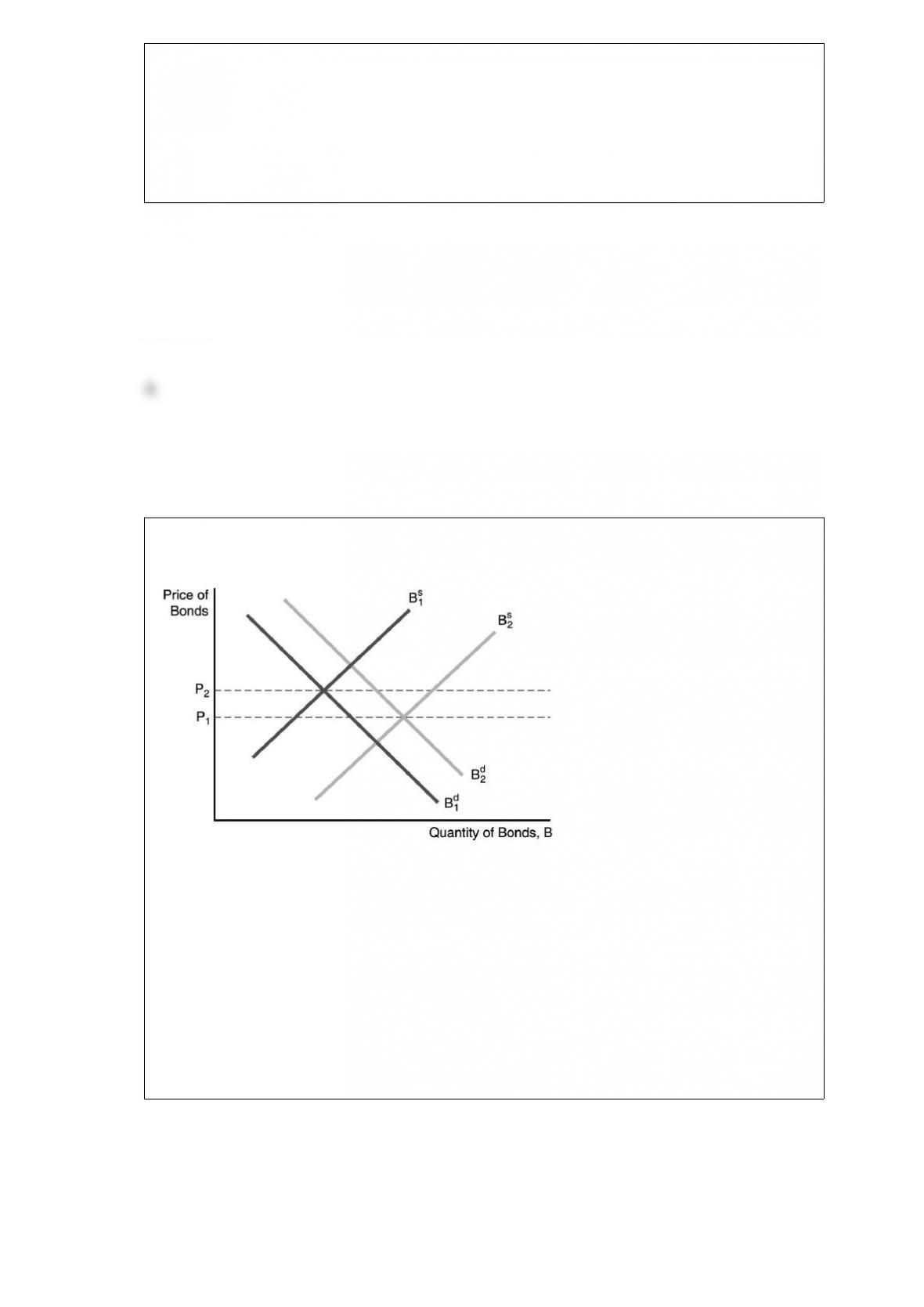
In the figure above, the price of bonds would fall from P2 to P1 if
A. there is a business cycle recession.
B. there is a business cycle expansion.
C. inflation is expected to increase in the future.
D. inflation is expected to decrease in the future.
Answer:

If the required reserve ratio is 10 percent, currency in circulation is $1,200 billion,
checkable deposits are $1,600 billion, and excess reserves total $2,500 billion, then the
M1 money multiplier is
a. 2.5.
b. 1.7.
c. 7.3.
d. 0.73.
Answer:
Unanticipated moral hazard contingencies can be reduced by
A. screening.
B. long-term customer relationships.
C. specialization in lending.
D. credit rationing.
Answer:

The present value of a fixed-payment loan is calculated as the ________ of the present
value of all cash flow payments.
A. sum
B. difference
C. multiple
D. log
Answer:
Which policy measure requires investment banks to sever the links between research
and securities underwriting?
A. Sarbanes-Oxley Act of 2002
B. Global Legal Settlement of 2002
C. Gramm-Leach-Bliley Act of 1999
D. Riegle-Neal Act of 1994
Answer:

The Keynesian theory of money demand emphasizes the importance of
A. a constant velocity.
B. irrational behavior on the part of some economic agents.
C. interest rates on the demand for money.
D. expectations.
Answer:
American businesses get their external funds primarily from
A. bank loans.
B. bonds and commercial paper issues.
C. stock issues.
D. loans from nonbank financial intermediaries.
Answer:
The components of the U.S. M1 money supply are demand and checkable deposits plus
A. currency.

B. currency plus savings deposits.
C. currency plus travelers checks.
D. currency plus travelers checks plus money market deposits.
Answer:
The ability of a central bank to set monetary policy goals is
A. political independence.
B. goal independence.
C. policy independence.
D. instrument independence.
Answer:
This theory views shocks to tastes (workers’ willingness to work, for example) and
technology (productivity) as the major driving forces behind short-run fluctuations in
the business cycle because these shocks lead to substantial short-run fluctuations in the
natural rate of output.
A. the natural rate hypothesis
B. hysteresis

C. real business cycle theory
D. the Phillips curve model
Answer:
Acquiring information on a bank’s activities in order to determine a bank’s risk is
difficult for depositors and is another argument for government
A. regulation.
B. ownership.
C. recall.
D. forbearance.
Answer:
One financial intermediary in our financial structure that helps to reduce the moral
hazard from arising from the principal-agent problem is the
A) venture capital firm.
B) money market mutual fund.
C) pawn broker.

D) savings and loan association.
Answer:
Everything else held constant, during a business cycle expansion, the supply of bonds
shifts to the ________ as businesses perceive more profitable investment opportunities,
while the demand for bonds shifts to the ________ as a result of the increase in wealth
generated by the economic expansion.
A. right; left
B. right; right
C. left; left
D. left; right
Answer:
As in the United States, an important factor in the banking crises in Latin America was
the
A. financial liberalization that occurred in the 1980s.
B. decline in real interest rates that occurred in the 1980s.
C. high inflation that occurred in the 1980s.

D. sluggish economic growth that occurred in the 1980s.
E.
Answer:
Under the Exchange Rate Mechanism of the European Monetary System, when the
German mark depreciated below its lower limit against the British pound, the German
central bank was required to buy ________ and sell ________, thereby ________
international reserves.
A) pounds; marks; losing
B) pounds; marks; gaining
C) marks; pounds; gaining
D) marks; pounds; losing
Answer:
Relative to life insurance companies, property and casualty insurance companies hold
A. more liquid assets.
B. more long-term government bonds.

C. more commercial mortgages.
D. fewer municipal bonds.
Answer:
Which of the following are NOT liabilities on the Fed’s balance sheet?
a. discount loans
b. bank deposits
c. deferred availability cash items
d. U.S. Treasury deposits
Answer:
Everything else held constant, if a factor decreases the demand for ________ goods
relative to ________ goods, the domestic currency will depreciate.
A. foreign; domestic
B. foreign; foreign
C. domestic; domestic
D. domestic; foreign

Answer:
Because of their ________ liquidity, ________ U.S. government securities are called
secondary reserves.
A. low; short-term
B. low; long-term
C. high; short-term
D. high; long-term
Answer:
An important function of secondary markets is to
A. make it easier to sell financial instruments to raise funds.
B. raise funds for corporations through the sale of securities.
C. make it easier for governments to raise taxes.
D. create a market for newly constructed houses.
Answer:

A decrease in the brokerage commissions in the housing market from 6% to 5% of the
sales price will shift the ________ curve for bonds to the ________, everything else
held constant.
A. demand; right
B. demand; left
C. supply; right
D. supply; left
Answer:
If a bank has $200,000 of checkable deposits, a required reserve ratio of 20 percent, and
it holds $80,000 in reserves, then the maximum deposit outflow it can sustain without
altering its balance sheet is
A. $50,000.
B. $40,000.
C. $30,000.
D. $25,000.
Answer:

During World War II, the Fed in effect relinquished its control of monetary policy
through its policy of
A. continually lowering reserve requirements.
B. continually raising reserve requirements.
C. pegging interest rates.
D. targeting free reserves.
Answer:
Property promised to the lender as compensation if the borrower defaults is called
A. collateral.
B. deductibles.
C. restrictive covenants.
D. contingencies.
Answer:

Suppose you are holding a 5 percent coupon bond maturing in one year with a yield to
maturity of 15 percent. If the interest rate on one-year bonds rises from 15 percent to 20
percent over the course of the year, what is the yearly return on the bond you are
holding?
A. 5 percent
B. 10 percent
C. 15 percent
D. 20 percent
Answer:
The bond demand curve is ________ sloping, indicating a(n) ________ relationship
between the price and quantity demanded of bonds, everything else equal.
A. downward; inverse
B. downward; direct
C. upward; inverse
D. upward; direct
Answer:

Cutting the money supply by one-third is predicted by the quantity theory of money to
cause
A. a sharp decline in real output of one-third in the short run, and a fall in the price level
by one-third in the long run.
B. a decline in real output by one-third.
C. a decline in output by one-sixth, and a decline in the price level of one-sixth.
D. a decline in the price level by one-third.
Answer: