
Everything else held constant, in the market for reserves, when the supply for federal
funds intersects the reserve demand curve on the downward sloping section, decreasing
the interest rate paid on excess reserves
A. increases the federal funds rate.
B. lowers the federal funds rate.
C. has no effect on the federal funds rate.
D. has an indeterminate effect on the federal funds rate.
Answer:
The collapse of the subprime mortgage market increased the spread between Baa and
default-free U.S. Treasury bonds. This is due to
A. a reduction in risk.
B. a reduction in maturity.
C. a flight to quality.
D. a flight to liquidity.
Answer:
The incentive for analysts in investment banks to distort research increases when

A. revenues from brokerage commissions increase.
B. the potential revenues from underwriting greatly exceed brokerage commissions.
C. the potential brokerage commissions greatly exceed revenues from underwriting.
D. revenues from underwriting decrease.
Answer:
The interest rate charged on overnight loans of reserves between banks is the
A. prime rate.
B. discount rate.
C. federal funds rate.
D. Treasury bill rate.
Answer:
________ in the expected future domestic exchange rate causes the demand for
domestic assets to decrease and the domestic currency to ________, everything else
held constant.
A. An increase; appreciate

B. An increase; depreciate
C. A decrease; appreciate
D. A decrease; depreciate
Answer:
By hedging a portfolio, a bank manager
A. reduces interest-rate risk.
B. increases reinvestment risk.
C. increases exchange-rate risk.
D. increases the probability of gains.
Answer:
All else equal, when interest rates ________, the duration of a coupon bond ________.
A. rise; falls
B. rise; increases
C. falls; falls

D. falls; does not change
Answer:
The sum of the Fed’s monetary liabilities and the U.S. Treasury’s monetary liabilities is
called
A. the money supply.
B. currency in circulation.
C. bank reserves.
D. the monetary base.
Answer:
On paper, the Bank of Canada has ________ instrument independence and ________
goal independence when compared to the Federal Reserve System.
A. less; less
B. less; more
C. more; less
D. more; more
Answer:
Which of the following is most likely to lead to inflationary monetary policy?
A. declining oil prices
B. resolution of conflict in the Middle East
C. the enactment of a free-trade agreement with Mexico
D. rising government budget deficits
Answer:
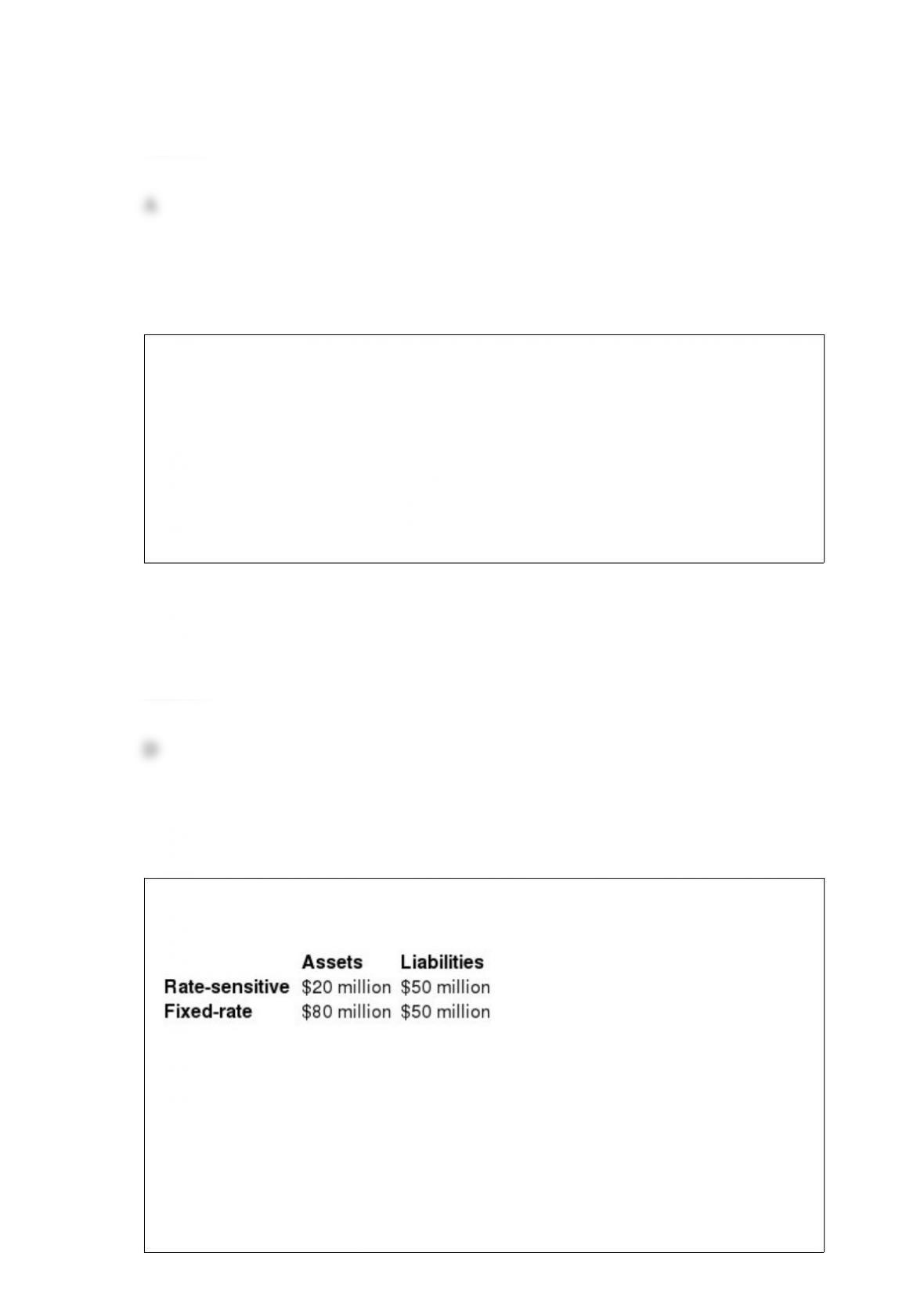
First National Bank
Assuming that the average duration of its assets is five years, while the average duration
of its liabilities is three years, then a 5 percentage point increase in interest rates will
cause the net worth of First National to decline by ________ of the total original asset
value.
A. 5 percent
B. 10 percent

C. 15 percent
D. 25 percent
Answer:
An expansionary monetary policy increases net exports by ________ interest rates and
________ the value of the dollar.
A. lowering nominal; decreasing
B. lowering real; decreasing
C. raising nominal; increasing
D. raising real; increasing
Answer:
Reinsurance allows ________ to reduce the risks of exposure by allocating a portion of
the risk to ________ in exchange for a portion of the premium.
A. insurance companies; another insurance company
B. insurance companies; the insured
C. the insured; the insurance company

D. the insured; a bank
Answer:
The problem with spinning is that it may ________ the cost of capital to a firm and thus
________ the efficiency of the capital market.
A. increase; increase
B. increase; decrease
C. decrease; increase
D. decrease; decrease
Answer:
When the Fed buys $100 worth of bonds from a primary dealer, reserves in the banking
system
A. increase by $100.
B. increase by more than $100.
C. decrease by $100.
D. decrease by more than $100.

Answer:
The rate of inflation tends to remain constant when
A. the unemployment rate is above the NAIRU.
B. the unemployment rate equals the NAIRU.
C. the unemployment rate is below the NAIRU.
D. the unemployment rate increases faster than the NAIRU increases.
Answer:
A central bank ________ of domestic currency and corresponding ________ of foreign
assets in the foreign exchange market leads to an equal decline in its international
reserves and the monetary base, everything else held constant.
A) sale; purchase
B) sale; sale
C) purchase; sale
D) purchase; purchase

Answer:
The goals of bank asset management include
A. maximizing risk.
B. minimizing liquidity.
C. lending at high interest rates regardless of risk.
D. purchasing securities with high returns and low risk.
Answer:
Everything else held constant, a decrease in the excess reserves ratio causes the M1
money multiplier to ________ and the money supply to ________.
a. decrease; increase
b. increase; increase
c. decrease; decrease
d. increase; decrease
Answer:

Assuming initially that the required reserve ratio = 10%, the currency-deposit ratio =
40%, and the excess reserve ratio = 0, an increase in the required reserve ratio to 15%
causes the M1 money multiplier to ________, everything else held constant.
a. increase from 2.55 to 2.8
b. decrease from 2.8 to 2.55
c. increase from 1.82 to 2
d. decrease from 2 to 1.82
Answer:
In both New Zealand and Canada, what has happened to the unemployment rate since
the countries adopted inflation targeting?
A. The unemployment rate increased sharply.
B. The unemployment rate remained constant.
C. The unemployment rate has declined substantially after a sharp increase.
D. The unemployment rate declined sharply immediately after the inflation targets were
adopted.
Answer:

Evidence against market efficiency includes
A. failure of technical analysis to outperform the market.
B. the random walk behavior of stock prices.
C. the inability of mutual fund managers to consistently beat the market.
D. the January effect.
Answer:
Suppose your payroll check is directly deposited to your checking account. Everything
else held constant, total reserves in the banking system ________ and the monetary
base ________.
A. remain unchanged; remains unchanged
B. remain unchanged; increases
C. decrease; increases
D. decrease; decreases
Answer:

A monetary expansion ________ stock prices due to a decrease in the ________ and an
increase in the ________, everything else held constant.
A. reduces; future sales price; expected rate of return
B. reduces; current dividend; expected rate of return
C. increases; required rate of return; future sales price
D. increases; required rate of return; dividend growth rate
Answer:
A particularly attractive feature of the ________ is that it tells you what the market is
predicting about future short-term interest rates by just looking at the slope of the yield
curve.
A. segmented markets theory
B. expectations theory
C. liquidity premium theory
D. separable markets theory
Answer:
Everything else held constant, an increase in the money market fund ratio will result in

________ in the M1 money multiplier and ________ in the M2 money multiplier.
a. an increase; an increase
b. no change; an increase
c. a decrease; a decrease
d. no change; a decrease
Answer:
The data lag is
A. the time it takes for policy makers to obtain data indicating what is happening in the
economy.
B. the time it takes for policy makers to be sure of what the data are signaling about the
future course of the economy.
C. the time it takes to pass legislation to implement a particular policy.
D. the time it takes for policy makers to change policy instruments once they have
decided on the new policy.
E. the time it takes for the policy actually to have an impact on the economy.
Answer:

The excess reserves ratio is ________ related to expected deposit outflows, and is
________ related to the market interest rate.
a. negatively; negatively
b. negatively; positively
c. positively; negatively
d. positively; positively
Answer:
The FHLBS gives loans to S&Ls and thus performs a function similar to the ________
for commercial banks.
A) Federal Reserve
B) U.S. Treasury
C) Office of the Comptroller of the Currency
D) U.S. Mint
Answer:
Everything else held constant, an appreciation of the domestic currency will cause the
IS curve to shift to the ________ and aggregate demand will ________.

A. right; increase
B. right; decrease
C. left; increase
D. left; decrease
Answer:
The Fed’s use of the ________ as an operating target in the 1970s resulted in ________
monetary policy.
A. federal funds rate; countercyclical
B. federal funds rate; procyclical
C. M1 money supply; countercyclical
D. M1 money supply; procyclical
Answer:
The duration of a coupon bond increases
A. the longer is the bond’s term to maturity.

B. when interest rates increase.
C. the higher the coupon rate on the bond.
D. the higher the bond price.
Answer:
The strengthening of the dollar between 1980 and 1985 contributed to a ________ in
American competitiveness, putting pressure on the Fed to pursue a more ________
monetary policy.
A. decrease; contractionary
B. increase; expansionary
C. increase; contractionary
D. decrease; expansionary
Answer: