
In the Gordon growth model, a decrease in the required rate of return on equity
A. increases the current stock price.
B. increases the future stock price.
C. reduces the future stock price.
D. reduces the current stock price.
Answer:
Parties who have bought a futures contract and thereby agreed to ________ (take
delivery of) the bonds are said to have taken a ________ position.
A. sell; short
B. buy; short
C. sell; long
D. buy; long
Answer:
In general, banks make profits by selling ________ liabilities and buying ________
assets.

A. long-term; shorter-term
B. short-term; longer-term
C. illiquid; liquid
D. risky; risk-free
Answer:
In the 1990s Japan had the lowest interest rates in the world due to a combination of
A. inflation and recession.
B. deflation and expansion.
C. inflation and expansion.
D. deflation and recession.
Answer:
The primary indicator of the Fed’s stance on monetary policy is
A. the discount rate.
B. the federal funds rate.

C. the growth rate of the monetary base.
D. the growth rate of M2.
Answer:
When the Federal Reserve purchases a government bond from a primary dealer,
reserves in the banking system ________ and the monetary base ________, everything
else held constant.
A. increase; increases
B. increase; decreases
C. decrease; increases
D. decrease; decreases
Answer:
Aggregate output and the interest rate are ________ related to government spending
and are ________ related to taxes.
A. positively; positively
B. positively; negatively
C. negatively; positively

D. negatively; negatively
Answer:
When financial institutions go on a lending spree and expand their lending at a rapid
pace they are participating in a
A. credit boom.
B. credit bust.
C. deleveraging.
D. market race.
Answer:
In the long-run ISLM model and with everything else held constant, the long-run effect
of an autonomous fall in consumption expenditure is to ________ real output and
________ the interest rate.
A. increase; increase
B. increase; not change
C. not change; increase

D. not change; decrease
Answer:
Instrument independence is the ability of ________ to set monetary policy ________.
A. the central bank; goals
B. Congress; goals
C. Congress; instruments
D. the central bank; instruments
Answer:
An inverted yield curve predicts that short-term interest rates
A. are expected to rise in the future.
B. will rise and then fall in the future.
C. will remain unchanged in the future.
D. will fall in the future.

Answer:
The analysis of how asymmetric information problems affect economic behavior is
called ________ theory.
A. uneven
B. parallel
C. principal
D. agency
Answer:
Because ________ are less liquid for the depositor than ________, they earn higher
interest rates.
A. money market deposit accounts; time deposits
B. checkable deposits; savings accounts
C. savings accounts; checkable deposits
D. savings accounts; time deposits
Answer:

Because shifts in aggregate demand are not viewed as being particularly important to
aggregate output fluctuations, they do not see much need for activist policy to eliminate
high unemployment. “They” refers to proponents of
A. the natural rate hypothesis.
B. monetarism.
C. the Phillips curve model.
D. real business cycle theory.
Answer:
If the money supply is $600 and nominal income is $3,600, the velocity of money is
A. 1/60.
B. 1/6.
C. 6.
D. 60.
Answer:

The theory of bureaucratic behavior suggests that the objective of a bureaucracy is to
maximize
A. the public’s welfare.
B. profits.
C. its own welfare.
D. conflict with the executive and legislative branches of government.
Answer:
A call option gives the owner the
A. right to sell the underlying security.
B. obligation to sell the underlying security.
C. right to buy the underlying security.
D. obligation to buy the underlying security.
Answer:

When I purchase ________, I own a portion of a firm and have the right to vote on
issues important to the firm and to elect its directors.
A. bonds
B. bills
C. notes
D. stock
Answer:
Critics of nationwide banking fear
A) an elimination of community banks.
B) increased lending to small businesses.
C) cutthroat competition.
D) banks with economies of scale problems.
Answer:
If reserves in the banking system increase by $200, then checkable deposits will
increase by $500 in the simple model of deposit creation when the required reserve
ratio is

A. 0.04.
B. 0.25.
C. 0.40.
D. 0.50.
Answer:
A goal of the Securities and Exchange Commission is to reduce problems arising from
A. competition.
B. banking panics.
C. risk.
D. asymmetric information.
Answer:
The price of a barrel of oil doubled between 2007 and the middle of To make matters
worse, a financial crisis hit the U.S. economy starting in August of 2007. Which of the
following is TRUE of the United Kingdom’s experience?
A. The increase in the price of oil immediately shifted the AS curve to the left.

B. The financial crisis did not take hold right away so the AD curve did not
immediately shift.
C. Eventually, the Lehman Brothers bankruptcy caused a negative demand shock
leading to a further fall in output and an increase in the unemployment rate.
D. All of the above.
E. None of the above.
Answer:
If stock prices are expected to drop dramatically, then, other things equal, the demand
for stocks will ________ and that of Treasury bills will ________.
A. increase; increase
B. increase; decrease
C. decrease; decrease
D. decrease; increase
Answer:
Suppose the U.S. economy is operating at potential output. A negative supply shock that
is accommodated by an open market purchase by the Federal Reserve will cause

________ in real GDP in the long run and ________ in inflation in the long run,
everything else held constant.
A. no change; an increase
B. no change; a decrease
C. an increase; an increase
D. a decrease; a decrease
Answer:
The declining cost of computer technology has made ________ a reality.
A. brick and mortar banking
B. commercial banking
C. virtual banking
D. investment banking
Answer:
Which policy measure requires investment banks to make public their analysts’
recommendations?

A. Sarbanes-Oxley Act of 2002
B. Global Legal Settlement of 2002
C. Gramm-Leach-Bliley Act of 1999
D. Riegle-Neal Act of 1994
Answer:
Lucas argues that when policies change, expectations will change thereby
A. changing the relationships in econometric models.
B. causing the government to abandon its discretionary stance.
C. forcing the Fed to keep its deliberations secret.
D. making it easier to predict the effects of policy changes.
Answer:
Which of the following is an example of an intermediate-term debt?
A. a fifteen-year mortgage
B. a sixty-month car loan
C. a six-month loan from a finance company
D. a thirty-year U.S. Treasury bond
Answer:
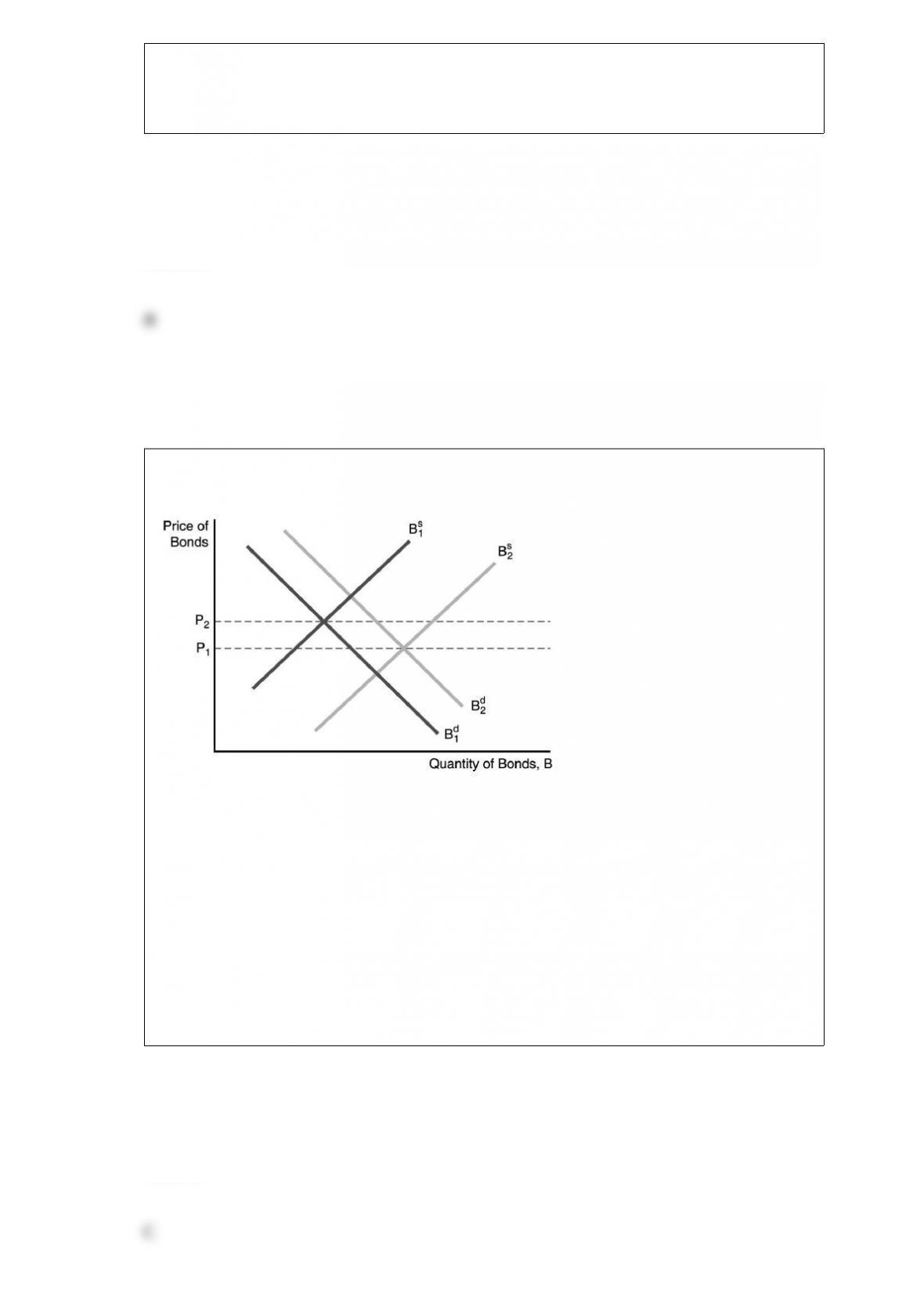
In the figure above, a factor that could cause the supply of bonds to increase (shift to
the right) is
A. a decrease in government budget deficits.
B. a decrease in expected inflation.
C. expectations of more profitable investment opportunities.
D. a business cycle recession.
Answer:

When stock prices become more volatile, the ________ curve for gold shifts right and
gold prices ________, everything else held constant.
A. demand; increase
B. demand; decrease
C. supply; increase
D. supply; decrease
Answer:
The Bretton Woods agreement created the ________, which was given the task of
promoting the growth of world trade by setting rules for the maintenance of fixed
exchange rates and by making loans to countries that were experiencing balance of
payments difficulties.
A) IMF
B) World Bank
C) Central Settlements Bank
D) Bank of International Settlements
Answer:

During the beginning on the global financial crisis in the United States when the effects
of the crisis were mostly confined within the United States, the U. S. dollar ________
because demand for U.S. assets ________.
A. appreciated; increased
B. depreciated; increased
C. appreciated; decreased
D. depreciated; decreased
Answer:
An innovation that blurred the distinction between brokerage firms and commercial
banks was Merrill Lynch’s development in 1977 of the
A. cash management account.
B. money market mutual fund.
C. individual retirement account.
D. discount brokerage.
Answer: