
On January 25, 2009, one U.S. dollar traded on the foreign exchange market for about
3.33 Romanian new lei. Therefore, one Romanian new lei would have purchased about
________ U.S. dollars.
A. 0.30
B. 1.86
C. 2.86
D. 3.33
Answer:
The government safety net creates ________ problem because risk-loving entrepreneurs
might find banking an attractive industry.
A. an adverse selection
B. a moral hazard
C. a lemons
D. a revenue
Answer:
The entry of AT&T and GM into the credit card business is an indication of

A. government’s efforts to deregulate the provision of financial services.
B. the rising profitability of credit card operations.
C. the reduction in costs of credit card operations since 1990.
D. the sale of unprofitable operations by Bank of America and Citicorp.
Answer:
The theory of portfolio choice suggests that the most important factor affecting the
demand for domestic and foreign assets is the ________ on these assets relative to one
another.
A. interest rate
B. risk
C. expected return
D. liquidity
Answer:
An important source of short-term funds for commercial banks are ________ which can
be resold on the secondary market.

A. negotiable CDs
B. commercial paper
C. mortgage-backed securities
D. municipal bonds
Answer:
From 1950-2014 the price level in the United States increased more than
A. twofold.
B. threefold.
C. sixfold.
D. tenfold.
Answer:
If you purchase a $100,000 interest-rate futures contract for 110, and the price of the
Treasury securities on the expiration date is 106, your ________ is ________.
A. profit; $4000
B. loss; $4000

C. profit; $6000
D. loss; $6000
Answer:
In the Keynesian cross diagram, a decline in autonomous consumer expenditure causes
the aggregate demand function to shift ________, the equilibrium level of aggregate
output to fall, and the IS curve to shift to the ________, everything else held constant.
A. up; left
B. up; right
C. down; left
D. down; right
Answer:
Capital ________ are American purchases of foreign assets, and capital ________ are
foreign purchases of American assets.
A) inflows; outflows
B) inflows; inflows

C) outflows; outflows
D) outflows; inflows
Answer:
Everything else held constant, a decrease in government spending ________ aggregate
________.
A. increases; demand
B. decreases; demand
C. decreases; supply
D. increases; supply
Answer:
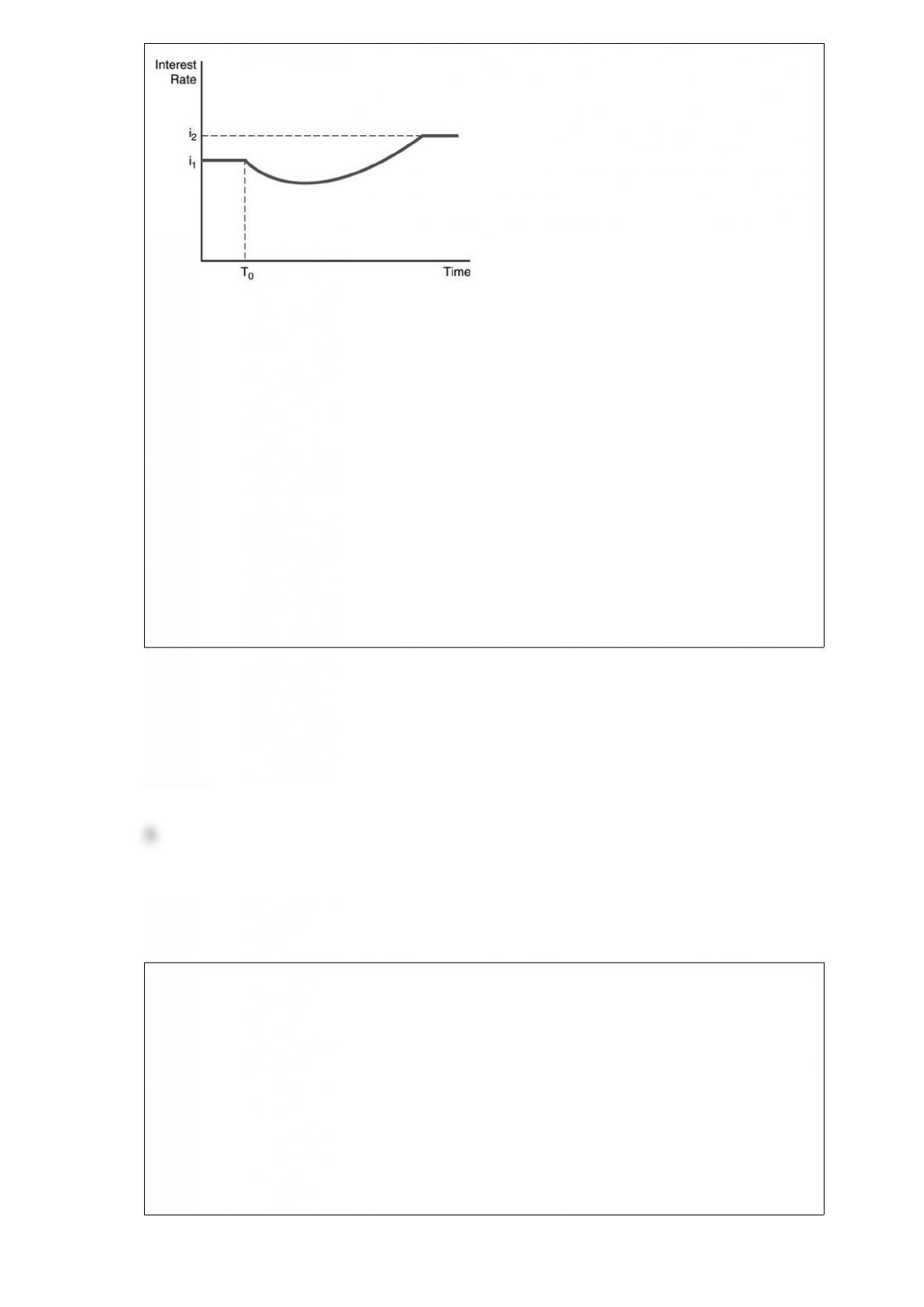
The figure above illustrates the effect of an increased rate of money supply growth at
time period T0. From the figure, one can conclude that the
A. Fisher effect is dominated by the liquidity effect and interest rates adjust slowly to
changes in expected inflation.
B. liquidity effect is dominated by the Fisher effect and interest rates adjust slowly to
changes in expected inflation.
C. liquidity effect is dominated by the Fisher effect and interest rates adjust quickly to
changes in expected inflation.
D. Fisher effect is smaller than the expected inflation effect and interest rates adjust
quickly to changes in expected inflation.
Answer:
The interest rate that equates the present value of payments received from a debt
instrument with its value today is the
A. simple interest rate.
B. current yield.
C. yield to maturity.
D. real interest rate.

Answer:
If a firm is due to be paid in euros in two months, to hedge against exchange-rate risk
the firm should ________ foreign exchange futures ________.
A. sell; short
B. buy; long
C. sell; long
D. buy; short
Answer:
The ________ that required separation of commercial and investment banking was
repealed in 1999.
A. the Federal Reserve Act.
B. the Glass-Steagall Act.
C. the Bank Holding Company Act.
D. the Monetary Control Act.
Answer:

If the Fed injects reserves into the banking system and they are held as excess reserves,
then the monetary base ________ and the money supply ________.
a. remains unchanged; remains unchanged
b. remains unchanged; increases
c. increases; increases
d. increases; remains unchanged
Answer:
According to this theory of the term structure, bonds of different maturities are not
substitutes for one another.
A. segmented markets theory
B. expectations theory
C. liquidity premium theory
D. separable markets theory
Answer:

Social Security is a
A. fully funded pension plan.
B. federally insured private pension plan.
C. government sponsored private pension plan.
D. “pay-as-you-go” system.
Answer:
Overseeing who operates banks and how they are operated is called
A. prudential supervision.
B. hazard insurance.
C. regulatory interference.
D. loan loss reserves.
Answer:

Whether one views the discretionary policies of the 1960s and 1970s as destabilizing or
believes the economy would have been less stable without these policies, most
economists agree that
A. stabilization policies proved more difficult in practice than many economists had
expected.
B. stabilization policies proved not to be inflationary.
C. the nondiscretionary policymakers were right in believing that the private economy
is inherently stable.
D. the discretionary policymakers were right in believing that the private economy is
inherently stable.
Answer:
________ assume the risk of issuing a new stock in the hope of earning profits on its
sale.
A. Stock brokers
B. Securities dealers
C. Underwriters
D. Stock speculators
E. Reinsurers
Answer:
Net profit after taxes per dollar of equity capital is a basic measure of bank profitability
called
A. return on assets.
B. return on capital.
C. return on equity.
D. return on investment.
Answer:
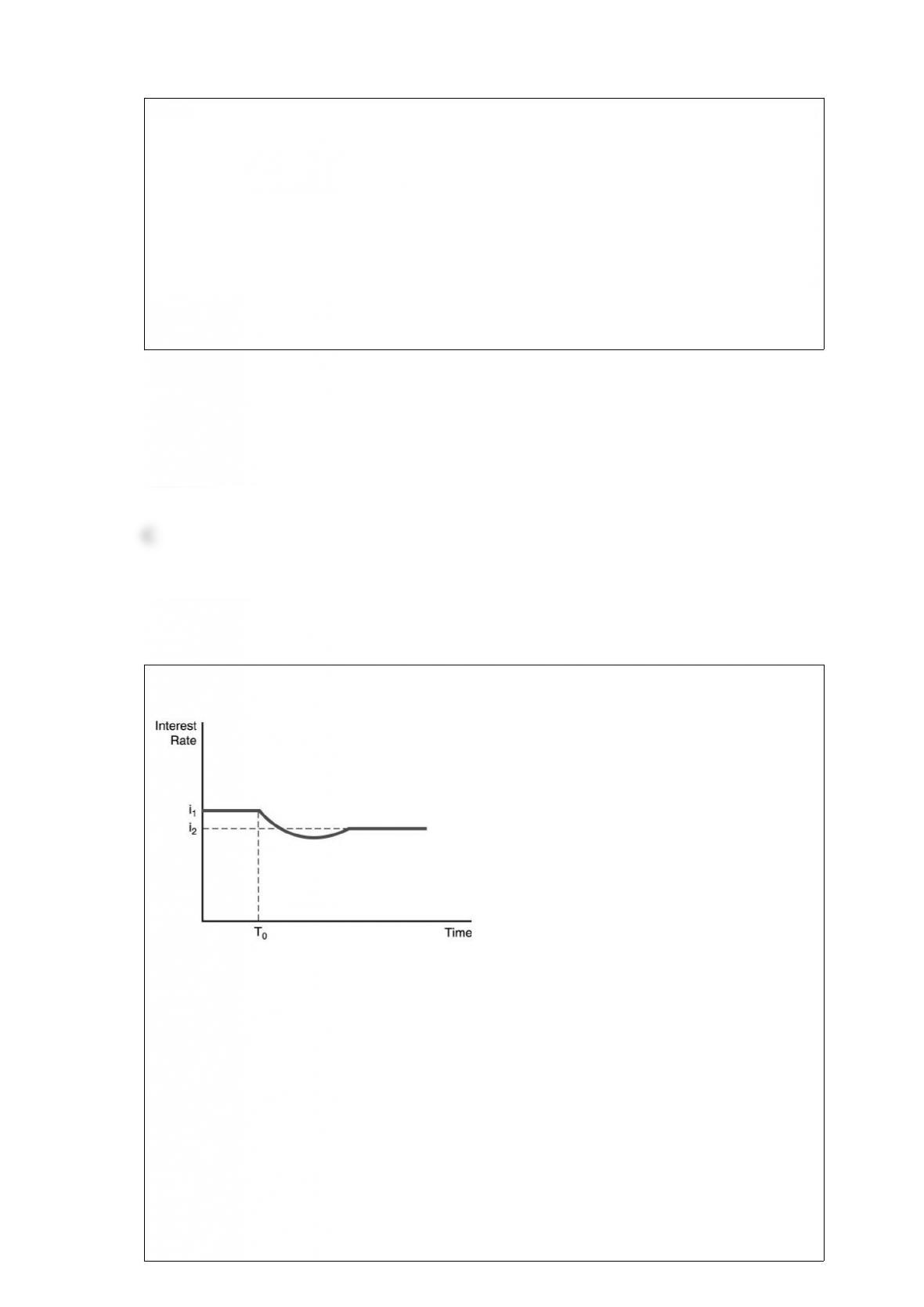
The figure above illustrates the effect of an increased rate of money supply growth at
time period T0. From the figure, one can conclude that the
A. liquidity effect is smaller than the expected inflation effect and interest rates adjust
quickly to changes in expected inflation.
B. liquidity effect is larger than the expected inflation effect and interest rates adjust
quickly to changes in expected inflation.
C. liquidity effect is larger than the expected inflation effect and interest rates adjust
slowly to changes in expected inflation.

D. liquidity effect is smaller than the expected inflation effect and interest rates adjust
slowly to changes in expected inflation.
Answer:
An example of the problem of ________ is when a corporation uses the funds raised
from selling bonds to fund corporate expansion to pay for Caribbean cruises for all of
its employees and their families.
A. adverse selection
B. moral hazard
C. risk sharing
D. credit risk
Answer:
Suppose that from a new checkable deposit, First National Bank holds two million
dollars in vault cash, one million dollars in required reserves, and faces a required
reserve ratio of ten percent. Given this information, we can say First National Bank has
________ million dollars in excess reserves.
A. one
B. two

C. nine
D. ten
Answer:
Financial intermediaries develop ________ in things such as computer technology
which allows them to lower transactions costs.
A. expertise
B. diversification
C. regulations
D. equity
Answer:
________ in the foreign interest rate causes the demand for domestic assets to shift to
the ________ and the domestic currency to depreciate, everything else held constant.
A. An increase; right
B. An increase; left
C. A decrease; right

D. A decrease; left
Answer:
When workers voluntarily leave work while they look for better jobs, the resulting
unemployment is called
A. structural unemployment.
B. frictional unemployment.
C. cyclical unemployment.
D. underemployment.
Answer:
According to the law of one price, if the price of Colombian coffee is 100 Colombian
pesos per pound and the price of Brazilian coffee is 4 Brazilian reals per pound, then
the exchange rate between the Colombian peso and the Brazilian real is
A. 40 pesos per real.
B. 100 pesos per real.
C. 25 pesos per real.
D. 0.4 pesos per real.

Answer:
Financial crises generally develop along two basic paths
A. mismanagement of financial liberalization/globalization and severe fiscal
imbalances.
B. stock market declines and severe fiscal imbalances.
C. mismanagement of financial liberalization/globalization and stock market declines.
D. stock market declines and unanticipated declines in the value of the domestic
currency.
Answer:
With the followings is NOT one of the reasons why quantitative easing in and of itself
will not necessarily be stimulative?
A. Most of the resulting increase in the monetary base just flows into holdings of excess
reserves.
B. Banks just add to their holdings of excess reserves instead of making loans.
C. The asset purchase program involves only the purchase of short-term government
securities.
D. The asset purchase program involves only the purchase of long-term government
securities.

Answer:
Suppose the economy is producing at the natural rate of output and the government
passes legislation that severely restricts a company’s ability to reduce production costs
via outsourcing. Everything else held constant, this policy action will cause ________
in the unemployment rate in the short run and ________ in inflation in the short run.
A. an increase; an increase
B. a decrease; a decrease
C. a decrease; an increase
D. no change; no change
Answer:
In a(n) ________ market, dealers in different locations buy and sell securities to anyone
who comes to them and is willing to accept their prices.
A. exchange
B. over-the-counter
C. common
D. barter
Answer: