
Funds held in ________ are subject to reserve requirements.
A. all checkable deposits
B. all checkable and time deposits
C. all checkable, time, and money market fund deposits
D. all time deposits
Answer:
Experts predict that the future structure of the U.S. banking industry will have
A) an increased number of banks.
B) as few as ten banks.
C) several thousand banks.
D) a few hundred banks.
Answer:
An essential characteristic of credit unions is that
A) they are typically large.

B) branching across state lines is prohibited.
C) their lending is primarily for mortgage loans.
D) they are organized for individuals with a common bond.
Answer:
The principal-agent problem
A) occurs when managers have more incentive to maximize profits than the
stockholders-owners do.
B) in financial markets helps to explain why equity is a relatively important source of
finance for American business.
C) would not arise if the owners of the firm had complete information about the
activities of the managers.
D) explains why direct finance is more important than indirect finance as a source of
business finance.
Answer:
Adverse selection is a problem associated with equity and debt contracts arising from
A. the lender’s relative lack of information about the borrower’s potential returns and
risks of his investment activities.

B. the lender’s inability to legally require sufficient collateral to cover a 100% loss if the
borrower defaults.
C. the borrower’s lack of incentive to seek a loan for highly risky investments.
D. the lender’s inability to restrict the borrower from changing his behavior once given
a loan.
Answer:
Estimates from large macroeconometric models of the U.S. economy suggests that it
takes over ________ for monetary policy to affect output and over ________ for
monetary policy to affect the inflation rate.
A. 1 year; 2 years
B. 2 years; 1 year
C. 1 year; 6 months
D. 6 months; 1 year
Answer:
The Dodd-Frank bill created an agency to monitor markets for asset price bubbles and
the buildup of systemic risk. This agency is called the

A. Resolution Trust Authority.
B. Board of Governors.
C. Financial Stability Oversight Council.
D. Macroprudential Supervisory Agency.
Answer:
Sometimes one observes that the price of a company’s stock falls after the
announcement of favorable earnings. This phenomenon is
A. clearly inconsistent with the efficient markets hypothesis.
B. consistent with the efficient markets hypothesis if the earnings were not as high as
anticipated.
C. consistent with the efficient markets hypothesis if the earnings were not as low as
anticipated.
D. consistent with the efficient markets hypothesis if the favorable earnings were
expected.
Answer:
The more interest-sensitive is money demand, the

A. more effective is fiscal policy relative to monetary policy.
B. more effective is monetary policy relative to fiscal policy.
C. steeper is the IS curve.
D. steeper is the LM curve.
Answer:
Holding everything else constant, if interest rates are expected to increase, the demand
for bonds ________ and the demand curve shifts ________.
A. increases; right
B. decreases; right
C. increases; left
D. decreases; left
Answer:
In the simple deposit expansion model, if the required reserve ratio is 20 percent and
the Fed increases reserves by $100, checkable deposits can potentially expand by
A. $100.

B. $250.
C. $500.
D. $1,000.
Answer:
If the liquidity effect is smaller than the other effects, and the adjustment to expected
inflation is immediate, then the
A. interest rate will fall.
B. interest rate will rise.
C. interest rate will fall immediately below the initial level when the money supply
grows.
D. interest rate will rise immediately above the initial level when the money supply
grows.
Answer:
Which of the followings is NOT true about the word “autonomous” that economists
use?
A. Changes in autonomous components are associated with movements along a curve.

B. Changes in autonomous components are associated with shifts of a curve.
C. The autonomous component of a variable is exogenous.
D. The autonomous component of a variable is independent of other variables in the
model.
Answer:
If aggregate demand equals output,
A. the economy is in a recession.
B. output will increase.
C. output will fall.
D. the economy is at its equilibrium level.
Answer:
When the SEC requires companies to publicly release financial statements, which of the
following remedies of conflicts of interest does this fall under?
A. leave it to the market
B. regulate for transparency

C. supervisory oversight
D. separation of functions
Answer:
The Fed is considering eliminating
A. primary credit lending.
B. secondary credit lending.
C. seasonal credit lending.
D. its lender of last resort function.
Answer:
The demand for money as a cushion against unexpected contingencies is called the
A. transactions motive.
B. precautionary motive.
C. insurance motive.
D. speculative motive.

Answer:
The present value of an expected future payment ________ as the interest rate
increases.
A. falls
B. rises
C. is constant
D. is unaffected
Answer:
FDICIA ________ incentives for banks to hold capital and ________ incentives to take
on excessive risk.
A. increased; decreased
B. increased; increased
C. decreased; decreased
D. decreased; increased

Answer:
According to Tobin’s q theory, when equity prices are high the market price of existing
capital is ________ relative to new capital, so expenditure on fixed investment is
________.
A. cheap; low
B. dear; low
C. cheap; high
D. dear; high
Answer:
A tax increase ________ disposable income, ________ consumption expenditure, and
shifts the IS curve to the ________, everything else held constant.
A. increases; increases; right
B. increases; decreases; left
C. decreases; increases; left
D. decreases; decreases; left
Answer:

Which policy measure makes it unlawful for a registered public accounting firm to
provide any nonaudit service to a client contemporaneously with an impermissible
audit?
A. Sarbanes-Oxley Act of 2002
B. Global Legal Settlement of 2002
C. Gramm-Leach-Bliley Act of 1999
D. Riegle-Neal Act of 1994
Answer:
In practice, the Fed’s policy of targeting ________ in the 1960s proved to be ________,
destabilizing the economy.
A. money market conditions; countercyclical
B. money market conditions; procyclical
C. monetary aggregates; countercyclical
D. monetary aggregates; procyclical
Answer:

When Jane Brown writes a $100 check to her nephew and he cashes the check, Ms.
Brown’s bank ________ assets of $100 and ________ liabilities of $100.
A. gains; gains
B. gains; loses
C. loses; gains
D. loses; loses
Answer:
Deposit insurance is only one type of government safety net. All of the following are
types of government support for troubled financial institutions EXCEPT
A. forgiving tax debt.
B. lending from the central bank.
C. lending directly from the government’s treasury department.
D. nationalizing and guaranteeing that all creditors will be repaid their loans in full.
Answer:

The additional incentive that the purchaser of a Treasury security requires to buy a
long-term security rather than a short-term security is called the
A. risk premium.
B. term premium.
C. tax premium.
D. market premium.
Answer:
Which of the following statements concerning external sources of financing for
nonfinancial businesses in the United States are TRUE?
A. Issuing marketable securities is the primary way that they finance their activities.
B. Bonds are the least important source of external funds to finance their activities.
C. Stocks are a relatively unimportant source of finance for their activities.
D. Selling bonds directly to the American household is a major source of funding for
American businesses.
Answer:
An increase in the riskiness of corporate bonds will ________ the price of corporate

bonds and ________ the price of Treasury bonds, everything else held constant.
A. increase; increase
B. reduce; reduce
C. reduce; increase
D. increase; reduce
Answer:
Recent financial innovation makes the Federal Reserve’s job of conducting monetary
policy
A. easier, since the Fed now knows what to consider money.
B. more difficult, since the Fed now knows what to consider money.
C. easier, since the Fed no longer knows what to consider money.
D. more difficult, since the Fed no longer knows what to consider money.
Answer:
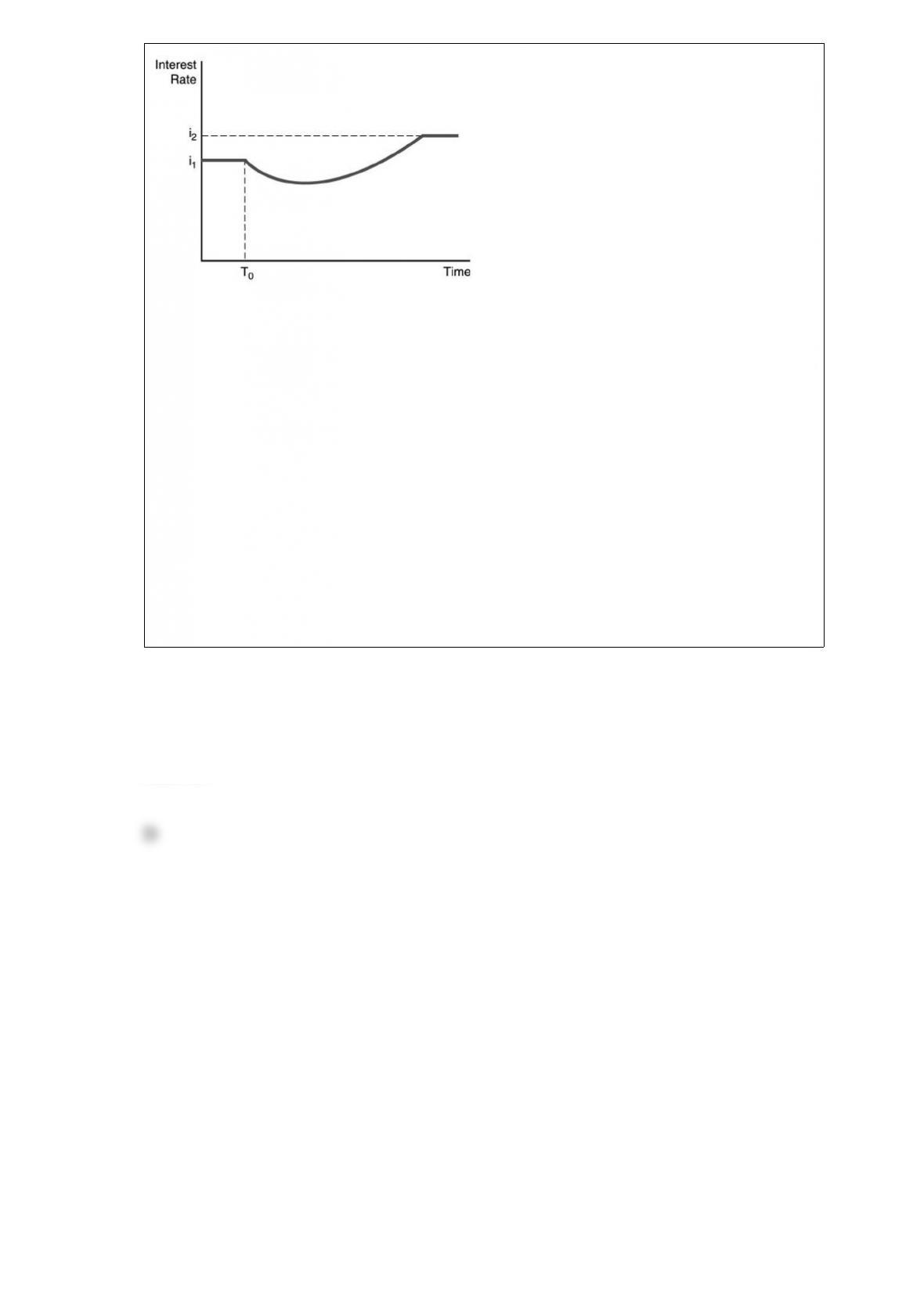
The figure above illustrates the effect of an increased rate of money supply growth at
time period T0. From the figure, one can conclude that the
A. liquidity effect is smaller than the expected inflation effect and interest rates adjust
quickly to changes in expected inflation.
B. liquidity effect is larger than the expected inflation effect and interest rates adjust
quickly to changes in expected inflation.
C. liquidity effect is larger than the expected inflation effect and interest rates adjust
slowly to changes in expected inflation.
D. liquidity effect is smaller than the expected inflation effect and interest rates adjust
slowly to changes in expected inflation.
Answer: