
Which of the following is most likely to result from a stronger dollar?
A. U.S. goods exported aboard will cost less in foreign countries, and so foreigners will
buy more of them.
B. U.S. goods exported aboard will cost more in foreign countries and so foreigners will
buy more of them.
C. U.S. goods exported abroad will cost more in foreign countries, and so foreigners
will buy fewer of them.
D. Americans will purchase fewer foreign goods.
Answer:
If you sell twenty-five $100,000 futures contracts to hedge holdings of a Treasury
security, the value of the Treasury securities you are holding is
A. $250,000.
B. $1,000,000.
C. $2,500,000.
D. $5,000,000.
Answer:

Solutions to the moral hazard in equity contracts include all of the following EXCEPT
A) government regulations to increase information.
B) the use of financial intermediaries.
C) the use of debt contracts.
D) government ownership of resources.
Answer:
The fluctuations in both money supply growth and the federal funds rate during
1979-1982 suggest that the Fed
A. had shifted to borrowed reserves as an operating target.
B. had shifted to total reserves as an operating target.
C. had shifted to the monetary base as an operating target.
D. never intended to target monetary aggregates.
Answer:
The ________ problem of discretionary policy arises because economic behavior is
influenced by what firms and people expect the monetary authorities to do in the future.

A. moral hazard
B. time-inconsistency
C. nominal-anchor
D. rational-expectation
Answer:
Which of the following are generally TRUE of bonds?
A. A bond’s return equals the yield to maturity when the time to maturity is the same as
the holding period.
B. A rise in interest rates is associated with a fall in bond prices, resulting in capital
gains on bonds whose terms to maturity are longer than the holding periods.
C. The longer a bond’s maturity, the smaller is the size of the price change associated
with an interest rate change.
D. Prices and returns for short-term bonds are more volatile than those for longer-term
bonds.
Answer:
Bankers’ concerns regarding the optimal mix of excess reserves, secondary reserves,
borrowings from the Fed, and borrowings from other banks to deal with deposit

outflows is an example of
A. liability management.
B. liquidity management.
C. managing interest rate risk.
D. managing credit risk.
Answer:
The theory of bureaucratic behavior when applied to the Fed helps to explain why the
Fed
A. was supportive of congressional attempts to limit the central bank’s autonomy.
B. was so secretive about the conduct of future monetary policy.
C. sought less control over banks in the 1980s.
D. was willing to take on powerful groups that may threaten its autonomy.
Answer:
The president from which Federal Reserve Bank always has a vote in the Federal Open
Market Committee?

A. Philadelphia
B. Boston
C. San Francisco
D. New York
Answer:
During a “flight to quality”
A. the spread between Treasury bonds and Baa bonds increases.
B. the spread between Treasury bonds and Baa bonds decreases.
C. the spread between Treasury bonds and Baa bonds is not affected.
D. the change in the spread between Treasury bonds and Baa bonds cannot be
predicted.
Answer:
The most important advantage of discount policy is that the Fed can use it to
A. precisely control the monetary base.
B. perform its role as lender of last resort.

C. control the money supply.
D. punish banks that have deficient reserves.
Answer:
If a borrower takes out a $200 million loan in a repo agreement and is asked to post
$220 million of mortgage-backed securities as collateral, the “haircut” is
A. 5%.
B. 10%.
C. 20%.
D. 50%.
Answer:
In the Keynesian framework, as long as output is ________ the equilibrium level,
unplanned inventory investment will remain negative and firms will continue to
________ production.
A. below; lower
B. above; lower

C. below; raise
D. above; raise
Answer:
Factors likely to cause a financial crisis in emerging market countries include
A. severe fiscal imbalances.
B. decreases in foreign interest rates.
C. a foreign exchange crisis.
D. too strong oversight of the financial industry.
Answer:
If a central bank does not want to see its currency ________ in value, it may pursue
expansionary monetary policy to lower the domestic interest rate, thereby ________ its
currency.
A) fall; strengthening
B) fall; weakening
C) rise; strengthening

D) rise; weakening
Answer:
It is possible that when the money supply rises, interest rates may ________ if the
________ effect is more than offset by changes in income, the price level, and expected
inflation.
A. fall; liquidity
B. fall; risk
C. rise; liquidity
D. rise; risk
Answer:
Everything else held constant, an increase in the required reserve ratio will result in
________ in M1 and ________ in M2.
a. an increase; an increase
b. an increase; a decrease
c. a decrease; an increase
d. a decrease; a decrease

Answer:
This method of financing government spending is frequently called printing money
because high-powered money (the monetary base) is created in the process.
A. financing government spending with taxes
B. financing government spending through a Treasury sale of bonds that are then
purchased by the Fed
C. financing government spending by selling bonds to the public, which pays for the
bonds with currency
D. financing government spending by selling bonds to the public, which pays for the
bonds with checks
Answer:
Everything else held constant, an increase in financial frictions ________ aggregate
________.
A. increases; demand
B. decreases; demand
C. decreases; supply
D. increases; supply

Answer:
Decisions by ________ about their holdings of currency and by ________ about their
holdings of excess reserves affect the money supply.
A. borrowers; depositors
B. banks; depositors
C. depositors; borrowers
D. depositors; banks
Answer:
A borrower who takes out a loan usually has better information about the potential
returns and risk of the investment projects he plans to undertake than does the lender.
This inequality of information is called
A. moral hazard.
B. asymmetric information.
C. noncollateralized risk.
D. adverse selection.

Answer:
Financial innovation has caused
A. banks to suffer declines in their cost advantages in acquiring funds, although it has
not caused a decline in income advantages.
B. banks to suffer a simultaneous decline of cost and income advantages.
C. banks to suffer declines in their income advantages in acquiring funds, although it
has not caused a decline in cost advantages.
D. banks to achieve competitive advantages in both costs and income.
Answer:
If workers do not believe that policymakers are serious about fighting inflation, they are
most likely to push for higher wages, which will ________ aggregate ________ and
lead to unemployment or inflation or both, everything else held constant.
A. decrease; demand
B. increase; demand
C. decrease; supply
D. increase; supply

Answer:
Everything else held constant, the vertical section of the supply curve of reserves is
lengthened when the
A. discount rate increases.
B. discount rate decreases.
C. federal funds rate rises.
D. federal funds rate falls.
Answer:
If gold becomes acceptable as a medium of exchange, the demand for gold will
________ and the demand for bonds will ________, everything else held constant.
A. decrease; decrease
B. decrease; increase
C. increase; increase
D. increase; decrease
Answer:
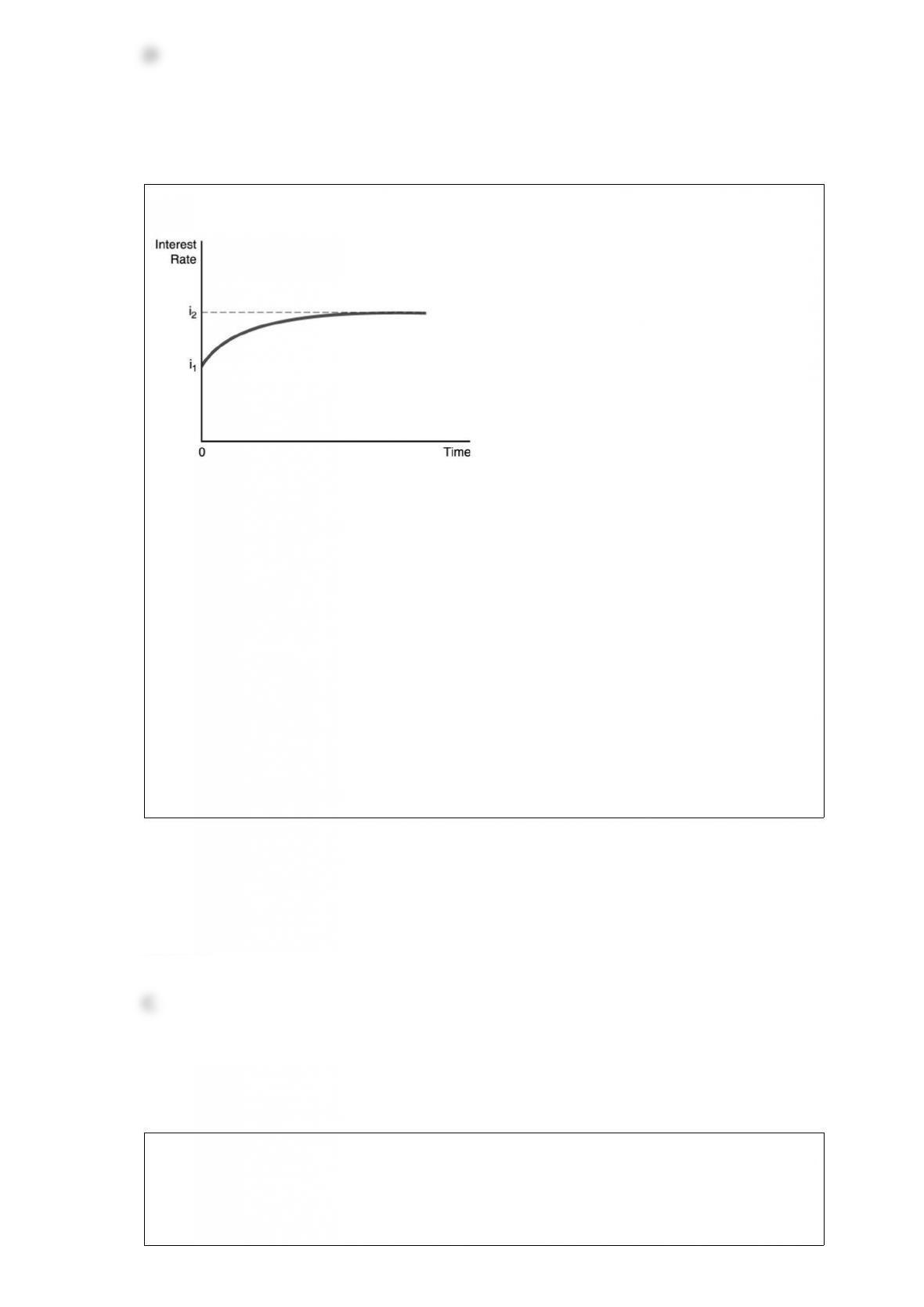
In the figure above, illustrates the effect of an increased rate of money supply growth at
time period 0. From the figure, one can conclude that the
A. Fisher effect is dominated by the liquidity effect and interest rates adjust slowly to
changes in expected inflation.
B. liquidity effect is dominated by the Fisher effect and interest rates adjust slowly to
changes in expected inflation.
C. liquidity effect is dominated by the Fisher effect and interest rates adjust quickly to
changes in expected inflation.
D. Fisher effect is smaller than the expected inflation effect and interest rates adjust
quickly to changes in expected inflation.
Answer:
Hedging by buying an option
A. limits gains.

B. limits losses.
C. limits gains and losses.
D. has no limit on option premiums.
Answer:
If monetary policy can influence ________ prices and conditions in ________ markets,
then it can affect spending through channels other than the traditional interest-rate
channel.
A. asset; labor
B. asset; credit
C. commodity; labor
D. commodity; credit
Answer:
If the banking system has a large amount of reserves, many banks will have excess
reserves to lend and the federal funds rate will probably ________; if the level of
reserves is low, few banks will have excess reserves to lend and the federal funds rate
will probably ________.
A. fall; fall

B. fall; rise
C. rise; fall
D. rise; rise
Answer:
Velocity is defined as
A. P + M + Y.
B. (P × M)/Y.
C. (Y × M)/P.
D. (P × Y)/M.
Answer:
Although the Fed professed employment of a monetary aggregate targeting strategy
during the 1970s, its behavior suggests that it emphasized
A. free-reserve targeting.
B. interest-rate targeting.

C. a real-bills doctrine.
D. price-index targeting.
Answer: