
In the basic closed-economy ISLM model, the LM curve can be described by an
equation where
A. output is a function of consumption.
B. money is a function of interest rates.
C. output is a function of money.
D. interest rate is a function of output.
Answer:
The legislation that effectively prohibited banks from branching across state lines and
forced all national banks to conform to the branching regulations in the state in which
they reside is the
A) McFadden Act.
B) National Bank Act.
C) Glass-Steagall Act.
D) Garn-St.Germain Act.
Answer:
Monetary policy is considered time-inconsistent because

A. of the lag times associated with the implementation of monetary policy and its effect
on the economy.
B. policymakers are tempted to pursue discretionary policy that is more contractionary
in the short run.
C. policymakers are tempted to pursue discretionary policy that is more expansionary in
the short run.
D. of the lag times associated with the recognition of a potential economic problem and
the implementation of monetary policy.
Answer:
In the case of an insurance policy, ________ occurs when the existence of insurance
encourages the insured party to take risks that increase the likelihood of an insurance
payoff.
A. moral hazard
B. opportunism
C. adverse selection
D. shirking
Answer:

An important function of the regional Federal Reserve Banks is
A. setting reserve requirements.
B. clearing checks.
C. determining monetary policy.
D. setting margin requirements.
Answer:
Of the following financial intermediaries, which holds the least liquid assets?
A. property and casualty insurance companies
B. life insurance companies
C. money market mutual funds
D. commercial banks
Answer:
Of the four sources of external funding for nonfinancial businesses, the least often used
in the U.S. is
A. bank loans.

B. nonbank loans.
C. bonds.
D. stock.
Answer:
At the time of the South Korean financial crisis, the merchant banks were
A. almost virtually unregulated.
B. subject to heavy government regulation.
C. engaged in long-term lending to the corporate sector.
D. restricted to long-term foreign borrowing.
Answer:
Suppose the economy is producing at the natural rate of output. Assuming a fixed
natural rate of output and everything else held constant, the development of a new,
more productive technology will cause ________ in the unemployment rate and
________ in the inflation in the long run.
A. an increase; an increase

B. a decrease; a decrease
C. a decrease; an increase
D. no change; no change
Answer:
Suppose that the Bank of Japan buys yen-denominated assets with U.S. dollar assets.
Everything else held constant, this transaction will cause ________ in the foreign assets
held by the Federal Reserve and ________ in the U.S. monetary base.
A) an increase; an increase
B) an increase; a decrease
C) a decrease; an increase
D) a decrease; a decrease
Answer:
Depositors lack of information about the quality of bank assets can lead to
A. bank panics.
B. bank booms.

C. sequencing.
D. asset transformation.
Answer:
The January effect refers to the fact that
A. most stock market crashes have occurred in January.
B. stock prices tend to fall in January.
C. stock prices have historically experienced abnormal price increases in January.
D. the football team winning the Super Bowl accurately predicts the behavior of the
stock market for the next year.
Answer:
Everything else held constant, an increase in interest rates on student loans
A. increases the cost of a college education.
B. reduces the cost of a college education.
C. has no effect on educational costs.
D. increases costs for students with no loans.

Answer:
Increasing the amount of information available to investors helps to reduce the
problems of ________ and ________ in the financial markets.
A. adverse selection; moral hazard
B. adverse selection; risk sharing
C. moral hazard; transactions costs
D. adverse selection; economies of scale
Answer:
If the yield curve is flat for short maturities and then slopes downward for longer
maturities, the liquidity premium theory (assuming a mild preference for shorter-term
bonds) indicates that the market is predicting
A. a rise in short-term interest rates in the near future and a decline further out in the
future.
B. constant short-term interest rates in the near future and a decline further out in the
future.
C. a decline in short-term interest rates in the near future and a rise further out in the
future.
D. a decline in short-term interest rates in the near future and an even steeper decline

further out in the future.
Answer:
________ is the process of researching and developing profitable new products and
services by financial institutions.
A. Financial engineering
B. Financial manipulation
C. Customer manipulation
D. Customer engineering
Answer:
In the market for reserves, if the federal funds rate is above the interest rate paid on
excess reserves, then an open market ________ the supply of reserves, raising the
federal funds interest rate, everything else held constant.
A. sale decreases
B. sale increases
C. purchase increases
D. purchase decreases

Answer:
To hedge the interest rate risk on $4 million of Treasury bonds with $100,000 futures
contracts, you would need to purchase
A. 4 contracts.
B. 20 contracts.
C. 25 contracts.
D. 40 contracts.
Answer:
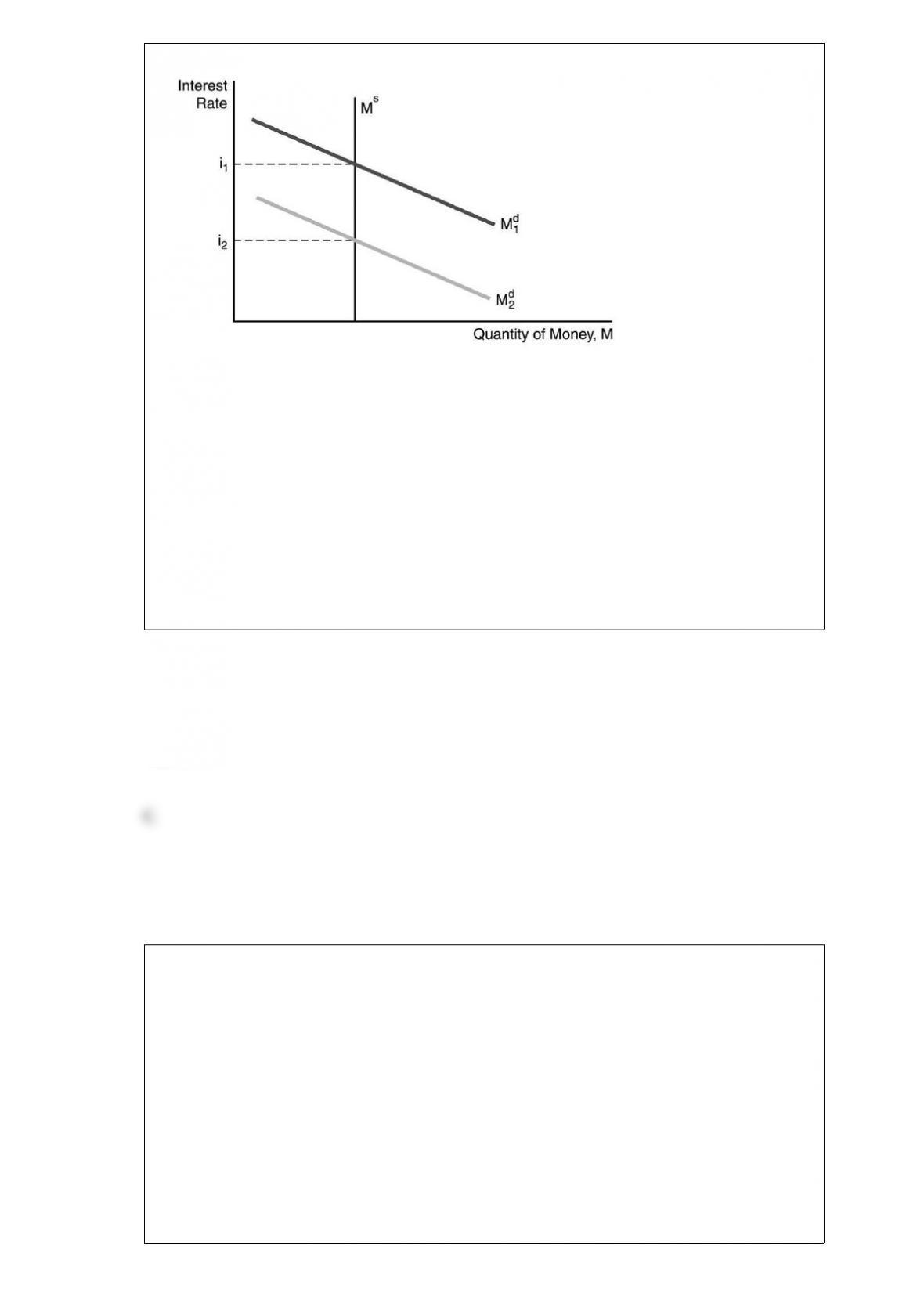
In the figure above, one factor NOT responsible for the decline in the demand for
money is
A. a decline the price level.
B. a decline in income.
C. an increase in income.
D. a decline in the expected inflation rate.
Answer:
You read a story in the newspaper announcing the proposed merger of Dell Computer
and Gateway. The merger is expected to greatly increase Gateway’s profitability. If you
decide to invest in Gateway stock, you can expect to earn
A. above average returns since you will share in the higher profits.
B. above average returns since your stock price will definitely appreciate as higher
profits are earned.
C. below average returns since computer makers have low profit rates.
D. a normal return since stock prices adjust to reflect expected changes in profitability

almost immediately.
Answer:
A contractionary monetary policy raises the real interest rate, causing the domestic
currency to ________, thereby ________ net exports.
A. appreciate; raising
B. appreciate; lowering
C. depreciate; raising
D. depreciate; lowering
Answer:
In its earliest years, the Federal Reserve’s guiding principle for the conduct of monetary
policy was known as the
A. real bills doctrine.
B. liberal liquidity doctrine.
C. free reserves doctrine.
D. quantity theory of money.

Answer:
One of the factors that contributed to the success German policymakers had using a
monetary targeting type policy starting in the mid-1970s and continuing through the
next two decades was that
A. they used a rigid target for the money growth rate.
B. they implemented policy so their inflation rate goal was met in the short run.
C. the money target was flexible to allow the Bundesbank to concentrate on other goals
as needed.
D. they rarely communicated the intentions of policy to the public in order to keep the
public from panicking.
Answer:
In a study published in 1963, Milton Friedman and Anna Schwartz found that in every
business cycle they studied over nearly a hundred-year period
A. the growth rate of the money supply decreased before output decreased.
B. interest rates decreased before output decreased.
C. the growth rate of federal government spending decreased before output decreased.
D. the growth rate of state and local government spending decreased before output
decreased.

Answer:
When talking about a coupon bond, face value and ________ mean the same thing.
A. par value
B. coupon value
C. amortized value
D. discount value
Answer:
The total collection of pieces of property that serve to store value is a person’s
A. wealth.
B. income.
C. money.
D. credit.
Answer:

Which of the following can be described as involving indirect finance?
A. You make a loan to your neighbor.
B. A corporation buys a share of common stock issued by another corporation in the
primary market.
C. You buy a U.S. Treasury bill from the U.S. Treasury at TreasuryDirect.gov.
D. You make a deposit at a bank.
Answer:
Lessons that economists and policy makers have learned from the recent global
financial crisis include
A. Developments in the financial sector have a far greater impact on economic activity
than was earlier realized.
B. The zero lower bound on interest rates can be a serious problem.
C. The cost of cleaning up after a financial crisis is very high.
D. Price and output stability do not ensure financial stability.
E. All of the above.
Answer:

When the value of the British pound changes from $1.50 to $1.25, then the pound has
________ and the U.S. dollar has ________.
A. appreciated; appreciated
B. depreciated; appreciated
C. appreciated; depreciated
D. depreciated; depreciated
Answer:
Under a fixed exchange rate regime, if the domestic currency is initially ________, that
is, ________ par, the central bank must intervene to purchase the domestic currency by
selling foreign assets.
A) overvalued; below
B) overvalued; above
C) undervalued; below
D) undervalued; above
Answer:

Conflicts of interest is a type of ________ problem that occurs when a person or
institution has multiple objectives that are in conflict with each other.
A. moral hazard
B. adverse selection
C. risk sharing
D. spinning
Answer:
The two most important categories of assets on the Fed’s balance sheet are ________
and ________ because they earn interest.
a. discount loans; coins
b. securities; discount loans
c. gold; coins
d. cash items in the process of collection; SDR certificate accounts
Answer:

The most important developments that reduced banks’ income advantages include
A) the increase in off-balance sheet activities.
B) the growth of securitization.
C) the elimination of Regulation Q ceilings.
D) the competition from money market mutual funds.
Answer:
During the boom years of the 1920s, bank failures were quite
A. uncommon, averaging less than 30 per year.
B. uncommon, averaging less than 100 per year.
C. common, averaging about 600 per year.
D. common, averaging about 1000 per year.
Answer:
Which of the following are short-term financial instruments?
A. a repurchase agreement

B. a share of Walt Disney Corporation stock
C. a Treasury note with a maturity of four years
D. a residential mortgage
Answer: